Leadership Update Filtered AI Delivery: A 2026 Guide
Discover how leadership update filtered AI delivery can streamline your decision-making with precise, accountable insights tailored for leaders.
ClaudeDrive
A Yungsten Tech product

Leadership Update Filtered AI Delivery: A 2026 Guide

A leadership update filtered through AI delivery is a structured briefing system where AI pulls, filters, and presents only the information a specific leader is authorized to see, with every line traceable to a real source. The concept sits at the intersection of AI leadership trends and governance, and the industry term for the broader practice is governed AI delivery. For CEOs, COOs, and chiefs of staff, this is not about adding another tool to the stack. It is about replacing the noise of scattered meeting notes, Slack threads, and GitHub activity with one clear, accountable briefing that arrives inside a platform they already use.
IBM’s 2026 CEO survey of 2,000 CEOs found that 83% say AI success depends on human adoption, not technology. That single finding reframes the entire conversation. Getting the delivery mechanism right matters far less than building a system leaders will actually trust and read.
What tools and governance frameworks are essential for filtered AI leadership updates?
The foundation of any trusted filtered AI delivery system is not the AI model itself. It is the governance layer that sits around it.
The tools that make traceability possible
Two categories of tooling matter here. The first is the delivery interface: where the leader reads the update. The second is the sourcing layer: what feeds the update and how each claim is tied back to a real record. ClaudeDrive Console operates as a private company-context layer inside Claude, connecting meeting notes, GitHub, and calendar data so each leader sees only what they are permitted to see. Userlytics AI Insights takes a similar traceability approach in a different domain: every AI-generated insight links back to the original session and annotation data, with no external model training. That architecture, source-first and permission-bound, is the right model for leadership briefings.

Governance frameworks that set the rules
The OECD.AI Governance Playbook defines 12 directives spanning strategy, risk, workforce readiness, and operations. The critical directive for leadership updates is continuous governance embedded in corporate strategy with executive sponsorship. That means someone at the C-suite level owns the rules about what the AI can surface, who sees what, and how errors get corrected. Without that ownership, filtered AI delivery becomes ungoverned AI delivery, which is a different and more dangerous thing.
The Governed Decision Record (GDR) is the artifact that makes this concrete. A GDR captures the decision question, AI prediction, evidence, risk posture, accountability chain, and escalation records before any action is taken. Think of it as the paper trail that proves the briefing was built on real data, reviewed by a named person, and approved for distribution.
Pro Tip: Before deploying any AI delivery system for leadership updates, assign a named owner to each data source the AI reads. If no one owns the source, the AI should not read it.
| Tool / Framework | Primary function |
|---|---|
| ClaudeDrive Console | Permission-bound daily briefing inside Claude |
| OECD.AI Governance Playbook | 12-directive framework for responsible AI governance |
| Governed Decision Record (GDR) | Pre-execution artifact capturing accountability and evidence |
| Userlytics AI Insights | Source-linked AI output with session-level traceability |
How do you implement a filtered AI delivery system for leadership updates?
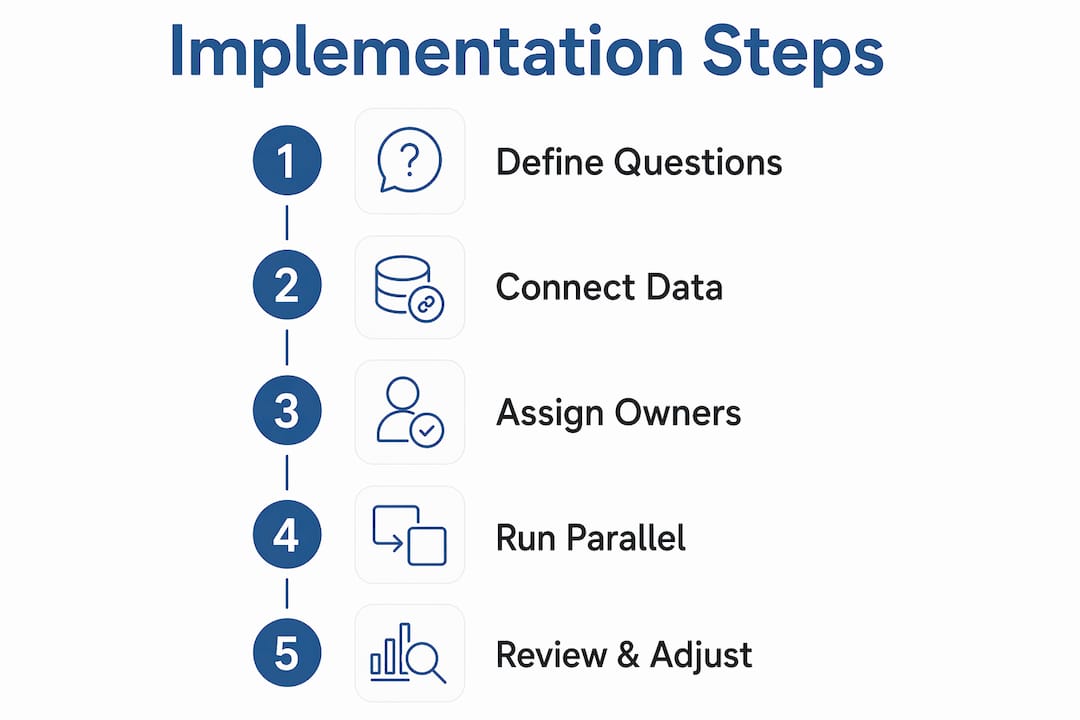
Implementation follows a clear sequence. Skipping steps does not save time. It creates the trust gaps that cause adoption to stall three months in.
Step-by-step setup
-
Define the decision questions. Before connecting any data source, write down the three to five questions each leader needs answered every day. A COO might need: What shipped? What is blocked? What escalated overnight? These questions set the scope of what the AI retrieves.
-
Map and connect authorized sources. Connect only the tools that hold answers to those questions: meeting notes, project management systems, the engineering repository, the calendar. Each source connection should be scoped to the leader’s role. A VP of Engineering does not need the CFO’s board prep notes.
-
Build the escalation logic. Decide in advance what the AI should flag rather than summarize. A production outage is not a bullet point in a briefing. It is an escalation. Define the threshold, name the person who receives the escalation, and document it in the GDR.
-
Require citations on every claim. Every line in the briefing must link to its source record. This is not optional. Traceability failures in AI-filtered updates undermine executive trust faster than any other single failure mode.
-
Run a human review cycle. For the first 30 days, a designated reviewer reads each briefing before it reaches the leader. This is not permanent overhead. It is calibration. The reviewer flags errors, adjusts source weights, and confirms the scope is correct.
-
Align the delivery rhythm. Match the briefing cadence to the leader’s existing decision rhythm. A CEO who reviews priorities at 7 AM needs the briefing ready at 6:45 AM. A chief of staff who runs a Monday planning session needs a weekly synthesis, not a daily one.
Pro Tip: Run the first two weeks of briefings in parallel with your existing update process. Leaders should be able to compare the AI briefing against what they already receive. Discrepancies are calibration data, not failures.
| Implementation phase | Key output |
|---|---|
| Define decision questions | Scoped question set per leader role |
| Connect authorized sources | Permission-mapped data connections |
| Build escalation logic | Named escalation thresholds and owners |
| Require citations | Source-linked briefing with zero unsourced claims |
| Human review cycle | 30-day calibration log |
| Align delivery rhythm | Cadence matched to leadership decision schedule |
What common challenges arise in filtered AI delivery, and how can leaders address them?
The obstacles are predictable. Most organizations hit the same three walls.
Adoption resistance from the leadership team itself. 64% of CEOs feel comfortable making strategic decisions based on AI input, but that leaves 36% who do not. The solution is not a training program. It is a proof-of-value moment. Show a skeptical leader one briefing that caught something they would have missed. That is worth more than any change management deck.
Error tolerance and quality control. AI systems make mistakes. The question is not whether errors will occur but whether the system surfaces them before they reach a decision. The MIT AI study on internal communications found that filtered AI summaries must be carefully vetted to avoid misinformation or unsourced claims that undermine trust. A single fabricated statistic in a leadership briefing can set adoption back by months.
Governance overhead that slows the system down. The GDR framework and OECD.AI directives are necessary, but they can become bureaucratic if implemented without discipline. The fix is to build governance into the workflow rather than on top of it. The GDR should be generated automatically from the briefing system, not filled out manually by a compliance team after the fact.
Oversight fatigue at the executive level. Leaders who are asked to review AI outputs every day will stop reviewing them. Satya Nadella’s restructuring of Microsoft addressed this directly: smaller leadership teams with weekly AI metrics reviews, not daily sign-offs on every output. The cadence matters. Weekly governance reviews with clear exception triggers are more sustainable than daily approval chains.
The organizations that get filtered AI delivery right treat governance as infrastructure, not as a checkpoint. The rules are built in. The accountability is automatic. The leader reads the briefing and makes the call.
How does filtered AI delivery transform leadership communication strategies?
The impact on leadership communication is structural, not cosmetic.
Decision confidence improves when the source is visible. A leader who reads a briefing and can click through to the original meeting note or GitHub commit makes decisions faster and with more confidence. The IBM 2026 data shows that 76% of organizations now have a Chief AI Officer, reflecting that executive ownership of AI decisions is becoming standard. That ownership only works when the AI output is auditable.
Cross-functional alignment tightens. When every leader on a team reads a briefing built from the same authorized sources, the baseline for any meeting is shared. Disagreements shift from “I didn’t know that” to “I see it differently.” That is a more productive starting point.
Human judgment stays in the loop. Effective AI delivery methods do not replace the leader’s read of a situation. They remove the time spent finding the facts so the leader can spend more time on interpretation. The governed decision intelligence approach makes this explicit: no AI system should autonomously decide critical leadership content without human oversight. The briefing informs. The leader decides.
Communication clarity compounds over time. As the system learns which sources matter and which questions recur, the briefing gets tighter. Leaders stop asking for context they already have. Meetings start at a higher level. The AI output testing practices that govern how filtered systems are documented and audited are what make this compounding possible. Without them, drift sets in and the briefing loses calibration.
Key takeaways
Filtered AI delivery works when governance is built into the system from day one, not added after adoption stalls.
| Point | Details |
|---|---|
| Define questions before connecting data | Scoping the briefing to specific decision questions prevents information overload and keeps the AI on task. |
| Traceability is non-negotiable | Every claim in a leadership briefing must link to a real source record or it should not appear. |
| Governance belongs in the workflow | GDRs and OECD.AI directives work best when generated automatically, not filled out manually after the fact. |
| Human review calibrates the system | A 30-day review cycle catches errors early and builds the trust that drives long-term adoption. |
| Cadence must match decision rhythm | Weekly governance reviews and role-scoped briefings are more sustainable than daily approval chains. |
Why I think most organizations are implementing this backwards
Most teams I have watched try to deploy AI-filtered leadership updates start with the technology and work backward to the governance. They connect the tools, run a pilot, get a few good briefings, and then hit a wall when a leader finds one wrong fact and loses confidence in the whole system. The trust problem was always going to arrive. They just did not build the structure to catch it before it did.
The organizations that get this right start with the accountability chain. They name the person who owns each data source. They define what the AI is not allowed to summarize. They build the escalation logic before the first briefing runs. That sequence feels slower at the start, but it is the only one that holds.
The IBM finding that 83% of CEOs say AI success depends on human adoption is the most important number in this space right now. It means the technology is not the constraint. The constraint is whether the leader trusts what they are reading. And trust is built through transparency, not through a better model.
My advice to any chief of staff or COO piloting this: do not hide the AI. Tell your leadership team exactly what the system reads, what it cannot read, and who reviews it before it reaches them. That transparency is not a weakness. It is the mechanism that makes the briefing credible.
— Paul
See what governed AI delivery looks like in practice
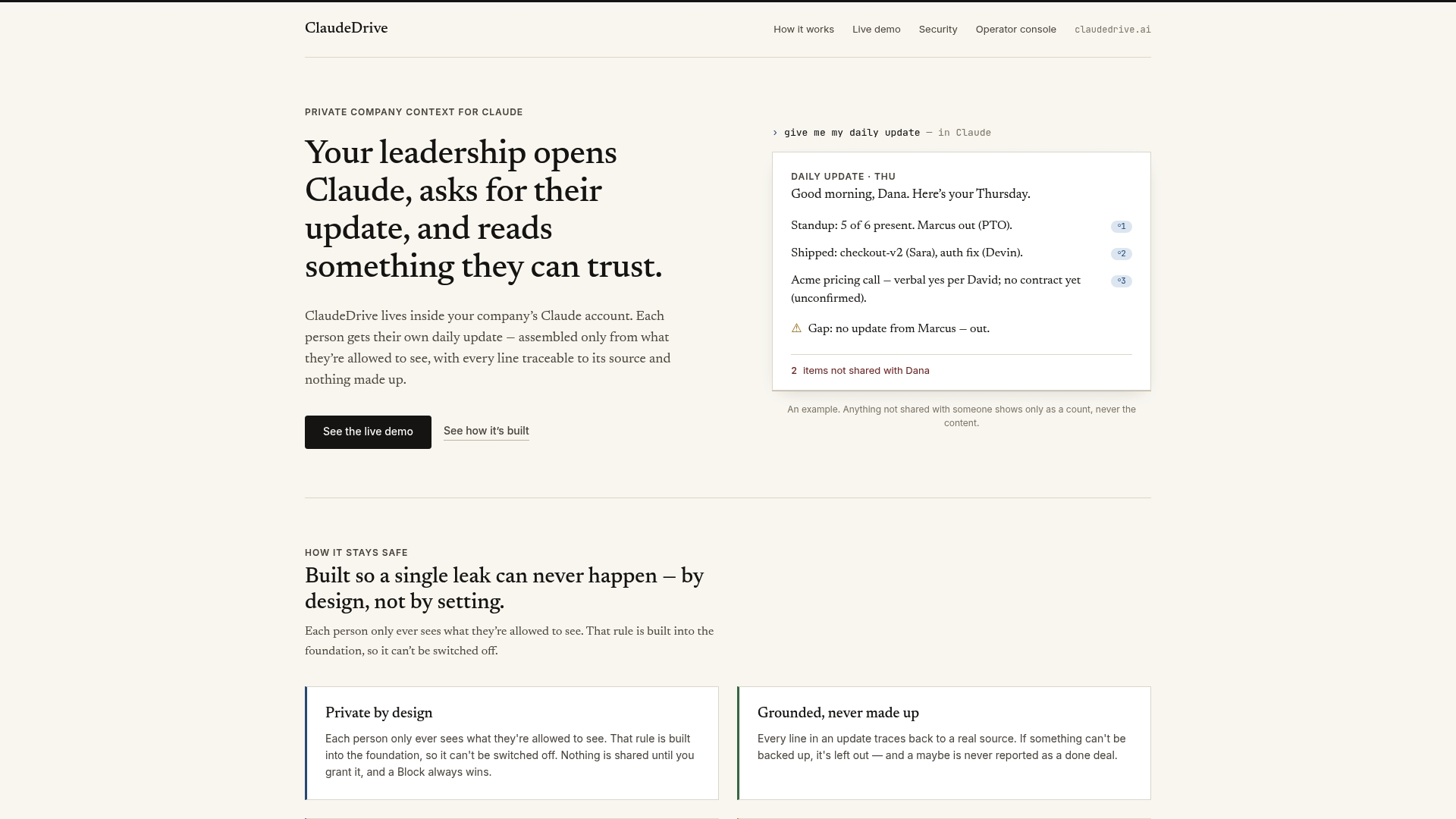
ClaudeDrive Console is built for exactly this use case. A leader opens Claude, asks for their update, and reads a briefing built only from what they are authorized to see. Every line traces back to a real source. Nothing is fabricated. Nothing crosses a permission boundary. Connect meeting notes, GitHub, and the calendar, and each person on your leadership team gets their own private view of what happened. No new app, no dashboard, no wiki. If you want to see how governed AI delivery works before committing to a rollout, see the live demo or talk to us about a pilot.
FAQ
What is filtered AI delivery in leadership updates?
Filtered AI delivery is a system where AI retrieves and presents only the information a specific leader is authorized to see, with every claim linked to a source record. The industry term for the broader practice is governed AI delivery.
How does a Governed Decision Record support leadership briefings?
A GDR captures the decision question, evidence, risk posture, accountability chain, and escalation logic before any briefing is published. It prevents black-box risk by documenting exactly how and why each piece of information was included.
Why do filtered AI leadership updates fail?
Most failures trace back to traceability gaps and adoption resistance. A single unsourced claim in a briefing can undermine executive trust, and 83% of CEOs say AI success depends on human adoption rather than the technology itself.
How often should leadership AI briefings be reviewed?
Weekly governance reviews with clear exception triggers are more sustainable than daily approval chains. Satya Nadella’s restructuring at Microsoft used weekly AI metrics reviews to maintain oversight without creating bottlenecks.
What is the first step to implement AI delivery for leadership updates?
Define the three to five decision questions each leader needs answered before connecting any data source. Scoping the system to specific questions prevents information overload and keeps every briefing relevant to the leader’s actual role.