How AI Replaces Status Reports for Business Leaders
Discover how AI replaces status reports for business leaders, streamlining updates and saving valuable time. Transform your reporting today!
ClaudeDrive
A Yungsten Tech product

How AI Replaces Status Reports for Business Leaders

AI-powered status reporting is defined as the automated extraction, synthesis, and narrative generation of project data from connected tools, delivered as a structured briefing without manual compilation. For business leaders and project managers, this shift is not incremental. AI in project management now replaces the weekly ritual of chasing updates, formatting slides, and summarizing threads by pulling from GitHub, calendar entries, meeting notes, and task trackers to produce a single, traceable briefing. The result is that reporting time drops from three to five hours weekly to fifteen to thirty minutes. That is a structural change in how leadership stays informed.
How AI replaces status reports through data integration
The core mechanism behind how AI replaces manual reporting is integration. AI systems connect directly to the tools where work actually happens: project management platforms, email threads, Slack channels, GitHub repositories, and spreadsheets. Instead of a project manager manually pulling data from five sources and writing a summary, an AI agent queries those sources continuously and assembles a coherent picture on demand.
This process involves three steps that happen without human intervention:
- Data extraction: The AI reads structured and unstructured inputs, including task completion rates, commit logs, calendar events, and meeting transcripts.
- Data cleaning and normalization: Conflicting labels, duplicate entries, and missing fields are reconciled before synthesis begins.
- Narrative generation: The AI converts raw signals into plain language, explaining what changed, why it changed, and what it implies for the project.
Agentic AI systems function as autonomous assistants that orchestrate project workflows by extracting, interpreting, and reporting critical status signals. This is not a chatbot answering questions. It is a system actively monitoring your data environment and surfacing what matters.
The challenge at this stage is data quality. AI tools must rely on up-to-date documentation, and stale source data leads directly to inaccurate report outputs. A system that reads outdated project plans will generate a confident but wrong briefing. This is why the integration layer is not just a technical setup. It is a governance decision.
Pro Tip: Before connecting any AI reporting tool to your project data, audit your documentation for freshness. Any source older than two weeks that feeds a live report is a liability, not an asset.
How does AI improve the quality of status reports?
The quality gap between manual and AI-generated reports is not primarily about speed. It is about depth and consistency. A manually written status report reflects the judgment and availability of whoever wrote it. An AI-generated report reflects the full data set, every time, without omission or fatigue.

Traditional static reports present numbers. AI-generated reports explain them. Narrative-driven AI reports transform raw numbers into cause-and-effect explanations, which is where strategic utility actually lives. A report that says “sprint velocity dropped 18%” is less useful than one that says “sprint velocity dropped 18% because three tickets were blocked by an unresolved dependency flagged on Tuesday.”
| Dimension | Traditional status reports | AI-generated reports |
|---|---|---|
| Preparation time | 3 to 5 hours per week | 15 to 30 minutes per week |
| Data coverage | Depends on author’s access | Pulls from all connected sources |
| Narrative depth | Summary of known facts | Cause-and-effect analysis |
| Stakeholder adaptation | One version for all audiences | Tailored by role and permission |
| Risk identification | Reactive, after the fact | Predictive, flagged early |
| Consistency | Varies by author and week | Uniform format every cycle |
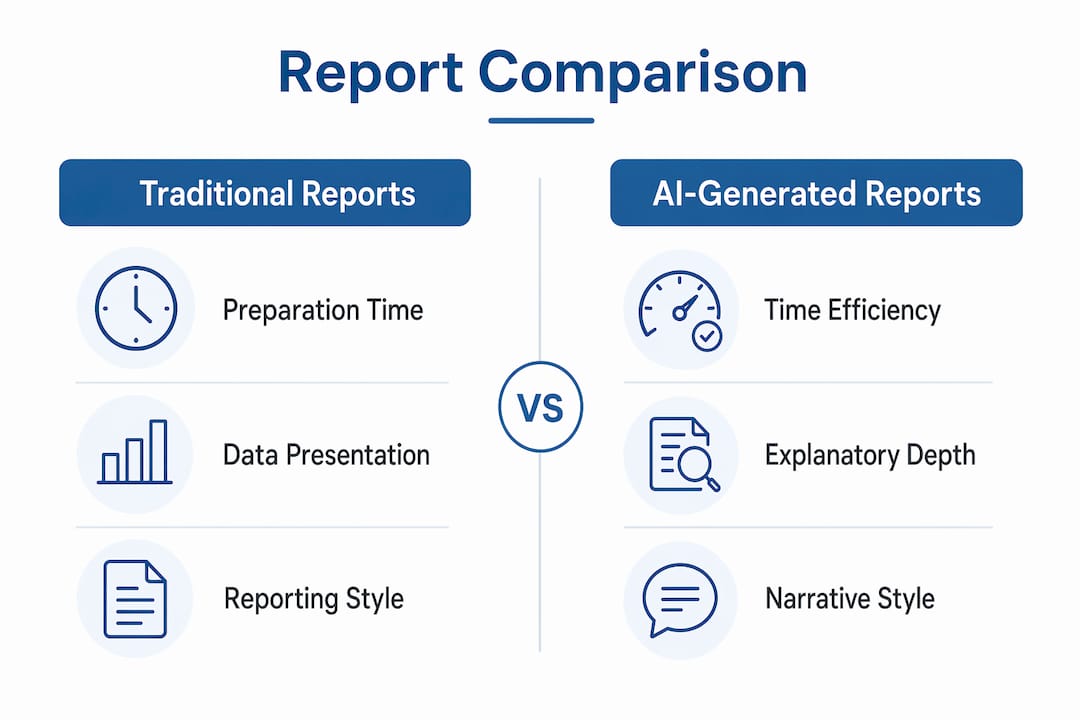
AI also shifts project monitoring from reactive to predictive. Early risk flagging by AI systems means leaders see a blocked dependency or a slipping milestone before it becomes a missed deadline. That is a fundamentally different posture than reading last week’s summary on Monday morning.
One underappreciated capability is audience adaptation. AI tailors reports for different stakeholders by adjusting narrative detail and focus automatically. A CEO sees budget exposure and timeline risk. A team lead sees task-level blockers and resource gaps. The same underlying data, shaped for the right reader, without a project manager writing two separate documents.
Pro Tip: When evaluating AI reporting tools, test them against your most complex stakeholder scenario first. If the system cannot produce a credible executive summary and a team-level detail view from the same data set, it is not ready for production use.
What are the common challenges of AI-driven status reporting?
The benefits of automating status updates are real, but the failure rate for enterprise AI projects is equally real. About 60% of enterprise AI projects are predicted to fail without proper data governance and quality standards. That number reflects a pattern: organizations deploy AI on top of messy, inconsistent data and then blame the AI when the outputs are unreliable.
The most common failure points are:
- Inconsistent data definitions: When your ERP calls a project “active” and your PM tool calls it “in progress,” the AI generates conflicting narratives. Unified data definitions across enterprise systems are not optional. They are the prerequisite.
- Stale documentation: AI cannot invent current information. If your project plans, risk logs, and meeting notes are not updated regularly, the AI report will be confidently outdated.
- Missing human validation: AI accelerates insight, but it does not replace judgment. Human oversight remains essential to verify that AI outputs reflect ground truth before they reach a board or a client.
- Treating AI as a full replacement: The most dangerous misconception is that AI eliminates the need for project managers to think critically about their data. AI is an intelligence layer. It amplifies what is already there, good or bad.
There is also an organizational readiness dimension that leaders underestimate. Deploying AI reporting without a pilot period means absorbing all the failure modes at once. Teams need time to calibrate prompts, validate outputs, and build trust in the system before it becomes the authoritative source of project truth.
How can leaders implement AI status reporting effectively?
Effective implementation follows a sequence, not a single deployment decision. The organizations that succeed with AI versus traditional reporting do not flip a switch. They run a structured pilot, fix what breaks, and expand from there.
Here is a practical sequence for business leaders:
- Identify the highest-cost reporting tasks first. Start with the report that consumes the most time and delivers the least strategic value. That is your pilot candidate.
- Audit your data sources before connecting them. Map every input the AI will read. Flag anything stale, inconsistent, or ungoverned. Fix it before the AI touches it.
- Establish unified data definitions. Align your ERP, CRM, and project management tools on shared terminology. This is the single most important governance step.
- Run a 60 to 90 day pilot. Recommended pilot periods of 60 to 90 days give teams enough time to tune the system, validate outputs, and measure actual time savings before full rollout.
- Involve project managers in validating outputs. PMs know when a report is wrong. Their feedback refines the AI’s prompts and improves accuracy over time.
- Measure and report the ROI. Track time saved, errors caught, and decisions accelerated. This data justifies expansion and builds organizational confidence in the system.
AI frees project managers to focus on strategic tasks and stakeholder relationships instead of data compilation. That shift is the real return on investment. The time recovered from manual reporting is time redirected toward the work that actually requires human judgment.
AI-augmented project systems can reduce peak uncertainty exposure by up to 33%, lower planning effort by 15%, and reduce overall project delays by 25%. Those numbers represent real capacity returned to your organization, not just faster reports.
Pro Tip: Pair your AI reporting pilot with a short weekly review where a senior PM reads the AI output critically before it goes to leadership. This catches errors early and builds the institutional trust that makes full adoption possible.
Key takeaways
AI replaces status reports most effectively when clean, governed data feeds a system that generates narrative briefings, not just data summaries, and when human validation remains part of the process.
| Point | Details |
|---|---|
| Reporting time reduction | AI cuts weekly report preparation from 3 to 5 hours down to 15 to 30 minutes. |
| Data quality is the prerequisite | Stale or inconsistent source data produces inaccurate AI outputs regardless of tool quality. |
| Narrative depth beats data dumps | AI reports that explain cause and effect deliver more strategic value than raw number summaries. |
| Pilot before full deployment | A 60 to 90 day pilot period is the recommended path to reliable AI reporting adoption. |
| Human validation stays in the loop | AI accelerates insight but does not replace the judgment needed to verify outputs before they reach leadership. |
Why I think most teams are implementing this backward
The standard advice on AI reporting is to pick a tool, connect your data, and let it run. That advice skips the part that actually determines whether the output is trustworthy.
What I have seen consistently is that the forcing function of setting up AI report generation exposes process failures that were already there. When you ask an AI to read your project documentation and it produces something incoherent, the problem is almost never the AI. It is that your documentation was already incoherent. The AI just made it visible.
This is actually the most underrated benefit of the whole exercise. Before you get a single useful AI briefing, you are forced to clean up your data, align your definitions, and decide what “done” means across your systems. That work has value independent of the AI. Teams that skip it and blame the tool are missing the point entirely.
The other thing I would push back on is the framing of AI versus traditional reporting as a competition. The leaders who get the most out of AI briefings are not the ones who eliminated human judgment from the process. They are the ones who redirected it. The PM who used to spend four hours compiling a report now spends forty-five minutes reviewing an AI draft, catching the two things it got wrong, and adding the context only a human can provide. That is a better use of a skilled person’s time, and it produces a better report.
The productivity gains from AI-assisted work are real, but they compound only when the human layer stays engaged. Treat AI as a first draft, not a final answer, and the quality of your leadership briefings will improve materially.
— Paul
How ClaudeDrive delivers trusted daily briefings
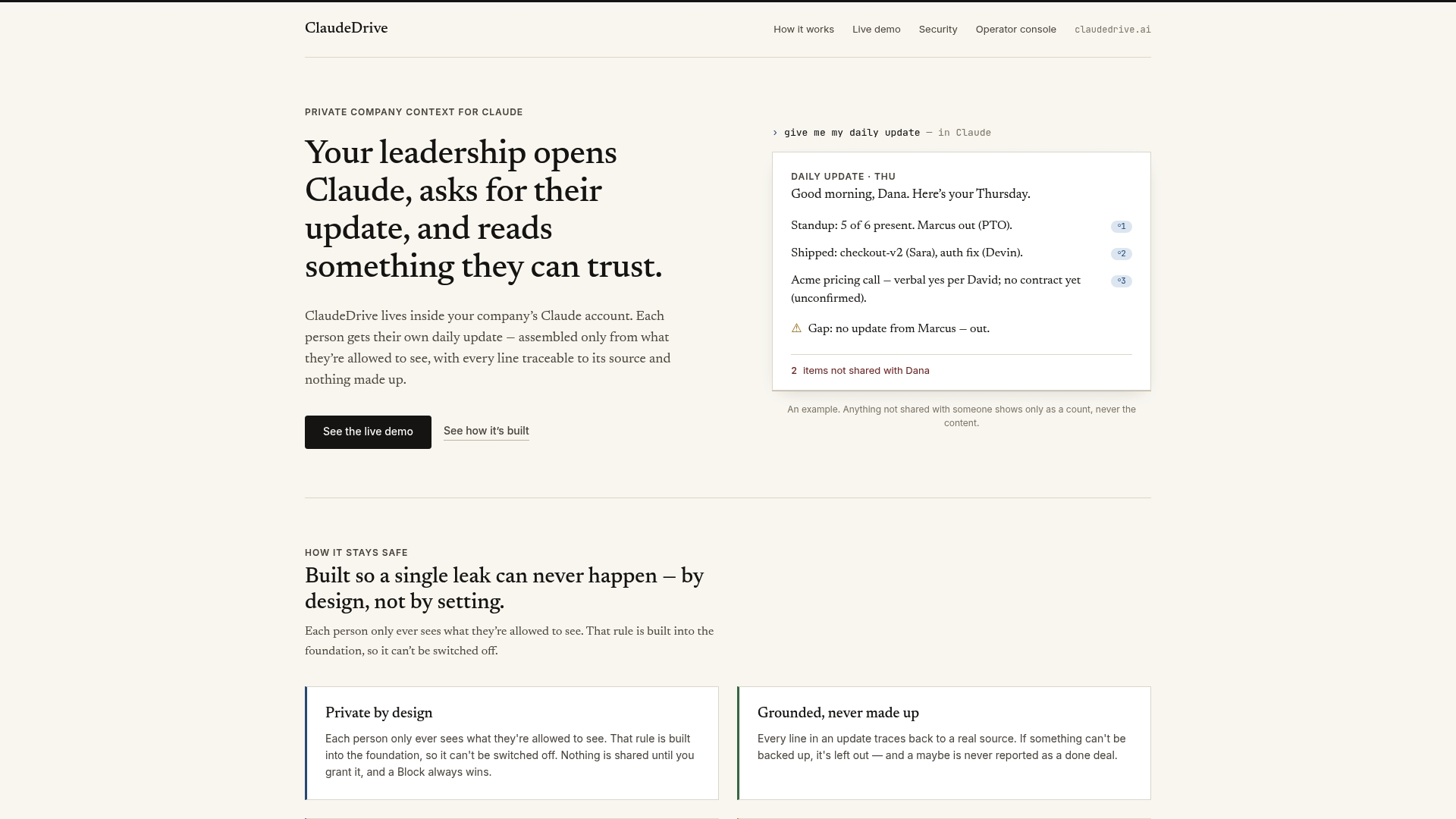
ClaudeDrive is built for exactly the scenario this article describes. A leader opens Claude, asks for their update, and reads a single briefing built only from sources they are authorized to see. Every line is traceable to a real source. Nothing is fabricated. Nothing crosses a permission boundary it should not.
Connect meeting notes, GitHub, and your calendar, and each person on your leadership team gets their own private view of what happened, without a new app to learn or a dashboard to maintain. ClaudeDrive is the company-context layer that feeds Claude directly, not another assistant to adopt on top of everything else. Built by Yungsten Tech for leaders who need to trust what they read.
See the live demo or talk to us about a pilot.
FAQ
How does AI replace manual status reporting?
AI replaces manual reporting by connecting to project tools, extracting data automatically, and generating narrative briefings without human compilation. The result is a structured update delivered in minutes rather than hours.
What is the biggest risk of AI-driven status reports?
The biggest risk is poor data quality at the source. AI systems that read stale or inconsistent documentation produce confident but inaccurate outputs, which is why data governance must precede any AI reporting deployment.
How long does it take to implement AI status reporting?
A 60 to 90 day pilot period is the recommended standard for transitioning from manual to AI-driven reporting. This window allows teams to validate outputs, refine prompts, and build confidence before full rollout.
Can AI status reports replace human project managers?
AI does not replace project managers. It removes the data compilation burden so managers can focus on stakeholder relationships, risk decisions, and strategic work that requires human judgment.
How much time do AI reports actually save?
AI-generated reports reduce weekly preparation time from three to five hours down to fifteen to thirty minutes, representing more than a 90% reduction in time spent on status report compilation.