Top 4 modelcontextprotocol.io alternatives 2026
Explore 4 modelcontextprotocol.io alternatives to discover effective solutions for team communication and project tracking in 2026.
ClaudeDrive
A Yungsten Tech product
Top 4 modelcontextprotocol.io alternatives 2026
Finding an enterprise context platform that delivers timely, accurate, and private context for leadership decisions is slow and full of tradeoffs. Most platforms either demand new app rollouts, lack fine-grained access controls, or require expensive engineering work before value appears. This review compares the core differences between four alternatives so leadership teams can match permission controls, audit trails, and context delivery to their operating style.
Table of Contents
ClaudeDrive
At a Glance
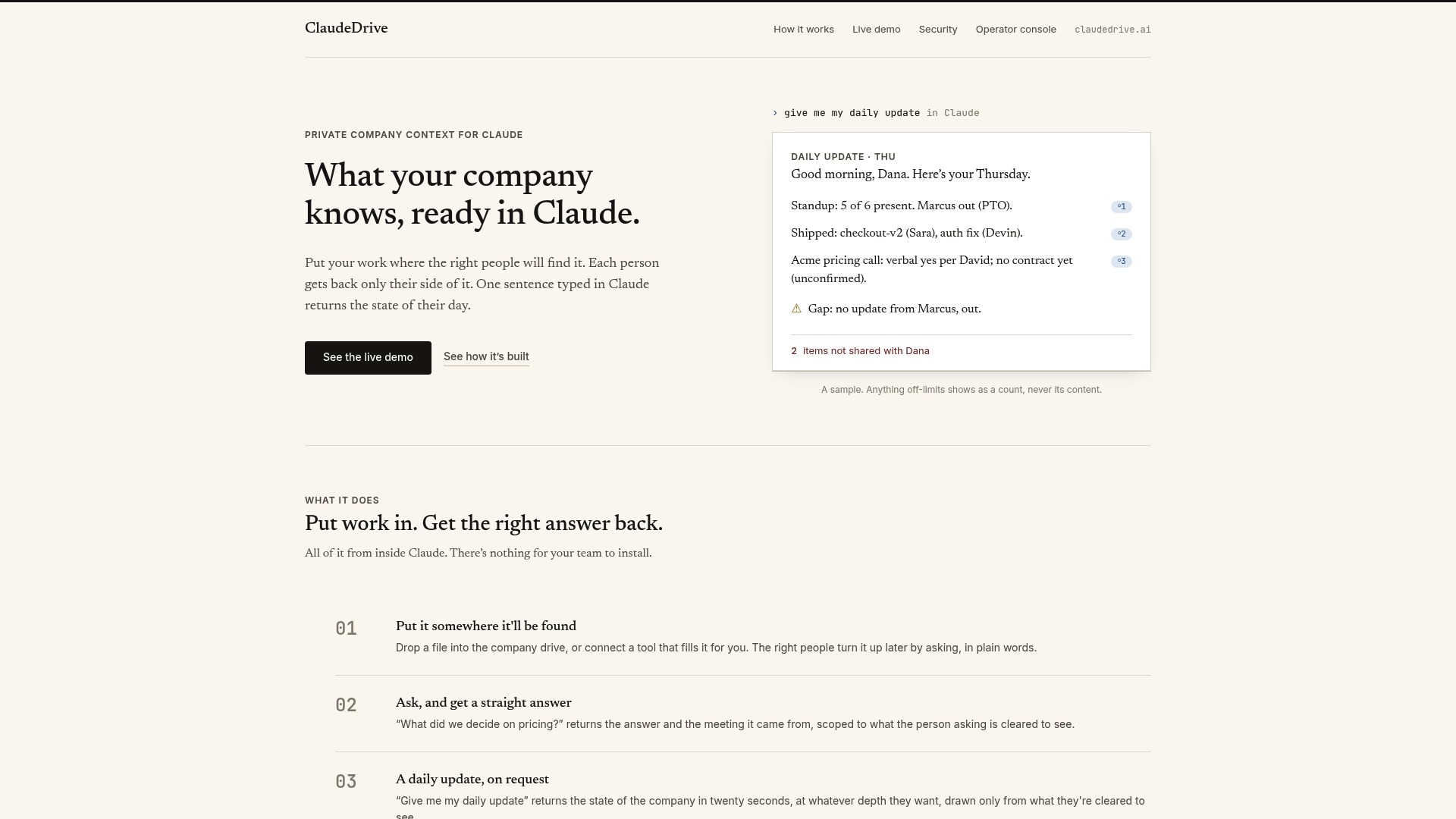
Leaders read a private, permissioned daily briefing directly inside their Claude account. Every line in the briefing is traceable to a real source and tied to the viewer’s permissions. No extra app, dashboard, or wiki is required for delivery.
Core Features
permission based controls limit each user’s view to data they are authorized to see. automatic sourcing attaches an auditable source to every line and shows where the information came from. Users request on demand summaries or answers drawn from connected meeting notes, GitHub, calendars, and files without installing another tool. Traceability applies to each statement so audits can link claims back to original documents.
Key Differentiator
ClaudeDrive’s core difference is delivering personalized updates while enforcing individual permissions for every piece of content. Each statement links back to a concrete source so leaders can verify why something appears in their briefing. That approach keeps sensitive items private while allowing timely context to the right people.
Pros
Strong permission controls secure sensitive information and make access auditable for compliance reviews. Transparent source attribution reduces follow-up questions because recipients can open the original note or file tied to a line. Delivering updates inside Claude removes the need for training on a new interface and speeds adoption across leadership.
Cons
- Limited to organizations with connected internal data sources and files.
Who It’s For
This suits corporate teams that already centralize documents, meeting notes, and operational tools. Leaders, chiefs of staff, and product managers who want quick, verifiable daily summaries will get most value. It is not aimed at organizations that lack structured internal data or unified access control.
Unique Value Proposition
Private briefings inside Claude require no new app rollout and no dashboard to train the leadership team on. That reduces rollout friction because leaders keep using the interface they already know while security teams retain control over access. For decision owners, this means fewer status meetings and fewer manual requests for source links.
Real World Use Case
A company configures connectors to meeting notes, calendars, and repositories. Every morning each manager receives a condensed, permissioned summary that lists decisions, blockers, and follow ups with source links. Sensitive lines appear only for authorized viewers so legal or HR items do not leak across teams.
Pricing
Public materials mark pricing as not applicable and describe the offering as informational only. The vendor does not publish standard tiers or a starting price. Contact the vendor to discuss a pilot or an enterprise arrangement.
Website: https://claudedrive.ai
Workfabric
At a Glance
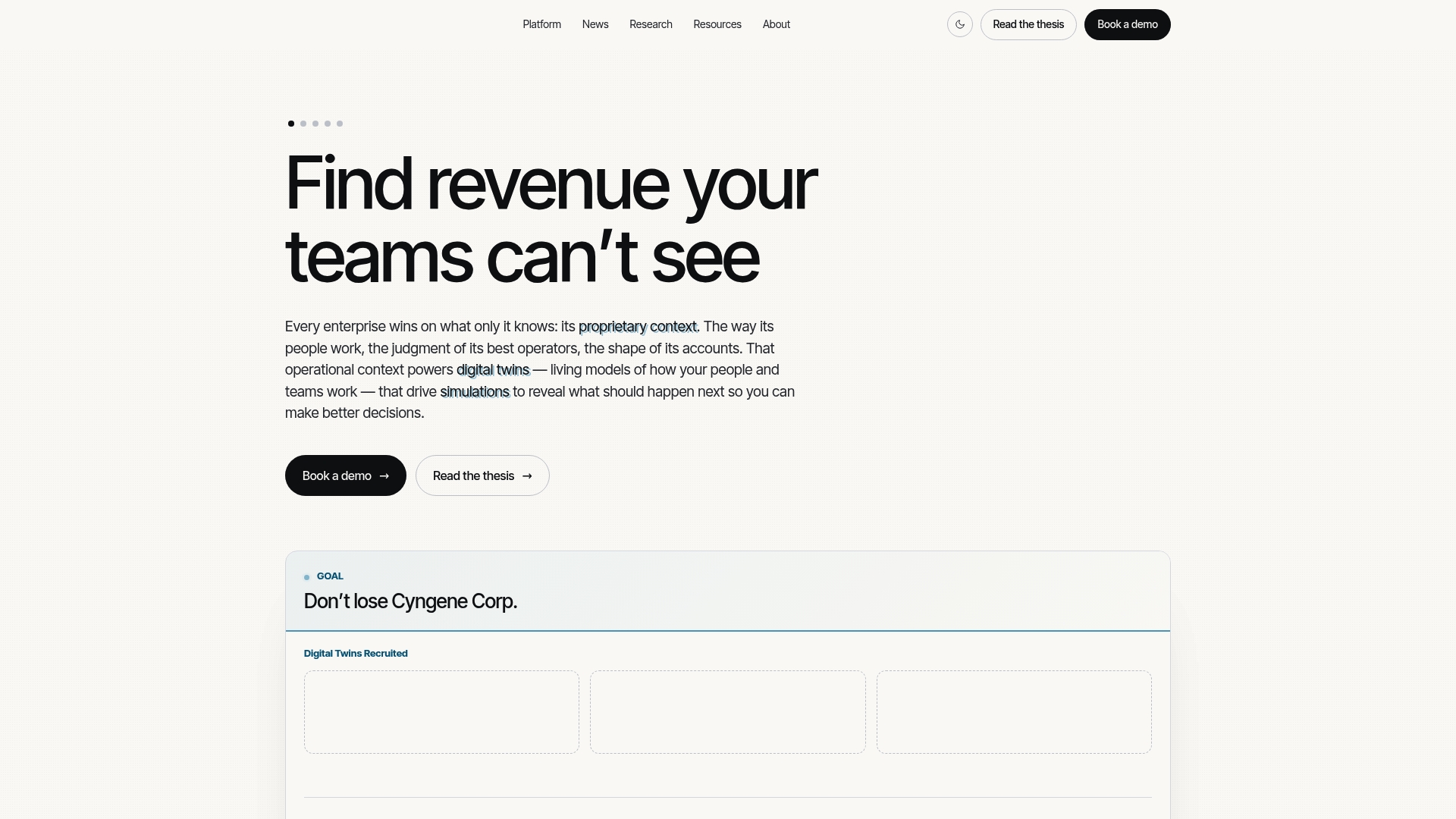
Workfabric’s marketing materials state a Fortune 500 customer surfaced $1 billion+ in net new revenue and cut IT incident resolution time by 73%. That vendor claim highlights the platform’s focus on measurable operational outcomes. Workfabric builds live digital twins from real work activity so enterprises can run simulations without adding connectors.
Core Features
Workfabric creates digital twins of accounts, teams, products, personas, and custom entities and keeps those models aligned to live work activity. The platform senses work across applications and communication tools, extracts structured operational signals, and synthesizes contextual insights for decision support. It also runs simulations of workflows and supports autonomous acting so organizations can test outcomes and let the system take predefined actions.
Key Differentiator
The product’s defining angle is that it claims to operate from live operational context with no integration required, which reduces the upfront engineering lift in complex estates. That approach aims to keep digital twins current and adaptive to real behavior rather than static snapshots. It is focused on enterprise simulation and autonomous actuation rather than short daily briefings for individual leaders.
Pros
Grounding models in live operational signals lets teams generate insights that map directly to how people actually work and to current account states. The vendor advertises autonomous decision-acting and continuous learning, which can reduce manual triage and free teams to focus on higher value work. Security, privacy, and governance features are listed as enterprise grade, making adoption easier for regulated organizations, and the platform claims measurable impact in large deployments, as shown by the Fortune 500 result above.
Cons
-
Setup complexity for highly customized enterprise environments can be high and may require external specialists to model workflows accurately.
-
The platform depends on the quality and completeness of live operational data. Poor telemetry will reduce the accuracy of simulations and recommendations.
-
Public pricing is not listed. That opacity suggests costs will vary and could be significant depending on deployment scope.
When It May Not Fit
If your company lacks consistent, high fidelity operational telemetry, Workfabric will struggle to produce reliable simulations. Smaller organizations with limited digital assets will likely find the solution oversized for their needs. If you need transparent, self service pricing or a light leader briefing rather than enterprise simulation, this is not the best match.
Who It’s For
Workfabric targets large enterprises and Fortune 500 scale organizations that run complex workflows across many systems and need to stress test operational strategies. It suits strategy, operations, and platform teams that want to model outcomes and let automation act on validated signals. If your priority is a leader facing daily briefing inside an assistant, this product serves a different operational use case.
Real World Use Case
A large enterprise used Workfabric to search for latent revenue opportunities inside existing accounts while shortening incident resolution time. The company ran multiple simulations to compare remediation strategies and then applied the winning approach across teams. That engagement is the source of the revenue and incident time figures cited above.
Pricing
Pricing is not specified publicly and is likely custom enterprise pricing based on deployment scope, data volume, and required customization. Expect a consultative sales process to define license and implementation costs.
Website: https://workfabric.com
Euno
At a Glance
Euno pairs end-to-end column level impact and lineage analysis with role aware, real time metadata delivery for AI agents. That combination supplies traceable context, so leaders can see which source fields drove a decision. The vendor positions the product as cloud native and ties billing to AI agent context consumption rather than seat counts.
Core Features
Euno automates metadata mapping and draws interactive lineage graphs while labeling assets for compliance and quality. It delivers role aware context to downstream systems so AI agents and analysts receive only the fields and labels relevant to their role. Governance workflows handle policy enforcement and conflict resolution and the platform reports impact to the column level for change management.
Key Differentiator
Euno’s distinguishing capability is its column level lineage plus role aware metadata delivery to AI agents. That pairing makes it possible to restrict agent access to certified fields and to trace every result back to a specific column and source. For leadership that needs auditability for AI-driven decisions, that combination shortens the path from incident to root cause.
Pros
Automated lineage and column level impact analysis reduce the manual work your data team must do when schemas change. The product routes role aware context to agents, which helps keep models operating on certified data and lowers the risk of incorrect outputs. Integrations with modern data stacks speed setup, and pricing geared to agent context consumption means costs scale with agent activity rather than seats.
Cons
- Privacy and security controls are standard. They may require customization for highly regulated environments.
- As a relatively new platform, some advanced enterprise features or integrations may still be under development.
- Pricing details are not publicly listed. You must contact sales for a custom quote.
When It May Not Fit
If your estate relies on legacy systems that do not support active integration, Euno can demand heavy customization to connect. Large enterprises with extreme scale or unusual compliance needs should validate performance and security posture before committing. If you need out of the box, prescriptive controls for every regulation, the platform may require additional work.
Notable Integrations
Euno integrates with common analytics and cloud warehouses including dbt, Looker, Tableau, Power BI, Snowflake, BigQuery, Redshift, and Azure Synapse. Those connections cover modeling, visualization, and storage so metadata follows data through the stack.
Who It’s For
Large enterprise data teams, data governance officers, and AI operations teams that need automated metadata, impact analysis, and governed context for AI and analytics. It suits organizations that already run modern data stacks and want to reduce manual metadata curation.
Real World Use Case
A Fortune 500 firm automated governance workflows and cut manual metadata curation. The company enabled ChatGPT and other LLMs to query certified enterprise data and trace outputs to source columns. That change improved decision traceability and reduced time spent investigating data incidents.
Pricing
Pricing is based on AI agent context consumption rather than user seats and varies by environment size and feature packs. Exact tiers and per consumption metrics are not publicly listed and require direct contact for a custom quote. For leaders, that model shifts cost toward agent usage rather than headcount.
Website: https://euno.ai
Colrows
At a Glance
Colrows’ marketing materials state it generates dialect perfect SQL for 16+ data engines, including Snowflake, Databricks, and BigQuery. The product builds a typed semantic graph that spans an enterprise data estate automatically. That graph enforces policies at compile time and produces traceable query execution for AI driven workflows.
Core Features
Colrows constructs a typed multi scope semantic graph by ingesting warehouses, catalogs, documentation, and metadata, and it updates automatically as sources change. It generates dialect perfect SQL tuned for many engines and enforces RBAC, ABAC, and row and column level security at compile time. The platform also exposes proven join paths and an audit trail that AI agents can reference for deterministic query execution.
Key Differentiator
What distinguishes Colrows is its autonomous creation of a governance enforced semantic layer that records proven join paths across sources. That design makes query results reproducible and traceable back to underlying tables and the policies that allowed each access. For teams that require a deterministic foundation for AI queries, this focus on governance and provenance is the defining capability.
Pros
Colrows reduces manual modeling by autonomously building and maintaining a semantic graph, which cuts ongoing upkeep for data teams. It produces reproducible, deterministic queries with a full audit trail, so leaders can trace decisions back to named sources and applied policies. The platform supports a wide set of engines and sources, giving flexibility for mixed cloud and warehouse environments, and third party reviewers highlight its production readiness and governance posture while noting the enterprise focus.
Cons
- Complex initial setup and integration required for regulated enterprise environments.
- Requires team knowledge of semantic graph concepts and governance policy design.
- Not suited to small businesses or simple analytics needs that need plug and play tools.
When It May Not Fit
If your organization lacks a dedicated data engineering resource, Colrows will feel heavy. Small analytics teams that need quick dashboards and lightweight transforms will find it more than they need. Organizations seeking an out of the box analytics tool without governance controls should look elsewhere.
Who It’s For
Colrows fits enterprise data teams, data engineers, and AI infrastructure architects working in regulated industries who need governed, deterministic data access. It also fits mid sized companies that operate like enterprises and must document provenance for audits. Technical decision makers buying this should plan for an integration and governance design phase.
Real World Use Case
A pharmaceutical company used Colrows to unify siloed clinical, lab, and commercial data, automating governance across sources. The company ran AI enabled queries that traced every join path and policy decision back to source tables. That allowed faster decision making while maintaining audit readiness for regulators.
Pricing
The vendor lists pricing as Not applicable — informational only. There is no public tiered pricing posted for the product. Prospective buyers should treat Colrows as an enterprise offering that requires sales engagement for cost details.
Website: https://colrows.com
Comparison of alternatives
ClaudeDrive outpaces its competitors by delivering leadership briefings directly within its platform, integrating securely with existing operational data, and offering personalized updates aligned with permission settings. This section contrasts ClaudeDrive’s advantages against the specialized strengths of Workfabric, Euno, and Colrows.
Content delivery and permissions model
ClaudeDrive offers its users tailored updates tied directly to operational data sources, ensuring compliance with varied access policies. In comparison, both Colrows and Euno excel in governance and provenance tracking for operational analytics but lack a simple mechanism to present controlled, summarized briefings that suit daily information needs.
Operational simulation capabilities
Workfabric distinguishes itself by providing real-time operational simulations using live telemetry data to identify workflow efficiencies. This level of automation, ideal for large-scale enterprise environments, surpasses the scope of easing day-to-day leadership updates, which is ClaudeDrive’s primary strength.
Best fit
- ClaudeDrive is ideal for leadership teams seeking clear, concise, and private briefings without introducing additional complexities in their toolsets.
- Workfabric suits enterprises that need advanced operational modeling and autonomous decision-acting based on live system telemetry.
- Euno is well-suited for data governance officers requiring detailed lineage and compliance from metadata-informed AI workflows.
- Choose Colrows if your organization needs deterministic queries that enforce governance policies across a broad data estate.
Our pick
ClaudeDrive leads in scenarios requiring leadership teams to access secure, permissioned, and concise updates without burdening the users with new software or interfaces. However, organizations focused solely on operational modeling or metadata lineage assurance may find a better match with Workfabric or Euno.
Focused on delivering private, permissioned briefings to leaders without requiring additional applications, these platforms each offer unique advantages for different organizational needs.
| Product | Core Feature | Key Differentiator | Best For | Pricing | Notable Limitation |
|---|---|---|---|---|---|
| ClaudeDrive | Permission-based content controls | Personalized briefings with auditable sources | Corporate teams centralizing documents | Price not published | Limited to internal data setups |
| Workfabric | Live operational digital twins | Real-time updates with no required connectors | Large enterprises with complex workflows | Price not published | High setup complexity might require external specialists |
| Euno | Interactive lineage analysis | Column-level impact tracing for certified data | Data teams in modern analytics environments | Price not published | Requires configuration for legacy system integration |
| Colrows | Semantic graph for governance | Autonomous governance layers for deterministic querying | Regulated industries and enterprise architects | Price not published | Demands expertise in semantic graph concepts and governance design |
How Can Leaders Simplify Their Daily Context Updates Without New Tools?
Leadership teams face a common challenge: getting precise, trustworthy updates without juggling multiple apps or risking information leaks. modelcontextprotocol.io alternatives often complicate this with extra dashboards or broad data exposure. ClaudeDrive solves this by delivering daily briefings directly inside the Claude account leaders already use.
ClaudeDrive limits each user to the information they are authorized to see. Every line in the briefing links back to a real source. There is no new app or dashboard. Connecting tools like meeting notes, GitHub, and calendars creates a private stream of company updates tailored to each leader’s role.
Learn how ClaudeDrive gives your leadership team a verified daily update that stays inside your existing workflow. See why fewer status meetings and transparent sources make a difference.
FAQ
How does ClaudeDrive ensure secure access to sensitive data?
ClaudeDrive employs strong permission controls to limit each user’s view to only the data they are authorized to see. This permission-based control feature allows leadership teams to maintain confidentiality while accessing necessary operational insights. Leaders can expect a secure and compliant way to manage sensitive information.
What is the difference between ClaudeDrive and Workfabric?
Workfabric excels at operating from live operational context with no integration required, which reduces upfront engineering efforts in complex environments. ClaudeDrive, on the other hand, delivers personalized updates while enforcing individual permissions for every piece of content. Leaders should choose ClaudeDrive when they need personalized and auditable briefings tailored to their specific needs.
Can ClaudeDrive handle multiple data sources for a comprehensive briefing?
Yes, ClaudeDrive can connect to various internal data sources, allowing users to request summaries drawn from meeting notes, calendars, and files on demand. This capability ensures that each briefing reflects a consolidated view of relevant information. Organizations should consider using ClaudeDrive to eliminate the need for multiple tools while centralizing briefings.
Does ClaudeDrive provide transparency in information sourcing?
ClaudeDrive attaches an auditable source to every line of information within its briefings, allowing users to trace back the data origins. This automatic sourcing capability reduces follow-up questions and builds trust among leadership regarding the information they receive. Leaders can rely on this transparency to verify the data presented in their briefings.
What types of organizations are best suited for ClaudeDrive?
ClaudeDrive is ideal for corporate teams that centralize documents and operational tools. It particularly benefits leaders, chiefs of staff, and product managers seeking quick and verifiable summaries. Organizations lacking structured internal data might find it challenging to use ClaudeDrive effectively.