AI Company Context Update Examples for Business Leaders
Discover effective AI company context update examples that keep your AI aligned with business goals, enhancing trust and accuracy. Learn more now!
ClaudeDrive
A Yungsten Tech product

AI Company Context Update Examples for Business Leaders

AI company context updates are structured processes that keep AI systems accurate, relevant, and aligned with a company’s current goals, data, and rules. Without them, AI tools drift from reality and start producing outputs that no longer reflect how the business actually operates. For high-growth companies, this drift is not a minor inconvenience. It erodes trust in every briefing, recommendation, and automated workflow the AI touches. The best practices for AI updates treat context changes the same way engineering teams treat software releases: versioned, tested, staged, and reversible.
1. What are AI company context update examples?
AI company context updates are changes made to the information, rules, and instructions that an AI system uses to generate responses. The industry term for this practice is context management, and it covers everything from updating brand guidelines inside a prompt to retraining a model on new operational data. The examples below show how real organizations apply this practice at scale.
2. Best practices for AI company context updates
Treating AI prompts as production assets is the single most important shift a leadership team can make. Prompt changes require offline evaluation, peer review, and staged rollout before reaching full production traffic. Teams that skip this step routinely discover silent regressions, where outputs quietly degrade without any error message or alert.

Structured versioning binds every context change to a full runtime package. That means the prompt, the model version, the retrieval configuration, and the test dataset all move together. If a rollback is needed, the team reverts the entire package, not just one file.
Signal-based retraining replaces calendar-based update schedules. High-growth teams trigger retraining when real data thresholds are crossed, such as a drop in output quality scores or a spike in user corrections. This keeps models fresh without the risk of unnecessary churn.
Automated rollback mechanisms protect production systems. Industry-standard safe rollout caps quality score changes at 2% and allows reversion to a previous version within one second. That speed matters when a bad update reaches thousands of users.
Pro Tip: Set a quality score floor before any staged rollout begins. If the canary slice drops below that floor, the system rolls back automatically without requiring a human decision at 2 a.m.
Governed read-write capabilities let AI agents update their own context documents within defined boundaries. This is the difference between an AI that forgets every session and one that compounds institutional knowledge over time.
3. Real-world AI context update implementations
The strongest evidence for context management comes from organizations that measured before and after.
-
Medicinal chemistry workflow: A research team integrated AI agents with persistent, context-aware systems into a chemistry optimization workflow. Mean reaction yield increased from 16.6% to 25.2%, and successful reactions above a 30% yield threshold rose from 15.6% to 37.5%. The context layer held the accumulated experimental rules that the AI applied to each new reaction.
-
Global bank compliance: A global bank narrowed the contextual targeting of its AI compliance tool to focus only on new hires below 60 days of tenure. Compliance workflow engagement jumped from 11% to 94%. Broad context had been diluting the signal. Tighter targeting made the AI relevant to the right people at the right moment.
-
Atlassian’s agentic shift: Atlassian moved from chatbot-style AI interactions to persistent agentic workflows with structured execution plans and checkpoints. This required AI context that could hold state across long-horizon tasks, not just single-turn conversations. The architectural change was a context management decision, not a model decision.
-
Ability.ai autonomous context logs: Ability.ai built AI agents that autonomously update writing rules based on executive feedback. An agent captures a preference like “never use em dashes” and self-enforces it on every future output. The context document updates itself, removing the manual maintenance burden from the team.
“The biggest business moat in AI is a proprietary, structured context layer that agents can read and autonomously update to compound institutional knowledge.” — Ability.ai
These cases share a common thread. The performance gain came from improving the quality and targeting of the context, not from switching to a more powerful model.
4. How do AI update deployment patterns compare?
Three deployment patterns cover most enterprise use cases. Each carries distinct trade-offs.
| Pattern | How it works | Best for | Main risk |
|---|---|---|---|
| Auto-update with monitoring | Model or prompt updates apply automatically; dashboards flag regressions | Fast-moving teams with strong observability | Silent regressions overnight |
| Manual update with testing | Every change goes through a human review and test cycle before deployment | Regulated industries, compliance-heavy workflows | Slow update velocity |
| Version pinning with staged rollout | Changes deploy to 1–5% of traffic first, then widen to 25%, 50%, 100% | Most enterprise production systems | Higher operational complexity |
Auto-update configurations can silently break production AI tools overnight. A model provider pushes a change, and by morning the outputs your team relies on have shifted in ways no one planned for. Version pinning prevents this by keeping the system on a known-good state until the team is ready to test the new version.
Feature flags add a layer of control on top of staged rollouts. Flag changes propagate within milliseconds with no redeployment step required. A leader can turn off a new context update for a specific team or task without touching the underlying system.
Pro Tip: Build your validation suite from real production traffic, not synthetic test cases. Narrow internal evaluations miss the edge cases that real users generate daily.
The rollout phases for a staged deployment follow a clear sequence: offline preparation, canary slice at 1–5% of traffic, gradual widening through 25% and 50%, then full production. Automated rollback triggers at each phase gate. This sequence applies equally to prompt changes, model upgrades, and context document updates.
5. How autonomous AI context management improves update speed
Autonomous context management is the practice of letting AI agents read and write their own context documents within defined rules. The alternative is a team member manually updating prompt files after every policy change or executive preference shift. That manual process does not scale.
The core benefits break down clearly:
- Immediate rule capture: An agent records a new preference the moment it receives feedback. The next output reflects that preference without a deployment cycle.
- Centralized memory: All AI tools in a workflow read from one context layer. A brand guideline update in one place propagates to every connected agent automatically.
- Reduced drift: Persistent context layers that include brand rules, standard operating procedures, and operational policies prevent the “stateless tool” problem, where an AI forgets everything between sessions and requires constant re-prompting.
- Sovereign control: Context architectures that run on private infrastructure keep business rules on-premises. Nothing leaves the company’s environment.
For marketing, sales, and operations teams, this means every AI-driven tool works from the same current version of company knowledge. A sales AI and a content AI both know about the pricing change announced last Tuesday, because both read from the same updated context document.
The compounding effect is significant. Each captured preference, each updated policy, each new product fact makes the AI more accurate over time. Teams that treat their context layer as a living asset build a knowledge base that grows with the company.
Pro Tip: Assign one person the role of context owner. That person reviews and approves autonomous updates on a weekly cadence. Autonomy without oversight creates a different kind of drift.
For a practical look at how this applies to daily leadership briefings, the AI daily update format guide from ClaudeDrive covers real-world format examples for tech organizations.
Key takeaways
Effective AI context management requires versioning, targeted rollouts, and autonomous update capabilities working together. No single practice delivers the full benefit in isolation.
| Point | Details |
|---|---|
| Treat prompts as production assets | Version every context change with its full runtime package and a rollback path. |
| Use signal-based triggers | Retrain or update context when data thresholds are crossed, not on a fixed calendar. |
| Stage every rollout | Start at 1–5% of traffic and widen only after quality scores hold at each phase gate. |
| Narrow your targeting | A global bank raised compliance engagement from 11% to 94% by focusing context on new hires only. |
| Build autonomous context layers | Agents that self-update their context compound institutional knowledge and reduce manual maintenance. |
Why most companies are still treating AI context like a wiki page
The pattern I see most often in high-growth companies is this: a team spends weeks configuring an AI tool, gets it working well, and then treats the context as done. Six months later, the outputs are stale, the team has stopped trusting the tool, and someone proposes buying a new one.
The problem is not the tool. The problem is that context was treated as a setup task rather than an ongoing operational responsibility. The companies that get durable value from AI, the chemistry team that doubled its reaction success rate, the bank that went from 11% to 94% engagement, all of them had someone actively managing what the AI knew and when it knew it.
The uncomfortable truth is that AI context management requires the same discipline as financial reporting. You would not let your books go unreconciled for six months. You should not let your AI’s knowledge of the business go unreconciled either. That means versioning, testing, and staged rollouts for every meaningful change, not just model upgrades.
Leadership involvement is the variable that separates the teams that get this right from the ones that do not. When a CEO or COO treats the context layer as a business asset, the rest of the organization follows. When it gets delegated entirely to a junior technical team with no governance, it drifts.
The good news is that the tooling is catching up to the discipline. Platforms that automate versioning, flag regressions, and surface context updates to leaders without requiring them to open a code editor are now available. The barrier is no longer technical. It is organizational.
— Paul
ClaudeDrive brings context management to every leadership briefing
ClaudeDrive is the private context layer that feeds Claude with what your leaders are actually allowed to see. Connect meeting notes, GitHub, and your calendar, and each person gets a daily briefing built only from verified, permissioned sources.
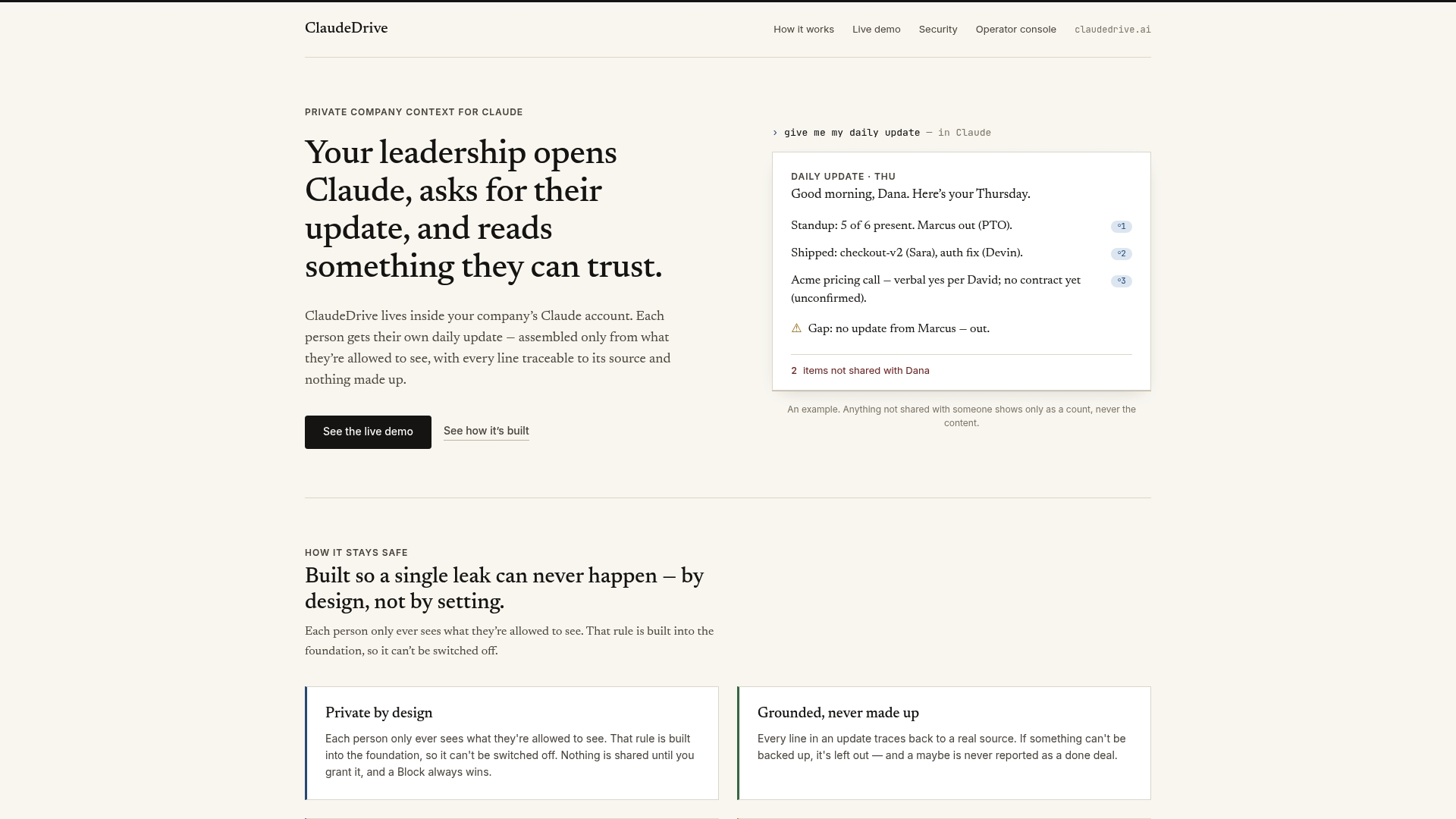
Every line in a ClaudeDrive briefing traces back to a real source. Nothing is made up. Nothing crosses a permission boundary. The ClaudeDrive Console gives your team versioned, auditable control over what the AI knows, without a new app to roll out or a dashboard to learn. For leaders who want to see how this works before committing, the right next step is to see the live demo or talk to us about a pilot.
FAQ
What is an AI company context update?
An AI company context update is a structured change to the information, rules, or instructions an AI system uses to generate outputs. It covers prompt changes, model upgrades, and updates to the documents or data the AI reads from.
Why do AI context updates fail in production?
Most failures come from skipping staged rollouts and validation against real traffic. Silent regressions occur when a change is applied to 100% of traffic without a canary phase to catch quality drops first.
How often should a company update its AI context?
Signal-based triggers outperform fixed schedules. Update context when data quality drops, when business rules change, or when user corrections spike, not on an arbitrary monthly or quarterly cycle.
What is the difference between a prompt update and a model update?
A prompt update changes the instructions the AI receives. A model update changes the underlying AI system itself. Both require the same versioning, testing, and staged rollout discipline to avoid breaking production outputs.
How does ClaudeDrive handle AI context updates for leaders?
ClaudeDrive connects to your existing tools and builds each leader’s briefing from permissioned, sourced data inside Claude. Leaders get current, accurate context without managing prompt files or context documents themselves. See the permission-aware update benefits for more detail on how access controls work in practice.