ACL-Aware RAG: Secure Retrieval for Enterprise AI
Discover how ACL-aware RAG enhances enterprise AI security by filtering documents at retrieval, ensuring trustworthy access to sensitive data.
ClaudeDrive
A Yungsten Tech product

ACL-Aware RAG: Secure Retrieval for Enterprise AI

ACL-aware RAG is defined as a retrieval augmented generation architecture that enforces Access Control List filtering directly at the retrieval step, so the AI only reads documents the requesting user is authorized to see. Standard RAG systems retrieve first and check permissions later, or not at all. That gap creates real exposure: an engineer asks the AI a question and gets fragments from a board-level compensation file they were never meant to read. ACL-aware retrieval systems close that gap at the source, before any content reaches the language model. The approach protects sensitive data, preserves retrieval accuracy, and gives leadership something they rarely get from AI search: a result they can actually trust.
What is ACL-aware RAG and how does it work?
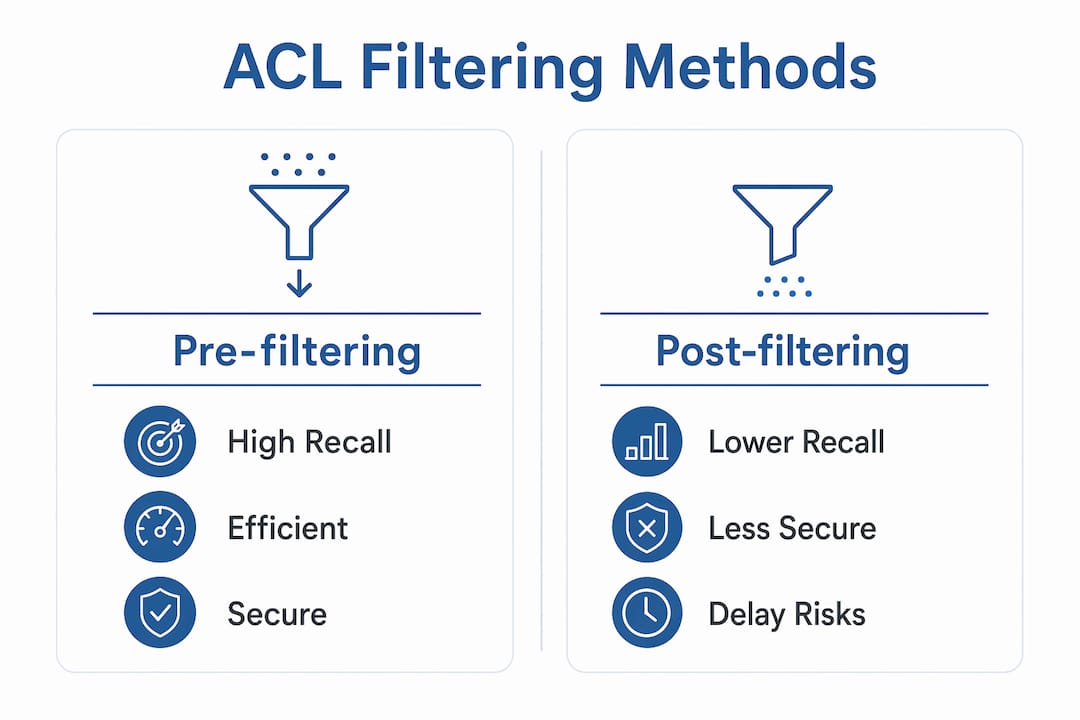
ACL-aware RAG integrates Access Control List enforcement as a filter applied during the Approximate Nearest Neighbor (ANN) query, not after it. Every document chunk stored in the vector index carries metadata that defines which users, groups, or roles are permitted to see it. When a user submits a query, the system reads their identity from a live access token, derives their current set of authorized principals, and passes those principals as a filter into the ANN search. Only chunks where the user’s principals intersect with the chunk’s allowed_principals metadata become candidates for retrieval.
This design matters because indexing chunks with ACL metadata removes unauthorized content from even being candidates, preventing data leakage before the language model ever sees a result. The filter is not a suggestion. It is a hard constraint applied at the vector store layer, equivalent to a WHERE clause that runs before any semantic ranking occurs.

The alternative, post-filtering, retrieves a broad candidate set and then discards unauthorized results. That approach fails in two ways. First, if unauthorized chunks rank higher than authorized ones, the authorized content gets pushed out of the top results, collapsing recall for the legitimate user. Second, the time it takes to retrieve and then discard results creates a timing side channel that can reveal the existence of restricted documents. Pre-filtering ACL during retrieval is the only approach that avoids both problems simultaneously.
Pre-filtering vs. post-filtering: a direct comparison
| Criterion | Pre-filtering ACL | Post-filtering ACL |
|---|---|---|
| Recall for authorized users | Preserved | Degraded when restricted chunks rank higher |
| Data leakage risk | Eliminated at query time | Present via timing side channels |
| Performance | Predictable | Variable; wasted compute on discarded results |
| Architectural complexity | Requires metadata at ingestion | Simpler ingestion, harder to secure |
| Industry recommendation | Standard practice | Not recommended for sensitive data |
Pro Tip: Test your ACL filter by querying as a low-privilege user and confirming that restricted document titles never appear in retrieved chunks, even when the query is semantically close to restricted content.
How should authentication feed into ACL enforcement?
Short-lived access tokens issued via OIDC or SSO are the correct mechanism for feeding user identity into an ACL-aware retrieval system. Protocols like those supported by Okta and Azure Active Directory issue tokens that carry group and role claims, which the retrieval system reads at query time to construct the user’s current principal set. Short-lived tokens of 15–60 minutes ensure that group memberships stay synchronized with the authoritative identity service, so a user who loses access to a project at 9:00 AM cannot retrieve that project’s documents at 9:05 AM.
The critical rule is that user principal sets must be derived at query time from the live token, never from a cached or pre-baked membership list stored in the index. Baking membership into the index creates stale ACL problems that are difficult to detect and expensive to remediate. A user who was removed from a security group last Tuesday may still retrieve restricted content if the index was not rebuilt.
The steps for integrating authentication with ACL enforcement follow a clear sequence:
- Authenticate the user via your OIDC/SSO provider and receive a signed access token.
- Extract principal claims (user ID, group IDs, role IDs) from the token payload at query time.
- Pass principals as a filter into the vector store query alongside the semantic search parameters.
- Validate token expiry before executing the query; reject expired tokens without fallback retrieval.
- Log the principal set used for each query to support audit and forensic review.
- Refresh tokens on schedule within the 15–60 minute window to prevent stale membership data from reaching the retrieval layer.
Pro Tip: Map your identity provider’s group claim names to your vector store’s filter field names during system design, not at deployment. Mismatched field names are the most common cause of ACL filters silently failing in production.
Understanding how document-level permissions map to chunk-level metadata is the next layer of complexity that authentication alone cannot solve.
How do you design metadata and evaluate ACL enforcement?
Every document chunk in the index needs a consistent ACL metadata schema. A practical schema includes: user_ids (a list of individual users with direct access), group_ids (groups or roles with access), acl_policy (the governing policy name or ID), and tenant_id (for multi-tenant deployments). Without a consistent schema across all chunks, filter logic becomes fragile and inconsistent results appear without obvious cause.
ACL integration is a design-level requirement, not a post-ingestion add-on. Mapping document-level permissions to chunk-level metadata during ingestion is complex because a single document may contain sections with different permission levels. Each chunk must inherit the most restrictive applicable permission, not the document’s average or most permissive setting.
Evaluation of ACL enforcement should be quantitative. One enterprise experiment using an LLM-as-judge evaluation harness showed that iterative ACL-aware architecture improved correctness from 0.10 to 1.00 across seven design cycles. That result shows how much correctness is left on the table when ACL enforcement is bolted on rather than built in from the start.
| Evaluation metric | Before ACL-aware design | After ACL-aware design |
|---|---|---|
| Retrieval correctness score | 0.10 | 1.00 |
| Unauthorized content in results | Present | Eliminated |
| Recall for authorized users | Degraded | Preserved |
| Audit log completeness | None | Full query and ACL trace |
Observability is a top implementation priority, requiring logs of queries, user and tenant IDs, and ACL evaluations to audit and debug. Without those logs, diagnosing why a user received no results, or why a result appeared that should not have, becomes guesswork. Audit logs also satisfy compliance requirements under frameworks like SOC 2 and ISO 27001, where access to sensitive data must be traceable.
Pro Tip: Run a weekly automated test that queries as each of your defined persona types (admin, standard user, guest) and checks that results match expected ACL boundaries. Catch drift before users do.
What are the common pitfalls in deploying ACL-aware RAG at scale?
Stale ACL data is the most operationally dangerous failure mode. An index that was built with correct permissions last week may be wrong today if users changed roles, documents were reclassified, or new data was ingested without proper metadata. The index must be treated as a live artifact, not a static snapshot.
Defense-in-depth requires both metadata filtering at retrieval and a final verify_access check before answer assembly. The metadata filter handles the bulk of enforcement efficiently. The final access check catches edge cases where index state has drifted from the authoritative permission source. Neither layer alone is sufficient for high-stakes deployments. Understanding why data security requires layered controls, not single points of enforcement, is foundational to getting this right.
Chunk-level permission mapping also creates complexity that document-level thinking misses. A legal contract may have a public summary section and a confidential pricing annex. If the chunking process splits those into separate vectors but assigns the document’s top-level permission to all chunks, the pricing annex becomes retrievable by anyone who can see the summary. Each chunk needs its own permission evaluation.
Common mistakes to avoid during ACL-aware RAG design and operation:
- Caching principal sets between requests. Always re-derive from the live token.
- Assigning document-level permissions to all chunks uniformly. Evaluate each chunk independently.
- Skipping the final verify_access check. Metadata filters can drift; the final check is not optional.
- Logging only errors, not successful retrievals. Compliance audits require full access traces, not just failure logs.
- Treating ACL enforcement as a one-time setup task. Permissions change; the enforcement pipeline must change with them.
- Building ACL logic into the application layer instead of the retrieval layer. Application-layer enforcement is bypassed whenever the retrieval layer is called directly.
Enforcing access control at retrieval requires treating the vector store as a security boundary, not just a search index.
Key Takeaways
ACL-aware RAG requires pre-filtering at the retrieval layer, live token-derived principal sets, chunk-level metadata, and full audit logging to deliver trustworthy, secure AI search.
| Point | Details |
|---|---|
| Pre-filter, never post-filter | Apply ACL filters during ANN queries to preserve recall and eliminate timing leaks. |
| Derive principals at query time | Pull group and role claims from live OIDC/SSO tokens; never use cached or index-baked membership data. |
| Design metadata at ingestion | Assign ACL metadata to each chunk individually during ingestion, not as a document-level override. |
| Add a final access check | Combine metadata filtering with a verify_access step before answer assembly for defense-in-depth. |
| Log everything | Record user ID, tenant ID, principal set, and ACL evaluation result for every query to support compliance. |
Why ACL enforcement is the foundation, not the feature
I have reviewed enough enterprise AI deployments to say this plainly: access control is almost always treated as a feature to add before launch, not a principle to build around from day one. That sequencing is the root cause of most of the security failures I see in production RAG systems.
The correctness improvement from 0.10 to 1.00 across seven iterative cycles is not a story about a team that got lucky. It is a story about what happens when you commit to measuring ACL enforcement rigorously and fixing what you find. Most teams stop after the first cycle because results look “good enough.” They are not.
The tooling is maturing. Evaluation harnesses, identity provider integrations, and vector stores with native metadata filtering are all more capable in 2026 than they were two years ago. But the tooling does not substitute for architectural discipline. A team that bolts ACL onto a retrieval system that was not designed for it will spend more time on remediation than they would have spent on correct design upfront.
The ongoing challenge is token lifecycle management and index freshness. Both require operational processes, not just code. The teams that get this right treat their ACL pipeline as a living system with its own monitoring, alerting, and review cadence. That is the standard worth building toward.
— Paul
ClaudeDrive and secure retrieval for enterprise teams
ClaudeDrive is built on the principle that every briefing a leader reads should contain only what they are authorized to see. Nothing more.
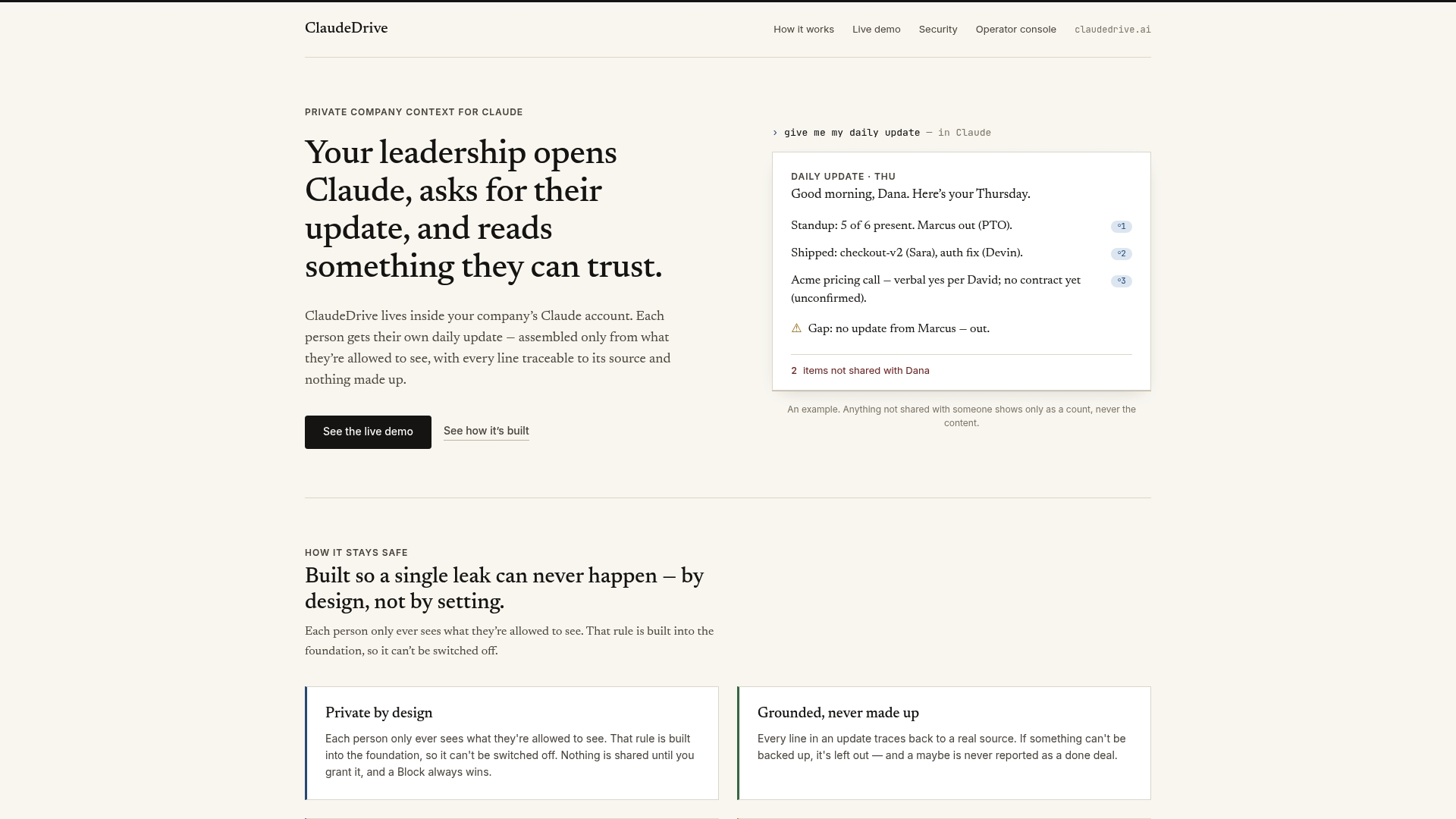
The ClaudeDrive Console connects to your existing tools, meeting notes, GitHub, calendars, and more, and applies permission-aware retrieval so each person gets their own private view of what happened. Every line in the briefing traces back to a real source. Nothing crosses a line it should not. For leaders who need to trust what the AI tells them, and for technical teams who need to prove that trust is warranted, ClaudeDrive Console offers a live demo and pilot program. See the live demo or talk to us about a pilot.
FAQ
What is ACL-aware RAG?
ACL-aware RAG is a retrieval augmented generation system that applies Access Control List filters during the vector search step, so only documents the user is authorized to see become candidates for retrieval.
Why is post-filtering ACL unsafe?
Post-filtering risks broken recall and timing side-channel leaks. If unauthorized chunks rank higher than authorized ones, authorized content gets dropped from results, and query latency can reveal the existence of restricted documents.
How often should access tokens refresh in an ACL-aware RAG system?
Tokens should refresh every 15–60 minutes via OIDC or SSO. This interval keeps group and role memberships synchronized with the authoritative identity service and prevents stale permissions from reaching the retrieval layer.
What metadata does each document chunk need for ACL enforcement?
Each chunk needs at minimum a list of authorized user IDs, group or role IDs, an ACL policy reference, and a tenant ID for multi-tenant deployments. Consistency across all chunks is required for reliable filter behavior.
How do you measure whether ACL enforcement is working correctly?
Use an LLM-as-judge evaluation harness to score retrieval correctness across defined user personas. Iterative ACL-aware design has been shown to bring correctness scores from near zero to perfect across successive evaluation cycles.