How Teams Audit AI Updates: A Practical 2026 Guide
Discover how teams audit AI updates with our 2026 guide. Ensure compliance, traceability, and trust in your AI systems today!
ClaudeDrive
A Yungsten Tech product

How Teams Audit AI Updates: A Practical 2026 Guide

AI update auditing is the systematic process of verifying that changes to AI systems, models, and workflows remain compliant, traceable, and aligned with company policy. For team leaders and project managers in tech companies, this process is no longer optional. Regulatory frameworks like the EU AI Act and internal governance standards now require documented evidence that AI changes are reviewed before they affect production. How teams audit AI updates determines whether leadership can trust the outputs their AI systems produce, or whether they are flying blind on changes that carry real business and compliance risk.
How teams audit AI updates: the core five-phase process
The standard AI update auditing process follows five structured phases: prepare scope, discover via surveys and signal analysis, sample workflows, decide with remediation plans, and communicate findings. Each phase produces a documented output that feeds the next. This modular structure means a team can run a focused audit without shutting down engineering velocity.
Phase 1: Prepare. Define the audit scope, assign owners, and confirm which AI systems are in scope. This includes building or refreshing an AI inventory that maps each tool to its data classification, business function, and risk tier.

Phase 2: Discover. Collect evidence through structured interviews, usage surveys, and automated signal analysis from logs. Discovery surfaces shadow AI use, undocumented model updates, and gaps between stated policy and actual behavior.
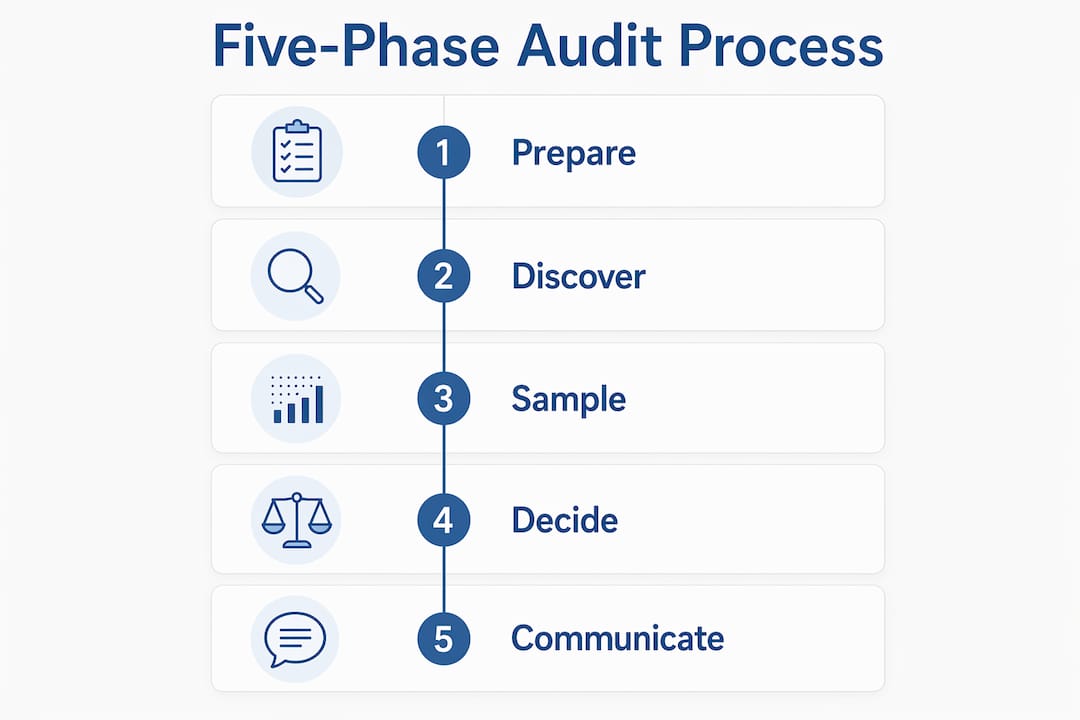
Phase 3: Sample workflows. Audit 3 to 5 high-impact workflows with trace comparisons between expected and actual outputs. This is where teams catch the most consequential issues. Up to 43% of AI-generated code changes require debugging in production, which means sampling is not a formality. It is a risk control.
Phase 4: Decide. Document findings, assign remediation owners, and set deadlines. Every decision, including the choice to accept a known gap, belongs in a decision log.
Phase 5: Communicate. Share findings with the governance board, affected teams, and any external stakeholders required by regulation. Transparency at this stage is what converts an audit from a compliance checkbox into a trust-building exercise.
For teams of 5 to 50 employees, a first-time audit typically requires 4 to 16 hours. Quarterly maintenance updates run under 2 hours. That ratio matters: the upfront investment is real, but the ongoing cost is low once the process is established.
Pro Tip: Build your AI inventory in a shared document before Phase 1 begins. Teams that skip this step spend most of their audit time discovering what systems exist rather than evaluating whether those systems are behaving correctly.
How do automated logs and continuous monitoring enhance AI update audits?
Manual audit evidence, collected after the fact from spreadsheets or screenshots, does not meet the bar that regulators or serious governance boards require. Continuous, machine-generated logs linking each AI interaction to its model version, policy state, enforcement outcome, and timestamp are the foundation of credible audit evidence. This is not a technical preference. It is a governance requirement.
The practical difference is significant:
- Point-in-time audits capture a snapshot. They miss changes that occurred and were corrected between audit cycles, and they cannot detect shadow AI and silent changes like prompt library updates that alter model behavior without a formal deployment event.
- Continuous monitoring creates an unbroken record. Every model version swap, every policy enforcement decision, and every anomaly is logged at the moment it occurs.
- SIEM integration allows security and compliance teams to query AI governance events alongside network and application events. This matters when an incident requires a unified timeline.
- Automated governance controls reduce the manual burden on engineering teams. When a policy violation triggers an alert rather than waiting for a quarterly review, remediation happens in days rather than months.
“Audit evidence is insufficient if gathered post-factum manually; continuous, automated logs are the foundation for reliable AI governance compliance.” — AI Governance Compliance Evidence Framework
The shift from periodic to continuous monitoring also changes what leadership can see. A daily AI update format built from live logs gives team leaders a current picture rather than a historical one. That is the difference between managing AI governance and reacting to it.
What roles and organizational structures support effective AI update audits?
Effective AI update audits require a cross-functional team, not a single compliance officer working in isolation. The core roles are: an AI or ML expert who understands model behavior, a compliance lead who maps findings to regulatory requirements, a domain expert who can evaluate whether outputs are fit for purpose, and a security representative who assesses data handling and access controls.
The most practical structure for most tech companies is a hybrid model. Internal teams handle routine audits efficiently because they have context, speed, and existing relationships with engineering. External firms handle pre-deployment audits for high-risk systems and any audit where regulatory credibility requires independence. External professional AI audits for large enterprises cost between $50,000 and $200,000 per system, but smaller teams can build internal audit readiness in 90 days. The hybrid model captures the speed of internal knowledge and the credibility of external validation without paying for external rigor on every low-risk system.
| Audit type | Who leads | When used | Key benefit |
|---|---|---|---|
| Routine internal audit | Internal cross-functional team | Quarterly or semi-annual | Speed, context, low cost |
| Pre-deployment audit | External firm or independent reviewer | Before high-risk system launch | Regulatory credibility |
| Post-incident review | Internal with external support | After a material AI failure | Root cause and remediation |
Governance boards set audit policy, approve scope, and track remediation. The boards that produce results are the ones that demand ownership of fixes, not just acknowledgment of findings. Rubber-stamping, where a board reviews a report and takes no follow-up action, is the single most common reason audit programs fail to improve AI governance over time.
Pro Tip: Assign a named remediation owner for every finding before the audit report is finalized. Findings without owners do not get fixed. This single practice separates audit programs that produce change from those that produce paperwork.
How do teams manage risk tiers and audit cadences for different AI systems?
Not every AI system carries the same risk, and auditing them all at the same frequency wastes resources while creating false confidence. A tiered approach, aligned with frameworks like the EU AI Act, maps audit depth and frequency to the actual risk a system poses.
| Risk tier | Example systems | Audit frequency | External review required |
|---|---|---|---|
| High-risk | Hiring tools, credit scoring, medical triage AI | Annual + post-material change | Yes |
| Medium-risk | Customer-facing chatbots, demand forecasting | Semi-annual or quarterly | Recommended |
| Low-risk | Internal productivity tools, meeting summarizers | Annual or as-needed | No |
High-risk AI systems require a full audit before deployment, quarterly production reviews, and re-audit after any material change. A model version update, a significant prompt change, or a new data source all qualify as material changes. Medium-risk systems run on semi-annual or quarterly cycles. Low-risk internal tools typically need only an annual review unless something changes in their data access or output scope.
The tiered approach also protects engineering velocity. A team that audits every AI tool with the same rigor as a high-risk production system will either slow down development or, more likely, treat every audit as a formality. A tiered risk approach concentrates rigorous processes on the systems that warrant them, which makes the audits that matter more credible and the overall program more sustainable.
Regulatory classification under the EU AI Act is a practical starting point for tier assignment, but internal risk criteria matter too. A low-risk tool by regulatory definition can become medium-risk if it starts processing sensitive employee data or feeding outputs into a high-stakes decision workflow.
Key takeaways
Effective AI update auditing combines a structured five-phase process, continuous automated logging, cross-functional team roles, and a tiered risk cadence to maintain control over AI changes and meet compliance requirements.
| Point | Details |
|---|---|
| Five-phase audit process | Prepare, discover, sample, decide, and communicate findings to produce documented, repeatable results. |
| Continuous logging over manual evidence | Machine-generated logs linking model versions and policy outcomes are required for credible audit trails. |
| Hybrid internal and external model | Internal teams handle routine audits; external firms validate high-risk systems for regulatory credibility. |
| Risk-tiered audit cadence | High-risk systems need annual and post-change audits; low-risk tools need only annual or as-needed reviews. |
| Governance board accountability | Boards that track remediation ownership outperform those that treat audit reports as final deliverables. |
Why most AI audit programs stall before they matter
The teams I see struggle most with AI update audits are not the ones that lack process. They are the ones that built a process for a point-in-time world and then watched AI development outpace it. A quarterly audit cycle made sense when model updates were rare and deliberate. Today, prompt library changes, fine-tuning runs, and third-party model version bumps can happen weekly. By the time a quarterly audit catches a silent change, that change has been in production for months.
The fix is not more audits. It is treating AI auditing as a lifecycle activity built into the development process, not bolted on afterward. Governance as code means audit evidence is generated automatically as part of every deployment, not assembled manually before a review meeting. Teams that make this shift find that their quarterly audit becomes a review of already-collected evidence rather than a scramble to reconstruct what happened.
The other pattern I see consistently is governance boards that approve audit scope and then disappear until the next cycle. The boards that actually improve AI governance are the ones that track remediation the same way they track product milestones. If a finding from a March audit still has no owner in June, that is a governance failure, not an audit failure. The audit did its job. The board did not.
The hybrid model is worth defending against internal pressure to cut costs by eliminating external reviews. For high-risk systems, external independence is not a luxury. It is what makes the audit credible to regulators, customers, and the board itself. The cost of a credible external audit is a fraction of the cost of a regulatory finding or a public AI failure.
— Paul
How ClaudeDrive supports your AI audit program
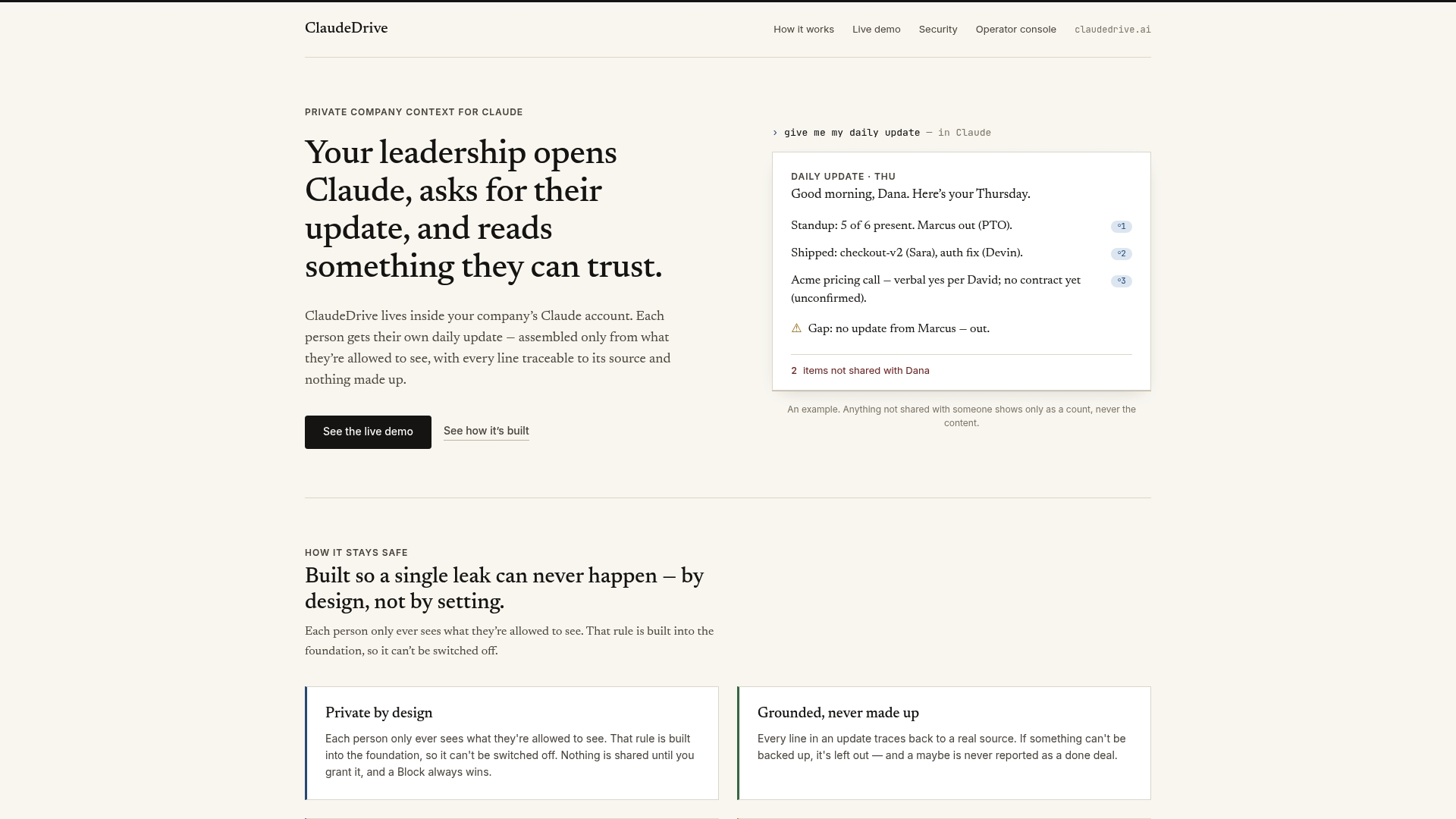
ClaudeDrive connects directly to the tools your team already uses, including meeting notes, GitHub, and calendars, and delivers each leader a daily briefing built only from sources they are authorized to see. Every line is traceable to a real source. Nothing is fabricated. For teams building out their AI update auditing process, that means audit-relevant signals, model changes flagged in GitHub, policy decisions recorded in meeting notes, and compliance updates from your calendar all surface in one trusted daily read.
You do not need a new dashboard or a separate compliance tool. ClaudeDrive feeds the Claude account your team already has, giving each person their own private view of what changed and why. If you want to see how this works in practice for your audit and governance workflow, see the live demo or talk to us about a pilot.
FAQ
What is the standard process for auditing AI updates?
The standard AI update auditing process follows five phases: prepare scope, discover via surveys and signal analysis, sample 3 to 5 high-impact workflows, decide with documented remediation plans, and communicate findings. A first-time audit for a team of 5 to 50 employees typically takes 4 to 16 hours, with quarterly updates under 2 hours.
How often should teams audit AI systems?
Audit frequency depends on risk tier. High-risk AI systems require a full audit before deployment, quarterly production reviews, and re-audit after any material change. Medium-risk systems run semi-annual or quarterly. Low-risk internal tools need only annual or as-needed reviews, aligned with frameworks like the EU AI Act.
Why are automated logs better than manual audit evidence?
Continuous, machine-generated logs link each AI interaction to its model version, policy state, and enforcement outcome at the moment it occurs. Manual or spreadsheet-based evidence gathered after the fact cannot capture silent changes like prompt library updates and does not meet the evidentiary standard required by regulators or serious governance boards.
Who should be on an AI update audit team?
An effective audit team includes an AI or ML expert, a compliance lead, a domain expert, and a security representative. For high-risk systems, an external firm should lead or co-lead the audit to provide the independence that regulatory credibility requires.
What is a hybrid AI audit model?
A hybrid audit model uses internal teams for routine, frequent audits and external firms for pre-deployment reviews of high-risk systems. Internal teams provide speed and context; external firms provide independence. This model delivers cost-effective coverage without paying for external rigor on every low-risk tool.