Benefits of Permission-Aware AI Updates for Tech Leaders
Discover the benefits of permission-aware AI updates for tech leaders, enhancing security, compliance, and trust in AI systems. Learn more!
ClaudeDrive
A Yungsten Tech product

Benefits of Permission-Aware AI Updates for Tech Leaders

Permission-aware AI updates are defined as AI workflows that enforce context-specific, least-privilege access controls at every step of data retrieval and output generation. For tech leaders and data privacy advocates, the benefits of permission-aware AI updates go well beyond security hygiene. They determine whether your AI systems can be trusted with sensitive organizational data, whether you can satisfy a regulator’s audit request in hours instead of weeks, and whether a single misconfigured agent can expose data across your entire organization. Frameworks like Auth0 and Permit, alongside compliance regimes including HIPAA and FERPA, have made this architecture the standard for enterprise AI in 2026.
1. How permission-aware AI updates reduce credential exposure
The most direct benefit of consent-based AI design is a smaller attack surface. Traditional AI integrations rely on broad, standing permission grants that remain valid long after a task completes. Capability-scoped permissions with token lifetimes measured in minutes compress credential exposure windows and prevent persistent leaks. This means a compromised token from a completed task cannot be reused to access unrelated systems.
The architecture works through three separated layers: identity (who is the agent), authorization (what is it allowed to do right now), and execution (what it actually does). Layered enforcement that isolates these components rejects unauthorized operations even when inherited permission tokens appear broad. That separation is what makes the model fundamentally different from static OAuth grants, which treat an agent’s permissions as fixed at login.
- Short-lived tokens expire after the task completes, eliminating standing access.
- Capability-scoped grants restrict each token to one operation type, not an entire system.
- Runtime enforcement validates context-specific policies at execution time, not just at authentication.
Pro Tip: When evaluating AI vendors, ask specifically whether their permission model is task-scoped or session-scoped. Session-scoped models carry the same risk profile as traditional service accounts.
2. Enhanced auditability and compliance through granular permission logs

Regulators do not ask general questions. They ask specific ones: who accessed this patient record, when, and what did the AI do with it? Multiple independent audit logs covering ontology actions, external calls, and AI reasoning build the kind of traceability that answers those questions directly. Organizations that cannot produce this evidence face enforcement exposure that far exceeds the cost of building the logging infrastructure.
Structured, append-only logs serve three distinct audiences simultaneously. Compliance officers use them to verify policy adherence. Security teams use them to reconstruct incident timelines. Executives use them to demonstrate governance to boards and regulators. Audit-ready logs that satisfy diverse regulator queries are architecturally distinct from standard engineering metrics, and conflating the two is a common and costly mistake.
The practical steps for building audit-ready permission logs follow a clear sequence:
- Log every access request, including denied ones, with a timestamp and the identity of the requesting agent.
- Record the authorization decision separately from the access event, capturing which policy rule applied.
- Capture AI reasoning traces so auditors can see why the model generated a specific output.
- Store all logs in an append-only format to prevent tampering.
- Index logs by data category so regulators can query by record type, not just by time range.
“Regulators require audit logs tailored to specific questions, making multiple independent logs critical for proving compliance and trustworthiness.” — AI Permission Architecture: 7 Rings of Defense
For regulated sectors like healthcare and financial services, this level of traceability is not optional. It is the difference between a clean audit and a material finding.
3. Preventing unauthorized data access before it reaches the AI
The most dangerous moment in an AI workflow is not when the model generates an answer. It is when the model retrieves documents to build its context. Pre-filtering based on permissions before the AI constructs its context window is the only reliable way to prevent unauthorized documents from influencing outputs. Post-filtering, which removes sensitive content after the model has already processed it, cannot guarantee that the model’s reasoning was not shaped by what it should never have seen.
This distinction matters enormously under FERPA and HIPAA. Both regulations treat exposure as occurring at the point the model processes a document, not at the point a user reads the output. Real-time permission validation against native identity and access management endpoints preserves policy autonomy and prevents cross-tenant data leaks in multi-resource environments.
| Approach | When filtering occurs | Compliance risk | Cross-tenant safety |
|---|---|---|---|
| Pre-filtering (permission-aware) | Before retrieval | Low | Protected |
| Post-filtering | After model sees documents | High | Not guaranteed |
| No filtering | Never | Critical | None |
The table makes the operational choice clear. Pre-filtering is the only architecture that satisfies both security and regulatory requirements simultaneously.
4. Mitigating AI output leakage through generation-level controls
Even with perfect retrieval filtering, a model trained on sensitive data can leak that information through its outputs. The Permit framework addresses this by intervening directly in the model’s hidden states during generation, steering outputs within permission-sensitive subspaces. Permit improves F1 scores by over 18% while using over 98% fewer trainable parameters compared to prior methods. That combination of better performance and lower overhead makes it practical for production deployment.
The mechanism works by applying low-dimensional geometric updates to the model’s internal representations rather than retraining the full model. Targeted hidden state interventions reduce permission leakage to near zero while enabling dynamic permission changes without retraining. For a CTO managing a model that serves multiple business units with different data access rights, this means permission boundaries can be updated at runtime as organizational roles change.
- Generation-level controls close a security gap that retrieval filtering alone cannot address.
- Lightweight parameter updates mean permission changes do not require model redeployment.
- Near-zero leakage rates are measurable, giving security teams a concrete metric to report.
- The approach scales to multi-tenant environments where different users have different generation rights.
Pro Tip: Ask your AI vendor whether their permission controls operate at the retrieval layer, the generation layer, or both. Retrieval-only controls leave a residual leakage risk that generation-level interventions eliminate.
5. How task-scoped authorization improves AI safety in autonomous workflows
Static permission models were designed for human users who make deliberate, discrete requests. AI agents operating in multi-step autonomous workflows do not fit that model. Microsoft Research’s PAuth framework uses natural language task slices to ensure an AI agent only executes operations explicitly authorized for the current task, raising alerts when it encounters operations outside that scope. This prevents the class of failures where an agent with broad permissions takes a consequential action that no human explicitly approved.
The practical difference between operator-scoped and task-scoped permissions is significant. Operator-scoped permissions grant an agent everything it might ever need for a category of work. Task-scoped permissions grant only what the current operation requires. Static OAuth-style grants do not suffice for non-deterministic AI, because the agent’s next action cannot be predicted at authentication time.
The safety improvement follows a clear operational sequence:
- Define the task in natural language before the agent begins execution.
- Derive the minimum permission set required for that specific task.
- Issue a short-lived token scoped to those permissions only.
- Monitor execution in real time and flag any operation outside the defined scope.
- Escalate to a human reviewer when the agent requests permissions not covered by the task definition.
For leaders running AI in finance, legal, or HR workflows, this architecture means an agent processing expense reports cannot simultaneously access compensation data, even if both datasets sit in the same system.
6. Building user trust through transparent refusal and escalation paths
Permission-aware AI that cannot answer a question should say so clearly. Explicit refusal paths that indicate “I cannot answer with the documents accessible to you” build more trust than partial answers that omit sensitive context without explanation. Users who receive confident but incomplete answers are more likely to act on incorrect information than users who receive an honest statement of the system’s limitations.
Measuring refusal accuracy during rollout is a concrete way to validate that permission boundaries are working as designed. Monitoring for stale-document traps during deployment catches synchronization lag between permission updates and document indexes, a failure mode that can expose recently restricted content. For data privacy advocates, this monitoring practice transforms permission enforcement from a static policy into a continuously verified control.
The AI security risks that make headlines are rarely the result of sophisticated attacks. They are the result of systems that answered questions they should have refused. Transparent refusal is not a limitation. It is a feature that protects both the organization and its users.
Key takeaways
Permission-aware AI updates deliver measurable security, compliance, and trust benefits by enforcing least-privilege access at retrieval, generation, and execution layers simultaneously.
| Point | Details |
|---|---|
| Credential exposure | Short-lived, task-scoped tokens eliminate standing access and compress the attack window. |
| Audit readiness | Multiple independent logs covering access, actions, and AI reasoning satisfy specific regulator queries. |
| Pre-filtering compliance | Filtering documents before retrieval is the only approach that satisfies HIPAA and FERPA at the point of exposure. |
| Generation-level controls | The Permit framework reduces output leakage to near zero with 98% fewer trainable parameters than prior methods. |
| Task-scoped safety | PAuth-style authorization prevents autonomous agents from taking actions outside explicitly defined task boundaries. |
Why permission-aware AI is the leadership decision most teams delay too long
I have watched organizations spend months debating AI adoption while their actual exposure sits in the permission model they never reviewed. The conversation in the boardroom is about capability. The conversation that matters is about what the AI is allowed to see and do when no one is watching.
The teams that get this right share one characteristic: they treat permission design as a product decision, not an IT configuration. When a leader at a financial services firm told me their AI briefing system was built so that each executive sees only what their role permits, with every line traceable to a source, I recognized that as a governance posture, not just a technical choice. That posture is what allows them to put AI in front of their most sensitive workflows without a legal review every time.
The data exfiltration risks in AI systems are real and well-documented. What is less discussed is that the organizations with the lowest incident rates are not the ones with the most security tooling. They are the ones where permission boundaries were defined before the first prompt was written. That sequence matters more than the technology stack.
My recommendation: before you expand AI access to any new data source, define the task scope, the permission boundary, and the refusal behavior first. Build the audit log before you need it. The compliance team will thank you, and so will the regulator.
— Paul
See how ClaudeDrive handles permissions from day one
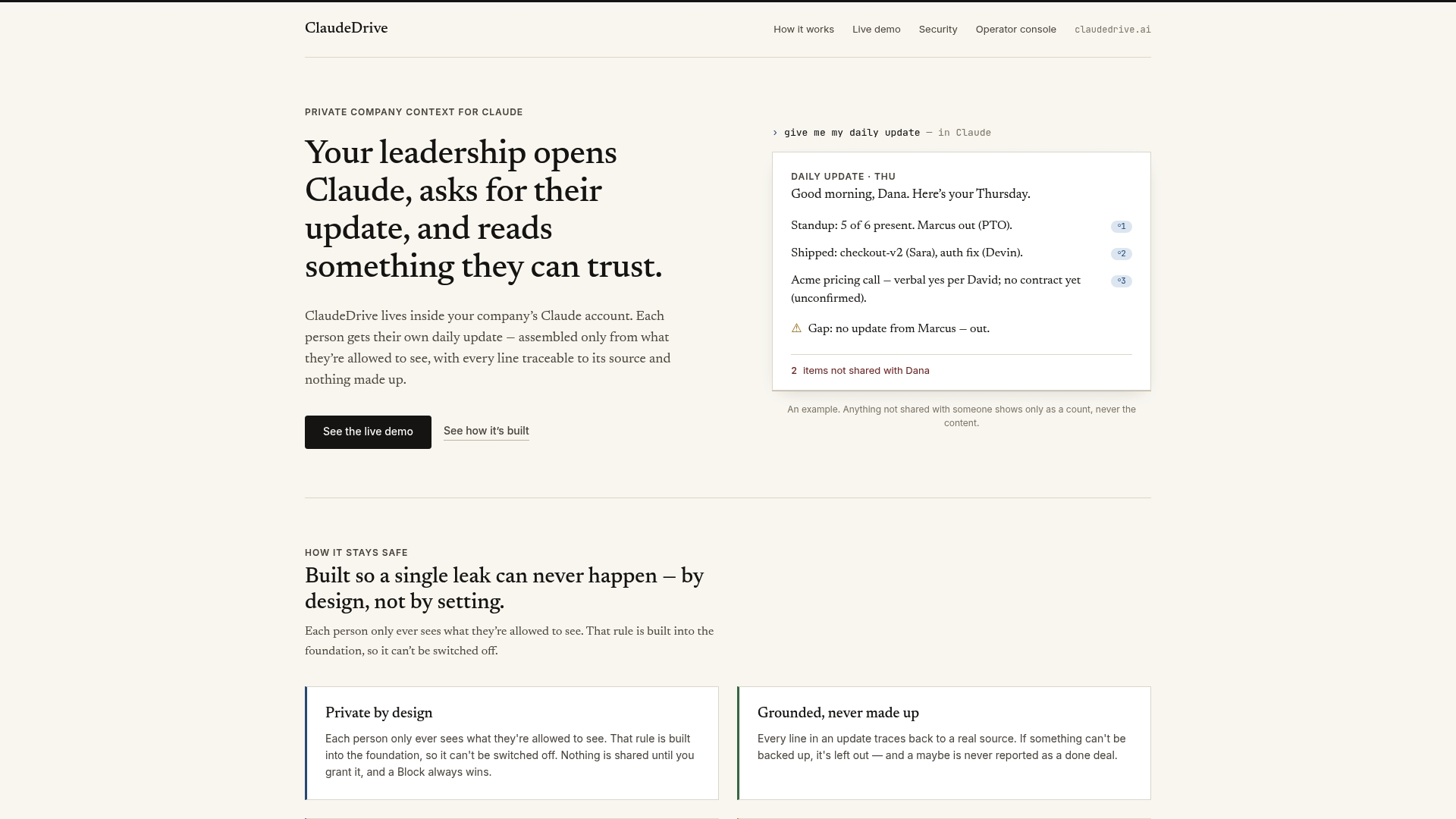
ClaudeDrive is built on the principle that every leader should read only what they are authorized to see, with every line traceable to a real source. Connect your meeting notes, GitHub, and calendar, and each person on your team gets their own private briefing inside the Claude account they already use. No document crosses a permission line it should not. No answer is generated from data the reader cannot access.
For tech leaders who want permission-aware daily updates without building the infrastructure themselves, ClaudeDrive delivers enterprise-grade access control as a ready-to-use context layer. See the live demo or talk to us about a pilot at claudedrive.ai.
FAQ
What is permission-aware AI?
Permission-aware AI is a design approach that enforces context-specific, least-privilege access controls at every stage of an AI workflow, from data retrieval through output generation. It ensures the AI only processes and returns information the requesting user is authorized to see.
How do permission-aware AI updates improve compliance?
They generate structured, append-only audit logs that capture who accessed what, when, and why, enabling organizations to answer specific regulator queries under frameworks like HIPAA and FERPA quickly and accurately.
What is the difference between pre-filtering and post-filtering in AI retrieval?
Pre-filtering removes unauthorized documents before the AI builds its context window. Post-filtering attempts to remove sensitive content after the model has already processed it, which does not satisfy HIPAA or FERPA because exposure occurs at the point of processing.
How does task-scoped authorization reduce AI risk?
Task-scoped authorization issues short-lived permissions tied to a specific operation rather than granting broad standing access. Microsoft Research’s PAuth framework demonstrates that this approach prevents autonomous agents from executing actions outside explicitly defined task boundaries.
Can permission controls affect AI output quality?
The Permit framework shows they can improve it. By steering generation within permission-sensitive subspaces, Permit raises F1 scores by over 18% compared to prior methods while using over 98% fewer trainable parameters, proving that tighter permission controls and better performance are not in conflict.