Benefits of Traceable Internal AI Updates for Leaders
Discover the benefits of traceable internal AI updates. Enhance compliance, speed up incident response, and improve governance in your organization.
ClaudeDrive
A Yungsten Tech product

Benefits of Traceable Internal AI Updates for Leaders

Traceable internal AI updates are defined as logged, verifiable records of every model change, data source, and decision path inside an AI system. The benefits of traceable internal AI updates go beyond compliance paperwork. They give leaders a clear, auditable view of what changed, when it changed, and why an AI responded the way it did. Organizations that implement structured lineage and version controls report 66% faster incident investigations and 75% fewer compliance findings within 12 months. That is not a marginal gain. It is the difference between reactive firefighting and proactive governance.
1. Benefits of traceable internal AI updates for incident response
Traceability cuts the time your team spends diagnosing AI failures. When an AI system produces a wrong answer or behaves unexpectedly, a traceable audit trail shows exactly which model version ran, which data it retrieved, and which reasoning steps it took. Without that trail, engineers guess. With it, they investigate.

Structured lineage controls produce 62% reduced audit effort alongside faster incident resolution. That reduction means your compliance team spends less time reconstructing events and more time on forward-looking governance.
Key incident response gains from traceability:
- Root cause identified from logs, not from memory or guesswork
- Precise error reports replace vague user complaints like “the AI was wrong”
- Regression detection surfaces the exact model version that introduced a problem
- Postmortem analysis becomes reproducible, not anecdotal
Pro Tip: Require that every AI response log captures the model version, prompt hash, and retrieved document IDs. Those four fields alone cut mean time to diagnosis by a measurable margin.
2. How traceability reduces support escalations
Visible reasoning trails change how support teams handle AI-related tickets. When users can see which sources an AI retrieved and why it gave a particular answer, they provide actionable feedback instead of vague complaints. That specificity lets support agents resolve issues on first contact rather than escalating to engineering.
Visible agent traces in AI support systems achieve 50% ticket deflection and improve first-contact resolution from 45% to 80%. P1 and P2 resolution times drop by 60% when agents can show users a transparent explanation of the AI’s decision path. Those numbers reflect a structural change in how support operates, not just a marginal improvement.
The mechanism is straightforward. A user who sees “the AI retrieved the wrong document” can confirm or correct that observation immediately. A user who only sees a wrong answer has no path forward except to escalate.
3. Leadership visibility and cross-team accountability
Leadership gains the most from traceable AI updates when those updates are filtered and prioritized. A raw log of every model change is noise. A curated stream of relevant changes, vendor patches, and quality regressions is signal. Traceability makes that curation possible because you can filter by impact, by team, and by risk level.
Filtered AI delivery updates prevent silent vendor changes from becoming systemic problems. A CEO or COO does not need to read every commit. They need to know when a change affects a customer-facing system or a regulated process.
Benefits for cross-functional teams include:
- Shared understanding of AI system status without requiring technical fluency
- Documented change history that satisfies governance and compliance reviewers
- Reduced risk exposure because leaders see relevant changes before they cause incidents
- Clearer accountability when a change produces a negative outcome
Pro Tip: Connect your AI update stream to your existing communication tools, such as Slack or Microsoft Teams, so leadership receives filtered briefings without opening a separate dashboard.
4. Quality control, reproducibility, and continuous improvement
Traceability is the foundation of AI quality assurance. Without it, you cannot reproduce a result, and without reproducibility, you cannot improve systematically. Structured lineage and version control raise reproducibility success to 92%. That figure means nine out of ten AI outputs can be reconstructed exactly, which is the baseline requirement for any serious quality program.
Immutable provenance metadata, including versioning and cryptographic hashes embedded directly in inference pipelines, shifts AI from a perceived “magical” system to an accountable, testable business tool. Engineers can target evaluations at specific retrieval or reasoning components rather than re-running entire pipelines.
| Quality challenge | Without traceability | With traceability |
|---|---|---|
| Reproducing a past output | Requires guesswork on model version | Exact version and prompt hash available |
| Identifying stale data sources | Manual audit of all sources | Provenance metadata flags outdated documents |
| Detecting contradictory data | Discovered after user complaints | Flagged during ingestion via lineage checks |
| Targeting a regression fix | Re-test the entire pipeline | Isolate the changed component directly |
Infrastructure-level provenance tracking is critical because models frequently misattribute sources. Independent chains of custody preserve accuracy and detect contradictions before they reach users.
5. Real-time monitoring and proactive risk mitigation
Traceable AI update streams function like a newsfeed for your AI infrastructure. Model updates, vendor patches, and quality regressions surface in a prioritized feed rather than arriving as surprise incidents. That shift from reactive to proactive is the core advantage of AI update tracking.
Early detection of upstream dependency changes prevents complicated incident diagnosis. A silent change in a third-party model or data provider can cascade into hard-to-diagnose failures if no one is watching. A traceable update stream watches automatically.
| Risk type | Detection method | Time to awareness |
|---|---|---|
| Vendor model version change | Automated hash comparison | Minutes after deployment |
| Data source quality regression | Provenance metadata diff | Before next inference run |
| Prompt behavior drift | Logged prompt and output pairs | Identified in daily review |
| Dependency version mismatch | Lineage graph comparison | Flagged at build time |
Teams shipping AI with provenance tracking see higher enterprise adoption and faster incident resolution. The pattern holds across industries because the underlying problem is the same: unmonitored AI changes create operational risk.
6. Building user trust through visible reasoning trails
Users trust AI more when they can see how it reached an answer. This is not a soft claim about perception. It is a measurable outcome. A system that shows retrieval sources, intermediate reasoning steps, and tool calls increases trust and adoption without requiring users to verify every citation themselves. The visibility alone changes behavior.
AI audit trails must capture non-deterministic elements including model version, prompt, intermediate reasoning, and tool calls with immutability guarantees. Those elements enable reconstruction of any AI decision and support compliance verification on demand.
Practical trust benefits from visible reasoning trails:
- Users provide specific, correctable feedback instead of general complaints
- Debugging time drops because engineers receive precise error reports
- Adoption accelerates because users feel in control of the AI’s behavior
- The “black box” perception disappears when reasoning is visible and verifiable
Traceability provides forensic clarity that conventional logs cannot match. That clarity accelerates review cycles and improves postmortem analysis across every team that touches the AI system.
7. Compliance readiness without extra work
Compliance teams benefit from traceability because the documentation builds itself. Every model change, data source, and decision path is logged automatically. When an auditor asks what the AI did on a specific date, the answer is already recorded. There is no reconstruction effort and no reliance on engineer memory.
Lineage coverage improving to 0.91 in organizations that implement structured controls translates directly to audit readiness. A lineage score near 1.0 means nearly every output can be traced to its origin. That is the standard regulators increasingly expect for AI systems in finance, healthcare, and legal services.
Provenance as a governance discipline enables better source verification, faster tuning, and a stronger compliance posture. Teams that treat provenance as an engineering requirement rather than an afterthought spend less time on audits and more time on building.
8. Faster debugging through source-traceable AI responses
The advantages of AI update tracking show up most clearly during debugging. A developer who knows exactly which document an AI retrieved, which model version processed it, and which tool call it made can fix a bug in minutes. A developer without that information can spend hours.
Source-aware response pipelines with independent chains of custody detect contradictions and misattributions that models introduce on their own. Models do not always cite sources accurately. Traceability catches those errors at the infrastructure level before users encounter them.
The practical outcome is a faster development cycle. Teams that audit AI updates systematically ship fixes faster because they spend less time on diagnosis and more time on resolution.
Key takeaways
Traceable internal AI updates deliver measurable gains in incident speed, compliance readiness, and user trust by creating a verifiable record of every model change and decision path.
| Point | Details |
|---|---|
| Incident response accelerates | Structured lineage controls produce 66% faster investigations and 62% less audit effort. |
| Support escalations drop | Visible reasoning trails achieve 50% ticket deflection and raise first-contact resolution to 80%. |
| Reproducibility reaches 92% | Version control and provenance metadata let teams reconstruct and improve any AI output. |
| Compliance documentation builds itself | Automatic logging eliminates reconstruction effort and satisfies auditor requests on demand. |
| Leadership gets signal, not noise | Filtered update streams surface relevant changes before they become operational incidents. |
Why traceability is the most underrated decision a leader can make
Most leaders I talk to treat AI traceability as an engineering concern. They delegate it to the infrastructure team and move on. That is the wrong frame. Traceability is a leadership decision because it determines whether you can trust the AI outputs your organization acts on.
The shift I have seen in organizations that adopt traceability is not primarily technical. It is cultural. When every AI response carries a visible chain of custody, teams stop arguing about whether the AI was right and start asking why it retrieved what it retrieved. That is a much more productive conversation. It moves the organization from defending AI outputs to improving them.
The forensic clarity that traceability provides is unattainable through conventional logging. You cannot reconstruct a non-deterministic AI decision from a standard application log. You need the model version, the prompt, the retrieved documents, and the intermediate reasoning steps, all captured immutably at inference time. Organizations that build this infrastructure early find that governance becomes a byproduct of normal operations rather than a separate workstream.
The leaders who move first on traceability also move faster on AI adoption overall. They have the evidence base to expand AI use confidently because they can demonstrate to regulators, boards, and customers exactly how their systems work. That is a durable competitive advantage, and it starts with a decision that most teams are still postponing.
— Paul
How ClaudeDrive delivers traceable AI updates to your leadership team
ClaudeDrive gives your leaders a daily briefing built entirely from sources they are allowed to see. Every line in that briefing traces back to a real document, a real meeting note, or a real commit. Nothing is invented, and nothing crosses a permission boundary.
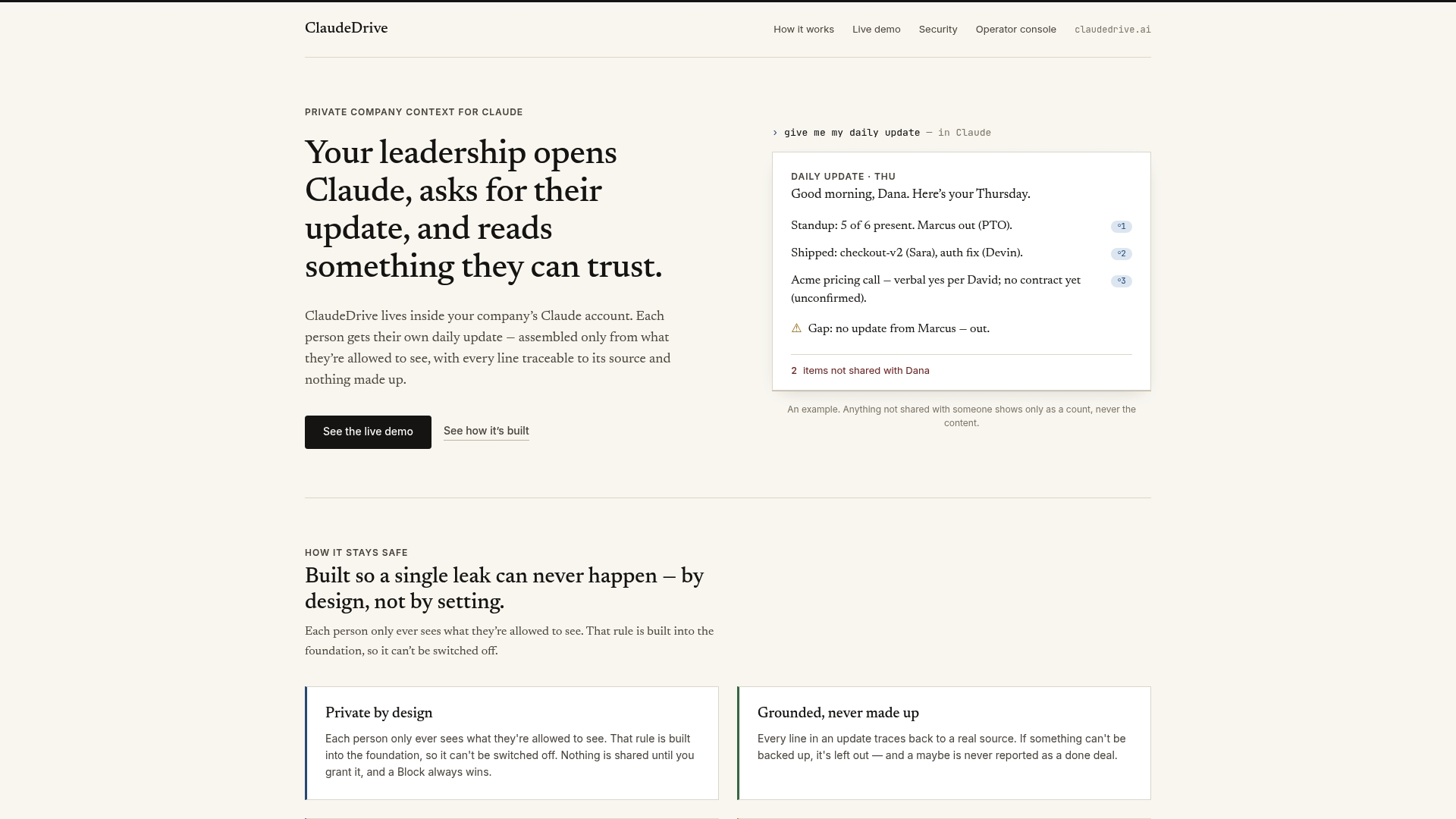
Connect GitHub, your calendar, and your meeting notes, and each leader gets their own private view of what changed. The ClaudeDrive console handles lineage, version tracking, and filtered delivery automatically. Your team does not adopt a new tool. They ask Claude for their update and read something they can verify. See the live demo or talk to us about a pilot.
FAQ
What are the main benefits of traceable internal AI updates?
Traceable internal AI updates produce faster incident investigations, fewer compliance findings, and higher user trust by creating a verifiable record of every model change and decision path. Organizations implementing structured lineage controls report 66% faster incident resolution and 75% fewer compliance findings.
How does AI update traceability reduce support tickets?
Visible reasoning trails let users identify exactly what went wrong, such as a wrong document being retrieved, which cuts vague complaints and enables first-contact resolution. Transparent AI systems achieve 50% ticket deflection compared to opaque alternatives.
Why does traceability matter for leadership, not just engineers?
Leaders need to know when AI changes affect customer-facing systems or regulated processes before those changes cause incidents. Filtered, traceable update streams give executives the signal they need without requiring technical fluency.
How do you track AI updates in practice?
Tracking AI updates requires capturing model version, prompt hash, retrieved document IDs, and intermediate reasoning steps at inference time with immutability guarantees. Tools like ClaudeDrive automate this capture and deliver filtered briefings to the right people.
What is the difference between an AI audit trail and a standard application log?
A standard application log records system events but cannot reconstruct a non-deterministic AI decision. An AI audit trail captures the model version, prompt, retrieved sources, and reasoning steps needed to reproduce and verify any specific output.