Company Context Layer Buyer Checklist for Leaders
Discover essential criteria in our company context layer buyer checklist. Empower your leadership decisions and maximize AI workflow efficiency.
ClaudeDrive
A Yungsten Tech product

Company Context Layer Buyer Checklist for Leaders

A company context layer is the inference-time, metadata-driven platform that injects business meaning and operational context into AI workflows, enabling leaders to trust the answers they get from AI agents. Most buyers confuse it with a data catalog. That confusion is expensive. A catalog stores and organizes metadata. A true context layer makes that metadata queryable in real time, so an AI agent can pull the right fact at the right moment. This company context layer buyer checklist covers the critical criteria, audit steps, and decision rules that high-growth leaders need before committing budget.
1. What does a company context layer buyer checklist cover?
A company context layer buyer checklist covers eight evaluation dimensions: inference-time queryability, metadata coverage, integration depth, deployment architecture, licensing model, vendor maturity, context provenance, and stack fit. Each dimension maps to a specific failure mode. Skip one, and you risk buying a catalog with a new label, duplicating tools you already own, or locking your company into a proprietary system with no exit path.
The primary objective of a context layer is to make AI agents accurate by enabling real-time, native metadata queries, not just cataloging. That distinction separates a true context layer from the majority of tools marketed as one. Use this checklist as your decision filter, not a feature wish list.

2. Inference-time queryability: the first gate
A true context layer is inference-time queryable and can inject dynamic, relevant context into AI models within 60 seconds. If a vendor cannot demonstrate real-time retrieval in a live technical demo, the product is a catalog with new branding. That is the single most important test in your evaluation.
Ask vendors to run a live query during the demo, not a recorded walkthrough. The query should pull schema, lineage, and semantic metadata simultaneously. If the response takes minutes or requires a manual export step, the architecture is not built for inference-time use.
Pro Tip: Request a technical architecture review, not just a product demo. Ask specifically: “How does your system respond to a metadata query at inference time?” A vendor who cannot answer that in plain language is selling you a catalog.
3. Metadata coverage across five dimensions
Context layers must support five metadata dimensions: schema, semantics, lineage, quality, and governance. Most vendors are strong in only one or two of these. Evaluating each dimension separately is the only way to find the gaps before you sign a contract.
| Dimension | What to verify | Red flag |
|---|---|---|
| Schema | Column names, types, relationships | Only surface-level table names |
| Semantics | Business definitions, synonyms | No business glossary support |
| Lineage | Data origin and transformation path | Lineage limited to one hop |
| Quality | Freshness, completeness, accuracy scores | No quality metrics exposed |
| Governance | Access policies, ownership, audit trail | Governance bolted on, not native |
Context layers must also support multi-hop reasoning across lineage, quality, and semantic metadata to enable effective AI agent logic. A vendor strong only in schema coverage will fail the moment your AI agent needs to trace a number back to its source.
4. Integration depth, not just connector count
Evaluating integration depth requires verifying metadata extracted, including lineage, quality metrics, and usage patterns, not just whether a connector exists. A vendor who lists 200 integrations but extracts only table names from each one delivers shallow context. Shallow context produces inaccurate AI outputs.
Ask for a connector specification sheet. For each source system, confirm what metadata fields are extracted, how often they refresh, and whether lineage is captured end-to-end. A connector that pulls schema but not lineage is half a connector.
5. How to audit your existing tech stack before buying
A stack audit takes 1–2 days and checks for native features, roadmap items, and integrations covering 70% or more of your needs before any new purchase. Skipping this step is the most common cause of redundant spending. The audit should be documented and signed off by your IT lead.
Follow this sequence:
- List every tool in your current stack that touches metadata, data governance, or AI context.
- For each tool, document native features, the published roadmap for the next 12 months, and any existing integrations with your AI infrastructure.
- Score each tool on coverage: does it already address 70% or more of your context layer requirements?
- Identify gaps that no existing tool covers natively or on its roadmap.
- Only proceed to vendor evaluation for gaps that remain after step 4.
30–40% of SaaS tools at mid-market companies have overlapping features with existing stacks. That overlap represents direct budget waste. A formal audit surfaces it before you commit.
Pro Tip: Set a review trigger for any purchase over $10,000 per year. Require IT lead sign-off and a documented audit before the purchase moves to procurement. This single rule prevents most redundant acquisitions.
6. Common pitfalls when selecting a context layer
The most costly mistake is mistaking a data catalog for a context layer. Catalogs lack inference-time queryability. They are useful for data discovery and governance, but they cannot feed an AI agent with real-time context. Buying one as a context layer wastes budget and delays your AI program by months.
Buyers often let demos convince them to buy before assessing adoption or build options, leading to redundant, costly acquisitions. The discipline is to run the stack audit first, then watch the demo, not the other way around.
Other common mistakes include:
- Skipping the technical architecture review. Marketing demos show happy paths. Architecture reviews reveal whether the system can handle your actual query volume and latency requirements.
- Ignoring context provenance. Stale or untraceable facts quietly governing AI decisions is a core failure mode. Verify that the vendor has active policies for provenance, lifecycle management, and audit access.
- Neglecting vendor maturity. Emerging vendors require limited-commitment contracts and clear reassessment triggers. An immature vendor with no reference customers in your industry is a risk, not an opportunity.
- Overlooking licensing terms. Open-source context layers reduce vendor lock-in and total cost of ownership compared to proprietary SaaS, which can carry three to five times higher infrastructure costs.
7. Build, buy, or adopt: the decision framework
The build-vs-buy-vs-adopt framework advises building core functions, buying mature market non-core functions, and adopting when 70% coverage already exists in your stack. Applying this framework to a context layer purchase requires one clarifying question first: is real-time AI context delivery a core function of your business, or a supporting capability?
For most high-growth companies, the answer is supporting capability. That means buying or adopting, not building. Building a context layer from scratch requires sustained engineering investment that most companies cannot justify unless they are a data infrastructure business.
| Decision | When it applies | Key condition |
|---|---|---|
| Build | Context layer is a core product differentiator | Engineering capacity exists; 18+ month runway |
| Buy | Market is mature; vendor has reference customers | Stack audit shows less than 70% coverage |
| Adopt | Existing tool covers 70% or more of needs | Roadmap confirms gap closure within 12 months |
| Bolt on | Partial gap; existing tool has a relevant integration | Integration covers the gap without new licensing |
For deals over $50,000 per year, formal RFP reviews take 8–12 weeks. Build that timeline into your planning. Rushing an RFP produces poor vendor selection. Emerging vendors in immature markets should receive limited-commitment contracts with explicit reassessment triggers at 12 months.
For a deeper look at the build-vs-buy decision specific to context layer technology, the context layer guide for technical leaders covers the framework in detail.
Pro Tip: When evaluating startup vendors in an immature market, ask for a 90-day pilot with a defined exit clause. This limits your exposure while giving you real performance data.
8. Open source vs. proprietary licensing
Open-source context layers provide full feature access, unlimited customization, and community-driven roadmaps under licenses like Apache 2.0. Proprietary SaaS vendors can carry three to five times higher infrastructure costs over a three-year period. That cost difference compounds as your data volume grows.
The practical question is not which model is philosophically better. It is which model fits your team’s capacity. Open source requires internal engineering to maintain and extend. Proprietary SaaS shifts that burden to the vendor but limits your ability to customize the context model for your specific business logic. Evaluate your internal engineering bandwidth honestly before choosing.
9. Continuous monitoring after purchase
Without continuous monitoring of tool adoption post-purchase, companies risk unused or underused context layer investments. Set a formal review trigger at 12 months post-deployment. The review should assess query volume, AI agent accuracy improvement, and user adoption rates across your leadership team.
A context layer that nobody queries is a catalog. Adoption data tells you whether the tool is delivering inference-time value or sitting idle. If adoption is low at 12 months, the problem is either integration depth or change management, and both are fixable before renewal.
For practical examples of what a well-adopted context layer delivers to leaders daily, the AI company context update examples article shows real-world output patterns.
Key takeaways
A company context layer delivers value only when it is inference-time queryable, covers all five metadata dimensions, and passes a rigorous stack audit before purchase.
| Point | Details |
|---|---|
| Inference-time queryability is non-negotiable | Verify real-time retrieval in a live demo before any other evaluation step. |
| Five metadata dimensions matter | Evaluate schema, semantics, lineage, quality, and governance separately for every vendor. |
| Stack audit prevents redundant spending | Run a 1–2 day audit and require IT sign-off before any purchase over $10,000 per year. |
| Build, buy, or adopt based on core function | Buy when the market is mature and your stack covers less than 70% of requirements. |
| Provenance and licensing affect long-term trust | Verify context lifecycle policies and compare open-source vs. proprietary total cost of ownership. |
What I’ve learned from watching leaders buy context layers wrong
I’ve watched high-growth companies spend six figures on tools that turned out to be data catalogs with a new pitch deck. The pattern is consistent. A vendor runs a polished demo, the AI output looks impressive, and the buyer signs before the IT lead has seen the architecture. Six months later, the tool is barely used because it cannot respond at inference time.
The stack audit step is where most teams cut corners. They treat it as a formality rather than a genuine filter. The SaaS buying decision tree exists precisely because buyers keep skipping this step and paying for it later. A two-day audit is not a delay. It is the cheapest insurance you can buy.
The other lesson I keep seeing ignored is provenance. Leaders assume that if an AI agent gives them a number, the number is current and traceable. It often is not. Stale context is worse than no context because it creates false confidence. Any vendor who cannot show you a clear lifecycle policy for context expiry is selling you a trust problem.
My honest advice: slow down the vendor evaluation by one week and spend that time on the audit and the architecture review. The deals that move fastest are usually the ones that disappoint fastest.
— Paul
ClaudeDrive: a private context layer built for leadership
Leaders evaluating a company context layer often want to see what one looks like in practice before committing to a full RFP process.
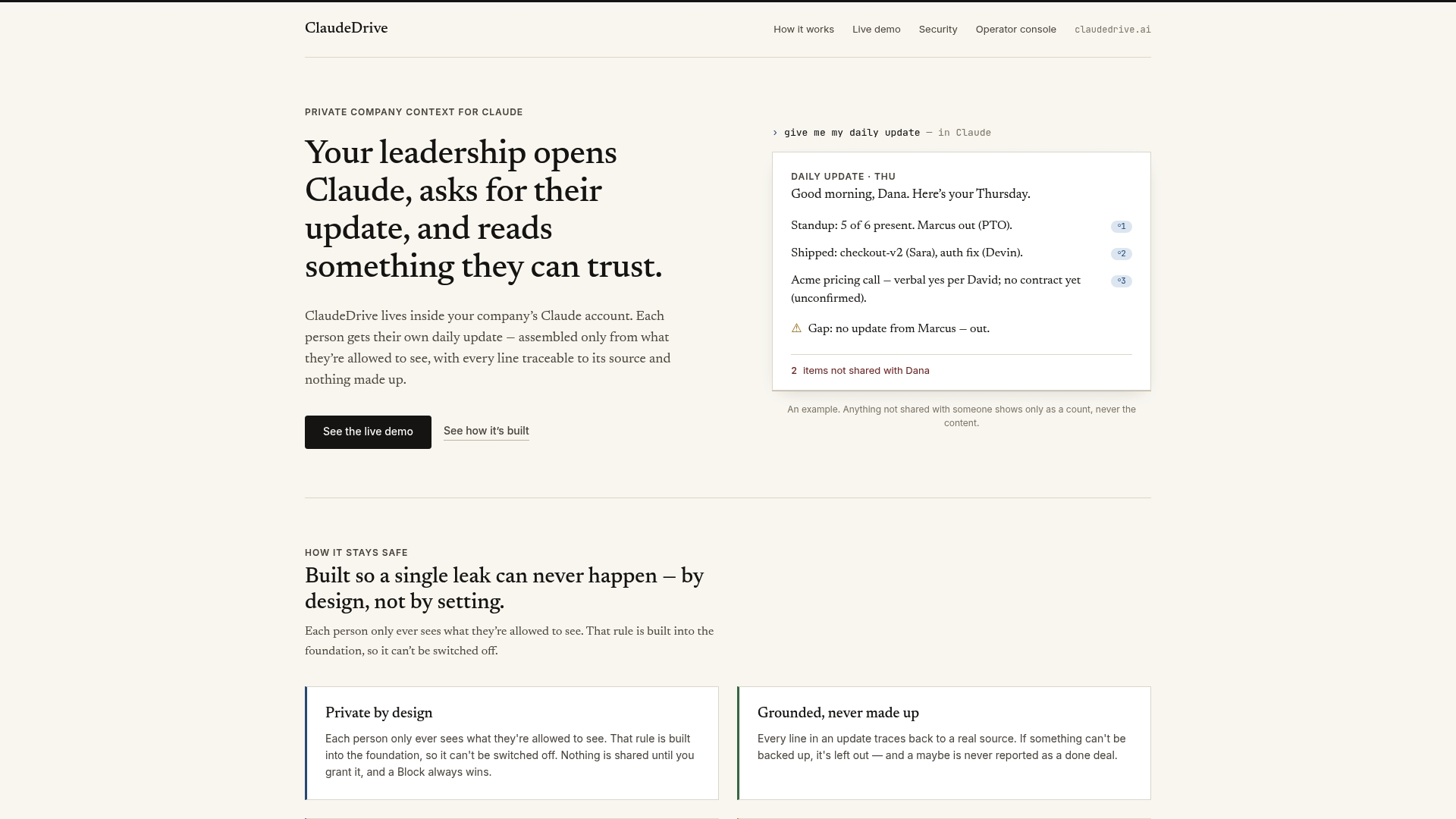
ClaudeDrive is the private company context layer that feeds Claude directly, with no new app to learn and no dashboard to maintain. Connect your meeting notes, GitHub, and calendar, and each leader gets a daily briefing built only from what they are permitted to see. Every line is traceable to a real source. Nothing is generated without a verified fact behind it. ClaudeDrive is built by Yungsten Tech and designed for leaders who need to trust what they read, not just read more. See the live demo or talk to us about a pilot.
FAQ
What is a company context layer?
A company context layer is an inference-time, metadata-driven platform that injects business meaning and operational context into AI workflows. It differs from a data catalog because it responds to real-time queries from AI agents, not just human searches.
How do I know if a vendor sells a true context layer or a catalog?
Ask the vendor to demonstrate real-time metadata retrieval during a live technical session. A true context layer delivers a response within 60 seconds; a catalog requires manual export or batch processing.
What does a stack audit involve for a context layer purchase?
A stack audit takes 1–2 days and documents every existing tool that touches metadata or AI context, checks native features and roadmaps, and confirms whether 70% or more of your requirements are already covered before you evaluate new vendors.
When should a company build its own context layer?
Build only when the context layer is a core product differentiator and your engineering team has an 18-month or longer runway to sustain it. For most high-growth companies, buying or adopting an existing solution is faster and less expensive.
Why does context provenance matter for AI decisions?
Stale or untraceable context quietly governs AI outputs without anyone knowing the facts are outdated. Buyers must verify that vendors have active lifecycle policies, provenance tracking, and audit access before signing any contract.