Company Daily AI Briefing Setup for Leaders
Discover how to implement a daily AI briefing for your team, enhancing efficiency and privacy while saving valuable time. Start your pilot today!
ClaudeDrive
A Yungsten Tech product

Company Daily AI Briefing Setup for Leaders

A permissioned, per-person daily briefing inside Claude is practical and safe today when built with agent identity, permission-aware retrieval, and privacy-by-default controls. The next step: propose a four-week pilot with ClaudeDrive integrated into your existing Claude account, and see the live demo before you commit to anything.
What this guide covers:
- What leaders actually get from a permissioned daily briefing
- How the access model controls who sees what
- The recommended privacy-first architecture
- Which sources to connect and how to scope them
- Security controls to require before going live
- A pilot checklist with timeline and success metrics
- A sample orchestration pattern to hand to engineering
Key Takeaways
A permissioned company daily AI briefing setup is practical today when permissions are enforced at retrieval time, confidential mode defaults to on, and every briefing line links to a verifiable source.
| Point | Details |
|---|---|
| Enforce permissions at retrieval | Tag chunks at ingest with source permissions; filter by relevance ∩ permission before the model sees anything. |
| Confidential mode defaults to on | Local inference runs by default; cloud refinement requires explicit user consent for each request. |
| Four-to-eight-week pilot is enough | Select two or three sources, configure agent identity, run a controlled pilot, and decide at week five. |
| Audit trail is non-negotiable | Log who asked, what was returned, and when; this log enables instant offboarding and compliance review. |
| ClaudeDrive integrates into Claude | No new app; leaders ask Claude for their update and read a source-linked, permissioned briefing. See the live demo. |
Table of Contents
- What does a permissioned daily briefing actually give leaders?
- How permissions and agent identity control what each person sees
- Recommended architecture: local-first inference with optional cloud refinement
- What security controls should you require before going live?
- Pilot-to-production checklist and timeline
- A sample orchestration pattern to show your engineering team
- Governance, KPIs, and go/no-go criteria for the pilot
- Why the privacy-first path is the right call, even when it slows you down
- ClaudeDrive gives leaders this system inside Claude, starting with a pilot
- Sources
What does a permissioned daily briefing actually give leaders?
The clearest benefit is time. A morning executive digest, built only from sources each person is cleared to read, replaces a 30-minute inbox scan and two status calls. Every assertion links back to a specific document or thread, so leaders can verify a claim in seconds rather than chasing down the person who said it. Daily AI briefings consistently outperform email update chains for decision speed precisely because the signal is already filtered.
Concrete outcomes leaders report:
- Morning digest: a three-to-five-minute read covering open decisions, blockers, and calendar context
- Exception alerts: flagged items that crossed a threshold since yesterday (a deal stalled, a build broke, a deadline slipped)
- Source-linked talking points: ready for a board call or investor meeting, with citations the leader can hand to a reviewer
A practical example: a chief of staff opens Claude each morning, asks for the daily update, and reads a briefing assembled from the previous day’s meeting notes, the engineering ticket queue, and the calendar. She decides in three minutes which two issues need the CEO’s attention before 9 AM. Agents only surface what’s been written down in accessible team systems, which means the briefing is only as good as the documentation discipline behind it. That is a feature, not a limitation: it creates an incentive to record decisions where they can be found.
How permissions and agent identity control what each person sees
The access model is the foundation. Without it, a shared AI assistant is a liability.
Agent identity lets admins define a workspace- or channel-level identity that scopes connectors, repo access, and standing instructions so the agent only reaches data granted to that compartment. The CEO’s briefing agent and the engineering lead’s briefing agent are distinct identities with distinct grants. One cannot read the other’s sources.
Per-channel scoping means an admin assigns each agent profile to specific channels or workspaces. The legal channel’s agent has no read access to the engineering repo. The engineering channel’s agent has no access to board materials. This is role-based access enforced at the agent level, not at the model level.
Confidential mode (privacy-by-default) is the fail-safe. When enabled, the system skips cloud refinement entirely and keeps all content on-device. It should default to on. Leaders who want a polished, presentation-quality output can explicitly consent to cloud refinement for that specific request. The hybrid architecture from Microsoft’s Foundry Local and Azure OpenAI pattern demonstrates exactly this: local inference runs by default, cloud is gated by a confidential-mode check.
Permissions must be enforced at retrieval time, not after generation. A system that generates a response and then filters it has already exposed the data to the model. Enforce relevance ∩ permission at query time so the model never sees content the user isn’t cleared for.
Pro Tip: Require your vendor or engineering team to show you the retrieval-time permission check in writing before you sign off on any pilot. If they cannot point to where in the pipeline the permission filter runs, the architecture is not safe for executive use.
Recommended architecture: local-first inference with optional cloud refinement
The right architecture for a company daily AI briefing setup balances speed, privacy, and output quality. Here is what to ask for:
Core components:
- Local inference layer (e.g., Foundry Local): handles routine briefings with sub-second response times; no data leaves the device
- Orchestration layer: validates requests, runs privacy checks, routes to local vs. cloud, and never persists content without explicit consent; this is the security boundary
- Optional cloud refinement (e.g., Azure OpenAI): available only when confidential mode is off and the user has explicitly consented; used for presentation-quality rewrites
- Failover and graceful degradation: if cloud is unavailable, the system falls back to local-only output with no error exposed to the user
| Layer | Function | Privacy guarantee |
|---|---|---|
| Local inference | Routine briefings, sub-second | Data stays on-device |
| Orchestration | Routing, validation, audit logging | No persistence without consent |
| Cloud refinement | Polished output on explicit request | Gated by confidential-mode check |
| Audit trail | Full log of who asked, what was returned | Supports instant offboarding |
AWS’s security reference architecture for generative AI recommends account separation, least-privilege roles for inference endpoints, and centralized logging. Apply the same discipline here: the inference account should have no write access to source systems, and every request should be logged with a timestamp and user identity.
What security controls should you require before going live?
Research on multi-user agentic systems shows high rates of internal visibility violations when architecture-level controls are absent. Prompt-level instructions alone are not sufficient to prevent data spillage across users.
Required controls:
- Redact PII and secrets before generation or logging. The model should never see raw credentials, personal identifiers, or confidential figures that fall outside the user’s permission scope.
- Enforce permissions at query time. Relevance ∩ permission, not relevance alone. See the secure document ingestion guidance for the ingestion-time tagging pattern.
- Comprehensive audit logging. Log who asked, what was returned (post-redaction), and when. This log is your evidence trail for compliance and your mechanism for instant offboarding.
Pilot-to-production checklist and timeline
A four-to-eight-week pilot is enough to validate accuracy, security, and adoption before committing to production.
Pilot roles: executive sponsor, product owner, security reviewer, IT platform lead, chief of staff.
Stepwise checklist:
- Select two or three high-value source systems and define permission boundaries for each
- Configure agent identity per channel; document which agent reads which sources
- Tag and ingest content with permissions attached at chunk level
- Enable confidential mode by default; document the consent flow for cloud refinement
- Run a controlled pilot with five to ten leaders for three weeks
- Review audit logs weekly; verify no cross-channel content appeared in any briefing
- Measure success metrics; make a go/no-go decision at week five
| Week | Milestone |
|---|---|
| — | Discovery: source selection, permission mapping, stakeholder alignment |
| 1–3 | Integration: agent identity setup, connector configuration, ingestion |
| 3–4 | Pilot: controlled briefings, audit log review, user feedback |
| 5 | Decision: go/no-go based on accuracy, security, and adoption metrics |
Success metrics: citation accuracy rate (every briefing line traceable to a source), time saved per leader per day, executive engagement rate (briefings opened and acted on), and zero severe spillage incidents during the pilot.
A sample orchestration pattern to show your engineering team
The orchestration layer is where privacy guarantees are enforced in code. Here is the core logic to request:
// Next.js API route: /api/briefing
export async function POST(req: Request) {
  const { userId, query, confidentialMode } = await req.json();

  // 1. Validate user identity and retrieve permission scope
  const permissions = await getUserPermissions(userId);

  // 2. Retrieve only chunks the user is cleared to see
  const chunks = await retrieveWithPermissions(query, permissions);

  // 3. Redact PII from retrieved chunks before passing to model
  const safeChunks = redactPII(chunks);

  // 4. Route: local inference if confidentialMode is true (default)
  if (confidentialMode) {
    return localInference(safeChunks, query); // Foundry Local
  }

  // 5. Cloud refinement only on explicit consent
  return cloudRefinement(safeChunks, query); // Azure OpenAI
}
Client UI pattern:
- Confidential toggle defaults to on; the user sees a visible model badge (“Local” or “Cloud”)
- Source provenance appears below each briefing section as a linked citation
- One-click “Refine with cloud” button triggers explicit consent and logs the action
| UI element | Default state | Purpose |
|---|---|---|
| Confidential toggle | On | Prevents cloud egress |
| Model badge | “Local” | Shows which inference ran |
| Source citations | Visible | Every line traceable |
| Refine button | Requires click | Explicit consent for cloud |
Pro Tip: Log every request and response at the orchestration layer, not at the model layer. If the enterprise AI pilot checklist for your organization requires incident response, this log is what security reviewers will ask for first. If cloud is unavailable, degrade gracefully to local-only with no user-facing error.

Governance, KPIs, and go/no-go criteria for the pilot
| Stakeholder | Role in pilot |
|---|---|
| Executive sponsor | Approves scope, owns go/no-go decision |
| Security/compliance | Reviews audit logs, approves permission model |
| IT infrastructure | Manages inference accounts, least-privilege roles |
| Product owner | Configures connectors, manages ingestion pipeline |
| Chief of staff | Primary user, reports on accuracy and time saved |
Key KPIs to track:
- Citation accuracy rate: proportion of briefing lines with a verifiable source link
- Executive engagement: proportion of briefings opened and acted on within a short window
- Mean time to detect a leakage event: speed at which the audit log surfaces a cross-channel incident
- Offboarding latency: duration from access revocation to confirmed removal from all agent scopes
Go/no-go criteria: citation reliability above a threshold agreed with the executive sponsor, zero severe spillage incidents during the pilot, and leadership adoption at or above the target the sponsor sets at kickoff.
Why the privacy-first path is the right call, even when it slows you down
The conventional wisdom in enterprise AI is to move fast and tighten controls later. For a daily briefing that surfaces confidential company information to named executives, that sequence is backwards.
A privacy-first, hybrid local-first architecture takes a few extra weeks to configure correctly. The payoff is that every leader who reads a briefing knows exactly where each line came from, knows that nothing crossed a line it shouldn’t have, and can hand the audit log to a compliance reviewer without preparation. That trust is what makes the briefing worth reading every morning. An AI update that leaders second-guess is worse than no update at all.
The trade-off is real: local inference is slightly less polished than a full cloud model for complex synthesis tasks. The answer is not to skip local inference; it is to use cloud refinement selectively, with explicit consent, for the outputs that genuinely need it. That is a design choice, not a limitation.
ClaudeDrive gives leaders this system inside Claude, starting with a pilot
ClaudeDrive is the private company-context layer that feeds Claude, not another assistant to adopt. Leaders open Claude, ask for their update, and read a briefing built only from what they are cleared to see. Every line links to a real source. Nothing is made up. Nothing crosses a permission boundary.
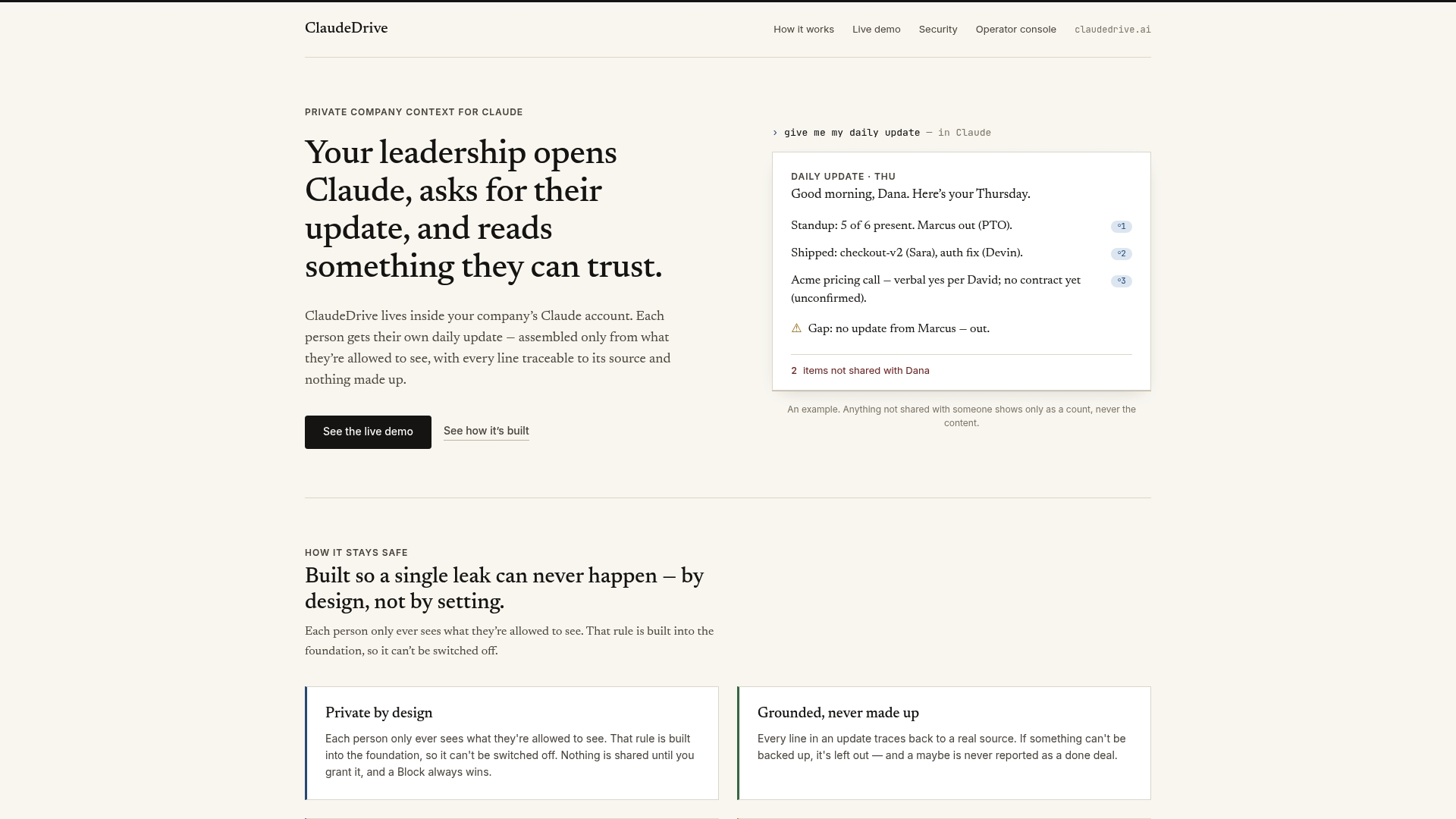
The guarantees ClaudeDrive enforces by default: confidential mode on, instant offboarding, full audit trail, and no new app to roll out. Connect meeting notes, GitHub, and the calendar. Tag access by person or channel. Each leader gets a private view of what happened. The ClaudeDrive Console is where you configure sources, manage permissions, and review audit logs. For leaders who want to verify what an AI briefing executives can trust actually looks like in practice, the demo shows a live permissioned briefing from real connected sources.
Talk to us about a pilot, or see the live demo at ClaudeDrive.

Sources
- Lessons from Anthropic on building effective human-agent teams | Claude by Anthropic
- Design secure document ingestion + RAG — A guided system design | Vibe Engines
- PiSAs: Benchmarking contextual integrity in multi-user agentic systems | arXiv
- Security reference architecture for generative AI | AWS