AI Briefing Executives Can Trust: A Practical Guide
Discover an AI briefing executives can trust, built from your own data, ensuring accountability and insights you can act on confidently.
ClaudeDrive
A Yungsten Tech product

AI Briefing Executives Can Trust: A Practical Guide

A trusted AI briefing for executives is a personalized, verifiable intelligence update built from your company’s internal data and governed by clear accountability standards. It is not a summary of news headlines or a chatbot response to a vague prompt. Every line traces back to a real source inside your organization, nothing is invented, and each leader sees only what they are authorized to see. That is the bar.
PwC’s 2026 Global CEO Survey found that companies with the fewest stakeholder trust concerns delivered total shareholder returns that were, on average, nine percentage points higher than those with the most over a 12-month period. Trust is not a soft topic. It is a financial one.
What a reliable executive briefing requires:
- Every insight traces to a named, internal source
- Access is scoped to what each leader is permitted to see
- No content is generated from outside the company’s own data
- Governance frameworks like HAIP reporting standards and the OECD AI Trust Standard set the transparency baseline
- Human oversight remains in place for any decision with material consequences
Table of Contents
- What actually makes an AI briefing trustworthy for executives
- Leadership practices that make AI briefings work
- How ClaudeDrive delivers personalized, trustworthy AI briefings
- Next steps for executives evaluating AI briefing solutions
- How to evaluate AI briefing tools and vendors
- Methods for validating AI-generated insights accuracy
- What successful AI briefing adoption looks like in practice
- Key Takeaways
- ClaudeDrive gives leaders a daily update they can act on
What actually makes an AI briefing trustworthy for executives
Trust in AI is not inherent. It must be built deliberately through governance, verification, and transparency, especially when the output informs board-level decisions.
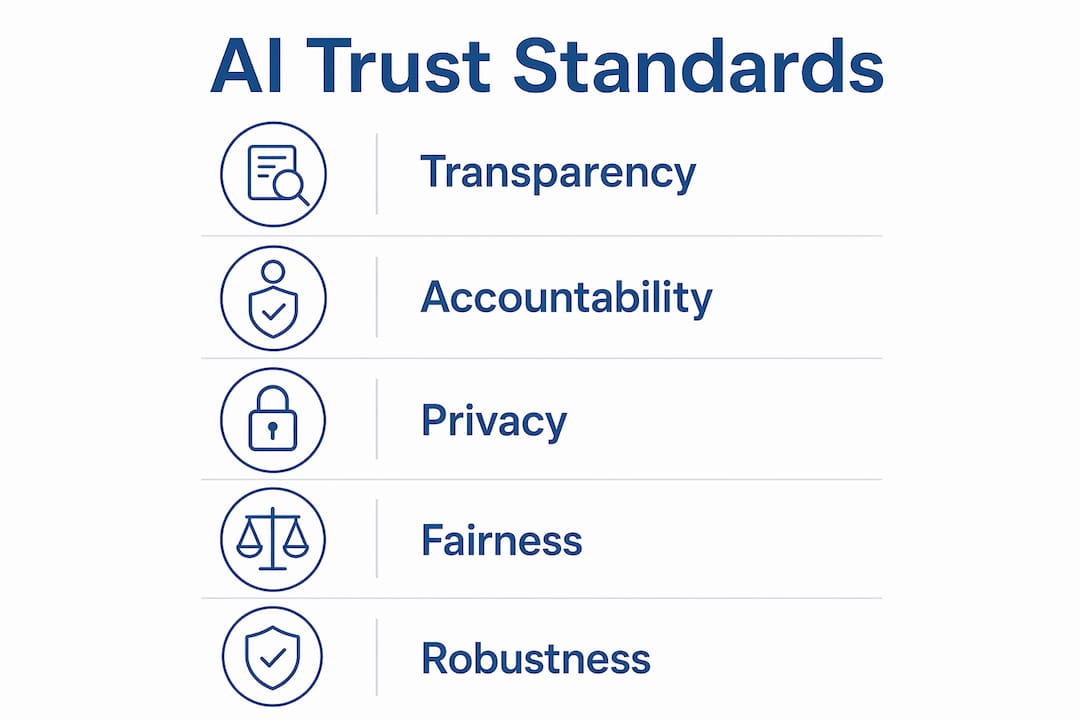
The OECD AI Trust Standard evaluates AI systems across five characteristics: transparency, accountability, privacy, fairness, and reliability. It does not offer a binary pass or fail. Instead, it provides a spectrum, which is more honest about how trust actually works in practice. An executive briefing tool should be measurable against each of those dimensions, not just claim them in marketing copy.
The Hiroshima AI Process reporting framework, launched by G7 countries in 2023 and officially released in February 2025, organizes AI accountability around seven areas: risk identification, risk management, transparency reporting, organizational governance, content provenance, AI safety research, and human interests. A briefing tool that cannot account for most of those areas is not ready for executive use.
Core trust elements to verify before deploying any AI briefing:
- Sourced lines only. Every claim in the briefing must link to a real internal document, meeting note, or data record.
- Audit trails. Leaders and their teams need to audit AI updates and verify what the system pulled and when.
- Data profile monitoring. Trustworthy AI requires lifecycle governance that tracks data drift and flags when the underlying information has changed in ways that affect reliability.
- Bias controls. AI systems trained or prompted on skewed data will surface skewed summaries. Controlled data access and explicit scope limits reduce that risk.
- No hallucination tolerance. A briefing that occasionally invents a fact is worse than no briefing at all. The standard is zero fabricated content.
Leadership practices that make AI briefings work
The technology is the easier part. The harder part is how leadership treats it.
Bain’s research on agentic AI is direct: leaders who succeed treat AI deployment as a business transformation, not a technology rollout. That means building “bilingual” teams that combine business judgment with technical understanding, and being clear about when a human must stay in the loop. An AI briefing that surfaces a stalled deal or a missed deadline is only useful if the leader reading it has the authority and context to act on it immediately.
The IBM 2026 CEO Study found that 76% of organizations now have a Chief AI Officer in place, up from 26% in 2025. CEOs who appointed a CAIO with real authority scaled 10% more AI initiatives across the enterprise. That is not a coincidence. Centralized AI governance with a clear mandate accelerates decisions and prevents the fragmented, siloed adoption that makes AI briefings unreliable.
Leadership best practices for integrating AI briefings:
- Redesign decision rights first. Identify which decisions slow everything else down and assign a single owner with explicit authority before deploying AI intelligence.
- Tie compensation to shared outcomes. When C-suite leaders are accountable for enterprise results, not just functional metrics, they use shared AI intelligence to coordinate rather than compete.
- Keep humans in the loop for material decisions. Regulatory filings, sensitive legal judgments, and material disclosures should not be delegated to AI output alone.
- Set clear escalation rules. Define in advance what triggers a human review of an AI-generated briefing before acting on it.
How ClaudeDrive delivers personalized, trustworthy AI briefings
ClaudeDrive, built by Yungsten Tech, takes a specific approach: it feeds context into Claude rather than building a separate assistant. A leader opens Claude, asks for their update, and reads a briefing built only from what they are authorized to see. No new app, no dashboard, no wiki to maintain.

The integration connects to the tools a company already uses: meeting notes, GitHub, calendars, and similar sources. Each person’s briefing is private and scoped to their access level. Nothing leaks across organizational lines. Every line in the briefing traces to a real internal source, which means a leader can ask “where did this come from?” and get a direct answer.
That traceability is what separates ClaudeDrive from general-purpose AI tools. A permission-aware briefing means the COO sees operational data, the CTO sees engineering status, and neither sees what they are not supposed to see. The system enforces that boundary by design, not by policy alone.
ClaudeDrive’s approach aligns with the HAIP and OECD governance principles discussed earlier: sourced content, controlled access, and no fabricated output. For executives who need to replace status reports with something faster and more reliable, this is the model that fits.
Next steps for executives evaluating AI briefing solutions
Before committing to any AI briefing tool, run it through a short governance checklist.
- Does every output line trace to a named internal source?
- Can you audit what data the system accessed and when?
- Is access scoped by role, so each leader sees only their authorized view?
- Does the vendor align with HAIP or OECD transparency standards?
- Is there a clear process for flagging and correcting errors in the briefing?
Pro Tip: Start with one data source, such as meeting notes or your project tracker, and run a two-week pilot before connecting additional tools. A narrow, accurate briefing builds more trust faster than a broad one with occasional errors.
Treat the AI briefing as a strategic asset, not a productivity shortcut. When leadership and operational teams share the same high-quality intelligence, strategic discussions move faster because everyone starts from the same verified baseline.
How to evaluate AI briefing tools and vendors
The vendor evaluation conversation usually starts with features and ends with pricing. It should start with governance. Ask any vendor to show you exactly where a briefing line came from. If they cannot demonstrate that in a live session, the tool is not ready for executive use.
Key criteria: data source control (you define what feeds the briefing), access scoping (each leader’s view is private), audit capability, hallucination rate (it should be zero for sourced internal content), and alignment with recognized trust frameworks. Deployment model matters too. A tool that requires a new platform, a new login, and a new workflow will not get used consistently.
Methods for validating AI-generated insights accuracy
Validation is not a one-time setup task. The lifecycle governance research from arxiv is clear: trustworthiness must be monitored continuously as data profiles drift and organizational context changes.
Practical validation methods include spot-checking a sample of briefing lines against their source documents weekly, running a structured review after any major organizational change (a reorg, a product launch, a new data source), and assigning a named person to own the briefing’s accuracy. The Biden White House principles for safe AI emphasized red-teaming and data lineage audits as foundational practices. Apply the same discipline to your internal briefing tool.
What successful AI briefing adoption looks like in practice
The IBM research describes a future where AI agents report on overnight market shifts before the morning stand-up. That is closer than most leaders expect. The organizations moving fastest are not just executing better; they are redesigning how decisions get made, with AI providing real-time intelligence and humans setting the guardrails.
The pattern in successful implementations is consistent: a narrow, well-governed pilot with one or two data sources, a clear owner for accuracy, and a leadership team that treats the briefing as the starting point for discussion rather than the final word. When the COO and the CEO read the same verified update before a strategy call, the conversation shifts from “what happened?” to “what do we do about it?” That shift is the real value.
Key Takeaways
A trusted AI briefing for executives requires sourced content, scoped access, and continuous governance, not just a capable AI model.
| Point | Details |
|---|---|
| Trust has financial stakes | Companies with fewer AI trust concerns delivered 9 percentage points higher shareholder returns over 12 months. |
| Governance frameworks matter | HAIP and the OECD AI Trust Standard provide measurable criteria for transparency, accountability, and reliability. |
| Leadership structure drives adoption | Organizations with a CAIO scaled 10% more AI initiatives enterprise-wide than those without. |
| Validation must be continuous | Data drift and organizational changes require ongoing monitoring, not a one-time accuracy check. |
| ClaudeDrive fits this model | ClaudeDrive delivers sourced, private, role-scoped briefings inside Claude with no additional apps or dashboards to manage. |
ClaudeDrive gives leaders a daily update they can act on
Most executives already know what a bad AI briefing looks like: a confident summary with no sources, visible only to whoever asked for it, and impossible to verify before the 8 AM call. ClaudeDrive is the alternative built specifically for that problem.
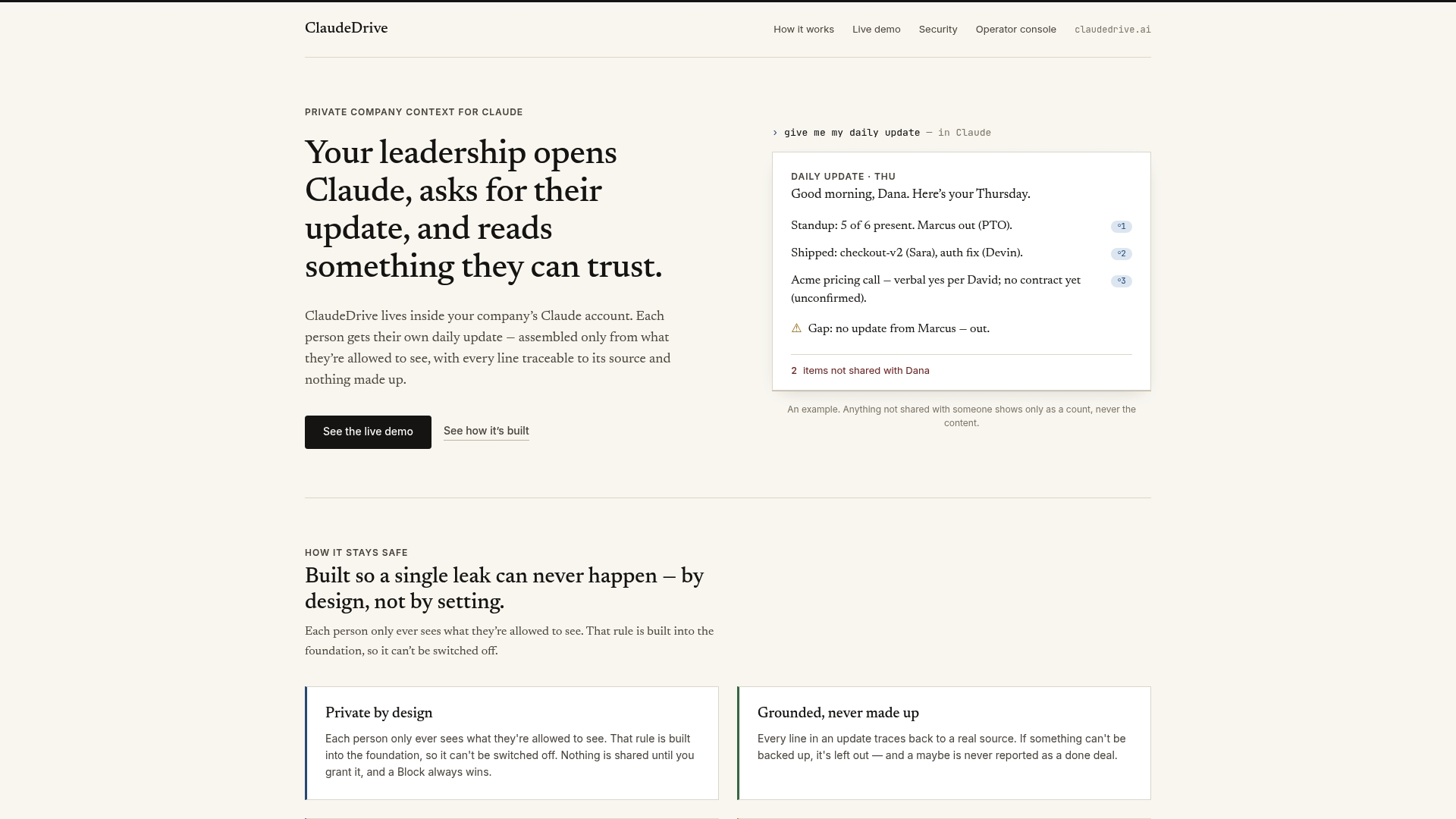
Connect your meeting notes, your calendar, and your project tools. Each leader gets a private briefing scoped to their access level, every line traceable to a real internal source, and nothing fabricated. It runs inside Claude, so there is no new platform to roll out and no dashboard to learn. Yungsten Tech built ClaudeDrive for exactly the leader reading this: someone who needs to trust what they read before they act on it.
See the live demo or talk to us about a pilot.