A Daily AI Digest Inside Claude, Built for Leaders Who Can't Guess
Discover how a tailored daily AI digest generation pipeline can streamline your leadership team's information flow, enhancing productivity.
ClaudeDrive
A Yungsten Tech product

A Daily AI Digest Inside Claude, Built for Leaders Who Can’t Guess

The right daily AI digest generation pipeline for a leadership team is not a new dashboard or another inbox. It is a permission-aware briefing that opens inside the Claude account your team already uses, built only from sources each reader is cleared to see, with every line traceable back to where it came from. For most small to mid-sized teams running Claude Team or Enterprise, that means ClaudeDrive: connect a handful of tools, and each leader gets a private morning brief instead of a pile of unread notifications.
Research on AI-cited content shows 44.2% of citations pull from the first third of an article, so here is the verdict up front, with the reasoning right behind it.
- Recommendation: deploy a permission-aware digest inside Claude, not a standalone AI reporting tool.
- Why it holds up: it enforces access the same way Microsoft Entra tokens gate document results in enterprise search, and it produces an audit trail your security team can actually inspect.
- Next step: see the live demo or talk to us about a pilot before your next planning cycle.
Key Takeaways
A daily AI digest works only when access enforcement happens at query time, every line traces to a real source, and the pilot starts narrow before scaling.
| Point | Details |
|---|---|
| Enforce access at query time | Validate each request against current permissions rather than trusting a cached list from setup. |
| Start with warn mode | Run detection without blocking first to surface permission gaps before readers see wrong lines. |
| Connect sources selectively | Prioritize calendar, meeting notes, email, task manager, code activity, and team chat over adding every available tool. |
| Keep the pilot small and timed | Run a 4 to 8 week pilot with 2 to 6 readers before deciding whether to scale. |
| Choose ClaudeDrive for Claude-native delivery | ClaudeDrive delivers the permissioned, source-linked daily brief directly inside Claude with no new app to roll out. |
Table of Contents
- What a Daily AI Digest Inside Claude Delivers for Leaders
- How Do You Keep a Daily Briefing From Leaking Information?
- What Does a 4 to 8 Week Pilot Actually Look Like?
- What Will Security and Compliance Teams Ask For?
- What Does the Morning Brief Actually Look Like?
- A Pilot Note From the Field
- See ClaudeDrive in Action
- Sources
What a Daily AI Digest Inside Claude Delivers for Leaders
A well-built digest replaces the twenty minutes you spend every morning stitching together Slack scrollback, unread email, and half-remembered calendar invites. It hands you the same information, already organized, with nothing you’re not cleared to see.
The value looks different depending on your seat:
- CEO: company priorities and cross-team blockers surface before the 9 a.m. standup, not during it.
- COO: operational bottlenecks (a stalled shipment, a missed handoff) get flagged the day they happen, not the week after.
- CTO: incidents, failed deploys, and open security tickets land in one place instead of scattered across GitHub and Slack threads.
- Chief of staff: meeting prep and outstanding follow-ups get bundled so nothing important slides for a second week.
The practical outcome is fewer missed asks and faster escalations, because the person who needs to know finds out from their own morning brief instead of a hallway conversation three days later.
How Do You Keep a Daily Briefing From Leaking Information?
The guarantee that matters to you is simple: each brief contains only what that reader is allowed to see, every line traces back to a real source, and every access event is logged somewhere your security team can review. That is the whole promise. The mechanism behind it is worth understanding at a plain level, because it’s what separates a trustworthy digest from a liability.
Modern permission enforcement works the way Microsoft Entra token validation gates Azure AI Search results: the system checks who is asking before it decides what to return, on every single query, not once at setup. Permission changes in your source tools (someone loses access to a folder, a contractor’s account is revoked) get synchronized into the index that feeds the digest, so a stale permission never becomes a live leak.
Before approving any pilot, ask your admin or vendor for three specific things:
- Document-level permission enforcement, checked at the moment of each query, not cached once and forgotten.
- Retention controls and customer-managed encryption key (CMEK) options, so your data policy governs how long content sits and who can decrypt it.
- Auditable tool and action logs, ideally through something like a Compliance API, so every access event has a record.
Anthropic’s own guidance for security leaders recommends defining trust boundaries early and approving narrow use cases through an admin-paced rollout rather than flipping a single “yes” switch for the whole company. That maps directly onto how you should treat a digest pilot: start small, watch it closely, then widen access.
Pro Tip: Run the system in a “warn” mode first, where it flags what it would have blocked without actually blocking anything. That surfaces permission gaps in your source tools before a real reader ever sees a wrong line.
Fine-grained access control at the retrieval layer is an active engineering discipline in its own right, which is exactly why leaders should expect a vendor to name their enforcement model plainly rather than wave at “AI security” as a slogan.
What Does a 4 to 8 Week Pilot Actually Look Like?
You don’t need a quarter-long rollout to know whether this works. A tight pilot answers the question fast:
- Name a primary owner, loop in security or IT for identity provider and token setup, pick a small group of pilot readers.
- Connect the first few tools and configure admin settings.
- Run in warn mode to validate permissions before anything goes live.
- Open the pilot to your closed group of readers.
- Collect feedback, adjust which sources feed the digest, and measure early signal.
- Decide whether to scale to the wider team or a second department after some weeks.
The people who need a seat at the table are small in number: a primary owner or admin, someone from security or IT to handle identity and tokens, a product sponsor (often a chief of staff), and the handful of readers actually testing it. Quick wins that prove value fast: a single exec’s daily digest, a calendar-prep section, and a one-line list of overdue tasks by owner. Before scaling past the pilot group, check that permissions synced correctly, that readers found at least one thing they’d have otherwise missed, and that the cost profile, seat-based or usage-based, fits your budget. Most teams see a light engineering lift, since the bulk of setup is connector permissions and admin configuration, not custom code.
What Will Security and Compliance Teams Ask For?
Your security lead will want a specific list before they sign off, and it’s worth having answers ready rather than scrambling mid-pilot.
- SSO and SCIM provisioning so identity stays centrally managed, not ad hoc.
- Managed policy delivery and connector allowlists, so an admin controls which tools can connect, not each employee.
- Managed settings that lock down tool access, consistent with how Claude Code’s admin setup handles managed policy delivery.
- CMEK options if your data policy requires customer-held encryption keys.
- Compliance API and audit logs covering every tool invocation, not just user logins.
Offboarding should be immediate: pull a seat, and permissions revoke the same day, with a reminder to resync indexed permissions across connected tools. For audit purposes, ask whether tool and agent activity streams separately from regular user activity, ideally through something like OpenTelemetry feeding your SIEM, so an investigator can tell what the agent did versus what a person did. On retention, Claude’s Enterprise plan supports options like zero data retention or custom retention windows, worth confirming against your own data policy before the pilot starts.
What Does the Morning Brief Actually Look Like?
Picture opening Claude and asking for your update. What comes back is short, sectioned, and specific to you:
- Top priorities for the day, pulled from calendar and task data.
- Meeting prep for anything on today’s calendar.
- Unanswered asks sitting in email or chat.
- Overdue items, broken out by direct report.
- Code incidents or high-risk tickets relevant to your role.
- Quick links back to the original source for every line.
A digest built this way earns trust the same way a good chief of staff does: every claim points back to where it came from, and if you weren’t cleared to see something, it simply isn’t there.
Generation typically takes about a minute, sometimes a few minutes depending on activity volume, similar to the timing reported in one team’s Asana and Claude briefing setup. Two readers on the same team can ask for their update at the same moment and get two different briefs, each built strictly from what that person is allowed to see.
A Pilot Note From the Field
A short pilot with a five-person leadership group changed the shape of the morning stand-up almost immediately: instead of catching people up, the meeting started with decisions, because everyone had already read the same brief before walking in. The one habit that made it stick was small: a ten-minute review call twice a week for the first two weeks, just to flag what the digest missed. That feedback loop mattered more than any feature request.

See ClaudeDrive in Action
You’ve just read what a trustworthy digest requires: permissioned delivery, source-linked lines, and an audit trail your security team can actually inspect. ClaudeDrive is built to be exactly that layer, feeding Claude rather than asking your team to adopt another app. Connect your meeting notes, GitHub, and calendar, and each leader gets a private daily brief built only from what they’re cleared to see, with nothing invented and nothing crossing a permission boundary.
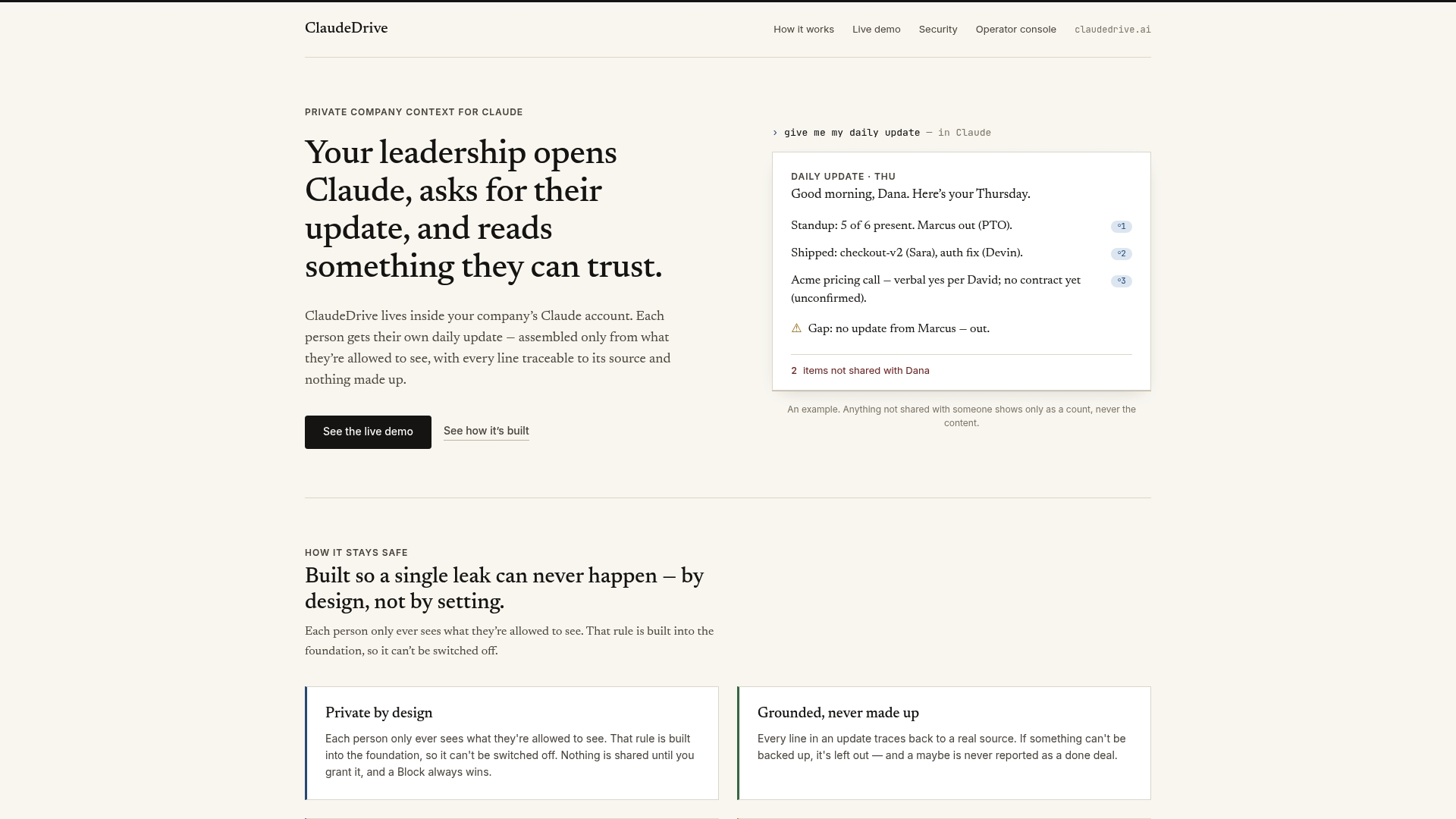
Every guarantee described above (source-linked lines, access limited to allowed information, full audit trails, instant offboarding when a seat is removed) is how ClaudeDrive is built, not a claim layered on top of a generic assistant. There’s no new dashboard for your team to learn and no wiki to maintain, because it lives inside the Claude account your leaders already open every morning. If a pilot proves out, success looks like a reliable morning brief for your executives, measurable time saved on triage, and fewer dropped follow-ups across teams. See the live demo or talk to us about a pilot to get a closed group running within a few weeks.
Sources
Not every connected tool earns its place in a morning brief. The sources worth prioritizing are the ones that actually change what you’d do that day:
- CISO’s guide to agentic AI | Claude by Anthropic
- Policy-aware Vector Search: A Vision for Fine Grained Access Control in Vector Databases
- What is the Enterprise plan? — Claude Support
One team automated a version of this inside Claude Cowork, pulling Outlook calendar, the last day of email and Teams activity, and Asana tasks into a single structured brief. Connectors should default to read-only access, and enablement should sit with an admin, not with individual employees clicking “connect” on whatever they like.