Can You Trust What AI Tells Executives? A 2026 Guide
Learn how to trust what AI tells executives with guarantees for transparency, ethics, and data integrity. Improve decision quality today!
ClaudeDrive
A Yungsten Tech product

Can You Trust What AI Tells Executives? A 2026 Guide

You can trust a Claude briefing for daily executive updates when three guarantees are met: every line traces to a real internal source, only data you’re authorized to see appears, and the briefing surfaces its own assumptions along with the strongest case against its conclusions. A 2026 Journal of Business Ethics study confirms that perceived AI trustworthiness — built on ethics, transparency, and explainability — directly improves decision quality, speed, and integrity. Meanwhile, 89% of executives trust AI to guide company decisions, yet many do so without those guarantees in place. ClaudeDrive, built by Yungsten Tech, delivers exactly those three guarantees inside the Claude account leaders already use. Open Claude, request today’s briefing, and confirm all three are visible before you act on anything.
Table of Contents
- Why should executives trust AI? The three pillars that actually matter
- What guarantees should you require before trusting a daily AI briefing?
- How do you roll out trustworthy daily AI briefings in one quarter?
- What should you ask vendors or internal teams before you rely on their AI briefings?
- What are the red flags that an AI briefing can’t be trusted?
- How ClaudeDrive meets the checklist inside Claude
- Key Takeaways
- The guarantees matter more than the confidence
- See ClaudeDrive in action or talk about a pilot
- Sources and further reading
Why should executives trust AI? The three pillars that actually matter
Trust in an AI briefing is not a feeling. It is a measurable property, and research is specific about what produces it: ethics, transparency, and explainability working together. When all three are visible to the decision-maker — not just claimed in a vendor document — perceived decision efficacy improves across quality, speed, and integrity.
Transparency means every claim has a source you can check. Explainability means the briefing tells you why it reached a conclusion, not just what it concluded. Ethics means the system only shows you what you’re allowed to see and flags what it doesn’t know.
Human involvement adds a layer, but it’s not a substitute for process. Experimental research shows that favorable outcomes can inflate perceived trust regardless of whether the underlying process was sound. A briefing that turned out to be right last quarter can still be dangerously wrong this quarter if the guarantees aren’t built in. That’s the trap: leaders conflate good outcomes with trustworthy process.
The practical fix is a small governance artifact: a one-line policy that forces every high-stakes AI output to surface its core assumptions, the explicit evidence behind each claim, what context is missing, and the strongest opposing argument. One line, applied consistently, closes most of the gap.
44% of C-suite executives say they would override a decision they had already planned to make based on AI insights alone, according to an SAP-sponsored survey. That level of deference makes the three pillars non-optional.
What guarantees should you require before trusting a daily AI briefing?
Treat this as a boardroom-ready checklist. Before relying on any briefing, confirm each item:
- Source traceability: Every line links to a specific internal document. No link, no trust. Untraceable claims are unverified by definition.
- Permission-aware filtering: The briefing shows only data the reader is authorized to access. Nothing leaks across organizational lines.
- Surfaced assumptions: The briefing states what it assumed to reach its conclusions, not just what it concluded.
- Explicit evidence: Each claim names the document or data point that supports it.
- Missing context: The briefing flags what it couldn’t find or didn’t have access to.
- Strongest opposing case: For any recommendation, the briefing presents the best argument against it.
| Guarantee | What it proves | What to ask for |
|---|---|---|
| Source traceability | Claims are verifiable, not generated | “Show me the document link for this line.” |
| Permission-aware access | No unauthorized data appears | “Who else can see this briefing?” |
| Surfaced assumptions | Conclusions are bounded, not absolute | “What did the system assume to reach this?” |
| Opposing case | Recommendation is stress-tested | “What’s the strongest argument against this?” |
Pro Tip: Require a one-line governance policy in writing: “For any briefing item above a defined stakes threshold, the system must surface assumptions, evidence, missing context, and the strongest opposing case before a leader acts on it.” Post it in your pilot charter and revisit it at each weekly review.
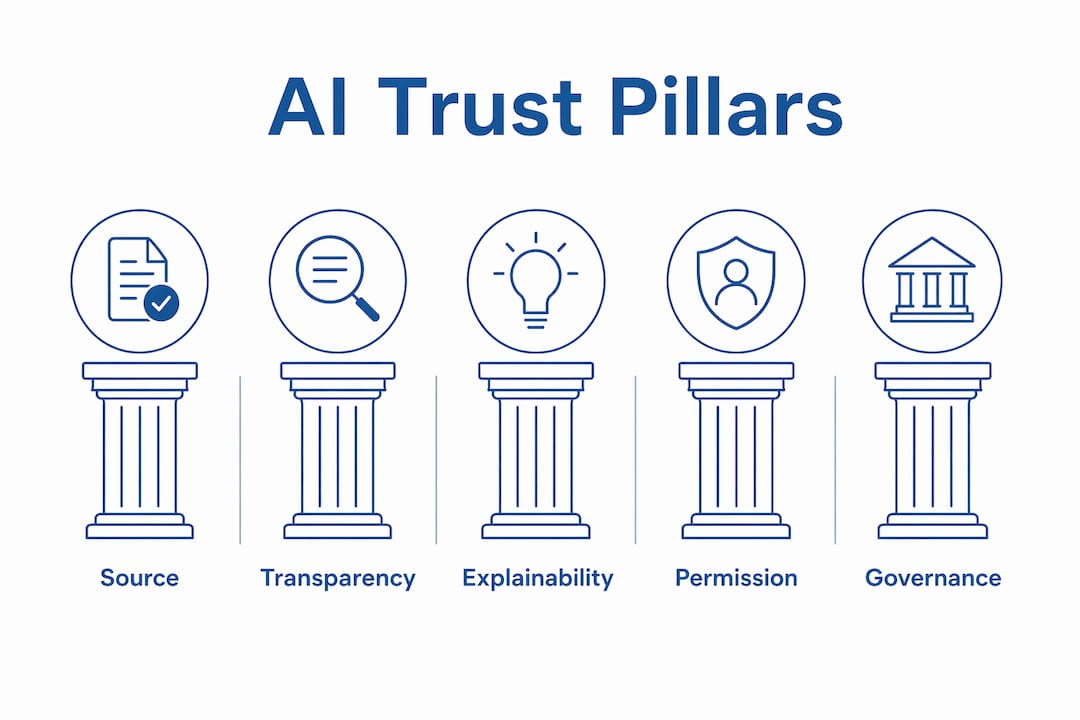
Permission-aware updates are the guarantee most often skipped in early pilots — and the one that causes the most damage when missing.

How do you roll out trustworthy daily AI briefings in one quarter?
This is a five-step plan a leader can assign on Monday and measure by end of quarter.
- Define stakes and sources. List the decisions that matter most this quarter. Then list the internal tools that feed them: meeting notes, GitHub, the calendar, project trackers. These become your data sources.
- Set permission boundaries and write the governance policy. Tag who can see what before connecting anything. Write the one-line governance artifact and attach it to the pilot charter.
- Run a 2–4 week pilot with 3–5 executives. Daily cadence, same briefing format each morning. Collect traceability logs and access records from day one.
- Validate against decision-efficacy KPIs. Sample outputs weekly: do lines map to real documents? Did the briefing flag missing context? Measure decision speed and the rate of sourced versus unsourced claims. Practical audit guidance covers exactly how to run this check.
- Scale and assign monitoring ownership. One person signs off on the weekly traceability report. Cadence becomes permanent. KPIs get reviewed monthly.
Quarter-ready timeline: weeks 1–2 for setup and permissions, weeks 3–4 for the pilot, week 5 for KPI review and scale decision.
What should you ask vendors or internal teams before you rely on their AI briefings?
Short questions, specific answers. Put these to any vendor or internal product owner before the pilot goes live:
- Who mapped the data sources, and can you show me the mapping?
- Can every briefing line link to a traceable internal document?
- Who can see each briefing, and how is that enforced?
- How does the system surface missing context — what does that look like in practice?
- How do you test for overconfidence in the output?
An acceptable answer to the traceability question: “Each line includes a persistent link to the source document and an access tag showing who is authorized to view it.” Anything vaguer than that is a red flag.
Traceability guidance gives concrete examples of what a compliant answer looks like versus a deflection.
What are the red flags that an AI briefing can’t be trusted?
The most dangerous briefing is one that sounds authoritative but isn’t. Watch for these every morning:
- No source links on any claim
- Repeated assertions without new evidence between updates
- Confidence that increases without a visible reason
- Recommendations that match current strategy too neatly (“strategy trendslop”)
- Private information appearing for someone who shouldn’t see it
The outcome-favorability trap deserves its own paragraph. Research confirms that people rate a process as trustworthy when the outcome is favorable, regardless of how the process actually worked. A briefing that was right three times in a row gets trusted on the fourth — even if the fourth has no traceable evidence. Process guarantees matter precisely because outcomes are not a reliable signal of process quality.
The primary operational risk is overconfidence: models present generalized ideas with exceptional certainty. The four-item check — assumptions, evidence, missing context, opposing case — is the practical mitigation.
How ClaudeDrive meets the checklist inside Claude
ClaudeDrive maps directly to the guarantees above. Here is what a leader sees when they open Claude and ask for their update:
- Per-line source links: Every briefing line traces to the internal document it came from. No line appears without a source.
- Permission-aware filtering: ClaudeDrive connects meeting notes, GitHub, and calendars and inherits the access controls already set on each tool. Nothing crosses a line it shouldn’t.
- Visible assumptions block: Each briefing surfaces what it assumed, what it couldn’t find, and the strongest case against its main recommendation.
- Private per-executive view: Each leader sees only their own briefing. No shared dashboard, no wiki to maintain, no new app to train anyone on.
ClaudeDrive is the private company-context layer that feeds Claude — not a separate assistant. Connect the tools, tag who’s allowed to see what, and each person gets their own daily update inside the Claude account they already use.
Key Takeaways
Executives can trust an AI briefing when three operational guarantees — source traceability, permission-aware access, and surfaced assumptions with an opposing case — are confirmed and visible before any decision is made.
| Point | Details |
|---|---|
| Three pillars of trust | Ethics, transparency, and explainability together improve decision quality, speed, and integrity. |
| Outcome favorability is a trap | Favorable results inflate perceived trust even when the underlying process is weak; enforce process guarantees regardless. |
| Four-item governance check | Require every high-stakes output to surface assumptions, evidence, missing context, and the strongest opposing case. |
| Quarter-ready rollout | A 2–4 week pilot with 3–5 executives, daily cadence, and weekly traceability audits is enough to validate and scale. |
| ClaudeDrive in Claude | ClaudeDrive delivers source-traceable, permission-aware daily briefings inside Claude — no new app, no dashboard, no wiki. |
The guarantees matter more than the confidence
The loudest argument for trusting AI in leadership is usually the wrong one: “It was right last time.” That’s outcome reasoning, and it’s how organizations end up making a consequential call on a briefing that had no traceable evidence behind it.
The research on this is clear. Trust that is built on visible ethics, transparency, and explainability holds up under scrutiny. Trust built on a string of favorable outcomes collapses the moment the streak ends — usually at the worst possible time. The governance artifact is not bureaucracy. It’s the difference between a briefing you can defend in a board meeting and one you can only defend by pointing at the result.
Yungsten Tech built ClaudeDrive on exactly this premise: that a daily update is only worth reading if every line in it can be verified, and only worth trusting if the system tells you what it doesn’t know.
See ClaudeDrive in action or talk about a pilot
ClaudeDrive gives leaders a daily briefing they can verify line by line, inside the Claude account they already use. No new tool to adopt, no permissions to rebuild from scratch.
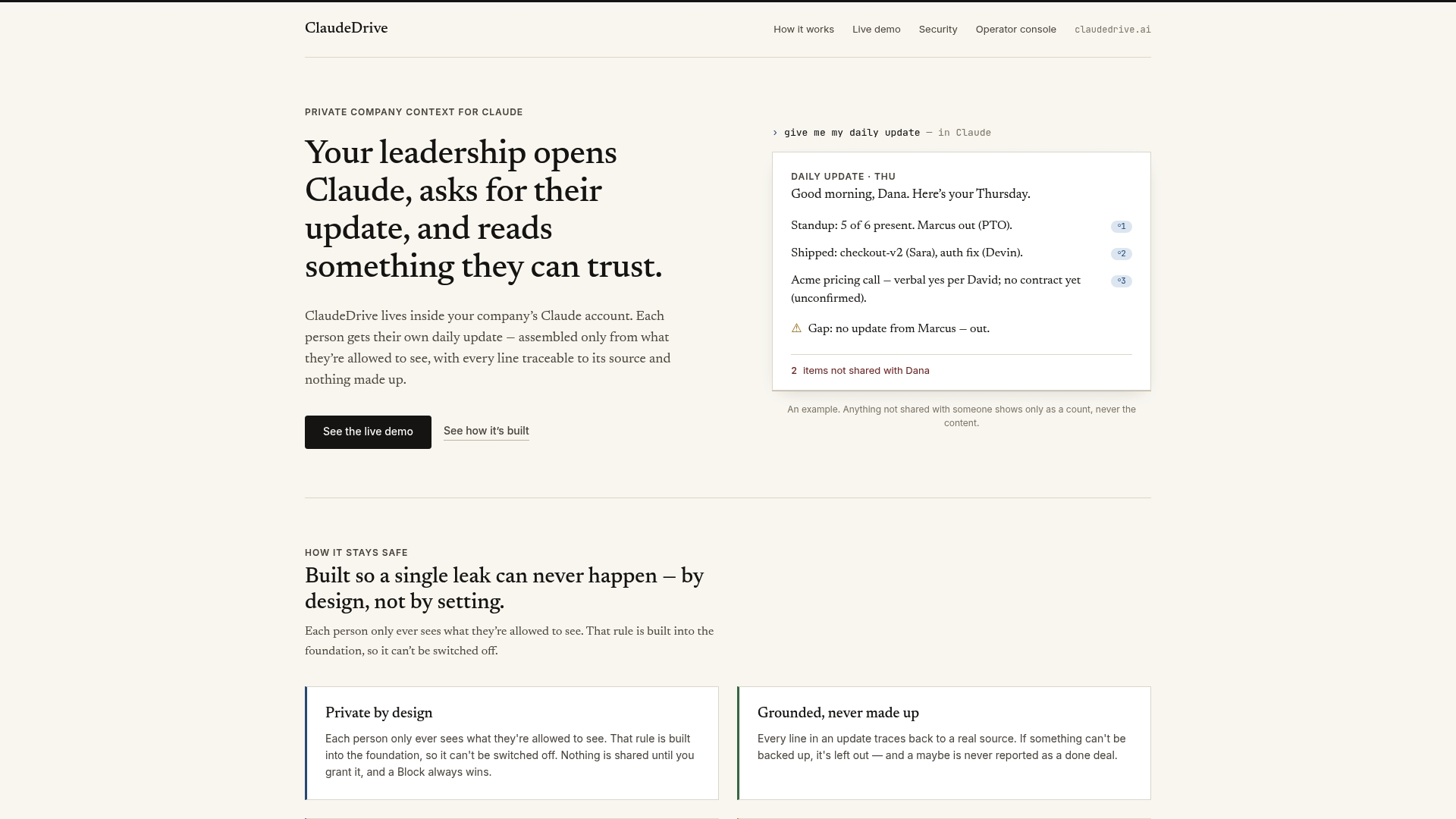
A standard pilot runs 2–4 weeks with 3–5 executives. You provide a list of internal sources (meeting notes, GitHub, calendar) and an executive cohort. ClaudeDrive connects the tools, inherits the permissions already in place, and delivers a private daily briefing to each leader. KPIs: traceability score (percentage of lines with a confirmed source link) and decision-efficacy improvement (speed and quality of decisions made from briefings versus baseline).
See the live demo or talk to us about a pilot — and confirm the three guarantees are visible before you commit to anything.
Sources and further reading
| Source | What it covers | Why it matters |
|---|---|---|
| Journal of Business Ethics (2026) | Ethics, transparency, explainability as drivers of AI trustworthiness and decision efficacy | Primary research basis for the three-pillar framework |
| A-Eye Level: Boardroom Risk of Confident AI | Four-item governance check; traceability as a trust mechanism | Source for the one-line policy and red-flag guidance |
| SAP News Center: Executives Trust AI Over Themselves | 44% of C-suite would override planned decisions based on AI; risks of sharing confidential data | Motivation for permission-aware filtering requirement |
| CompanyGlance: Most Executives Trust AI for Big Decisions | 89% of executives trust AI to guide company decisions; risky data-sharing behaviors | Adoption context and urgency for governance |
| Fairness and Trust in AI Decision-Making (Taylor & Francis) | Outcome favorability distorts perceived trust; human involvement and procedural fairness | Explains why process guarantees matter even when outcomes look good |
| ClaudeDrive: Permission-Aware AI Updates | How permission-aware updates work for tech leaders | Product proof point for the filtering guarantee |
| ClaudeDrive: Audit Guide | Practical steps for validating traceability and access controls during a pilot | Pilot validation methodology |
| ClaudeDrive: Traceability Guide | Source-mapping examples and traceability KPIs for pilots | Concrete traceability standards for vendor evaluation |