Why Daily AI Updates Beat Weekly Reports in 2026
Discover why daily AI updates beat weekly reports in 2026. Get timely insights for quick decision-making and stay ahead in fast-moving business.
ClaudeDrive
A Yungsten Tech product

Why Daily AI Updates Beat Weekly Reports in 2026

Daily AI updates are defined as AI-generated briefings delivered every 24 hours, built from live operational data, and scoped to what each leader needs to act on that day. Weekly reports, by contrast, aggregate the same data into a single document delivered once every seven days. The difference in cadence is not cosmetic. 33% of knowledge workers using generative AI now engage with it daily, according to a 2026 Federal Reserve study by Hartley et al. That number reflects how fast business conditions move and why daily AI updates beat weekly reports for leaders who need to act, not just review.
Why daily AI updates beat weekly reports: the cadence problem
The core issue is not technology. It is timing. Every business generates signals at different speeds: a customer escalation, a blocked deployment, a budget variance. The question is whether your reporting cadence matches the speed of those signals.
Fairview’s 2026 operating cadence framework draws a clear line between two purposes:
- Daily updates answer execution questions: What is blocked? What changed overnight? What needs a decision before noon?
- Weekly reports answer progress questions: Are we on track? What patterns emerged this week? What needs leadership escalation?
Mixing these purposes creates real risk. When a weekly report tries to serve both functions, it arrives too late for execution decisions and too noisy for strategic ones. Leaders either act on stale data or spend their weekly review firefighting issues that should have been resolved days earlier.
PageCrawl.io’s monitoring framework makes the same point through a different lens: the right reporting frequency depends on how fast the underlying data changes and the cost of acting late. A web page that changes hourly needs daily monitoring. A page that changes monthly needs monthly monitoring. The same logic applies to your business data.
The practical implication is that cadence choice is a design decision, not a default. Leaders who inherit weekly reporting cycles rarely question whether that cadence still fits their operational pace. Most of the time, it does not.

Pro Tip: Separate your daily issues list from your weekly decisions list. If something appears on both, it belongs on the daily list. Weekly meetings should finalize decisions, not discover problems.
Daily vs. weekly AI reports: benefits, trade-offs, and when to use each
Both cadences have genuine value. The mistake is treating them as interchangeable.
What daily AI updates deliver
- Fresher context for same-day decisions, reducing the gap between signal and response
- Faster blocker resolution, because problems surface within hours rather than days
- Reduced decision lag across distributed teams working across time zones
- Continuous learning loops, where each day’s update informs the next day’s priorities
What weekly reports still do well
- Comprehensive narrative across a full work cycle, useful for board updates and investor communications
- Reduced noise, because minor fluctuations average out over seven days
- Strategic pulse checks that require pattern recognition across multiple data points
- Lower cognitive load for leaders who do not need daily operational detail
The trade-off is straightforward. Daily updates risk noise if the underlying data is stable. Weekly reports risk staleness if the underlying data moves fast. Generative AI can reduce weekly report creation time from 3–5 hours to 15–30 minutes. That efficiency gain is real, but it does not solve the cadence mismatch. A faster weekly report is still a weekly report.
| Factor | Daily AI Updates | Weekly Reports |
|---|---|---|
| Best for | Fast-moving execution data | Stable progress tracking |
| Decision lag | Hours | Up to 7 days |
| Noise risk | Higher without calibration | Lower |
| Effort per update | Low with AI automation | Moderate even with AI |
| Recommended context | Operations, engineering, sales | Strategy, finance, board reporting |
The table above is not a ranking. It is a map. Most leadership teams need both cadences running in parallel, with clear boundaries between what each one is for.
How daily updates function as decision infrastructure
The most effective use of daily AI updates is not as a replacement for weekly reports. It is as pre-decision inputs that make weekly reviews more productive.
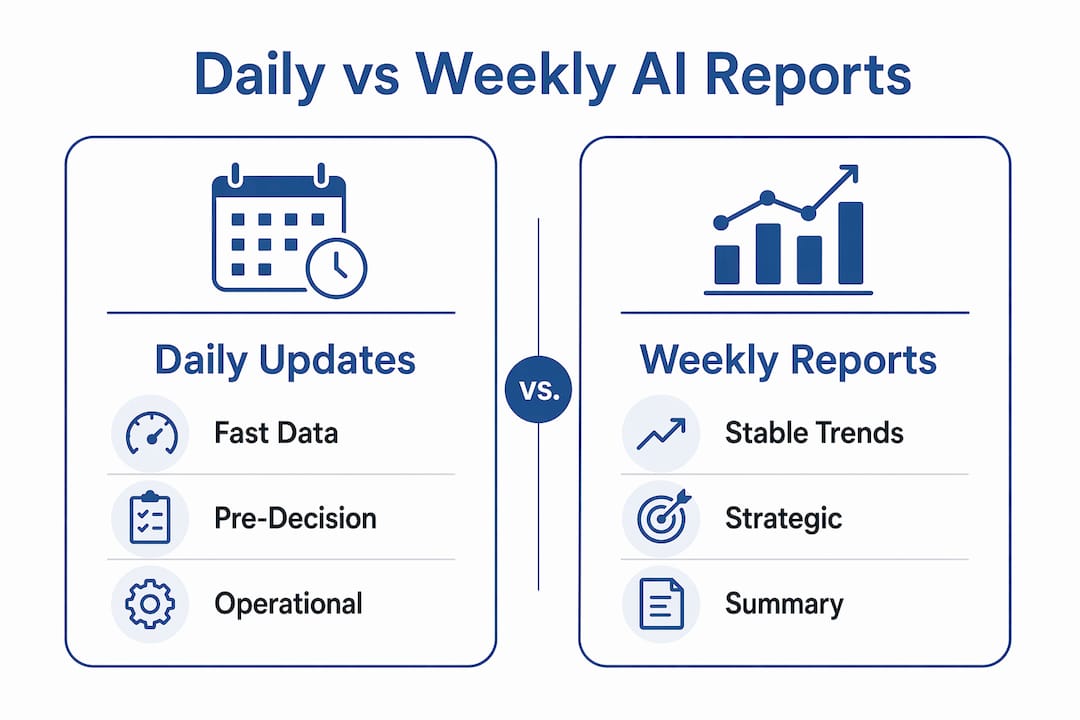
AdaptiveProduct’s operating model frames this precisely: decision infrastructure works best as a weekly habit supported by daily inputs, not as an annual planning event or a crisis-driven response. The daily update narrows the decision space before the weekly meeting opens.
Here is how that works in practice:
- Surface blockers early. A daily update flags a delayed vendor delivery on Monday. The team resolves it by Wednesday. The weekly review never needs to address it.
- Capture new evidence in real time. A competitor announces a pricing change on Tuesday. The daily update includes it. By Thursday’s strategy session, the leadership team has already processed the implication.
- Reduce backchannel decisions. When leaders have a shared daily briefing, fewer decisions happen in Slack threads or hallway conversations. The update creates a common information baseline.
- Improve weekly meeting quality. Weekly reviews become decision sessions rather than discovery sessions. Leaders arrive informed, not catching up.
Disciplined daily inputs paired with weekly reviews also reduce what AdaptiveProduct calls “portfolio drift,” where active priorities quietly shift without formal acknowledgment. Daily updates make those shifts visible before they compound.
For teams exploring what this looks like in practice, AI daily update formats designed for leadership visibility offer a useful starting point.
Pro Tip: Treat your daily update as a pre-read, not a report. It should take under five minutes to consume and answer one question: what do I need to know or decide before my first meeting?
When weekly AI reports still make sense
Daily updates are not the right answer for every data type. The decision depends on signal volatility and the cost of acting on noise.
Retina Media’s 2026 analysis argues that overly frequent refresh cycles create measurement noise rather than signal. When data does not change meaningfully within 24 hours, a daily update produces false urgency. Leaders start reacting to statistical variation rather than real events. That is a form of organizational waste.
The practical criteria for choosing cadence:
- Signal half-life: How long does a data point remain relevant? A customer complaint has a half-life of hours. A market share trend has a half-life of months.
- Decision cost: What is the cost of acting one week late? For a sales pipeline, it may be a lost deal. For a quarterly budget review, it is negligible.
- Measurement stability: Does the metric fluctuate naturally day to day? If yes, daily updates will generate noise. Weekly smoothing is more useful.
| Signal Type | Change Frequency | Recommended Cadence |
|---|---|---|
| Customer escalations | Hours | Daily |
| Engineering blockers | Hours to days | Daily |
| Sales pipeline movement | Days | Daily or twice weekly |
| Budget variance | Weekly | Weekly |
| Market share trends | Monthly | Monthly |
| Board-level KPIs | Quarterly | Weekly summary |
Calibrating refresh cadence to signal half-life prevents noise-driven churn and protects leadership attention. The goal is not maximum frequency. It is the right frequency for each data type.
For teams managing AI adoption across multiple tools, understanding why teams underuse AI tools often comes down to cadence mismatches exactly like this one.
Key takeaways
Daily AI updates outperform weekly reports when operational signals change faster than a seven-day cycle, and the two cadences work best when run in parallel with clear, distinct purposes.
| Point | Details |
|---|---|
| Cadence must match signal speed | Choose daily updates for fast-moving execution data; use weekly reports for stable progress tracking. |
| Daily updates are pre-decision inputs | Use them to surface blockers and new evidence before weekly meetings, not as standalone reports. |
| Weekly reports still have a role | Stable metrics, board communications, and strategic patterns belong in weekly or monthly cadences. |
| AI reduces effort but not cadence mismatch | Automating a weekly report does not fix the problem of receiving it seven days too late. |
| Calibrate to avoid noise | Update frequency faster than signal half-life produces false urgency and cognitive overload. |
The discipline most leaders skip
I have watched leadership teams adopt daily AI updates and immediately make the same mistake: they treat the daily briefing like a compressed weekly report. Every metric, every project, every open question, all of it crammed into a morning email. Within two weeks, nobody reads it.
The teams that get this right do something different. They define what belongs in a daily update and what does not, before they build it. Blockers, new evidence, and decisions needed today. That is the list. Everything else waits for the weekly review.
The harder discipline is organizational. When a daily update surfaces a problem, the instinct is to escalate it immediately to the weekly leadership meeting. That instinct defeats the purpose. The daily update exists so that problems get resolved before the weekly meeting, not so they arrive there with more documentation.
I have also seen the opposite failure: leaders who receive a well-designed daily update and then stop attending weekly reviews because they feel informed. The daily update narrows the decision space. The weekly review closes it. Both are necessary. Neither replaces the other.
The teams I have seen calibrate this well share one habit: they review their update format every quarter and ask which items consistently appear without generating a decision. Those items get removed. The update gets shorter. The signal-to-noise ratio improves. That continuous calibration is what separates a useful daily briefing from one that becomes background noise.
— Paul
How ClaudeDrive delivers daily updates leaders can trust
ClaudeDrive gives your leadership team a daily briefing built from the tools you already use: meeting notes, GitHub, the calendar, and whatever else feeds your decisions. Each leader opens Claude, asks for their update, and reads one clear briefing scoped to what they are allowed to see. Every line traces back to a real source.
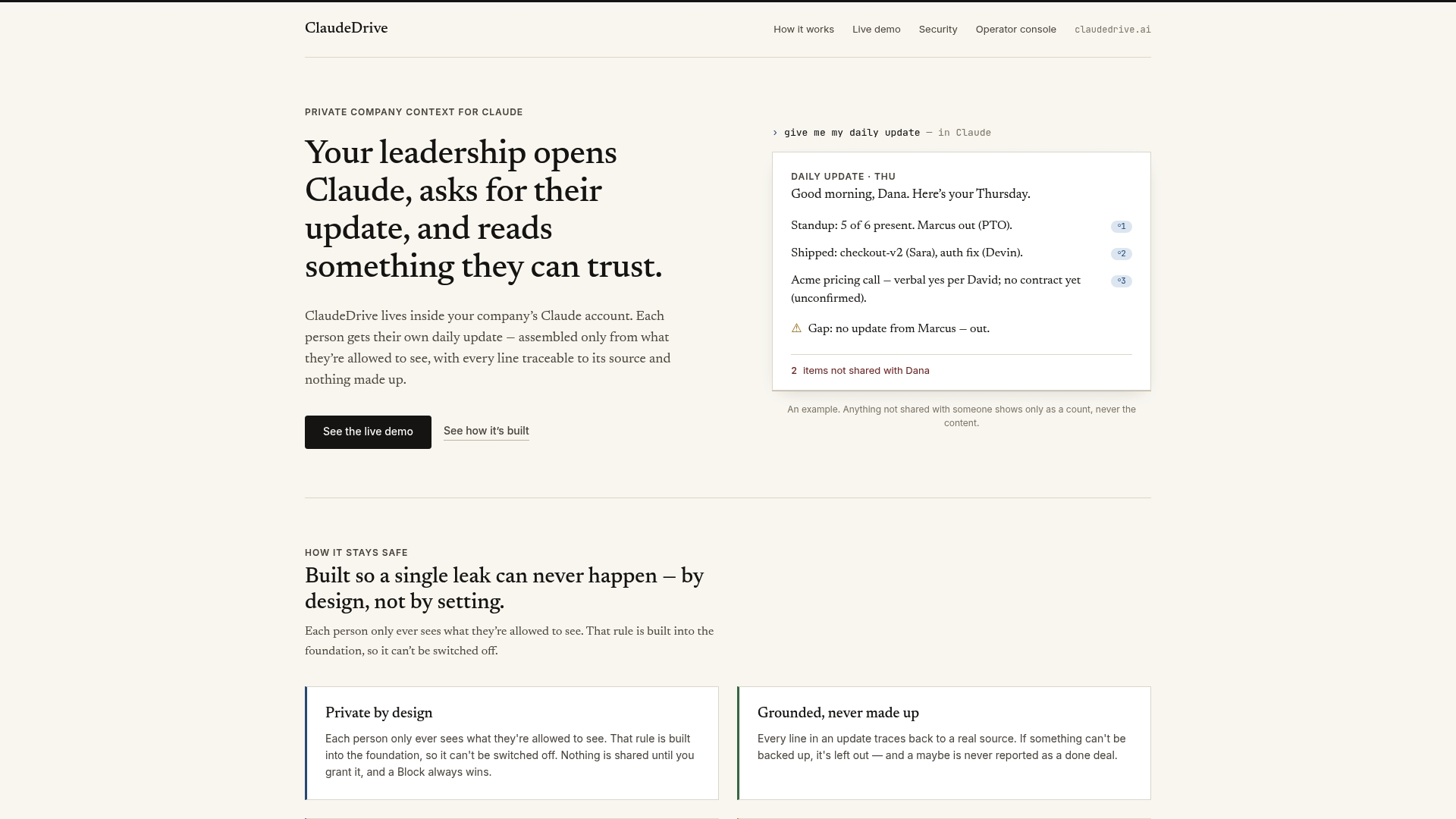
No new dashboard to learn. No wiki to maintain. No manual report to compile. ClaudeDrive connects to your existing tools and generates a daily decision-ready briefing that takes under five minutes to read and answers the one question every leader needs answered before their first meeting. See the live demo or talk to us about a pilot.
FAQ
What makes daily AI updates better than weekly reports?
Daily AI updates match the speed of fast-moving operational signals, surfacing blockers and new evidence within hours rather than days. Weekly reports are better suited for stable metrics and strategic pattern recognition.
How do i know if my team needs daily or weekly updates?
Base the decision on signal half-life and decision cost. If acting one week late on a data point would cause a meaningful problem, that data belongs in a daily update.
Can AI automate both daily and weekly reports?
Yes. AI automation can reduce weekly report creation time from several hours to under 30 minutes. Daily updates require the same automation applied to a narrower, more focused data set.
What is the risk of daily AI updates?
The main risk is noise. Retina Media’s analysis warns that update rates faster than signal half-life generate false urgency and cognitive overload. Calibrate frequency to data volatility.
How does ClaudeDrive fit into a weekly decision rhythm?
ClaudeDrive generates daily briefings that act as pre-decision inputs, so weekly leadership meetings focus on decisions rather than discovery. Each briefing is scoped to what each leader is permitted to see, with every claim traceable to a source.