Grounded Update for Executives: A 2026 Leader's Guide
Unlock effective decision-making with a grounded update for executives. Get clear wins, honest assessments, and actionable insights for 2026.
ClaudeDrive
A Yungsten Tech product

Grounded Update for Executives: A 2026 Leader’s Guide

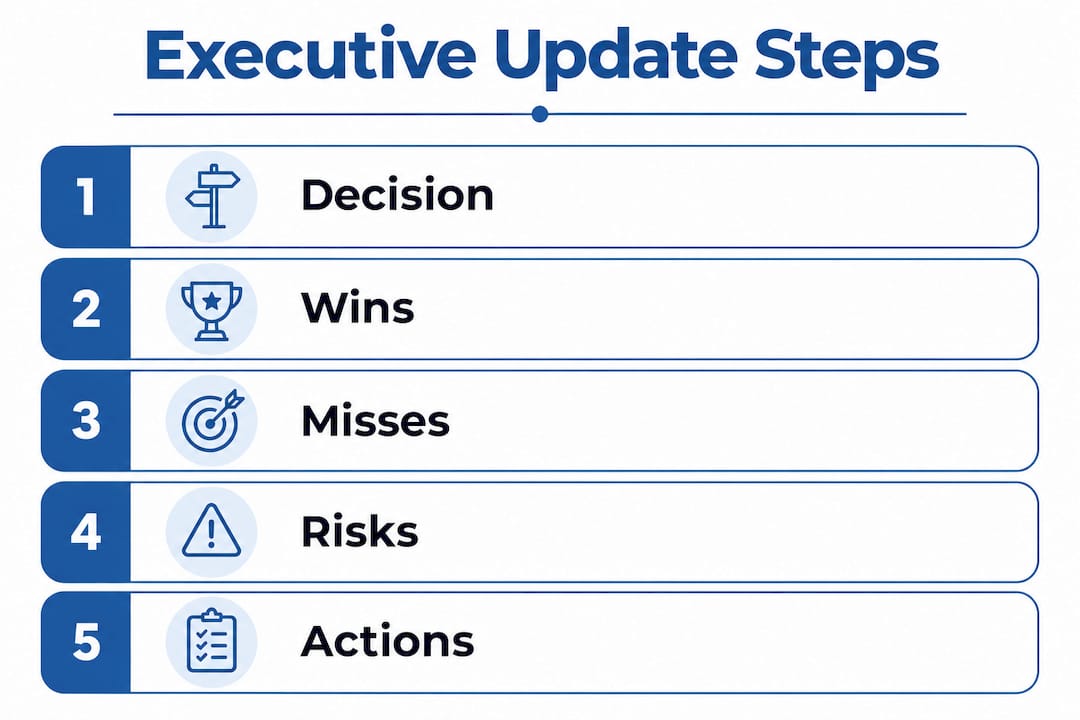
A grounded update for executives is a concise, decision-focused briefing that delivers the most critical business information upfront, without noise, spin, or filler. The standard industry term for this format is the executive briefing, and the best ones share one defining trait: they lead with the ask, not the backstory. 74% of executives admit overstating confidence in their AI strategy to stakeholders, which signals a deeper problem. Leaders are receiving polished updates that hide real risk, and they are making decisions on incomplete pictures. A well-structured, grounded update fixes that. It gives leaders what they actually need: clear wins, honest misses, flagged risks, and one specific decision to make.
What makes a grounded update for executives effective?
The structure of an effective executive briefing is not a matter of preference. Proven update formats follow a consistent pattern: top three wins with supporting metrics, top two honest misses, one specific decision requested, and one critical risk, all within 200 words for a weekly update. That constraint is the point. Brevity forces the author to prioritize, and prioritization is the real work.
Lead with the decision, not the context
Leading with the ask in line one saves executive time and signals that the update is built for action, not status theater. Most updates bury the decision request in paragraph three, after two paragraphs of scene-setting. By then, a busy CEO has already moved on. The ask belongs at the top, stated plainly: “We need your approval to extend the vendor contract by 60 days.”
Use a color-coded risk system with shared meaning
Color-coded risk status builds trust when the organization agrees on what each color means. Green means no action needed. Yellow means a plan is in place but monitoring is required. Red means an immediate decision is needed from leadership. All-green updates are a red flag. They signal either that nothing is being tracked honestly or that the author is managing perception rather than reporting reality.
Pro Tip: Define your color code meanings in a one-paragraph reference document and share it with every update author. Consistency across the organization is what makes the system work.
Match format to audience
A weekly internal update and a board-level briefing are different documents. Tactical updates fit one page. Board updates compress to three bullets plus a pre-read link. Audience-tailored formats increase comprehension speed and reduce the chance that critical information gets lost in the wrong level of detail.
| Format | Length | Primary audience |
|---|---|---|
| Weekly operational | 200 words max | COO, department heads |
| Tactical one-pager | One page | CEO, chief of staff |
| Board briefing | Three bullets + pre-read | Board members, investors |
How does AI improve leadership briefings in 2026?
AI changes the economics of producing honest, well-structured updates. AI tools can auto-draft updates that incorporate key asks, wins, misses, and risks, reducing the manual effort that leads authors to cut corners on honesty. When drafting takes 20 minutes instead of two hours, there is less temptation to recycle last week’s update with minor edits.

The more important benefit is consistency. AI enforces format discipline across an organization. Every update follows the same template, which means executives build a reading pattern. They know exactly where to find the risk flag, the decision request, and the metric summary. That familiarity accelerates comprehension and reduces the cognitive load of parsing a new format every week.
AI also filters by role and urgency. A CFO does not need the same update as a CTO. Role-filtered AI delivery means each leader reads only what is relevant to their decisions, without the noise of cross-functional status reports that do not apply to them.
ClaudeDrive is built specifically for this use case. Leaders open Claude, ask for their update, and read a briefing built only from sources they are authorized to see. Every line traces back to a real source. Nothing is generated from assumption. Connect meeting notes, a calendar, or a project tool, and ClaudeDrive produces a private, role-specific view of what happened. No new dashboard. No wiki to maintain.
CEOs increasingly use AI as a thought partner to stress-test assumptions and query business data before issues surface. That shift makes the quality of the underlying update more important, not less. Garbage in still produces garbage out, even with AI drafting the summary.
Pro Tip: Use AI to draft the first version of every update, then have a human reviewer check the risk section specifically. AI surfaces patterns well. Humans catch the context that makes a yellow risk actually red.
What pitfalls undermine executive update quality?
The most common failure in leadership briefings is overstated confidence. 99% of organizations changed their AI strategy significantly in the past 24 months, yet public-facing updates rarely reflect that level of flux. The gap between what leaders say in updates and what they believe internally is where trust erodes.
- All-green updates. An update with no yellow or red flags is almost never accurate. It signals that the author is filtering for comfort, not clarity.
- Burying the ask. Placing the decision request at the end of the update means many executives never reach it. The ask belongs in the first sentence.
- Excessive length. Updates that run three pages force executives to scan rather than read. Scanning produces missed signals.
- Inconsistent formats. Changing the template every few weeks forces executives to relearn the structure. Familiarity is a feature, not a limitation.
- Vague risk language. “Some concerns remain” is not a risk statement. “Vendor contract expires in 14 days with no renewal signed” is a risk statement.
- Cheerleading tone. Phrases like “the team is crushing it” or “we’re on track for a record quarter” without supporting metrics are noise. They reduce credibility.
88% of executives halted financially attractive AI initiatives due to governance, ethics, or risk concerns. That statistic shows that executives are willing to act on risk information when it is presented clearly. The problem is that most updates never surface the risk in the first place.
Pro Tip: Before sending any update, ask one question: “If this update were the only information a new executive had, would they know what decision to make today?” If the answer is no, revise.
How do you build a grounded update practice across your leadership team?
Institutionalizing disciplined executive briefings requires more than a template. It requires a shared commitment to honesty and a process that makes honesty the path of least resistance.
- Define your templates by audience. Create separate formats for weekly operational updates, board briefings, and investor updates. Each format should specify maximum length, required sections, and color code definitions.
- Train authors on the decision-first mindset. The person writing the update is not reporting history. They are preparing a leader to make a decision. That reframe changes what gets included and what gets cut.
- Set a hard length limit. A weekly update that exceeds 200 words is a draft, not a final. Enforce the limit through review, not suggestion.
- Reuse best-performing examples. When an update generates fast, clear decisions, save it as a reference. Consistent templates increase executive engagement and reduce update fatigue over time.
- Audit updates quarterly. Review the last 12 updates for each team. Count how many included a red or yellow risk flag. If the number is zero, the process is broken.
- Align updates with governance frameworks. An enterprise AI governance framework gives update authors a clear standard for what constitutes a reportable risk, which removes ambiguity and reduces the temptation to downplay issues.
- Use ClaudeDrive to automate the first draft. Connect your existing tools and let ClaudeDrive produce a structured briefing. Human reviewers then focus on judgment calls, not formatting.
| Practice | Why it matters |
|---|---|
| Audience-specific templates | Reduces noise and speeds comprehension for each reader |
| Hard length limits | Forces prioritization and removes filler |
| Quarterly audits | Catches all-green drift before it becomes a trust problem |
| AI-assisted drafting | Enforces format consistency and surfaces data patterns |
Key Takeaways
A grounded update for executives works because it leads with the decision, names risks honestly, and uses a consistent format that executives can read in under three minutes.
| Point | Details |
|---|---|
| Lead with the ask | Place the decision request in the first sentence, not the last paragraph. |
| Cap length by audience | Weekly updates max at 200 words; board briefings compress to three bullets. |
| Name risks with color codes | Green, yellow, and red must have shared definitions across the organization. |
| Audit for all-green drift | Zero risk flags over 12 updates signals a broken process, not a perfect operation. |
| Use AI for format discipline | AI drafts enforce template consistency and free human reviewers for judgment calls. |
Why I think most executive updates are broken by design
I have reviewed hundreds of executive briefings across industries, and the pattern is almost always the same. The update reads like a press release written for the author’s comfort, not the reader’s decision-making. The wins are front and center. The risks are buried in a footnote, softened with qualifiers, or missing entirely.
The uncomfortable truth is that most update authors are not being dishonest on purpose. They are responding to an incentive structure that rewards good news and punishes bad news. When a leader reacts badly to a yellow flag, the author learns to make it green next time. That dynamic compounds quietly until the executive is reading a document that bears no resemblance to operational reality.
The fix is not a better template, though templates help. The fix is leadership communication transparency that treats honest risk reporting as a signal of competence, not a sign of failure. When a leader responds to a red flag with “thank you for catching this early,” the author learns that honesty is safe. That psychological safety is the actual foundation of a grounded update culture.
Nearly 90% of firms report no measurable productivity impact from AI over the past three years. Part of that failure traces directly to updates that overstated progress and understated risk, leaving leaders unable to course-correct in time. The briefing format is not a communication nicety. It is a governance mechanism. Treat it that way.
— Paul
ClaudeDrive and the daily briefing leaders can trust
Leaders who want grounded, honest updates without building a new process from scratch have a direct path forward with ClaudeDrive.
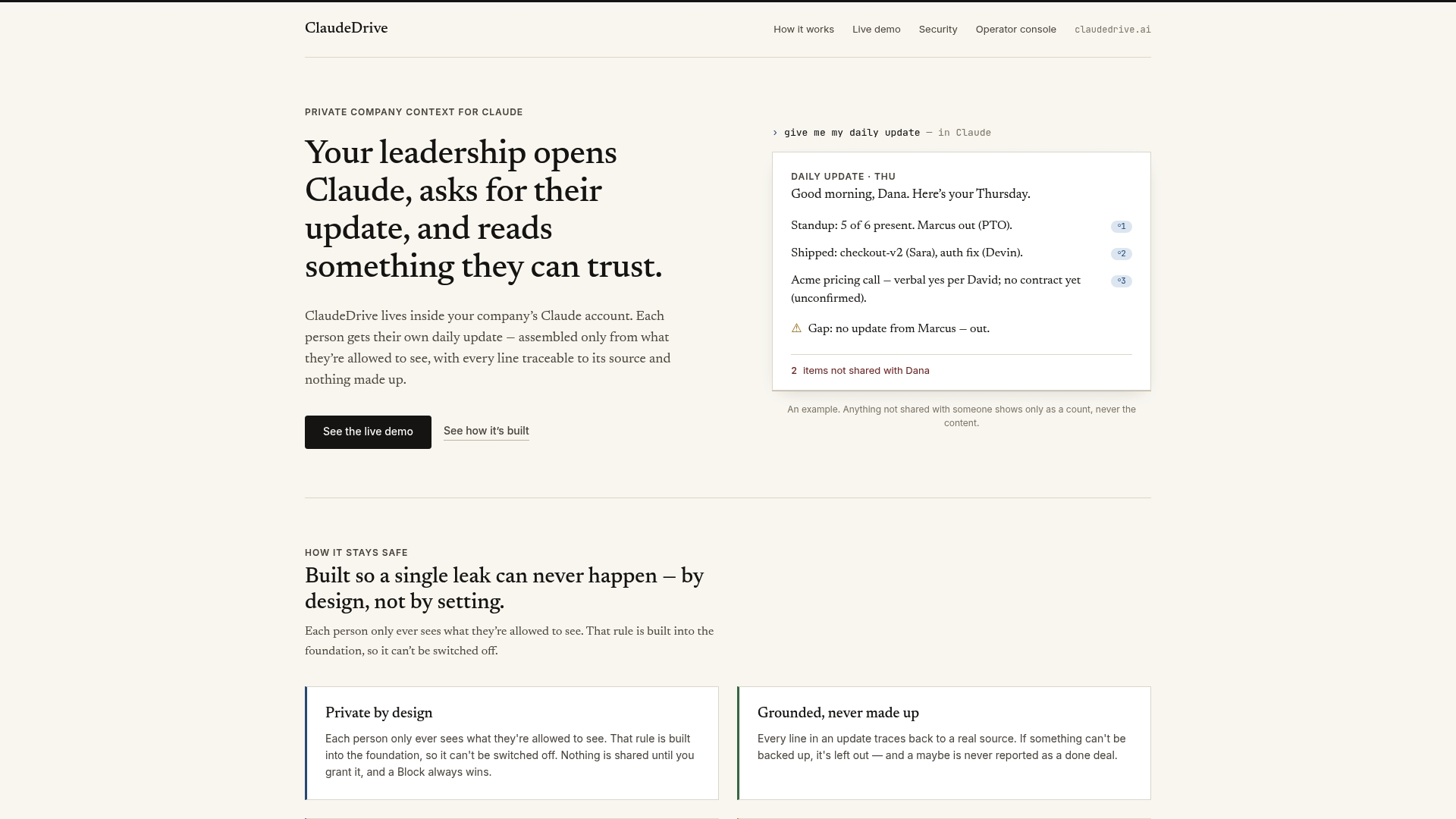
ClaudeDrive sits inside the Claude account your leadership team already uses. Connect your meeting notes, project tools, or calendar, and each leader gets a private, role-specific briefing built only from sources they are authorized to see. Every claim traces to a real source. No hallucinated metrics. No all-green spin. The format follows the same proven structure covered in this article: ask first, wins with metrics, honest misses, and a flagged risk. See the live demo at ClaudeDrive or talk to us about a pilot for your leadership team.
FAQ
What is a grounded update for executives?
A grounded update for executives is a concise briefing that leads with a specific decision request, followed by wins with metrics, honest misses, and a flagged risk, all within 200 words. The format prioritizes executive action over status reporting.
How long should an executive briefing be?
Weekly operational updates should stay at 200 words or fewer. Board-level briefings compress to three bullets plus a pre-read link. Length limits force prioritization and prevent signal loss.
Why do all-green updates damage trust?
An update with no yellow or red risk flags signals that the author is filtering for comfort rather than accuracy. Executives who see consistent all-green reports disengage because the updates stop reflecting operational reality.
How does AI support leadership grounded updates?
AI drafts updates using a consistent template that includes asks, wins, misses, and risks, reducing manual effort and enforcing format discipline across the organization. Role-filtered delivery means each leader reads only what is relevant to their decisions.
How often should executives receive grounded updates?
Weekly is the standard cadence for operational updates. Board briefings typically align with quarterly governance cycles. Frequency should match the decision-making rhythm of the audience, not the reporting convenience of the author.