Why Employees Ignore Company Updates: A Manager's Guide
Discover why employees ignore company updates and learn effective strategies to enhance engagement. Boost internal communication today!
ClaudeDrive
A Yungsten Tech product

Why Employees Ignore Company Updates: A Manager’s Guide

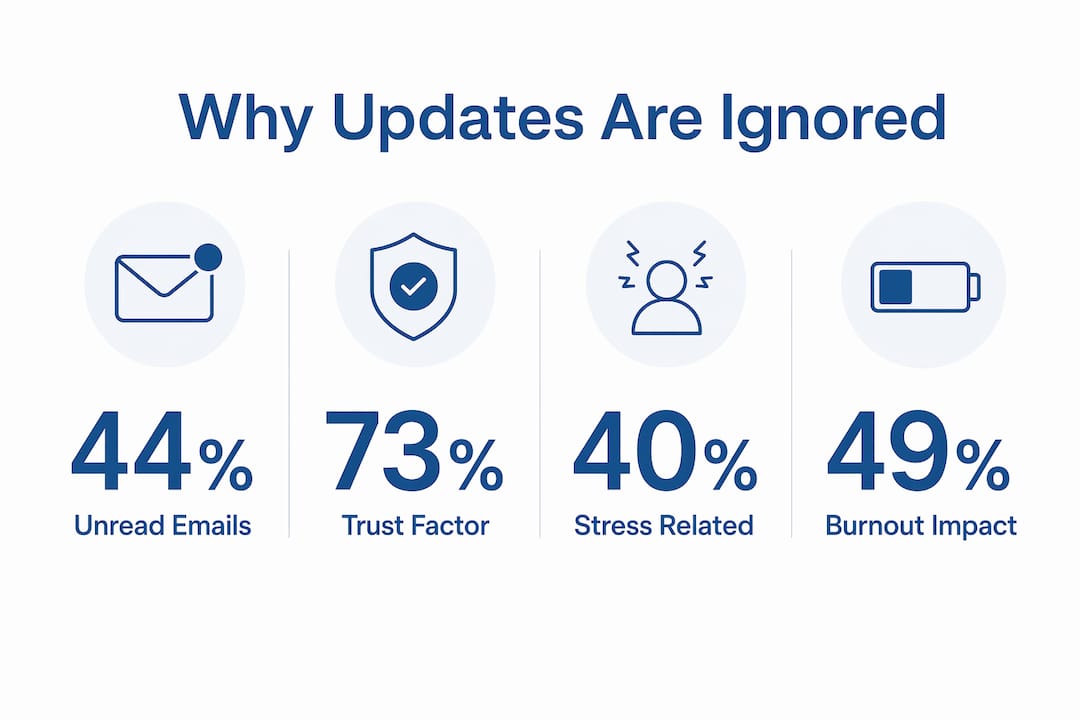
Employees ignore company updates when those updates fail to be clear, relevant, and tied to what actually matters in their day-to-day roles. 44% of internal emails are ignored entirely, and only 38% of employees engage with more than half of any given message. That number should stop every manager cold. The problem is not that employees are disengaged by nature. The problem is that most internal communication is built around the sender’s convenience, not the reader’s context. Understanding why employees ignore company updates is the first step toward fixing the infrastructure behind them.
Why employees ignore company updates: the root causes
Employee disengagement from internal messaging is the recognized term for what most managers experience as updates going unnoticed. It is not apathy. It is a rational response to communication that consistently fails to deliver value.
The data from 2026 is direct. 46% of employees tune out repetitive messages sent across multiple channels, while 40% ignore generic updates that feel irrelevant to their specific roles. These two causes alone account for the majority of unread communications in most organizations. Repetition creates fatigue. Irrelevance creates the habit of skipping.
Several structural factors compound the problem:
- Information overload. When employees receive dozens of messages daily across email, Slack, Teams, and intranets, they develop filters. Updates that do not immediately signal relevance get deprioritized or deleted.
- No clear call to action. Clear calls to action increase engagement by 13%, which means messages without them are treated as background noise rather than directives requiring a response.
- Generic company-wide messaging. A policy update relevant to the legal team should not land in the inbox of every warehouse supervisor. When it does, employees learn to ignore everything from that sender.
- Lack of clarity. Updates that bury the key point in three paragraphs of context train readers to stop reading before they reach it.
Employees focus on clarity, relevance, and trust rather than message volume when deciding what to engage with. More messages do not solve the problem. Better messages do.
Pro Tip: Before sending any company-wide update, ask one question: “What does a warehouse supervisor do differently after reading this?” If the answer is nothing, that person should not receive it.

How does trust in the source affect whether employees read updates?
Trust is the single most underestimated variable in internal communication. 73% of employees decide whether to trust a message based on who sent it, not what it says. That finding reframes the entire problem. You can write a perfectly clear, relevant update and still lose the reader if the sender lacks credibility.
Generic company accounts, “noreply” addresses, and messages signed “The Leadership Team” all suffer from the same deficit: they carry no personal accountability. Employees cannot ask a question, push back, or verify intent. The result is passive dismissal.
Recognized senders produce measurably better results. Sending from a known name increases email engagement by 8%. That gap is not trivial when you are trying to communicate a policy change or a strategic shift that requires behavioral response.
“Managers often misinterpret disengagement as lack of effort, when it is often due to cognitive overload and process friction.” — HCAMag, 2026
The practical implication for managers is clear. Updates that carry real weight should come from a named person with a direct line of contact. The direct manager is the most trusted communicator in any organization, consistently outperforming HR, corporate communications, and the CEO in day-to-day engagement. When managers relay updates in their own voice, with their own framing for the team’s context, read rates and response rates both improve.
The factors that build or erode source credibility include:
- Consistency. Managers who communicate regularly, not just during crises, build a baseline of trust that makes urgent messages land harder.
- Specificity. Vague reassurances (“We are committed to your success”) destroy credibility faster than silence. Specific, factual updates build it.
- Empathy signals. Acknowledging that a change is disruptive, or that a deadline is tight, signals that the sender understands the reader’s position.
Why current communication channels fail to reach employees
The cascade model, where leadership sends a message to directors who pass it to managers who relay it to teams, is the dominant model in most organizations. It is also the primary reason 61 to 76% of employees miss critical updates despite weekly communication touchpoints. Each handoff in the chain introduces delay, distortion, and the risk that the message simply stops moving.
The failure of official channels produces a predictable consequence. Employees migrate to shadow communications, using private chats, personal texts, and informal group threads to fill the information gap. These rogue relay networks operate outside leadership’s visibility and create real compliance and alignment risks. A manager who does not know what their team actually believes about a policy change cannot correct misunderstandings they cannot see.
Here is how the cascade model compares to a targeted delivery approach:
| Factor | Cascade model | Targeted delivery |
|---|---|---|
| Message reach | Dependent on each relay link | Direct to intended audience |
| Distortion risk | High at each handoff | Low, message is unchanged |
| Tracking capability | None | Measurable open and action rates |
| Relevance to recipient | Generic by the time it arrives | Filtered by role and context |
| Speed | Slow, days or weeks | Near real-time |
The structural fix is not to send more messages through the same broken pipes. It is to route the right message to the right person through a channel they actually use and trust. AI team update tools built for this purpose now make targeted routing practical at scale, without requiring a new platform rollout.
The hidden cost of channel failure is attrition. Failure in internal communication leads not just to lost information but to hidden attrition, as employees who feel uninformed disengage and eventually leave. The connection between poor update delivery and turnover is direct, and it is measurable.
Effective strategies to improve engagement with company updates
The shift from broadcast to targeted communication is the single highest-leverage change a manager can make. Segmentation by role and task significantly increases employee engagement compared to broad company-wide messaging. The mechanism is simple: when an employee reads an update and immediately recognizes it as relevant to their work, they read it fully and act on it.
Practical steps that produce measurable improvement include:
- Segment your audience before you write. Identify who actually needs to act on the information. Everyone else is a distraction recipient, and sending to them trains them to ignore you.
- Lead with the action, not the context. Put the key point or required action in the first sentence. Context belongs after the ask, not before it.
- Use digital signage for ambient updates. 72% of workers respond favorably to digital signage for company-wide messages. It is a low-friction channel that does not compete with inbox overload.
- Write subject lines that describe the action, not the topic. “Q3 budget approved, your team’s allocation attached” outperforms “Q3 Budget Update” every time.
- Tie updates to job expectations. Operational updates drive connection better than culture messaging for 50% of employees. Employees want to know what changed and what they need to do, not how the company feels about it.
The technology layer matters here. AI briefings outperform email updates for leaders precisely because they filter by role and context before delivery, removing the noise that causes disengagement. The format also matters. A daily briefing that surfaces only what is relevant to a specific person’s responsibilities eliminates the scanning fatigue that makes employees stop reading.
The impact of poor communication extends beyond missed messages. 40 to 49% of employees report stress or burnout linked to miscommunication. That is a workforce health issue, not just a messaging efficiency problem.
Key takeaways
Employees ignore company updates because the messages consistently fail on clarity, relevance, and source credibility, and fixing those three factors produces measurable engagement gains.
| Point | Details |
|---|---|
| Volume is not the problem | 44% of internal emails go unread; sending more messages does not improve engagement. |
| Source credibility drives trust | 73% of employees judge a message’s trustworthiness by who sent it, not what it says. |
| Cascade models fail by design | 61 to 76% of employees miss critical updates because each relay handoff introduces delay and distortion. |
| Segmentation is the fix | Targeting updates by role and task produces higher engagement than any company-wide broadcast. |
| Shadow communications signal failure | When employees form private relay networks, official channels have already lost their authority. |
What most managers get wrong about internal communication
I have spent years watching organizations invest in new communication platforms while the core problem stays exactly the same. The platform is never the issue. The content strategy is.
The most common misconception I see is that sending equals communicating. A manager sends an update, marks it done, and moves on. But the employee who received it alongside 47 other messages that morning made a split-second decision about whether it was worth their attention. If the subject line was vague, the sender was a generic alias, or the last three messages from that source were irrelevant to their role, the answer was no.
Trust deficits form fast and recover slowly. Once employees learn that a particular sender or channel consistently delivers noise, they stop checking. Rebuilding that attention requires a sustained period of high-relevance, high-clarity communication before the habit reverses. Most organizations never get there because they do not measure engagement at the message level and therefore never know the deficit exists.
The other thing I would push back on is the assumption that employees need to be motivated to read updates. They do not. They need the updates to be worth reading. The motivation is already there when the message is clearly relevant to their work, comes from someone they trust, and tells them exactly what to do next. That is not a high bar. Most organizations just never clear it consistently.
Real-time feedback loops are the missing piece in most communication programs. Without knowing which messages were read, which prompted action, and which were deleted unopened, managers are flying blind. The infrastructure question is not “what platform should we use” but “how do we know if this is working.”
— Paul
How ClaudeDrive delivers updates leaders can actually trust
The core problem with most internal communication is not effort. It is infrastructure. Leaders send updates into channels that were never designed to filter by role, track engagement, or surface only what a specific person needs to see.
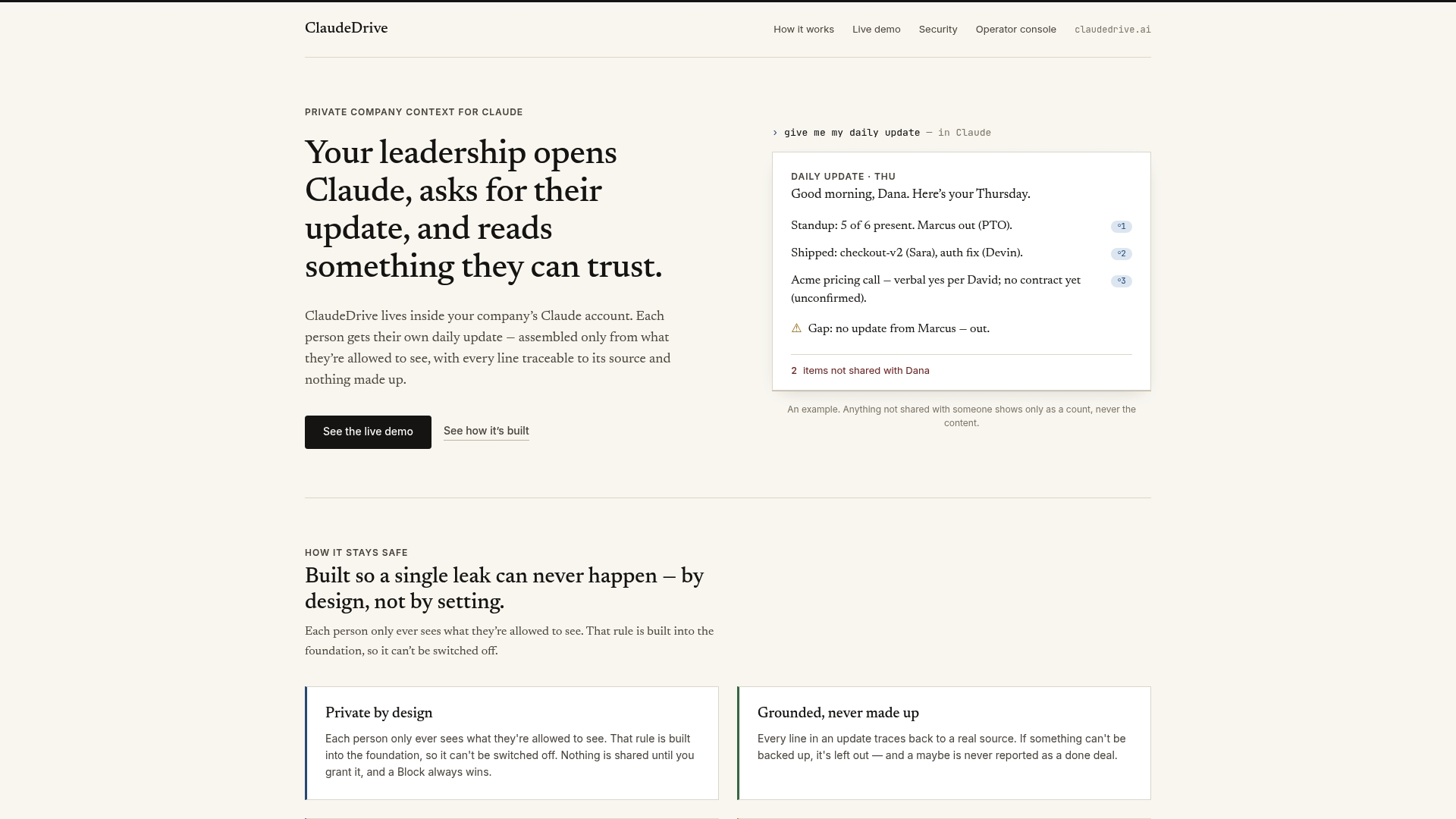
ClaudeDrive solves this at the source. Connect your meeting notes, calendar, and project tools, and each leader gets a daily briefing built only from what they are authorized to see, traceable to a real source, with nothing fabricated. No new dashboard to learn, no wiki to maintain. You open Claude, ask for your update, and read one clear briefing filtered to your context. For managers trying to understand filtered AI delivery at the leadership level, ClaudeDrive is the private context layer that makes it work. See the live demo at ClaudeDrive or talk to us about a pilot.
FAQ
Why do employees ignore company emails?
44% of internal emails are ignored because they lack relevance, clarity, or a clear call to action. Employees make a fast judgment based on the sender and subject line, and generic messages consistently lose that judgment.
How does message volume affect employee engagement?
Higher volume does not improve engagement. It accelerates disengagement. When employees receive too many updates, they develop filtering habits that cause even important messages to go unread.
What role does trust play in whether employees read updates?
73% of employees evaluate a message’s credibility based on who sent it. Updates from recognized, trusted senders consistently outperform those from generic company accounts.
What are shadow communications and why do they matter?
Shadow communications are the private chats and informal threads employees use when official channels fail them. They represent a direct signal that the formal communication system has lost authority, and they create compliance and alignment risks leadership cannot see.
How can managers improve update engagement quickly?
Segment messages by role, lead with the required action in the first sentence, and send from a named person rather than a generic account. These three changes address the most common reasons for employee disengagement with company updates.