30/90/180-Day Plan to Operationalize NIST AI RMF for U.S. Leaders
U.S. leaders: adopt the NIST AI Risk Management Framework with a 30/90/180‑day operational plan that uses the Playbook and Profiles to produce measurable,...
ClaudeDrive
A Yungsten Tech product

30/90/180-Day Plan to Operationalize NIST AI RMF for U.S. Leaders

The NIST AI Risk Management Framework is voluntary U.S. guidance built around four functions, Govern, Map, Measure, and Manage, that leaders use to scale AI responsibly while documenting trustworthiness. It carries no penalty for non-adoption, but it has become the reference standard U.S. regulators, auditors, and enterprise customers expect to see cited. Treat it as the operating system for AI governance decisions, not a compliance form to file once and forget.
TL;DR:
- Most organizations should start with Govern and Map, focusing on identifying AI risk owners and inventorying systems before measuring or managing risks.
- Adapting the NIST AI RMF requires assigning clear ownership for each action and tailoring the core functions to specific use cases and risk profiles.
- Sector-specific Profiles, such as the Generative AI Profile, help target relevant risks like hallucination and data leakage, saving time during implementation.
- Leaders should prioritize pilot projects on high-impact systems to generate concrete evidence before full-scale deployment, rather than attempting enterprise-wide adoption immediately.
- Implementing a real-time, source-linked update system enhances transparency, reduces shadow AI, and provides an audit trail for ongoing measurement and mitigation efforts.
Table of Contents
- What Is the NIST AI RMF? The Four Functions and Trustworthy AI
- How to Adopt the AI RMF: A 30/90/180-Day Plan for Leaders
- Profiles, the Playbook, and Use Cases: Materials Worth Reusing
- Governance Beyond IT: Why Cross-Functional Work Matters
- A Practical Example: Traceable Updates That Support Measure and Manage
- Resources and a Compact Adoption Checklist
- Challenges and Limitations of Implementing the AI RMF
- Where the AI RMF Fits Alongside Other AI Governance Rules
- Real-World Application: What Adoption Looks Like in Practice
- Metrics and Indicators for Measuring AI Risk
- What’s Next for the NIST AI RMF
- What Leaders Should Actually Prioritize
- See ClaudeDrive’s Approach to AI Governance Evidence
- Sources
What Is the NIST AI RMF? The Four Functions and Trustworthy AI
NIST built the AI Risk Management Framework as guidance, not law. No agency enforces it, no auditor certifies against it, and it applies to any sector or use case rather than a specific industry. That flexibility is the point: a hospital system, a bank, and a logistics company can all use the same structure without forcing their AI programs into someone else’s mold.
The Core organizes the work into four functions. Govern sits above the other three and runs across the entire AI lifecycle, covering culture, policy, and accountability. Map identifies context: what the system does, who it affects, and where it could go wrong. Measure applies tests, metrics, and evidence to those risks. Manage turns findings into action, mitigation, monitoring, and, when necessary, shutting a system down.
Underneath those functions sit seven characteristics NIST considers essential to trustworthy AI:
- Valid and reliable performance under real conditions
- Safe operation that avoids physical or psychological harm
- Secure and resilient systems that withstand attack or failure
- Accountable and transparent decision chains
- Explainable and interpretable outputs
- Privacy-enhanced design and data handling
- Fair treatment with managed bias
No system maximizes all seven at once. A highly explainable model often sacrifices some accuracy; a highly secure system can slow down usability. Leaders who understand this tradeoff make better calls than those chasing a perfect score on every dimension, because the framework never promises one. It gives a shared vocabulary and structure, not a checklist to complete.
How to Adopt the AI RMF: A 30/90/180-Day Plan for Leaders
Skip the temptation to run the whole Framework at once. NIST’s own Playbook offers staged, suggested actions precisely because organizations that try to do everything in month one tend to do nothing well. A phased path works better and gives you defensible progress markers along the way.
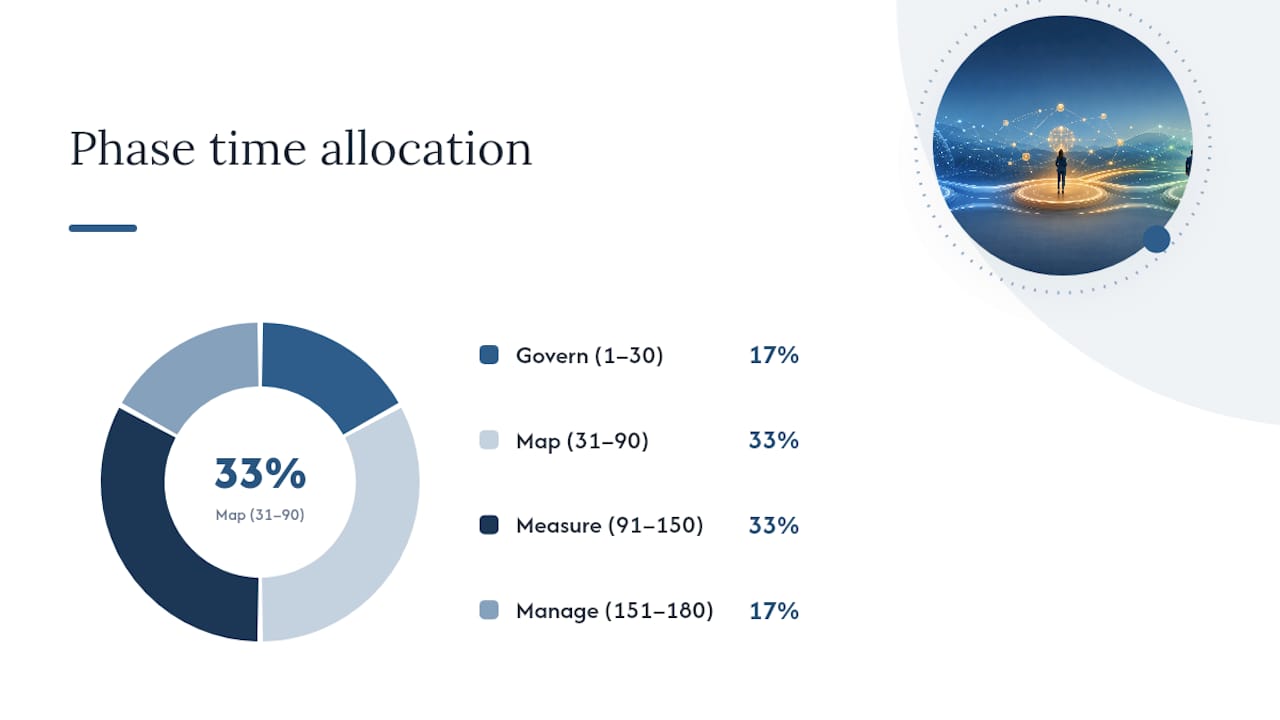
- Days 1 to 30, Govern. Name who owns AI risk (often a cross-functional committee reporting to the CTO or COO), set your organization’s risk tolerance in writing, and document legal and regulatory obligations tied to your sector.
- Days 31 to 90, Map. Inventory every AI system in production or development, note its context of use, who it touches, and what happens if it fails. Rank systems by potential harm and prioritize the highest-risk ones first.
- Days 91 to 150, Measure. Choose metrics and tests for your top-priority systems. Pull directly from Playbook suggested actions rather than inventing your own criteria from scratch.
- Days 151 to 180, Manage. Build mitigation playbooks, set up ongoing monitoring, define an incident response path, and decide the conditions under which a system gets retired.
Use Profiles to scope this work instead of applying every subcategory to every system. A generative AI chatbot and an internal fraud detection model carry different risks, and a relevant Profile tells you which suggested actions actually apply to each.
Pro Tip: Assign one named owner per Playbook action ID, not a team. When four people share responsibility for an action, none of them treat it as their job, and that’s exactly where audits find gaps.
Profiles, the Playbook, and Use Cases: Materials Worth Reusing
You don’t need to build implementation guidance from a blank page. NIST already published the pieces, and reusing them saves months.
- Profiles tailor the Core to a specific technology or sector. The Generative AI Profile, published as NIST AI 600-1, maps RMF functions directly to generative AI risks like hallucination, data leakage, and content provenance. If your organization runs any large language model tool, start here rather than the general Framework.
- The Playbook breaks each Core subcategory into suggested actions with action IDs (formatted like GV-1.1-001) that tie to specific roles and lifecycle stages. Assign these IDs directly to owners instead of writing your own task list.
- The AIRC use-case library, NIST’s Trustworthy and Responsible AI Resource Center, catalogs real applications of the Framework across sectors. Pulling a comparable use case cuts your Map and Measure work substantially, since someone has usually already scoped a similar risk profile.
Together, these three resources turn an abstract framework into an assignable backlog with clear line items.
Governance Beyond IT: Why Cross-Functional Work Matters
The single most common failure NIST’s own resources warn against is treating AI risk management as an IT problem. It isn’t. The AIRC resource center frames AI risk as socio-technical, meaning the hardest risks (bias, misuse, regulatory exposure) rarely show up in a code review.
Legal needs to weigh in on liability and disclosure obligations. HR needs to flag employment-related AI uses, hiring tools especially. Product teams know where customers will actually break the system in ways engineers never anticipated. Compliance and security round out the group, but they should never run it alone.
Two failure modes show up repeatedly. The first is checklist mentality: teams complete a form, file it, and consider the risk closed, even as the underlying model keeps changing in production. The second is siloing everything to IT or security, which strips out the business context that actually determines whether a risk matters.
Build three concrete artifacts to avoid both traps:
- A roles and responsibilities map naming who owns each Core function
- A communication plan for how risk findings reach leadership, not just engineering
- An accountability log tracking decisions, exceptions, and who approved them
Pro Tip: If your AI governance committee has no one from legal or HR, you don’t have a governance committee. You have an engineering review with better branding.
A Practical Example: Traceable Updates That Support Measure and Manage
Most Measure and Manage work stalls for a mundane reason: leaders can’t see what’s actually happening across scattered tools, so evidence collection becomes a scramble before every audit. A permissioned update system that pulls from meeting notes, code repositories, and calendars gives leaders a daily view built only from sources they’re cleared to see, with every line traceable back to its origin.
That structure supports RMF work in three concrete ways:
- It creates a running record of AI-related activity for Measure, instead of a retroactive reconstruction
- It surfaces unauthorized or unofficial AI tool use for Map, cutting down on shadow AI that never entered the risk inventory
- It enforces access boundaries so nothing crosses lines it shouldn’t, while keeping a full audit trail for Manage
The guarantee that matters to leaders is simple: what you read is real, sourced, and limited to what you’re allowed to see. A pattern like ACL-aware retrieval enforces that boundary technically, but the plain promise, nothing leaks across the line, is what leaders actually need to trust the output.
Resources and a Compact Adoption Checklist
Start with the primary sources rather than secondhand summaries. Read the AI RMF 1.0 PDF for definitions and the Core, the Playbook for action IDs to assign, the Generative AI Profile if you run any LLM tools, and the AIRC use-case library for comparable examples.
- Day 30: Governance roles assigned, risk tolerance documented
- Day 90: Full AI system inventory complete, ranked by risk
- Day 180: Metrics tracked, mitigation plans active, incident path defined
Challenges and Limitations of Implementing the AI RMF
The Framework’s biggest strength, flexibility, is also its biggest adoption hurdle. NIST deliberately avoided prescribing specific metrics, thresholds, or tools, which means two organizations can both claim RMF alignment while doing genuinely different work. That ambiguity frustrates risk managers who want a clear pass/fail bar to report to a board.
Resourcing is a real constraint too. Mapping every AI system across a mid-size organization takes real staff time, and many teams discover mid-inventory that they don’t actually know how many AI tools employees have quietly adopted. That gap alone often becomes the first genuine finding of the entire process.
Measurement poses its own problem. Some trustworthiness characteristics, fairness and explainability especially, resist clean quantification. A model can pass every accuracy test and still produce biased outcomes in a subgroup nobody tested for, and the Framework doesn’t tell you which subgroups to check.
Voluntary status cuts both ways. It keeps the Framework adaptable across sectors, but it also means internal champions have to build the business case for adoption without a regulatory mandate forcing the issue. That case gets easier as more procurement contracts and insurance underwriters start asking whether a vendor follows the AI RMF, but it isn’t automatic yet. Leaders who wait for a mandate before starting will find themselves months behind competitors who treated this as a genuine operating discipline early.
Where the AI RMF Fits Alongside Other AI Governance Rules
The AI RMF doesn’t operate alone, and treating it as your only governance reference leaves gaps. It works best as the operational backbone that other, more binding requirements plug into.
State-level rules, sector-specific regulations (financial services, healthcare, employment law), and contractual obligations from enterprise customers all impose harder requirements than NIST’s voluntary guidance. The Framework gives you the structure, Govern, Map, Measure, Manage, to organize compliance work across all of them instead of building separate processes for each regulation.
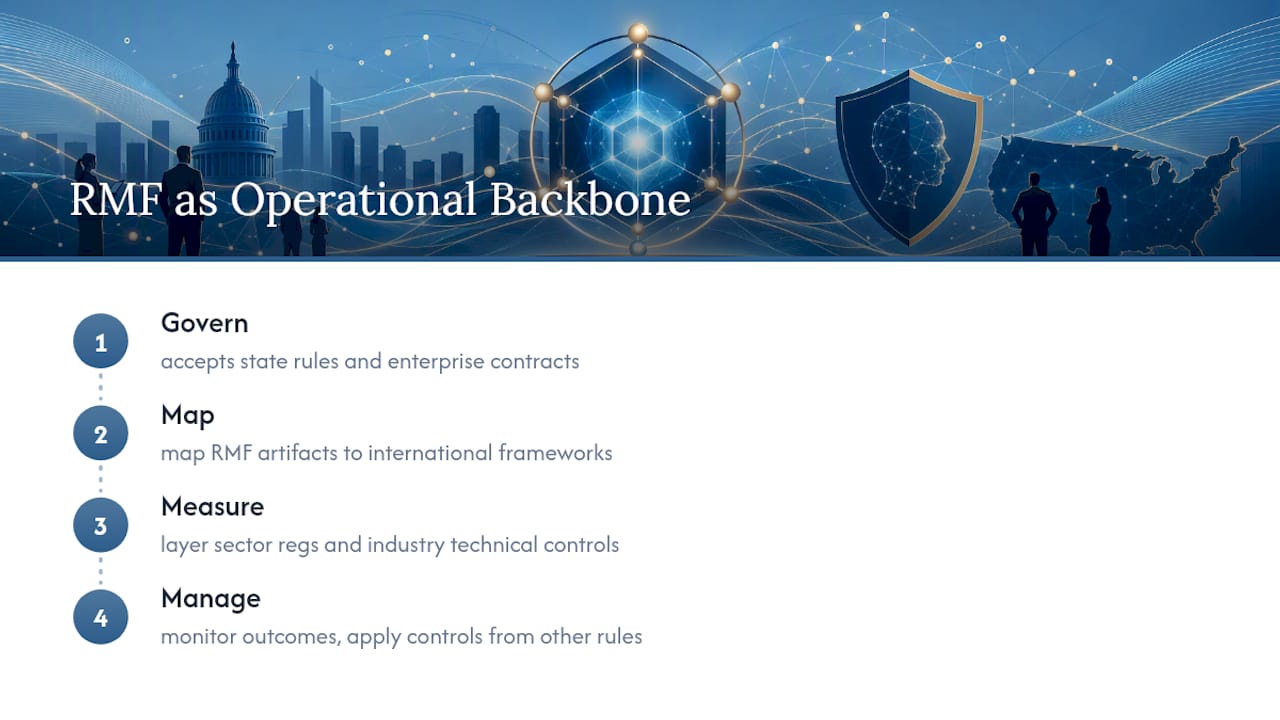
International frameworks matter too if your organization operates globally or serves customers who do. The overlap isn’t perfect, the EU’s approach leans more prescriptive with binding risk tiers, but the underlying logic, categorize risk, document controls, monitor outcomes, tracks closely enough that RMF documentation often satisfies a large share of what those frameworks demand. Mapping your RMF artifacts against whatever other standard applies to your sector avoids duplicate work.
Industry-specific guidance (financial model risk management rules, medical device software standards) tends to go deeper on technical detail than NIST’s general-purpose Framework. Use the RMF as your organizing structure and layer sector rules in at the Measure and Manage stages, where the specific metrics and controls actually live. Trying to run parallel, disconnected compliance tracks for each requirement is where most governance programs quietly collapse under their own paperwork.
Real-World Application: What Adoption Looks Like in Practice
Organizations that adopt the AI RMF successfully tend to share one trait: they start narrow. A bank piloting an AI-driven credit risk tool doesn’t try to map every AI system in the enterprise on day one. It runs the four functions against that single high-impact use case, generates real evidence, and only then expands the process outward.
That pattern matches what NIST’s own guidance recommends: operational pilots focused on a single high-impact use case produce measurable Measure and Manage evidence faster than attempting a company-wide rollout. A generative AI content tool used in marketing, for instance, is a common first pilot precisely because its risks (hallucination, brand tone, factual accuracy) are well documented in the Generative AI Profile, giving teams a running start.
Public sector examples in the AIRC use-case library show a similar pattern in hiring tools, fraud detection systems, and automated benefits screening: agencies mapped context and stakeholders first, measured against documented fairness and validity criteria, and only then scaled the tool into full production. The common thread across every credible case is sequencing. Govern and Map happen before a system goes live, not after something breaks and someone asks for the paperwork.
Metrics and Indicators for Measuring AI Risk
Measure is the function most leaders underestimate, because it requires picking concrete indicators rather than vague reassurances. NIST doesn’t hand you one universal scorecard. It expects you to select metrics that match the trustworthiness characteristics most relevant to your specific system.
For a customer-facing model, fairness metrics (disparate impact ratios across demographic groups) and explainability measures (can a reviewer trace why a decision was made) usually top the list. For infrastructure or security-critical systems, resilience testing and adversarial robustness checks matter more. For any generative AI tool, factual accuracy rates, hallucination frequency, and content provenance tracking become the core indicators, directly reflecting the risks the Generative AI Profile calls out.
Beyond model-level metrics, leaders should track process indicators: how many AI systems have completed a Map assessment, how many have documented mitigation plans, and how many incidents got logged versus quietly resolved off the record. That last number tends to be the most revealing one on any leadership dashboard, since a program with zero logged incidents after a year of AI use is usually hiding gaps rather than genuinely risk-free.
What’s Next for the NIST AI RMF
The Framework keeps expanding rather than sitting still. NIST released the Generative AI Profile in 2024 to address risks the original 2023 Framework didn’t anticipate at scale, and in 2026 it published a concept note for a Trustworthy AI in Critical Infrastructure profile, signaling more sector-specific guidance is coming for utilities, transportation, and similar high-stakes environments.
That pattern, general framework first, sector Profiles layered in over time, will likely continue as new AI applications create risks the original authors didn’t foresee. Leaders shouldn’t treat their current RMF documentation as a finished project. Check NIST’s framework page periodically for new Profiles relevant to your sector, since a Profile released next year could hand you suggested actions that save months of work you’d otherwise do from scratch.
What Leaders Should Actually Prioritize
Don’t apply the Framework uniformly across every system you own. Tailor it, weight Govern and Map heavily for anything customer-facing, and resist the checkbox instinct that treats a completed form as finished risk work. Visibility beats documentation every time an auditor or a board member starts asking real questions.
If you do one thing this quarter, pilot Measure and Manage on a single high-impact system and build real evidence before scaling further.
— Paul
See ClaudeDrive’s Approach to AI Governance Evidence
Most of the Measure and Manage work above depends on one thing: leaders actually seeing what’s happening across their AI systems without chasing five different tools for evidence. Get a daily update, permissioned and source-linked, right inside the Claude account used by your team. No new dashboard, no wiki to maintain, no separate app to roll out.
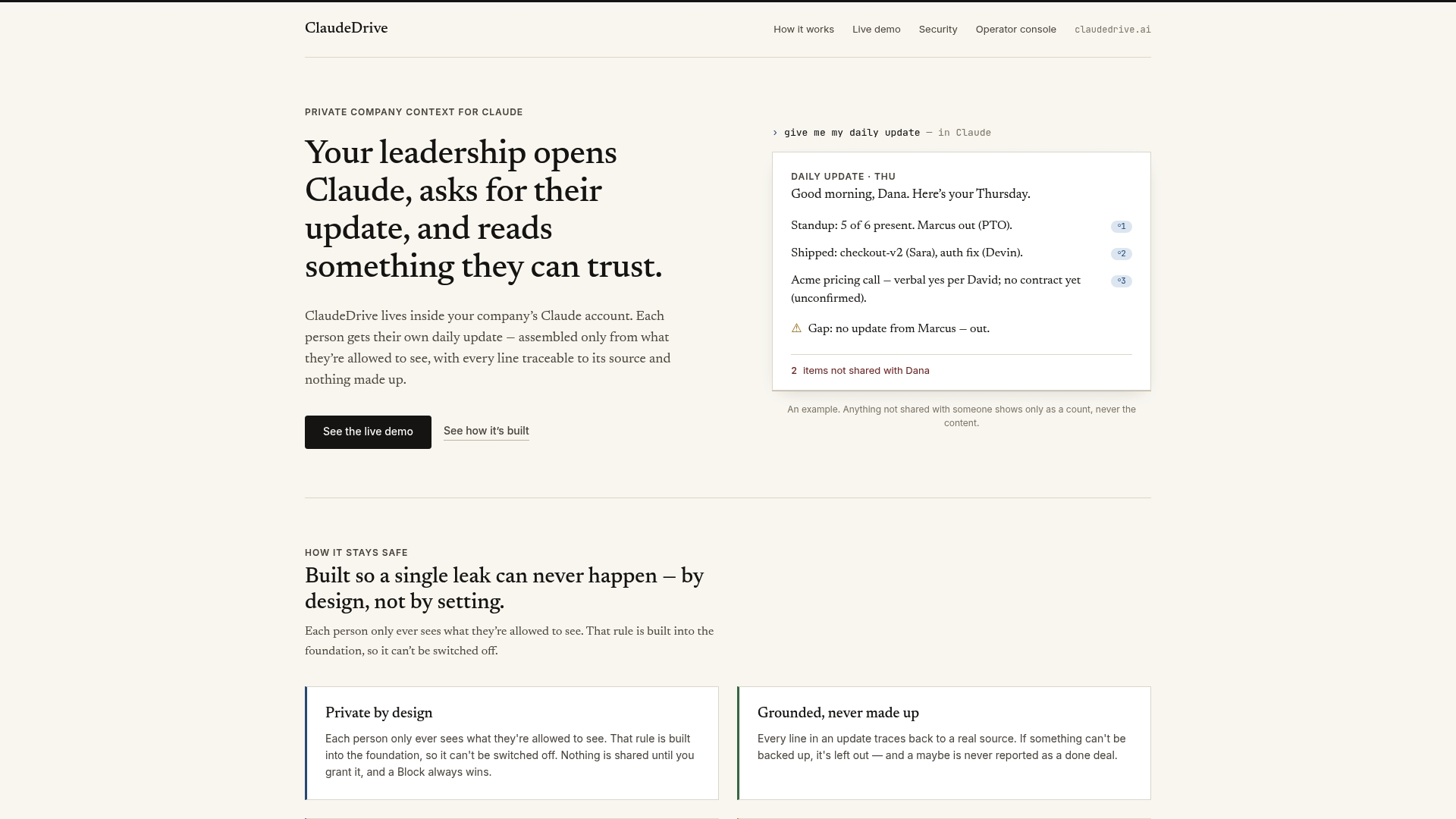
Connect meeting notes, GitHub, and your calendar, and each leader gets a personal view built only from what they’re allowed to see, with every line traceable back to its source. That structure directly supports the socio-technical governance work covered above: it reduces shadow AI by surfacing tool use that would otherwise stay invisible, and it gives you a running audit trail instead of a scramble before every review. For deeper background on the underlying risks this addresses, the AI security risks leaders face are worth a closer read.
See the live demo or talk to us about a pilot built around your highest-priority AI system.
Sources
- Artificial Intelligence Risk Management Framework (AI RMF 1.0) | NIST
- NIST AI RMF Playbook | NIST
- Artificial Intelligence Risk Management Framework: Generative Artificial Intelligence Profile
- AI RMF - AIRC