Build vs Buy Internal AI Context: A Leader's 90-Day Playbook
Discover how to navigate the build vs buy internal AI context. This 90-day playbook helps leaders optimize AI strategies for growth.
ClaudeDrive
A Yungsten Tech product

Build vs Buy Internal AI Context: A Leader’s 90-Day Playbook

For most high-growth teams, the right answer is to buy the infrastructure, rightsource the platform layer, and build only the domain logic that touches your proprietary data and carries your liability. That single rule covers the majority of the decision. The rationale comes down to three things: who explains a wrong output to a regulator or board, how much ongoing maintenance your team can realistically absorb, and where your competitive moat actually lives. Firms like JustSoftLab and AimTheory both frame this as a liability allocation question first, not a cost question. ClaudeDrive is one vendor that satisfies the mandatory controls on the buy side of that equation. Your immediate next step: this week, map each planned AI capability to the three layers below and mark which ones touch data you’d have to explain in a breach or audit.
Table of Contents
- How does the three-layer AI stack decide what to build vs buy?
- What decision criteria should you use to map each capability?
- What should you require from any internal AI context vendor?
- What do realistic timelines and costs actually look like?
- Who owns the risk, and what governance steps should you take now?
- How do you run a safe pilot and migrate to a hybrid approach?
- Who should own the context layer inside your company?
- What is the final verdict and your 90-day action plan?
- Key Takeaways
- The decision most leaders get wrong
- ClaudeDrive covers the checklist from day one
- Useful sources and templates for your procurement work
How does the three-layer AI stack decide what to build vs buy?
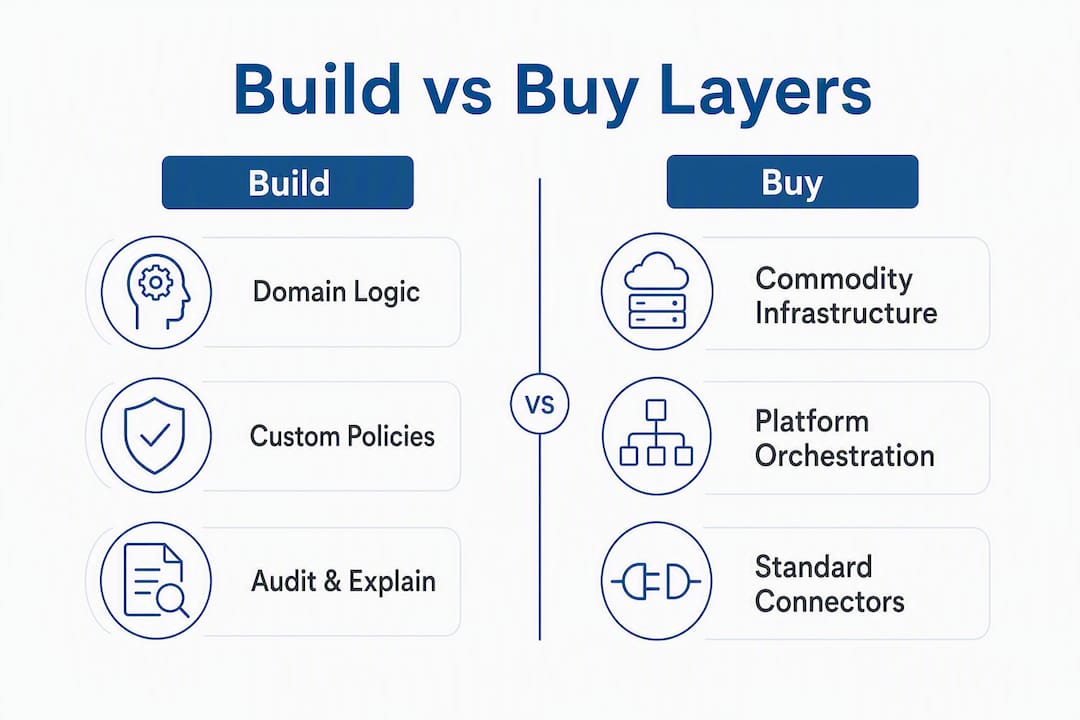
Every internal AI context decision maps cleanly to three layers, and the sourcing logic is different at each one.
Layer 1: Commodity infrastructure. Cloud compute, vector databases, standard connectors, observability tooling. Buy this. There is no competitive advantage in rebuilding ingestion pipelines or basic access control from scratch, and teams that try consistently burn months on work that open-source or vendor solutions already handle well.
Layer 2: Platform and orchestration. The layer that routes queries, enforces permissions, logs decisions, and manages context windows. This is where the sourcing choice depends on your team’s maturity. If you have platform engineers with SRE experience and a clear governance architecture, a hybrid approach works: buy the connectors and baseline governance, build the policy logic. If you don’t, buy this layer from a vendor with proven audit and offboarding controls, and plan to own the policy configuration.
Layer 3: Application and domain logic. The prompts, retrieval policies, and domain-specific rules that shape what your AI actually says and does. Build this. It touches your proprietary data, encodes your competitive judgment, and is the layer a regulator or executive will ask you to explain. Handing it to a vendor means that vendor’s model trains on your competitive intelligence.
| Layer | What lives here | Default sourcing | Build when… |
|---|---|---|---|
| Commodity infrastructure | Cloud, connectors, vector DB | Buy | Almost never |
| Platform/orchestration | Routing, permissions, audit logs | Buy or hybrid | You have SRE depth and a governance lead |
| Application/domain | Prompts, retrieval policy, domain rules | Build | Always, if it touches proprietary data |
Shopify’s internal platform work illustrates the principle at scale: decoupling the decision/observability layer from the execution layer makes each component safer to replace and cheaper to audit. The same logic applies whether you’re Shopify or a 40-person growth team.
What decision criteria should you use to map each capability?
The five axes that matter most, in order of weight:
- Data sensitivity. Does this capability touch data you’d have to disclose in a breach? If yes, you need full audit trails and the ability to revoke access instantly. A vendor without those controls is a liability, not a shortcut.
- Liability exposure. Who explains a wrong output? In regulated domains, the answer is always an internal owner. Build what you must be able to explain; buy what a vendor can indemnify.
- Maintenance capacity. Ongoing calibration, connector updates, and policy governance are not one-time costs. Teams routinely underestimate this. If you can’t staff a platform engineer and a governance lead, a vendor absorbs that surface area.
- Time-to-MVP. A credible in-house context layer takes 9–14 months with a multi-role team. A vendor pilot can be live in 30 days. That gap matters when the business is moving.
- Scale and velocity. High query volume and rapid feature iteration favor vendor platforms until your internal team has the depth to keep up.
| Dimension | Build wins | Buy wins | Rightsource |
|---|---|---|---|
| Data sensitivity (high) | ✓ domain layer | ✓ platform layer | |
| Liability (regulated) | ✓ policy logic | ||
| Maintenance capacity (low) | ✓ | ||
| Time-to-MVP (urgent) | ✓ | ||
| Scale/velocity (high) | ✓ | ✓ |
Scoring shortcut: if a capability scores “buy” on three or more axes, buy it. If it scores “build” on data sensitivity AND liability, build it regardless of the other scores.
What should you require from any internal AI context vendor?
The non-negotiables, in plain terms:
- Permission-aware retrieval. Access must be enforced at the moment of retrieval, not just at login. A person who loses access to a file should stop seeing it in AI outputs immediately. This is the governance baseline for any production context platform.
- Immutable audit trails. Every retrieval, every output, every access change must be logged in a way that cannot be edited after the fact. No audit trail means no explainability.
- Instant offboarding and data revocation. When someone leaves, their access and their data contributions should be removable in minutes, not a support ticket.
- Exportable context with metadata and history. You must be able to take your data out. If a vendor can’t give you a clean export with provenance, you’re locked in.
Contract clauses to insist on:
- No training on customer data without explicit opt-in, in writing. Vendors that use your data to improve their models are building a competitive advantage at your expense.
- Clear data egress terms: format, timeline, and completeness.
- Indemnity scope for data misuse and model behavior failures.
- SLA with teeth: defined response times and remediation for access-control failures.
Red flags: a vendor that can’t show you a third-party SOC 2 or ISO 27001 report, can’t demonstrate an offboarding test, or gives vague answers about export completeness is not production-ready. Walk away.
What do realistic timelines and costs actually look like?
The 30/60/90-day vendor path: a scoped pilot live by day 30, two or three integrations connected by day 60, governance policies and SLAs finalized by day 90. That’s achievable with one platform lead and a vendor with working connectors.
The build path is a different story. A credible internal context and orchestration layer runs 9–14 months with a team that includes platform engineers, a security/governance lead, and product management. Some teams with deeper platform maturity have done it faster, but the NOFire analysis puts the realistic runway for a credible in-house platform at well over a year in many cases.
Cost categories to budget for either path:
- Engineering headcount (the largest line item for a build)
- Cloud infrastructure and vector storage
- Integration work for each connected tool
- Governance setup: access policies, audit configuration, incident runbooks
- Ongoing calibration: model drift, connector updates, policy changes
The maintenance trap is where initial savings evaporate. Teams that build often budget for launch and forget that connectors break, models drift, and access policies need continuous review. That ongoing work is real engineering time, every quarter.
Who owns the risk, and what governance steps should you take now?
Build-vs-buy is a risk allocation question at its core. The layer that generates a wrong output or an unauthorized disclosure is the layer whose owner answers for it. That maps directly to your sourcing choice.
Governance actions to take immediately:
- Require traceable audit logs from day one of any pilot, vendor or internal.
- Define an allowed-use policy: what questions can the AI answer, for whom, and under what conditions.
- Write an incident runbook before you go live: who gets called, what gets shut down, and how you communicate externally.
- Assign a single internal owner for the context layer, with a clear SLA to business teams.
Pro Tip: Build what you must audit and explain. Buy the rest. That one rule resolves most of the build-vs-buy debate for leaders who don’t have time for a full framework.
The liability gap is real for in-house builds: granular audit trails, explainable retrieval pathways, and rollback semantics are non-trivial to implement and routinely underbudgeted. If your team hasn’t built this before, a vendor with proven controls reduces your exposure faster than a sprint plan will.
How do you run a safe pilot and migrate to a hybrid approach?
A safe pilot has four steps:
- Pick one or two high-value use cases with clear success criteria. Daily leadership briefings and engineering standup summaries are good starting points because the value is visible and the failure modes are low-stakes.
- Enforce export and logging from day one. Don’t wait until the pilot succeeds to negotiate export terms.
- Capture prompt-response pairs throughout the pilot. That data is the foundation of any future in-house domain layer.
- Run an explicit offboarding test before you sign a contract. Remove a test user and confirm their data disappears from outputs within minutes.
Safety controls during the pilot: scoped access (only the use cases in scope), a rollback plan if outputs degrade, and a weekly audit review with the platform owner.
Migration pattern: use the vendor for time-to-value, build a thin abstraction layer so vendor calls are swappable, then build the domain layer in-house once you have enough prompt-response data to do it well. This is the rightsourcing pattern JustSoftLab recommends: borrow execution experience to shorten time-to-value, keep ownership of the policy and domain logic.
Who should own the context layer inside your company?
Ownership belongs in the platform or product organization, with a single accountable leader. Not split across engineering and IT. Not owned by the AI team as a side project.
The roles that matter:
- Platform engineer: owns reliability, connector health, and export guarantees.
- Security/governance lead: owns access policies, audit configuration, and incident response.
- Product manager for domain logic: owns the prompts, retrieval policies, and business rules that shape outputs.
- SRE/ops footprint: small, but necessary for on-call coverage and incident runbooks.
The operational model that works: keep the platform team focused on reliability and exports; keep product teams focused on domain value. When those responsibilities blur, you get a system that’s neither reliable nor useful. NOFire’s analysis is direct on this point: teams lacking causal reasoning, SRE expertise, and governance architecture hit long timelines and brittle systems.
What is the final verdict and your 90-day action plan?

Buy the infrastructure and platform layer from a vendor that satisfies the procurement checklist above. Build the domain logic that touches your proprietary data. Rightsource the platform layer if your team has the depth to own policy but not to build connectors from scratch.
Five steps for the next 90 days:
- Days 1–10: Map each planned AI capability to the three-layer stack. Mark which ones touch data you’d have to explain in an audit.
- Days 11–30: Run a vendor bake-off using the procurement checklist. Require a live offboarding test and a SOC 2 report before shortlisting.
- Days 31–45: Launch a scoped pilot on one use case. Enforce logging and export terms from day one.
- Days 46–75: Finalize SLA and contract terms, including the no-training clause and data egress terms.
- Days 76–90: Review pilot outputs, audit logs, and maintenance load. Decide whether to expand the vendor scope or begin building the domain layer in-house.
At the 90-day mark, ask one question: can you explain every output the system produced, and can you remove any user’s data in under an hour? If yes, you’re ready to scale. If not, fix the governance before you expand.
Key Takeaways
For most high-growth teams, the right sourcing model is buy the platform layer from a vendor with proven audit and offboarding controls, and build only the domain logic that touches proprietary data and carries organizational liability.
| Point | Details |
|---|---|
| Buy the platform layer | Vendors with SOC 2, audit trails, and instant offboarding reduce liability faster than an in-house build. |
| Build the domain layer | Any capability touching proprietary data or requiring explainability to regulators must stay in-house. |
| Budget for maintenance | In-house builds require ongoing calibration, connector updates, and governance work every quarter. |
| Pilot with an offboarding test | Run an explicit offboarding test before signing any vendor contract; if data doesn’t disappear in minutes, walk away. |
| ClaudeDrive satisfies the checklist | ClaudeDrive enforces access at retrieval, provides full audit trails, and supports instant offboarding inside Claude. |
The decision most leaders get wrong
The build-vs-buy debate in AI almost always gets framed as a cost or speed question. It isn’t. It’s a question of who signs the incident report when something goes wrong.
Leaders who treat this as procurement end up with a vendor that has no indemnity clause, no audit trail, and no offboarding guarantee. Leaders who treat it as an engineering challenge end up with a 14-month build that’s already behind the vendor’s feature set by the time it ships. Neither outcome serves the business.
The governance frame changes the decision. When you ask “who explains this output to the board or a regulator,” the answer tells you exactly which layer to own and which to buy. The domain layer, where your competitive logic lives, is yours to own. The platform layer, where connectors and access controls live, is a vendor problem unless you have the depth to do it well.
ClaudeDrive’s permission-aware retrieval and audit guarantees are worth noting here not as a sales point but as a benchmark. Any vendor you evaluate should be able to match those controls. If they can’t, the liability stays with you regardless of what the contract says.
ClaudeDrive covers the checklist from day one
The hardest part of the procurement checklist isn’t finding a vendor that claims to meet it. It’s finding one where you can verify it before you sign. ClaudeDrive is built around exactly the controls this article describes: access enforced at retrieval so a person who loses permission stops seeing data immediately, full audit trails on every update, instant offboarding, and outputs that trace every line to a real source. No new app for your team to learn. Leaders open Claude, ask for their update, and read a briefing built only from what they’re allowed to see.
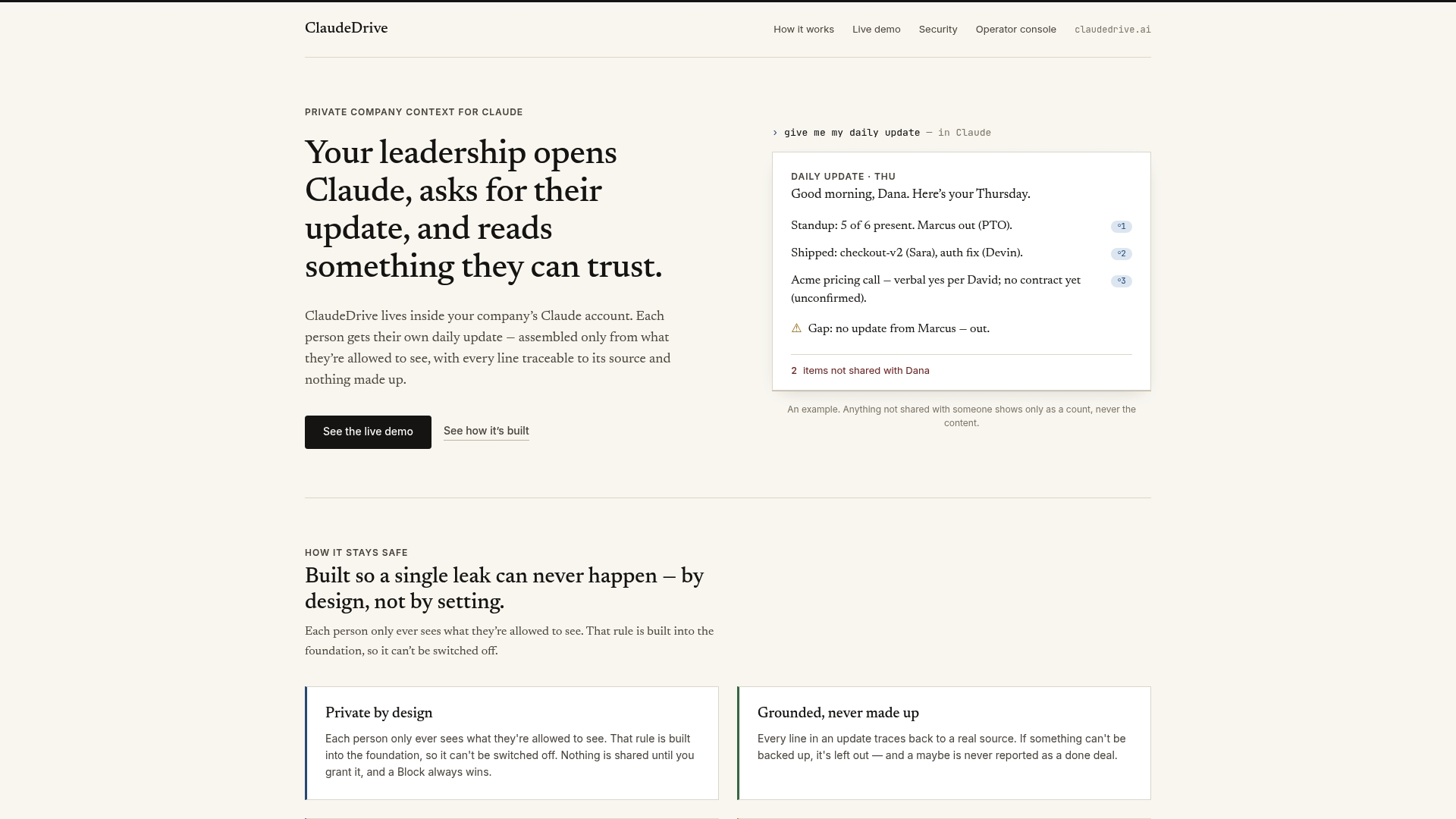
For a high-growth team that needs a trusted daily context layer without a 14-month build, ClaudeDrive is the pilot-ready option that satisfies the non-negotiables from day one. Connect meeting notes, GitHub, and your calendar, set who sees what, and your leadership team has a private, sourced update inside Claude by end of week.
See the live demo or talk to us about a pilot.
Useful sources and templates for your procurement work
- Company Context Layer Buyer Checklist for Leaders — a ready-to-use vendor evaluation checklist from ClaudeDrive
- How Teams Audit AI Updates: A Practical 2026 Guide — practical audit trail guidance for governance leads
- Build or Buy a Company Context Layer for Claude — deeper background on the sourcing decision specific to Claude deployments
- Under the River (2026) — Shopify’s internal platform substrate design, illustrating decoupled observability and execution layers