Cut Shadow AI Risk in 180 Days: Visibility First Playbook for Leaders
Find where sensitive data flows into unapproved AI, stop the worst leaks, and follow a 0–180 day visibility-first playbook for leaders, with...
ClaudeDrive
A Yungsten Tech product

Cut Shadow AI Risk in 180 Days: Visibility First Playbook for Leaders

Shadow AI risk is the exposure created when employees use AI tools your company never approved, reviewed, or secured. The immediate action is not a ban. It is discovery: find where sensitive data is flowing into unapproved AI tools, cut off the worst leaks first, and put security and business leadership jointly in charge of what happens next.
TL;DR:
- Nearly all organizations use some form of shadow AI, often without visibility, risking data leaks and regulatory violations across sensitive information categories.
- Common vectors include personal chatbot accounts, unreviewed browser extensions, OAuth permissions, public model downloads, and unvetted team workflows.
- Shadow AI incidents frequently involve exposure of customer PII, source code, API keys, or strategic documents, often through routine employee actions.
- Detection relies on logs from proxy servers, SaaS platforms, identity providers, and endpoints, with risk classified using data scope, autonomy, persistence, and supply chain transparency.
- Governance success depends on assigning clear ownership, implementing a tiered policy system, continuous monitoring, and embedding AI reviews into procurement and incident response processes.
Table of Contents
- What is shadow AI, and how is it different from shadow IT?
- How does shadow AI happen: common vectors and examples
- What are the real risks: data exposure, compliance, and financial cost?
- How do you detect and measure shadow AI in your environment?
- How do you govern and mitigate shadow AI across its lifecycle?
- What should leaders do first: a 0 to 180-day checklist?
- How does permission-aware AI reduce shadow AI pressure?
- What are the legal implications and privacy considerations?
- What do real shadow AI incidents actually look like?
- Where is shadow AI risk heading next?
- Perspective for leaders: what success actually looks like
- See how permission-aware updates cut shadow AI risk
- Primary sources and frameworks to read next
- Sources
What is shadow AI, and how is it different from shadow IT?
Shadow AI is any AI tool, model, or agent an employee adopts for work without security review or IT approval. Picture someone pasting a draft contract into a public chatbot to get a faster summary, or a sales rep feeding a spreadsheet of prospect names into a browser extension that promises better email drafts. Neither action feels reckless in the moment. Both can permanently expose confidential information.
Shadow IT has been a known problem for two decades. Someone signs up for a project management tool without a purchase order, and IT eventually finds it during a license audit. Shadow AI carries the same unapproved-tool problem, plus three features that make it structurally worse.
- Persistence. Once text enters a model’s training pipeline or a vendor’s logs, deleting the original file does not undo the exposure.
- Autonomy. Agentic tools can take actions (send emails, query databases, push code) without a human approving each step.
- Speed. A new AI tool can go from browser extension to company-wide habit in a week, long before procurement or security even hears about it.
The scale backs this up. Research from the Cloud Security Alliance finds nearly all organizations now report some form of unsanctioned AI use, and most lack real visibility into where that data is actually going. That is not a fringe problem limited to a few careless employees. It is the default state of most companies that have not yet built AI governance into how they operate.
The label “shadow AI governance” matters here because it signals a distinct discipline from generic shadow IT management. Traditional shadow IT policy assumes a static tool with a stable feature set. Shadow AI governance has to account for models that update weekly, agents that chain multiple actions together, and vendors whose data retention policies can change without much notice.
How does shadow AI happen: common vectors and examples
Most shadow AI does not arrive through some dramatic breach. It arrives through five ordinary paths, each one a habit an employee picked up because the approved option was slower or missing entirely.
Personal chatbot accounts. An employee signs up for a public AI assistant using a personal email, then uses it for work tasks because the company version is locked down or does not exist. This is the single most common entry vector, and it usually starts with something small: rewriting an email, summarizing a PDF, brainstorming a slide.
Browser extensions and note-taking bots. Meeting transcription tools, sales-call recorders, and “smart” browser plugins often request broad permissions and quietly upload conversation data to third-party servers. Many employees install these without reading the permission prompt, because the tool solves a real annoyance (nobody likes typing meeting notes).
OAuth-connected apps. An employee clicks “Continue with Google” or “Continue with Microsoft” to authorize a new AI tool, and that authorization can grant read access to email, files, and calendar data. These connections rarely show up on a security team’s radar because no software gets installed. The access lives entirely inside your identity provider’s permission grants.
Public model pulls and unreviewed agents. Developers download open models from public hubs to prototype a feature, or a team stands up an autonomous agent framework to automate a workflow, both without a security review. Security Info Watch notes that unreviewed agentic workflows expand the attack surface in ways traditional endpoint security was never built to catch.
Supply-chain assembly. Modern AI products are rarely one model. They are a model plus plugin plus third-party APIs, stitched together by a vendor you may have vetted, connected to sub-vendors you never did.
Here is roughly how these vectors tend to appear, in order of how often security teams find them during a first audit:
- Personal chatbot use for drafting, summarizing, or research
- Browser extensions with broad data-access permissions
- OAuth grants to AI tools inside core SaaS platforms
- Team-level agent deployments built without security sign-off
- Public model downloads used in internal prototypes
IBM points out that generative AI adoption has driven a sharp rise in employees pasting sensitive work content into tools accessed through personal, unmanaged accounts. That single behavior, copying and pasting into a browser tab, is responsible for more shadow AI exposure than almost anything else on this list.
What are the real risks: data exposure, compliance, and financial cost?
The damage from shadow AI risk falls into five buckets, and leaders need to know which data categories are most exposed before they can prioritize a response.
Data exposure by category. Personally identifiable information (PII) and protected health information (PHI) top the list because they carry direct regulatory consequences. Close behind: proprietary source code pasted into a public model for debugging help, credentials embedded in config files uploaded for “quick analysis,” and strategic documents (board decks, financial forecasts, M&A drafts) summarized through an unapproved tool because it was faster than waiting on IT.
Compliance and regulatory exposure. If PHI ends up inside a public AI tool’s logs, that can trigger HIPAA breach-notification obligations, regardless of whether the employee meant any harm. If EU customer data crosses into a model provider with no data processing agreement, that can violate GDPR’s rules on data transfers and processing purpose. Regulators are not concerned with intent. They are concerned with whether your company can show it knew where the data went and had a lawful basis for it going there. Most companies using shadow AI cannot answer that question today.
Supply-chain and model manipulation risks. Prompt injection attacks, where malicious instructions are hidden inside documents, web pages, or emails that an AI agent processes, are treated by security researchers as a top-tier model risk. The OWASP GenAI Top 10 guidance recommends treating every model, plugin, and agent artifact the way you would treat a third-party software dependency: with provenance checks, version tracking, and a default assumption that anything pulled from a public hub is untrusted until proven otherwise.
Quantified cost signal. This is where the numbers get hard to ignore.
The cost gap is measurable. IBM’s research finds that roughly one in five organizations has already experienced a breach or data-leakage incident traceable to employee use of generative AI. The Cloud Security Alliance adds that breaches connected to shadow AI carry materially higher costs than breaches without an AI component. Shadow AI is not a hypothetical line item on a risk register. It is already showing up on incident reports at a meaningful share of companies.
Reputational and financial fallout. A leaked source-code snippet is bad. A leaked customer list tied to a regulatory violation is worse, because it becomes a disclosure event, a legal exposure, and a headline all at once. Boards increasingly ask about AI governance specifically because the financial tail on these incidents (legal fees, notification costs, customer churn) tends to run longer than the initial breach story suggests.
A short list of what tends to get exposed first, roughly in order of how often it shows up in incident postmortems:
- Customer PII pasted for “quick formatting” or list cleanup
- Internal source code shared for debugging assistance
- API keys and credentials embedded in shared config files
- Strategic or financial documents summarized through unapproved tools
- Employee PII (compensation data, performance reviews) processed by HR-adjacent AI features
How do you detect and measure shadow AI in your environment?
You cannot govern what you cannot see, and that principle is the entire foundation of a workable shadow AI response. Discovery comes before policy, and policy comes before enforcement. Skip the order and you end up writing rules for a threat landscape you have not actually mapped.
Detection draws on six overlapping data sources, and no single one gives you the full picture:
- Proxy and DNS logs, which reveal traffic to known AI domains even when no software was formally installed.
- CASB (cloud access security broker) reporting, which flags new or unusual SaaS connections.
- Identity and OAuth inventories, pulled from your identity provider, showing every third-party app an employee has granted access to.
- DLP (data loss prevention) event logs, which catch sensitive-data uploads if your rules are tuned for AI destinations specifically, not just generic file transfer.
- Browser and endpoint telemetry, which can flag extension installs and clipboard activity tied to known AI domains.
- SaaS audit logs, especially inside platforms like Google Workspace or Microsoft 365, which often log connected-app grants that never touch your network perimeter at all.
An audit of OAuth grants and connected-app lists inside your core SaaS platforms is often the fastest way to surface unapproved AI integrations, according to Security Info Watch, because it requires no endpoint agent and no new tooling. You are reading permissions your employees already granted.
Once you have visibility, prioritize what you found using four dimensions the Cloud Security Alliance recommends for classifying shadow AI risk:
- Data scope. What categories of data can this tool access, and how sensitive are they?
- Action authority. Can the tool only read data, or can it take actions (send, delete, execute) on its own?
- Persistence. Does the tool retain data after a session ends, and for how long?
- Supply-chain transparency. Do you know which underlying model, sub-vendors, and data-handling practices this tool actually relies on?
A tool that scores high on all four (broad data access, autonomous action, long retention, opaque supply chain) goes to the top of your remediation list, ahead of a tool that only summarizes text a user pastes in manually with no memory.
Pro Tip: Run your first OAuth and connected-app audit before you write a single policy document. Most leadership teams are surprised to find that the riskiest tool in their environment was authorized by a well-meaning employee eight months ago and never revisited.
How do you govern and mitigate shadow AI across its lifecycle?
Discovery tells you what exists. Governance decides what happens next, and that requires converting a messy inventory of unsanctioned tools into a small number of clear, enforceable rules.
1. Assign ownership. AI lifecycle management needs a named owner, typically a joint function between security and a business leader (COO, CIO, or chief of staff) who understands both the risk and the operational reason employees reached for shadow AI in the first place. One insight worth taking seriously: the primary driver of shadow AI is rarely malicious intent. It is an accountability gap, where the approved option was too slow, too restrictive, or simply did not exist, so employees filled the gap themselves.
2. Build a four-tier policy taxonomy. Sort every AI tool into one of four statuses, each carrying its own data rules:
- Approved: vetted, contracted, monitored, safe for defined data categories.
- Monitored: in evaluation, allowed for low-sensitivity use with active logging.
- Restricted: allowed only for specific teams or specific data types, under added controls.
- Blocked: no sanctioned use case, access denied at the network or identity layer.
3. Layer in technical controls. DLP rules should be tuned specifically for AI destinations, not just generic external transfer. OAuth governance means reviewing and periodically re-certifying every third-party app connection, not just approving it once and forgetting it. Sandboxing isolates experimental AI tools from production data until they clear review. Model provenance checks confirm you know which model, version, and vendor sub-processors sit behind any tool you approve, consistent with treating AI artifacts as supply-chain items rather than one-time software installs.
4. Extend procurement and incident response. New SaaS purchases need an AI-feature review baked into the contract process, because vendors quietly add AI capabilities to existing products more often than they launch new AI products outright. Incident response plans need an AI-specific playbook: who investigates a suspected data leak into an AI tool, how fast, and with what evidence standard. Offboarding needs to include revoking AI tool access and OAuth grants the same day an employee leaves, not during the next quarterly audit.
5. Treat governance as continuous, not a one-time project. AI systems evolve faster than most regulatory or audit cycles, which means a model you approved in January can behave differently by June if the vendor pushes an update. One-time validation is not governance. It is a snapshot that expires.
Two frameworks make this less improvised. The NIST AI Risk Management Framework organizes the work into four functions, govern, map, measure, manage, that map cleanly onto the steps above: govern sets ownership and policy, map is your discovery and classification work, measure is your monitoring and KPIs, and manage is your enforcement and incident response. The OWASP GenAI Top 10 fills in the model-level detail, particularly around prompt injection and agent-specific risks that a general IT framework tends to miss.
One control worth calling out separately: non-human identities. Long-lived service accounts and API keys created by shadow AI workflows, often to let an agent access a database or send emails automatically, tend to outlive the project that created them. Orphaned credentials like these are one of the most persistent, least visible ways shadow AI risk lingers long after the original tool was forgotten.
Organizations without this kind of structure tend to see recurring data-policy violations tied to the same handful of unmanaged tools, because nobody owns the follow-up after the first violation gets flagged.
What should leaders do first: a 0 to 180-day checklist?
You do not need a twelve-month AI governance program before you take your first meaningful action. Here is a realistic sequence, broken into three windows.
Immediate (first two weeks):
- Run an OAuth and connected-app audit across your identity provider and top three SaaS platforms.
- Pull DLP logs filtered specifically for known AI domains, not generic external transfer.
- Set one emergency DLP rule blocking uploads of your single most sensitive data category (customer PII, source code, or financials, whichever applies) to unapproved AI destinations.
30 to 90 days:
- Classify every discovered AI asset using the four-dimension risk model (data scope, action authority, persistence, supply-chain transparency).
- Assign each tool a policy status: approved, monitored, restricted, or blocked.
- Stand up continuous monitoring for your highest-risk category, rather than treating the initial audit as a one-time event.
90 to 180 days:
- Add an AI-feature review gate to procurement for every new SaaS contract.
- Integrate AI-specific scenarios into your incident response plan, with named owners and evidence standards.
- Build continuous assurance into your review cycle, quarterly at minimum, since models and vendor policies change faster than annual audits can track.
For board reporting, three KPIs tend to matter most: the percentage of discovered AI tools with an assigned policy status, the number of unapproved sensitive-data uploads blocked per month, and time-to-detection for new shadow AI tools entering the environment. None of these require exotic tooling. They require you to have finished the discovery work first.
How does permission-aware AI reduce shadow AI pressure?
Most shadow AI does not start with bad intent. It starts with an employee who needs an answer and does not have a trustworthy, fast way to get it inside the tools they already use. That gap is exactly what drives someone toward a personal chatbot account in the first place.
ClaudeDrive addresses that gap directly. It gives each person on your team a daily update, built only from the sources they are already allowed to see, delivered inside the Claude account they already open every day. Connect meeting notes, GitHub, and the calendar once, and each person’s update draws only from what applies to their role. Nothing gets copied into a public tool because there is no reason to. The answer is already sitting inside Claude, sourced and traceable.
Every line in that update ties back to a real source, nothing is invented, and nothing crosses a line a given person should not see. That is the same discipline your governance policy is asking for: know what data a tool touches, know who is allowed to see it, and be able to show your work if a regulator or a board member asks. Instant offboarding revokes access the moment someone leaves, closing the same gap that orphaned credentials create elsewhere. A permission-aware update model gives security leaders something concrete to point to instead of a policy document nobody reads.

For sensitive categories specifically, the same principle applies to HR and investor data and to separating board-level information from engineering access. The goal is not adding another dashboard. It is removing the reason employees reach for one.
What are the legal implications and privacy considerations?
Shadow AI creates legal exposure in two distinct ways, and leaders need to treat them separately rather than lumping them into one generic “compliance risk” bucket.
The first is data-protection law. If a shadow AI tool processes EU resident data, GDPR’s rules on lawful processing, cross-border transfer, and data processing agreements apply regardless of whether the tool was ever approved by anyone. The company remains the data controller in most cases, meaning liability sits with you, not with the employee who pasted the data in. If a healthcare organization’s staff run patient information through a public AI tool, that can trigger HIPAA breach-notification requirements the same way any other unauthorized disclosure would, because HIPAA does not distinguish between malicious breaches and well-intentioned ones.
The second is contractual and intellectual-property exposure. Source code or proprietary documents pasted into a public model may be retained by the vendor under terms most employees never read, which can create IP disclosure problems, especially for patent-sensitive work or code under a strict client confidentiality agreement.
The practical takeaway: regulators generally do not accept “we didn’t know” as a defense once shadow AI use is widespread enough to be foreseeable, and the Cloud Security Alliance’s research suggests it usually is foreseeable, given how common unsanctioned AI use has become. Legal and compliance teams should be involved in shadow AI governance from day one, not brought in after an incident.
What do real shadow AI incidents actually look like?
The pattern across publicly reported shadow AI incidents tends to follow a common shape: a well-intentioned employee, a task that felt routine, and a data category nobody had flagged as high-risk until it leaked.
One recurring scenario involves engineering teams pasting proprietary source code into public coding assistants to debug faster, only to discover the code (or fragments of it) had been retained by the vendor under terms the team never reviewed. Another common pattern involves HR or recruiting staff using AI tools to screen resumes or draft offer letters, unknowingly processing candidate PII through a service with no data processing agreement in place, creating exposure the moment a candidate later files a privacy complaint.
A third pattern shows up in finance and strategy functions: someone uses an AI summarization tool to condense a board deck or M&A briefing ahead of a meeting, not realizing the tool’s free tier retains uploaded content for model improvement. The document itself never left the building through a traditional breach vector. It left through a browser tab.
What connects these cases is not recklessness. It is the absence of a fast, sanctioned alternative that made the unapproved tool feel like the reasonable choice at the time. That is precisely the accountability gap the Cloud Security Alliance points to as the primary driver of shadow AI adoption, and it is why blanket bans rarely solve the underlying problem. The employee’s actual need does not disappear just because the tool got blocked.
Where is shadow AI risk heading next?
Three trends are reshaping shadow AI risk faster than most governance programs can keep pace with.
Autonomous agents are the biggest shift. Early shadow AI was mostly a copy-paste problem: a person moving text into a chatbot. Agent frameworks change that by letting AI systems take multi-step actions on their own, querying databases, sending communications, triggering workflows, often stitched together by a team without a formal security review. That autonomy means a shadow AI incident increasingly looks less like a leak and more like an unauthorized action with real consequences.

Embedded AI features inside existing SaaS tools are the second shift, and arguably the sneakier one. Vendors are adding AI capabilities to products your company already approved and pays for, which means a tool that passed procurement review last year can quietly gain new AI-driven data processing this year with no new contract, no new vendor review, and no flag raised anywhere. Recurring feature audits of your existing SaaS stack are becoming as important as vetting new tools.
The third shift is regulatory catch-up. AI governance frameworks are increasingly framed as continuous processes rather than one-time certifications, because AI systems evolve faster than the regulatory cycles meant to govern them. Expect more jurisdictions to formalize AI-specific breach-notification and audit requirements over the next several years, following the general pattern GDPR set for data protection broadly. Leaders who build continuous assurance into their governance program now will be adapting to those rules from a position of readiness, not scrambling to retrofit compliance after the fact.
Perspective for leaders: what success actually looks like
Success is not zero shadow AI. It is a complete inventory, a falling count of unapproved-tool incidents, and something you can put in front of your board with confidence. The biggest pitfall I see is the blanket ban: it drives usage underground and solves nothing, because the accountability gap that created the shadow tool in the first place is still there. The second pitfall is ignoring embedded AI features inside tools you already approved, since those slip past procurement entirely. Make the sanctioned path the fast path, and most of this problem solves itself.
— Paul
See how permission-aware updates cut shadow AI risk
Every governance step in this article points to the same conclusion: employees reach for shadow AI when the sanctioned option is slower or less useful than the alternative. ClaudeDrive removes that trade-off. It gives each person a daily update built only from sources they are cleared to see, delivered inside Claude, with every line traceable back to a real source and nothing invented along the way.
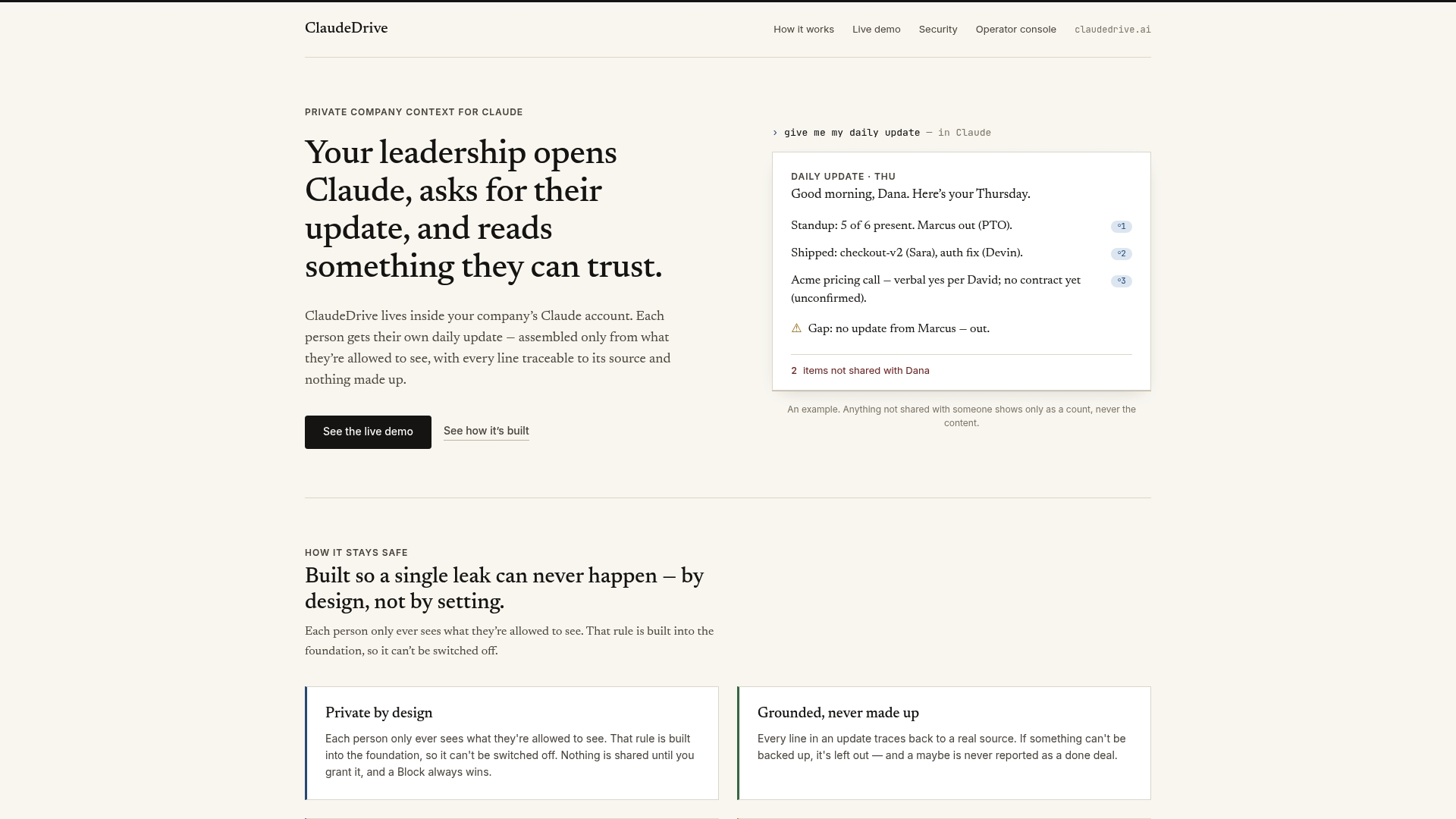
That means no new dashboard to roll out, no wiki to maintain, and no reason for a team member to paste a meeting note or a GitHub update into a public chatbot just to get a straight answer. Connect meeting notes, GitHub, and the calendar once, and each person gets their own private view of what happened, with access enforced at the source and full audit trails behind it. For a leader trying to reduce shadow AI pressure without adding friction, that combination, per-person privacy paired with traceability, is the practical middle ground between a total ban and doing nothing.
If you want to see how it holds up against your own team’s data before rolling it out, see the live demo or talk to us about a pilot.
Primary sources and frameworks to read next
For leaders who want the original documents rather than a summary: the Cloud Security Alliance’s shadow AI research covers scale, breach-cost data, and the four-dimension risk classification referenced throughout this article. The NIST AI Risk Management Framework lays out the govern-map-measure-manage structure for lifecycle governance. IBM’s shadow AI research quantifies breach incidence tied to generative AI use. The OWASP GenAI Top 10 guidance details prompt injection and agent-specific model risks. For a broader governance framework overview, Tekkr’s breakdown of AI governance walks through implementation steps for teams building a program from scratch.
Sources
- Shadow AI Infrastructure: systemic risk to the enterprise — Cloud Security Alliance (2026)
- NIST AI Risk Management Framework
- Shadow AI risks security teams can’t afford to ignore — Security Info Watch (2026)
- What Is Shadow AI? — IBM Think