Permission-Aware Retrieval for LLM: 2026 Guide
Discover permission-aware retrieval for LLM in this 2026 guide. Ensure secure data access and protect sensitive information with effective frameworks.
ClaudeDrive
A Yungsten Tech product

Permission-Aware Retrieval for LLM: 2026 Guide

Permission-aware retrieval for LLM is the practice of enforcing strict access rights during data retrieval so that a language model consumes only the information a requesting user is authorized to see. Without this control, an LLM can surface confidential records, cross tenant boundaries, or expose data that belongs to a different team or role. Industry frameworks including Authorization-First Retrieval, Row-Level Security, and Attribute-Based Access Control each treat retrieval as a hard security gate, not a downstream filter. For any organization deploying AI across multiple teams or data sources, this is the foundational control that determines what the model is even allowed to know.
What is authorization-first retrieval and why does it matter?
Authorization-First Retrieval, commonly abbreviated as AFR, is an architectural principle that requires every document in a candidate set to pass an authorization check before any model processes it. The formal guarantee is direct: every document retrieved must satisfy authorize(user, document) = true before it enters model context. That guarantee eliminates the most common failure mode in LLM retrieval systems, which is retrieving broadly and filtering late.
The alternative, a retrieve-then-filter approach, is structurally unsafe. A pipeline that defers authorization until after reranking or model generation cannot guarantee strict authorization correctness. Sensitive data can leak into intermediate representations, log files, or model outputs before any filter runs. The exposure is not hypothetical. It is a direct consequence of where in the pipeline the check lives.
AFR fits naturally into Retrieval-Augmented Generation pipelines. In a standard RAG setup, a query triggers a search across a document index, and the top results become the model’s context. AFR inserts the authorization check between the search and the context assembly steps. The model never sees a document it should not see, because that document never enters the retrieval result set.
“Retrieval is the control plane enforcing least privilege at context fetch time, not a downstream filter. Treating permission-aware retrieval as a content moderation feature is a critical architectural mistake.”
The performance case for AFR is also strong. A single-pass join between user permissions and document availability, rather than a multi-stage filter, reduces pipeline complexity and cuts the surface area for bugs. Security and efficiency point in the same direction here.
How do Row-Level Security and ABAC integrate with LLM retrieval?
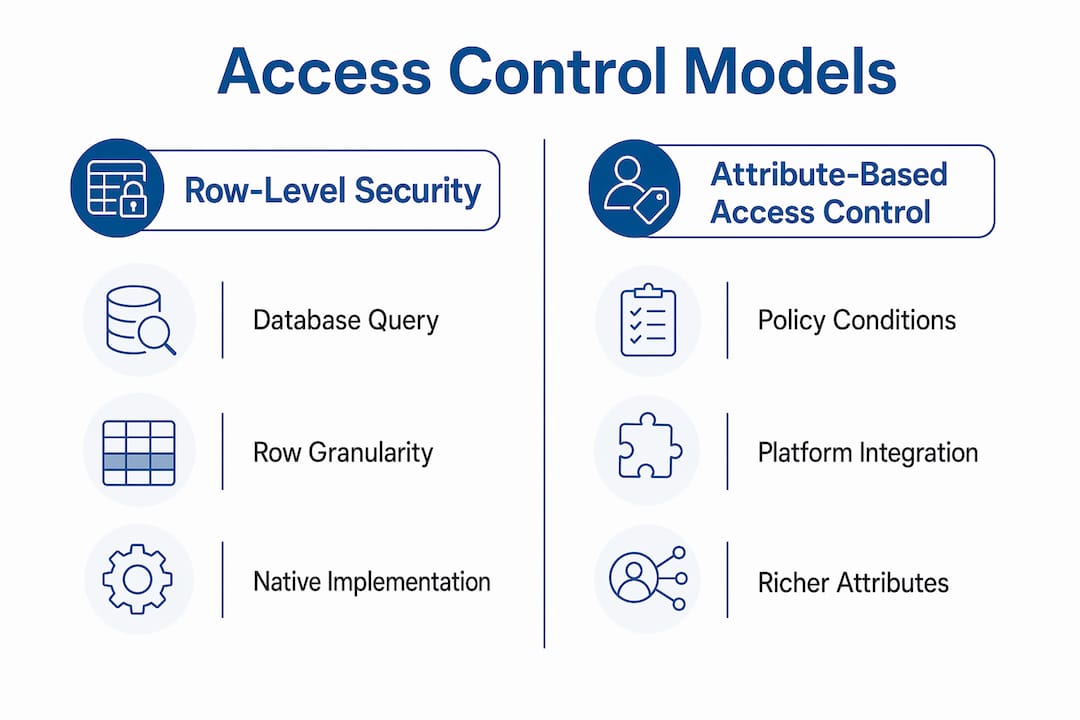
Enterprise permission-based data access relies on two well-established models: Row-Level Security and Attribute-Based Access Control. Both enforce the same principle. Access decisions are made at query time, based on the identity of the requester, and they apply regardless of whether the query comes from a human or an LLM.
Row-Level Security, implemented natively in databases like PostgreSQL, restricts which rows a user can read or modify based on boolean policy expressions evaluated per row. A default-deny applies when no policy exists. This means an LLM querying a PostgreSQL-backed retrieval index inherits the same row-level restrictions as any direct SQL client. The model cannot bypass the policy by phrasing a query differently.
Attribute-Based Access Control extends this logic to richer policy conditions. Platforms like Databricks implement ABAC to enforce policy-driven access based on user attributes such as department, clearance level, or project membership. This is particularly useful in multi-tenant AI environments where the same model serves users with very different entitlements.
| Access control model | Enforcement point | Best suited for |
|---|---|---|
| Row-Level Security | Database query layer | Structured data with row-granular policies |
| Attribute-Based Access Control | Policy engine at retrieval | Complex, multi-attribute entitlement rules |
| Access Control Lists stored with embeddings | Vector index | Unstructured document retrieval in RAG |
The limitation of both models is consistency. Neither RLS nor ABAC helps if permission logic is scattered across multiple services, each enforcing rules differently. A unified permission management layer that consolidates authorization checks across all data sources is the only way to reduce risk from scattered logic and inconsistent entitlements.
Pro Tip: Centralize your permission logic into a single authorization service that all retrieval components call. Distributed permission checks create gaps that are difficult to audit and easy to exploit.
What are the key design principles for a secure retrieval pipeline?
Building a retrieval pipeline that enforces least privilege end to end requires more than a single authorization check. Permissions must be enforced at every stage: candidate generation, permission filtering, ranking, and context assembly. Ignoring entitlements at any one stage creates a path to context leakage.

The most reliable architectural pattern stores access control metadata alongside document chunks in the retrieval index. This enables a single-pass filter that joins user permissions with document availability before any ranking occurs. It also prevents metadata leaks, where a document’s title or summary appears in search results even though the full content is restricted.
Identity validation is a separate and equally critical concern. The retrieval service must derive the user’s identity from a trusted external provider. Identity must come from SSO, OIDC, or SAML, not from a natural language prompt. Allowing an LLM to self-report or self-correct authorization via prompt input is a critical security flaw. The model has no way to verify claims made in its own input.
Multi-agent systems introduce additional complexity. When one AI agent calls another, the downstream agent must operate within the original calling user’s access scope. Inherited delegation enforces this by restricting each agent in a chain to only the data the originating user is authorized to see. Without inherited delegation, a multi-step reasoning chain can quietly accumulate access beyond what any single step would allow.
Context graphs that model entitlements and data provenance support both security and auditability. They provide a clear record of which user triggered which retrieval, which documents were considered, and which were excluded. This is the foundation for document-level permissions in AI search that compliance teams can actually inspect.
Pro Tip: Treat your retrieval pipeline as a security boundary, not a convenience layer. Audit every stage independently and verify that authorization checks survive pipeline refactors and model upgrades.
How can enterprises operationalize permission-aware retrieval for compliance?
Operationalizing secure LLM queries means embedding permission controls into the organization’s existing security architecture, not building a parallel system. Zero Trust Architecture provides the right frame. Every retrieval request is treated as untrusted until the user’s identity is verified and their entitlements are confirmed. No document is assumed accessible by default.
The business outcomes are concrete. Enforcing least privilege at retrieval time reduces the risk of data leaks across team or tenant boundaries. It supports auditability because every context window assembled for the model is traceable to a specific user identity and a specific set of entitlements at a specific time. Leaders can answer the question “what did the AI know when it gave that answer?” without guessing.
Compliance frameworks including GDPR, HIPAA, and SOC 2 all require demonstrable controls over who accesses sensitive data. Permission-aware retrieval provides the technical mechanism that maps to those requirements. The retrieval log becomes an audit trail. The permission policy becomes a documented control. Both are reviewable by auditors without requiring access to model internals.
| Compliance requirement | How permission-aware retrieval addresses it |
|---|---|
| Data minimization | Model context contains only authorized documents |
| Access auditability | Every retrieval is logged with user identity and entitlements |
| Least privilege enforcement | Candidate set is authorization-constrained before model use |
| Tenant boundary protection | Per-user permission filters prevent cross-tenant exposure |
Policy review cycles matter as much as the initial implementation. Entitlements change when employees change roles, projects close, or data classifications are updated. A retrieval system that enforces stale permissions is only marginally better than one with no permissions at all. Building approval workflows and scheduled policy reviews into the operational model keeps the system honest over time. For a practical look at how access control at retrieval works in practice, the enforcement patterns are well-documented for 2026 deployments.
Key Takeaways
Permission-aware retrieval is the security gate that determines what an LLM is allowed to know, and it must be enforced before the model ever sees a document.
| Point | Details |
|---|---|
| Authorization before retrieval | AFR guarantees every document passes an access check before entering model context. |
| Centralize permission logic | Scattered authorization checks across services create gaps that auditors and attackers both find. |
| Identity from trusted providers | User identity must come from SSO, OIDC, or SAML, never from prompt input. |
| Enforce at every pipeline stage | Candidate generation, ranking, and context assembly each require independent permission enforcement. |
| Compliance is a retrieval outcome | Audit trails, data minimization, and least privilege all map directly to retrieval-layer controls. |
Why retrieval permissions are the real AI security question
The debate about AI safety in enterprises tends to focus on model behavior: what the model says, how it reasons, whether it hallucinates. That focus misses the more immediate risk. The model can only work with what it retrieves. If the retrieval layer is insecure, the model’s behavior is irrelevant. It will faithfully summarize data it should never have seen.
What I find most underappreciated is how often organizations treat permission-aware retrieval as a content moderation problem. They add output filters, they review responses, they build approval queues. None of that addresses the root issue. The document was already in the context window. The exposure already happened. Filtering the output is closing the door after the data has left the room.
The multi-agent future makes this more urgent, not less. As AI systems chain together multiple models and tools, each step in the chain is a potential authorization gap. Inherited delegation is not a nice-to-have feature. It is the mechanism that keeps a five-step reasoning chain from quietly accumulating access that no single user was ever granted. Understanding how RAG systems propagate context across agents is the prerequisite for designing safe ones.
My honest view is that leadership teams should treat the retrieval layer with the same scrutiny they apply to database access controls. The question is not “what can the AI do?” The question is “what is the AI allowed to see?” That question has a technical answer, and it lives in the retrieval pipeline.
— Paul
ClaudeDrive builds permission-aware context into every briefing
ClaudeDrive is the private company-context layer that feeds Claude, built specifically so that leaders get a daily briefing drawn only from what they are authorized to see.
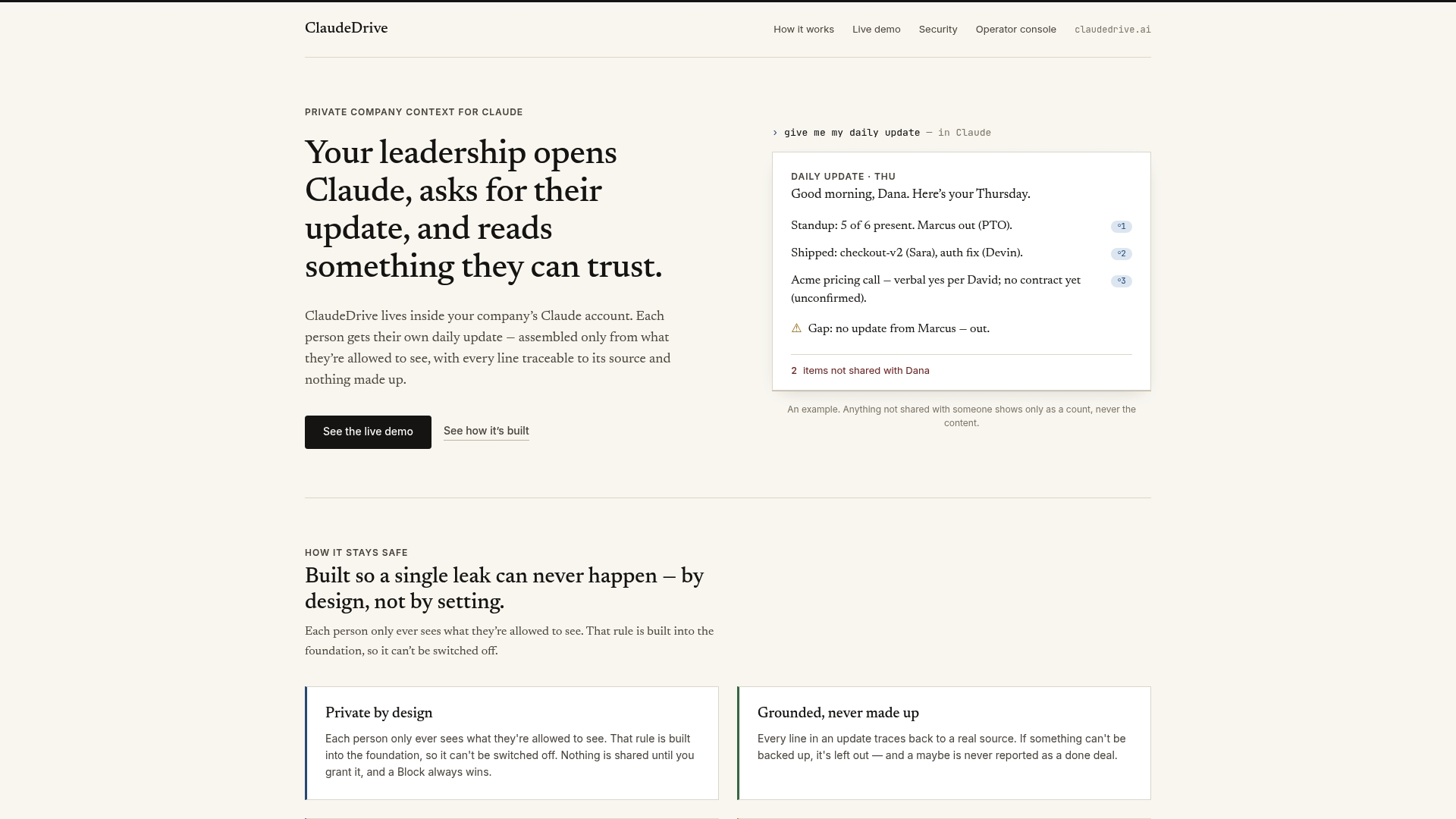
Every briefing ClaudeDrive delivers is traceable to a real source, filtered by who is asking, and assembled without crossing any access line. Connect your meeting notes, GitHub, or calendar, and each person on your team gets their own private view of what happened. No document leaks across a boundary it should not cross. If you want to see how permission-based data access works in a live environment, talk to us about a pilot or see the live demo.
FAQ
What is permission-aware retrieval for LLM?
Permission-aware retrieval for LLM is the practice of enforcing user-specific access rights during the retrieval stage so that a language model only processes documents the requesting user is authorized to see. It functions as a hard security gate, not a post-processing filter.
What is Authorization-First Retrieval?
Authorization-First Retrieval is an architectural principle that requires every document in a retrieval candidate set to pass an authorization check before the model consumes it. It formally guarantees that no unauthorized document enters the model’s context window.
Why can’t an LLM verify permissions through its prompt?
An LLM has no way to verify claims made in its own input, so prompt-based identity verification is a critical security flaw. User identity must come from a trusted external provider such as SSO, OIDC, or SAML.
How does Row-Level Security apply to LLM retrieval?
Row-Level Security in databases like PostgreSQL enforces row-granular access policies at query time, applying equally to direct SQL clients and LLM-driven retrieval. The model inherits the same restrictions as any other authorized requester.
How does inherited delegation work in multi-agent AI systems?
Inherited delegation restricts each agent in a multi-step AI chain to the access scope of the original calling user. This prevents a reasoning chain from accumulating permissions beyond what any single user was granted, preserving authorization correctness across the full pipeline.