The Daily Update Problem for Leaders: A 2026 Guide
Discover the daily update problem for leaders. Learn how to bridge the information gap and enhance decision-making with effective communication.
ClaudeDrive
A Yungsten Tech product

The Daily Update Problem for Leaders: A 2026 Guide

The daily update problem for leaders is defined as the structural gap between the information leaders need to make decisions and what their teams actually deliver each day. Reliable, timely updates are the backbone of effective leader communication, yet most organizations run on a broken system: vague summaries, missed submissions, and reports written from memory hours after the fact. Research shows that manual report collection achieves only 55–70% completion rates in non-automated systems. That number means nearly one in three updates never reaches the leader who needs it. The fix is not more pressure on teams. It is a better system.
What are the common pitfalls causing daily update problems in leadership?
Most leadership daily updates fail before they are even written. The problem starts with structure, or the lack of it.
Vague reporting that answers nothing. Updates that omit specifics like who did what, what was blocked, and what happens next give leaders nothing to act on. A report that says “good progress today” protects no one and informs no one. Leaders end up chasing clarification, which defeats the purpose of the update entirely.

The memory problem. After-hours reporting leads directly to inaccurate updates. When a team member writes their update at 9:00 PM from memory, details compress, blockers get softened, and timelines drift. The update becomes a reconstruction, not a record.
The reporting trap. Demanding too much detail triggers a counterproductive response. Teams write filler to satisfy length requirements, or they delay submission entirely because the task feels too large. This is what researchers call the “reporting trap,” where excessive detail requirements reduce both quality and compliance.
Hidden blockers. Teams that do not log blockers honestly create invisible risks. A persistent “no blockers” status is almost never accurate. It usually signals that team members fear judgment or do not believe reporting problems will lead to solutions.
Manual workflows and version chaos. When updates live in email threads, shared documents, or chat messages, version control collapses. Leaders read outdated information. Manual collection consumes 30–90 minutes per day just chasing submissions. That time compounds across weeks into a serious operational cost.
- Updates that lack specifics on activities, delays, and responsible parties fail to protect decisions or margins.
- Memory-based reporting introduces inaccuracy that compounds over time.
- Excessive detail requirements reduce submission rates and invite filler.
- Absent or vague blocker reporting hides the risks leaders most need to see.
- Unstructured collection channels create version control failures and wasted time.
Pro Tip: Set a single, non-negotiable submission window. Updates submitted outside that window are flagged, not accepted late. This one rule eliminates the memory problem and trains the habit.
How can leaders redesign the daily update process for clarity and efficiency?
The fix for most daily briefing issues is not a new tool. It is a better format and a clearer contract with the team.
-
Define the three-question format. Every update answers three questions: What did you complete today? What is blocked? What is the plan for tomorrow? Nothing else is required unless something unusual happened. This format takes under ten minutes to complete, which research confirms is the target completion time for consistent, accurate updates.
-
Set a hard submission window. Updates submitted at the end of the workday, before the team member closes their laptop, are accurate. Updates submitted at night are reconstructions. Define a window, such as 4:00–5:00 PM, and hold it firm. Same-day completion is the single most effective way to improve update reliability.
-
Require specific blockers. Replace “no blockers” with a required field: “What, specifically, would help you move faster?” A team member who has nothing blocked should write “none” with a brief reason. This small change surfaces real friction and gives leaders something to act on.
-
Use incident mode for abnormal events. Routine days get the three-question format. Abnormal events, such as a missed deadline, a client escalation, or a system failure, trigger a short incident note. This keeps daily updates brief while ensuring critical information gets flagged immediately.
-
Build the habit before the tool. Format and cadence must be stable before automation adds value. Leaders who automate a broken process get faster noise, not better signal. Establish the format, run it manually for two weeks, then layer in technology.
Pro Tip: Review the first five updates from any new format personally. If you see vague answers or missing blockers, coach the individual directly. Public correction kills honest reporting. Private coaching builds it.
What tools and technologies can leaders use to fix daily update problems?
Technology does not solve a culture problem, but it does eliminate the mechanical failures that make good processes collapse.
Automated collection and reminders
Automated systems send update prompts at a fixed time, collect responses in a structured format, and escalate non-submissions to a manager. Automated daily report systems achieve 85–95% completion rates and reduce the time leaders spend chasing updates from 45–90 minutes to nearly zero. That is the clearest ROI case in the update management space.
Mobile-first, point-of-work forms
Updates completed at the point of work, on a phone or tablet while the work is still fresh, are more accurate than updates written later at a desk. Structured mobile forms with required fields prevent the vague, open-ended responses that plague email-based reporting. For teams in the field or across time zones, this approach closes the accuracy gap that memory-based reporting creates.
AI synthesis for leadership briefings
Raw updates from ten team members are not a briefing. They are raw material. AI synthesis reads across all submissions, identifies patterns, surfaces blockers, and produces a single executive summary. The U.S. President’s Daily Brief model demonstrates this principle at scale: curated, synthesized briefings outperform raw data dumps for leadership decision-making. The same logic applies to any organization with more than five direct reports.
ClaudeDrive applies this model directly. A leader opens Claude, asks for their update, and reads one clear briefing built from connected sources: meeting notes, GitHub activity, calendar events. Every line traces to a real source. Nothing is invented. Each person sees only what they are authorized to see.
Audit trails and legal defensibility
State statutes require daily reports to be retained for 4–10 years in many regulated industries. Non-editable, timestamped records carry more weight in disputes than edited documents or reconstructed summaries. Automated systems that lock submissions on receipt solve this problem without adding administrative work. Leaders in construction, healthcare, and financial services face the highest exposure here, but the principle applies broadly. Incomplete or delayed documentation contributes to over 40% of construction disputes. The cost of a missing update is rarely visible until it is too late.
For leaders evaluating AI team update tools, the key criteria are source traceability, access controls, and integration with existing workflows. A tool that requires a new app, a new login, or a new habit from the team will face adoption resistance. The best systems connect to tools the team already uses.
Pro Tip: Before selecting any update tool, map where your team’s work actually lives: GitHub, Slack, a project management platform, a calendar. The right tool reads from those sources directly. If it requires manual data entry, it will fail at scale. For SMB teams, understanding how project management tools work alongside update systems is worth the time before committing to a stack.
How do effective leaders handle daily update problems with adaptive leadership?
Adaptive leadership treats daily updates as operational signals, not administrative tasks. The distinction matters because it changes what leaders do with the information.
-
Treat updates as early warning systems. Effective leaders treat frontline feedback from daily updates as early signals of operational friction. A pattern of delays in one area, repeated blockers from one team, or consistently vague updates from one individual all point to something structural. The update is the symptom. The leader’s job is to find the cause.
-
Avoid the pivot trap. Leaders often treat surface symptoms in daily reports instead of diagnosing root causes. A team that consistently misses update deadlines is not lazy. They are probably overloaded, unclear on expectations, or working in a system that makes reporting harder than the work itself.
-
Build a culture where blockers are safe to report. A team that hides problems in their updates is a team that does not trust the response. Leaders who react to blockers with blame train their teams to omit them. Leaders who respond with “what do you need from me?” train their teams to report early and specifically.
-
Use update patterns for continuous learning. Weekly review of update trends reveals where the organization is slowing down before the slowdown becomes a crisis. This is the operational intelligence function that most leaders leave on the table.
-
Coach specificity, not volume. The goal is not longer updates. It is more precise ones. A blocker described as “waiting on legal” is not actionable. A blocker described as “contract review stalled since Monday, need a nudge from the COO to legal by Wednesday” gives a leader exactly what they need to unblock the work.
Key takeaways
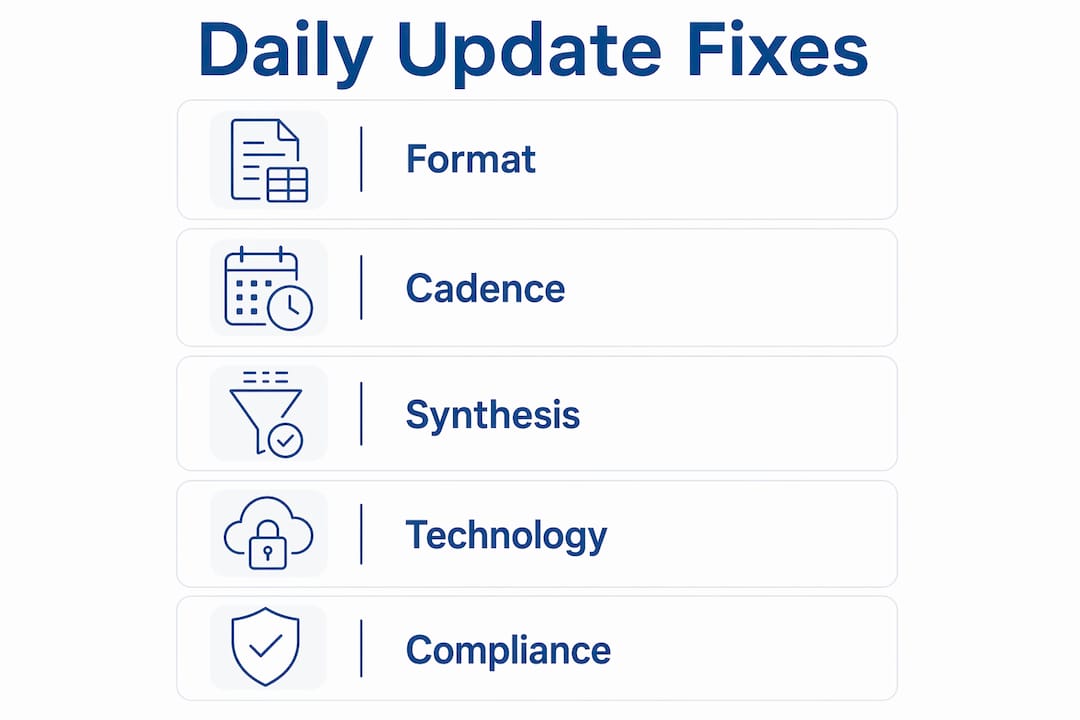
The daily update problem for leaders is solved by fixing format, cadence, and synthesis, not by demanding more from teams.
| Point | Details |
|---|---|
| Format drives accuracy | Three-question updates completed same-day outperform open-ended, after-hours reports. |
| Completion rates collapse without automation | Manual systems reach only 55–70% completion; automated systems reach 85–95%. |
| Vague blockers hide real risk | Require specific, named blockers to surface friction before it becomes a crisis. |
| AI synthesis replaces raw data dumps | Leaders need one clear briefing, not ten raw submissions to read and reconcile. |
| Audit trails protect the organization | Timestamped, non-editable records carry legal weight that edited documents do not. |
What I have learned from watching leaders get this wrong
Most leaders I have worked with discover the update problem the same way: a project fails, a client escalates, or a key hire leaves, and the post-mortem reveals that the warning signs were in the daily updates all along. Nobody read them carefully. Or nobody submitted them at all.
The instinct after that moment is to demand more. More detail, more frequency, more accountability. That instinct makes the problem worse. Teams respond to pressure by writing longer updates that say less. Compliance goes up. Signal goes down.
The leaders who actually fix this shift their frame. They stop treating updates as a reporting obligation and start treating them as the organization’s nervous system. They design the format around what they need to decide, not around what is easy to ask. They respond visibly to blockers so teams learn that reporting problems leads to help, not judgment.
The other mistake I see consistently is skipping the format-first step and going straight to technology. Automation of a broken process produces faster noise. The sequence matters: fix the format, stabilize the cadence, then automate. In my experience, two weeks of manual discipline before any tool change is the difference between adoption and abandonment.
The leaders who get this right are not the ones with the best tools. They are the ones who treat the daily update as a leadership responsibility, not a team task.
— Paul
How ClaudeDrive addresses the daily update problem
Leaders who have fixed their format and cadence still face one remaining problem: synthesis. Reading ten updates, reconciling them against a calendar and a project tracker, and producing a clear picture of where the organization stands takes time that most leaders do not have.
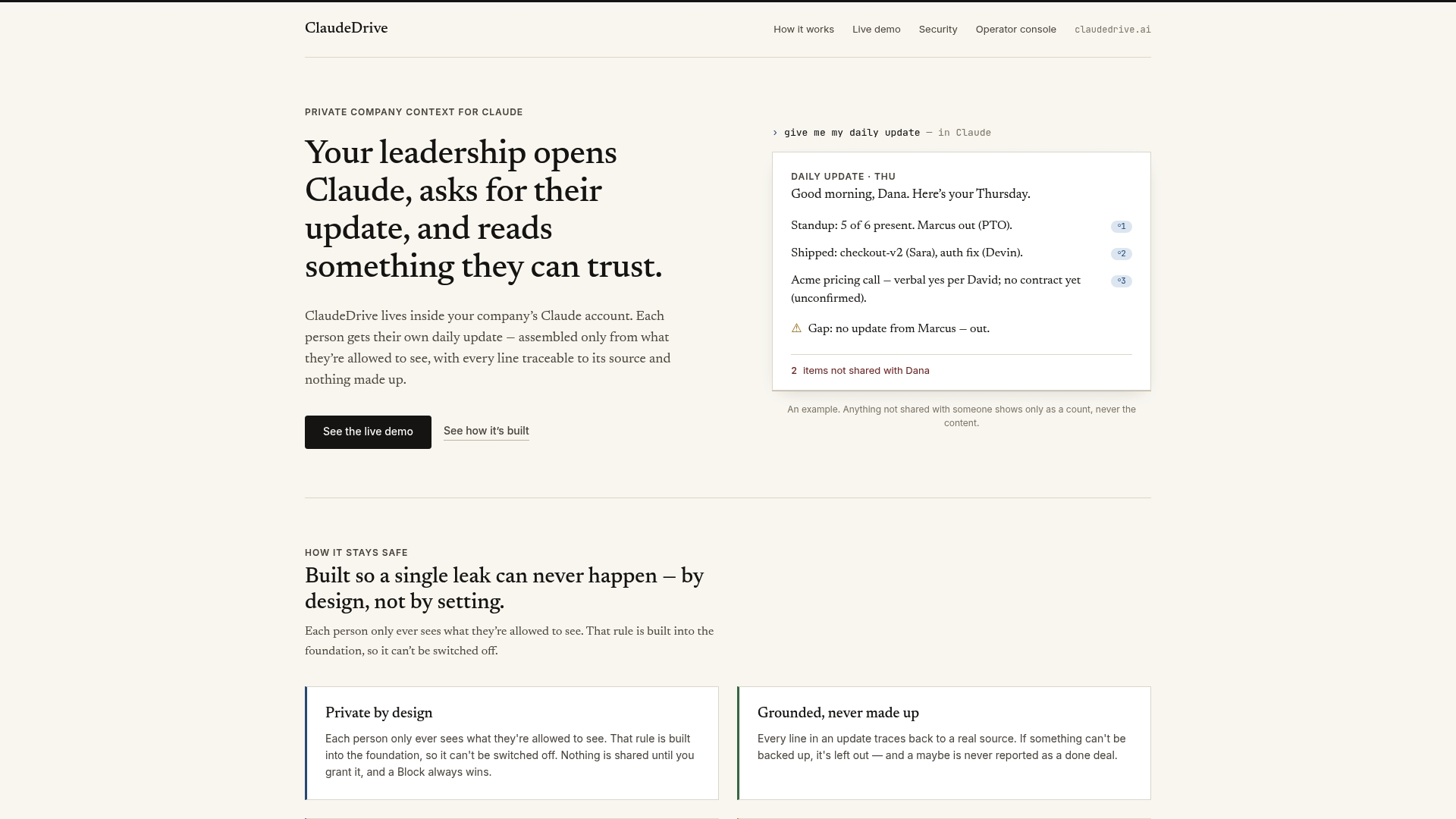
ClaudeDrive solves that last mile. Connect your meeting notes, GitHub, and calendar, and each leader gets a private briefing built only from sources they are authorized to see. Every line traces to a real source. Nothing is invented. No new app, no new dashboard, no wiki to maintain. A leader opens Claude, asks for their update, and reads something they can trust. See the live demo at ClaudeDrive or talk to us about a pilot for your team.
FAQ
What is the daily update problem for leaders?
The daily update problem for leaders is the gap between the information leaders need and what teams actually deliver each day. It includes vague reporting, low submission rates, memory-based inaccuracies, and the absence of honest blocker reporting.
How long should a daily update take to complete?
Effective daily updates should take no longer than ten minutes to complete. Updates that take longer see lower compliance and more filler content, which reduces their value to leadership.
Why do teams consistently report “no blockers”?
A persistent “no blockers” status usually signals team fear or apathy, not an absence of problems. Leaders must coach teams to name specific blockers and respond to those reports with help rather than judgment.
What completion rate should leaders expect from automated update systems?
Automated daily report systems achieve 85–95% completion rates, compared to 55–70% in manual systems. That gap represents the updates leaders are currently missing every week.
How does AI help leaders manage daily update overload?
AI reads across all team submissions, identifies patterns, and produces a single synthesized briefing. This replaces the manual work of reconciling multiple raw updates and surfaces the blockers and risks that matter most to leadership decisions.