Why Teams Miss Critical Updates: A Manager's Guide
Discover why teams miss critical updates and how to improve communication. Enhance your team's efficiency and ensure vital info is received!
ClaudeDrive
A Yungsten Tech product

Why Teams Miss Critical Updates: A Manager’s Guide

Missing critical updates is defined as the failure of teams to receive, understand, or act on important information due to unreliable communication systems rather than a lack of effort. Research from Firstup’s 2026 survey of 6,200+ employees across North America and the UK found that 61–76% of employees miss critical updates despite regular communication efforts. That number should stop any manager cold. The problem is not message volume. The problem is that most communication systems rely on human relay points with no verification that messages were understood or acted upon.
Why teams miss critical updates: the root causes
The causes of missed updates run deeper than a cluttered inbox or a skipped meeting. They live in the structure of how information moves through an organization.
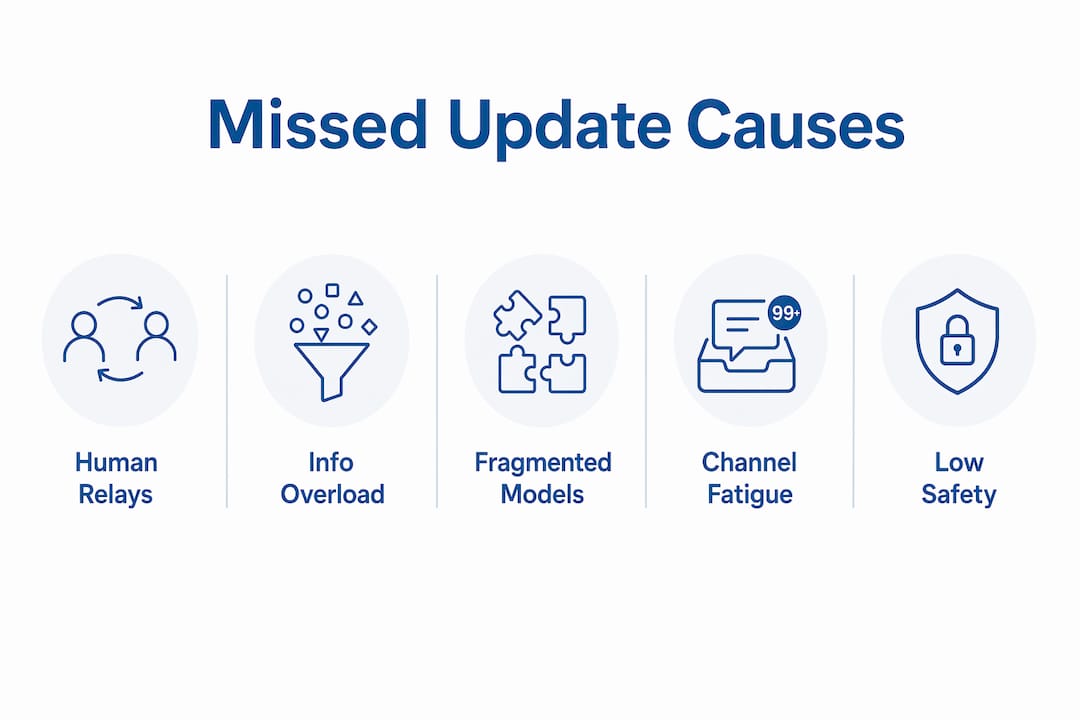
Human relay dependency is the first structural failure. Most teams route critical information through managers, who then pass it down through personal judgment calls about timing, channel, and wording. Firstup’s 2026 data shows that 70–77% of managers struggle to communicate effectively, and 62–65% bypass official channels using personal email or SMS. Every relay point is a place where a message can be delayed, diluted, or dropped entirely.

Information overload compounds the problem. A Korbyt and Reworked workplace study found that 44% of employees feel overwhelmed by communication and tune out messages that lack clarity, relevance, or trust. When every message competes for the same attention, critical updates get buried alongside routine announcements.
Fragmented mental models create a third failure mode. A knowledge transfer study identified a “Month 6 cliff” pattern where incomplete handoffs cause critical diagnosis failures six months after a transition. Teams receive the words but not the context needed to act correctly. The message arrives. The understanding does not.
Pro Tip: Before your next all-hands or team briefing, ask yourself: “If this message passes through three people before it reaches the front line, what will be left of it?” If you cannot answer confidently, the relay chain is your risk.
Here is a summary of the core failure modes:
- Ungoverned relay chains: Managers use personal channels with no audit trail or consistency check.
- Volume without relevance: High message frequency trains teams to skim or ignore updates entirely.
- Transmission without comprehension: Delivery confirmation is mistaken for understanding.
- Context gaps: New team members or cross-functional partners lack the background to interpret updates correctly.
- No feedback loop: No mechanism exists to confirm who understood and who acted.
McKinsey research cited by MangoApps found that knowledge workers lose roughly 20% of their weekly work time searching for internal information. That is one full day per week per person spent chasing context that should have arrived with the original update.
How do communication channels and human behavior contribute?
Channel fragmentation is where team communication issues become structural rather than personal. When managers bypass Slack, Microsoft Teams, or official intranets in favor of personal email or text messages, they create two problems at once. First, the message reaches some people and not others. Second, there is no record of what was said, to whom, or when.
Fragmented routing and unclear governance drive reliance on untracked personal channels, creating audit and compliance risks that most managers do not recognize until something goes wrong. A product recall, a regulatory deadline, a security patch: these are exactly the updates that cannot afford an informal relay chain.
“Communication systems relying on ‘heroic’ individuals to bridge informal and formal update streams are fragile and prone to drift.” — The Status Update Nobody Gives
Channel fatigue makes the behavioral side worse. Teams exposed to high message volume across multiple platforms learn to triage aggressively. They open what looks urgent and defer the rest. The Korbyt and Reworked study confirms that channel discipline and relevance matter more than frequency. Teams tune out repetitive, unclear, or non-actionable messages regardless of how often they arrive.
Psychological safety adds another layer. Teams where members fear speaking up will suppress critical information rather than flag it. Psychological safety enables team members to surface critical updates, reducing silent failures and enabling early mitigation. When a team member notices a discrepancy in a status report but stays quiet because they do not feel safe raising it, the missed update becomes invisible. No one knows it was missed.
The combination of ungoverned channels, channel fatigue, and suppressed dissent creates what researchers call “interpretation drift.” A message sent at the top of the organization arrives at the front line with a different meaning, a different urgency, or no meaning at all.
What measurement and governance practices actually work?
Most managers measure communication success by open rates and delivery confirmations. Both are insufficient proxies for true understanding. An email opened on a phone during a commute is not the same as an update understood and acted upon before a deadline.
The shift required is from delivery metrics to comprehension and action metrics. Here is how to build that shift into your governance model:
- Define what “received” actually means. Set a standard: a critical update is received only when the recipient has confirmed understanding, not just opened the message.
- Assign ownership for each update. Every critical message needs a named owner responsible for verifying that the intended audience acted on it.
- Establish channel governance. Designate which channels carry which types of updates. Personal email and SMS are not approved channels for critical operational information.
- Build audit trails. Use platforms that log who received a message, when, and what action followed. This is not surveillance. It is risk management.
- Close the loop with feedback. After every critical update, collect a brief confirmation: “Did you receive this? Do you have what you need to act?”
Pro Tip: Map your last three critical updates. For each one, ask: “Can I prove who received it, understood it, and acted on it?” If the answer is no for any of them, you have a governance gap, not a communication problem.
The table below shows the difference between traditional and governance-based communication measurement:
| Metric Type | Traditional Approach | Governance-Based Approach |
|---|---|---|
| Delivery | Open rate or send confirmation | Confirmed receipt with timestamp |
| Comprehension | Assumed from delivery | Verified via acknowledgment or brief check-in |
| Action | Inferred from silence | Tracked against a named owner and deadline |
| Audit trail | None or email logs | Centralized, permission-aware record |
| Feedback loop | Occasional surveys | Built into every critical update cycle |
Overreliance on healthy-looking metrics can mask degradation in team shared understanding and cause missed system signals. A dashboard showing 90% open rates tells you nothing about whether the 90% understood what they were supposed to do next.
How can managers prevent missed updates starting now?
Practical strategies for avoiding missed updates do not require new software. They require new habits and clear norms. The following steps apply immediately in any fast-growing team.
- Write for action, not awareness. Every critical update should answer three questions: What happened? What does the reader need to do? By when? If your message does not answer all three, rewrite it before sending.
- Reduce channel count. Pick one official channel per update type and enforce it. Teams that receive the same update across five channels learn to wait for the “real” version and often miss all of them.
- Build psychological safety deliberately. Leaders who treat communication as a risk control surface set boundaries that encourage early dissent without normalizing workarounds. Ask your team directly: “What did you hear from last week’s update?” The answers will tell you more than any open rate.
- Avoid the personal channel trap. When a manager sends a critical update via personal SMS because it is faster, they create an invisible gap. The message may arrive, but it cannot be verified, tracked, or audited.
- Use permission-aware updates for sensitive information. Teams with different roles have divergent situational awareness of operational statuses. An update that reaches the wrong person at the wrong level creates confusion. An update that misses the right person creates risk.
- Leverage AI-assisted briefings for daily context. Tools that connect meeting notes, project trackers, and calendars into a single verified briefing reduce the search time McKinsey identified and eliminate the relay chain entirely. The benefits of permission-aware AI updates for tech leaders include reduced communication fatigue and faster verified action.
The goal is a communication system that does not depend on any single person’s memory, judgment, or availability. Fast-growing companies are especially vulnerable here because relay chains grow faster than governance does.
Key takeaways
Teams miss critical updates because communication systems rely on unverified human relays, ungoverned channels, and delivery metrics that measure transmission rather than comprehension or action.
| Point | Details |
|---|---|
| Human relay chains fail | 62–65% of managers use personal channels, creating invisible gaps with no audit trail. |
| Volume causes tuning out | 44% of employees feel overwhelmed and ignore messages that lack clarity or relevance. |
| Open rates are not enough | True communication success requires verified comprehension and confirmed action, not delivery logs. |
| Governance closes the gap | Designating channels, assigning update owners, and building audit trails prevents silent failures. |
| Psychological safety matters | Teams that feel safe raising concerns surface missed updates before they become operational failures. |
The communication failure nobody talks about
I have watched fast-growing companies build elaborate communication stacks: Slack, Confluence, weekly all-hands, daily standups, and still lose critical updates in the space between tools. The failure is never the technology. It is the assumption that sending equals communicating.
The most dangerous pattern I see is what I call the “heroic manager” model. One person knows everything, bridges every gap, and keeps the team informed through sheer personal effort. It works until that person is on vacation, overwhelmed, or simply has a bad week. Then the whole system collapses quietly. Nobody knows what they missed because nobody was tracking it.
The fix is not more messages. It is building a system where every critical update has a named owner, a verified delivery path, and a confirmation mechanism. That sounds bureaucratic until the first time it prevents a missed deadline or a compliance failure.
Leaders in fast-growing companies need to treat communication governance the same way they treat financial controls. You would not accept “I think the invoice was approved” as a sufficient answer. You should not accept “I think the team got that update” either. The AI daily update formats that work best are the ones built around verified, traceable briefings, not broadcast messages hoping for the best.
— Paul
How ClaudeDrive helps leaders close the update gap
If your team’s communication relies on relay chains and open rate reports, ClaudeDrive is built for exactly this problem.
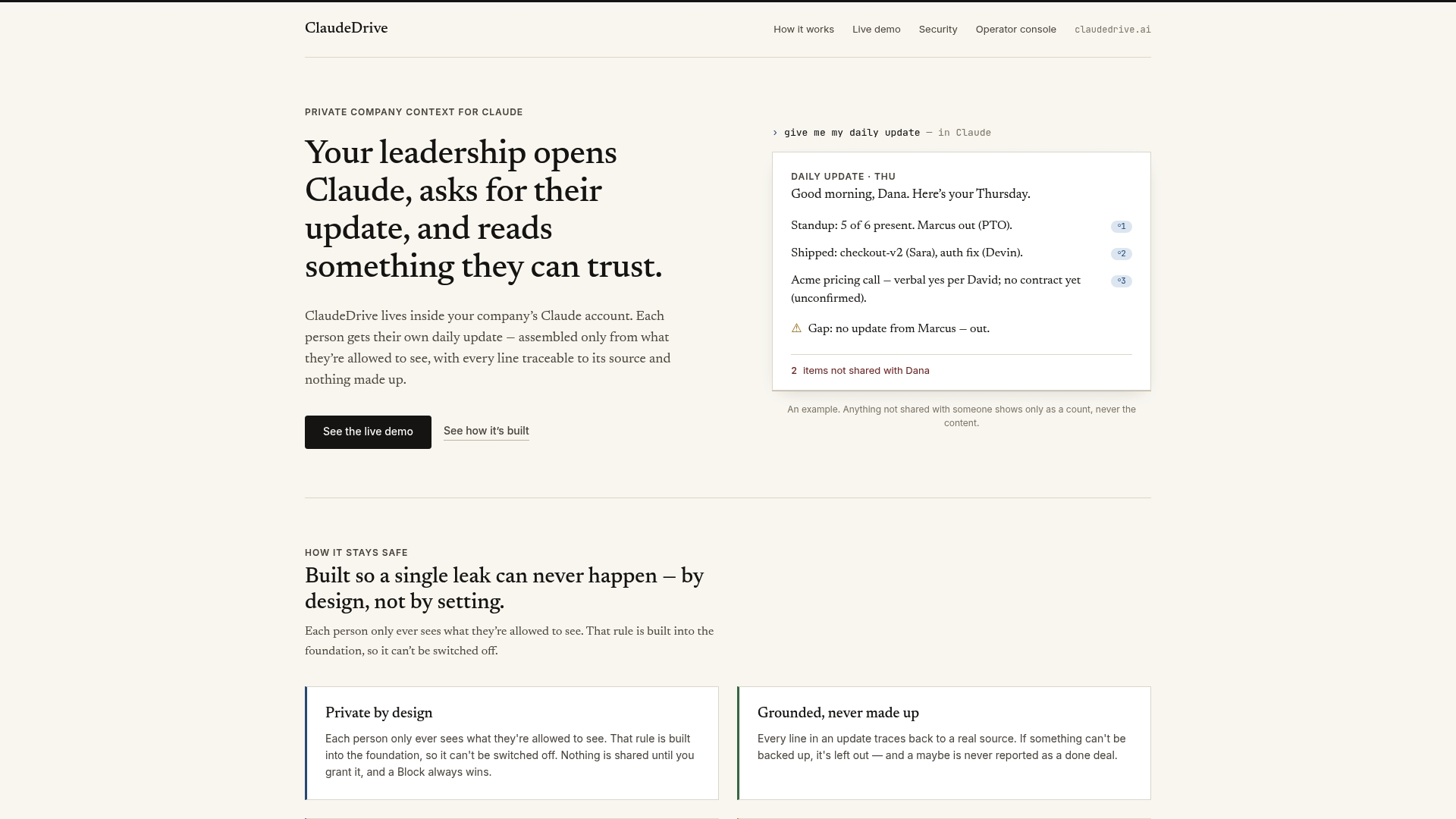
ClaudeDrive gives leaders a daily briefing inside the Claude account they already use. Connect your meeting notes, GitHub, and calendar, and each leader gets a private, permission-aware view of what happened, built only from verified sources. Nothing is made up. Every line traces back to a real document or event. There is no new dashboard to learn and no wiki to maintain.
For managers who need to know that critical updates reached the right people and were understood, ClaudeDrive replaces the relay chain with a traceable, auditable briefing. Visit the ClaudeDrive Console to see the live demo or talk to us about a pilot.
FAQ
Why do teams overlook critical updates even with regular communication?
61–76% of employees miss critical updates despite regular communication because delivery does not equal comprehension. Without verification that messages were understood and acted upon, high message frequency actually increases tuning out.
What is the biggest communication channel mistake managers make?
The biggest mistake is using personal email or SMS for critical updates. Firstup’s 2026 research shows 62–65% of managers bypass official channels, creating ungoverned relay chains with no audit trail and inconsistent delivery.
How should managers measure communication effectiveness?
Managers should measure comprehension and confirmed action, not open rates. A message is only effective when the recipient understood it and completed the required action by the stated deadline.
What is the “month 6 cliff” in team communication?
The “Month 6 cliff” describes how incomplete knowledge transfer during handoffs causes critical failures six months later, when team members lack the mental models needed to diagnose and resolve issues correctly.
How does psychological safety reduce missed updates?
Psychological safety allows team members to flag discrepancies and raise concerns without fear. Teams with low psychological safety suppress critical information, turning missed updates into invisible operational failures.