What Is an Automated Company Update? A 2026 Guide
Discover what is an automated company update and how it streamlines communication. Learn to save time and enhance stakeholder engagement!
ClaudeDrive
A Yungsten Tech product

What Is an Automated Company Update? A 2026 Guide

An automated company update is a system-generated communication that pulls from a single source of business data and delivers tailored briefings to different stakeholder groups with minimal manual effort. The term “automated company update” is the common search phrase for what practitioners call stakeholder communication automation or automated reporting workflows. These systems replace the hours a chief of staff or founder would spend drafting separate emails, board decks, and team summaries each week. Tools like ClaudeDrive take this further by generating each person’s update directly inside Claude, sourced only from what that person is authorized to see, with every line traceable to a real document or data point.
What is an automated company update and how does it work?
An automated company update works by connecting a single authoritative data source to a transformation layer that produces audience-specific communications on a set schedule. The raw inputs are the same for everyone: OKR progress, meeting notes, financial metrics, project status, and risk flags. What changes is how that data is shaped for each reader.
The mechanism has four distinct stages:
- Data ingestion: The system pulls from connected tools such as GitHub, a calendar, a project tracker, or a CRM. One data pull feeds all downstream outputs.
- Audience mapping: The system identifies who receives what. An executive gets a one-page summary of business impact. A board member gets governance-level metrics. A team lead gets task-level progress. A customer gets a service status note.
- Narrative transformation: Audience-specific transformation generates multiple tailored reports for executives, boards, investors, teams, and customers from one consistent data set, adjusting tone, format, and detail level per group.
- Scheduled delivery: The system runs on a defined cadence. Weekly and monthly schedules are standard, with team and customer briefings running weekly and executive, board, and investor updates running monthly.
Pro Tip: Before connecting any tools, write down what each stakeholder group actually needs to know. A board member and a team lead reading the same raw data will reach very different conclusions about what matters. Defining that gap upfront is what makes the transformation layer useful.
The result is that a single data pull produces five or six distinct communications, each appropriate for its audience, without anyone writing them from scratch.

What are the primary benefits of automated company updates?
Automated company updates deliver three categories of measurable value: time savings, stakeholder trust, and message consistency.
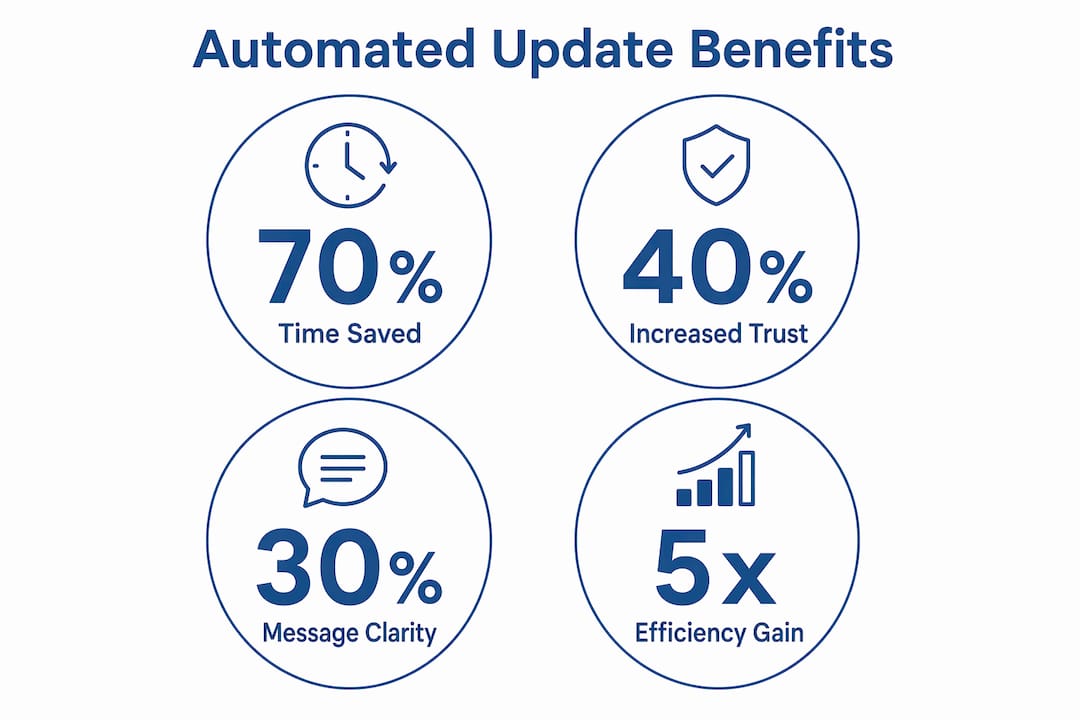
On time, the numbers are concrete. Manual writing time drops from one to two hours per update down to ten to fifteen minutes of refinement. That difference compounds fast. A founder sending weekly updates to four stakeholder groups was spending roughly six hours a week on communication preparation alone. Automation cuts that to under an hour, freeing leadership attention for decisions rather than drafting.
On trust, proactive communication does something reactive communication cannot. Automated updates improve stakeholder trust by delivering information before it is asked for, which directly increases retention and responsiveness. Stakeholders who receive regular, accurate updates stop sending inquiry emails. Proactive automated communication cuts support inquiries by 20 to 30 percent during high-incident periods and reduces communication costs by up to 25 percent. That is not a marginal efficiency gain. It is a structural reduction in reactive overhead.
On consistency, automation produces audit-ready updates that support compliance and internal governance. When a board asks why a metric moved, the answer is traceable to the same source document that generated the update. Manual processes cannot guarantee that. Different drafters, different weeks, and different levels of attention produce different versions of the same facts.
“Automated updates are a strategic necessity to manage stakeholder expectations proactively and improve retention through transparency.” — moin.ai
The consistency benefit also extends to multi-channel delivery. Automated systems can push updates through SMS, email, Slack, or WhatsApp, meeting stakeholders where they prefer to receive information rather than forcing them to check a portal.
How do automated updates compare to manual communication?
Manual updates and automated updates are not just different in speed. They differ in reliability, scalability, and the cognitive load they place on leadership.
| Factor | Manual updates | Automated updates |
|---|---|---|
| Time per update | 1 to 2 hours of writing | 10 to 15 minutes of refinement |
| Consistency across audiences | Variable, depends on drafter | Consistent, same source data |
| Scalability | Degrades as audience count grows | Scales without additional effort |
| Audit trail | Fragmented across drafts and inboxes | Centralized, traceable to source |
| Error risk | High, especially under time pressure | Low, data pulled directly from source |
| Frequency possible | Weekly is often the practical ceiling | Daily or weekly without added labor |
The scalability gap is where manual processes break first. A founder with three investors, one board, two team leads, and a customer base can sustain manual updates for a quarter. By month four, something gets skipped. The investor update goes out late. The team briefing gets shortened. A single source of truth architecture prevents multiple document versions and saves significant time by applying audience-specific transformations to the same underlying data.
Manual updates also carry a hidden cost that rarely appears in time estimates: the cognitive overhead of context-switching. Writing for a board requires a different mental frame than writing for an engineering team. Doing both in the same afternoon is draining. Automation removes that switching cost entirely.
Pro Tip: If you are evaluating whether automation is worth the setup effort, count how many distinct stakeholder groups receive updates from your organization. If the answer is more than three, the ROI on automation is almost certain. If it is more than five, manual processes are already costing you more than you realize.
For a practical look at how AI-generated daily updates are structured across different audiences, the format examples from ClaudeDrive’s blog show what good automated output actually looks like.
What are best practices for implementing automated update workflows?
Setting up an automated update system that leaders actually trust requires more than connecting a few tools. The following sequence reflects what works in practice.
-
Choose one authoritative data source to start. Pick the system that already holds your most important metrics: your OKR tracker, your project management tool, or your financial dashboard. Resist the urge to connect everything at once. One clean source produces better outputs than five messy ones.
-
Define each stakeholder group and their information needs explicitly. Write a one-paragraph brief for each audience: what they care about, what level of detail they expect, and what decisions they make based on your updates. This brief becomes the specification for your transformation rules.
-
Build audience-specific transformation rules. For executives, the rule might be: summarize to three key metrics and one risk flag. For investors, it might be: include month-over-month comparisons and a forward-looking note. Founder-to-investor reporting automation cuts data assembly costs by leaving only narrative sections for manual editing, which is the right model for any audience-specific workflow.
-
Set a schedule and hold it. Weekly team and customer briefings and monthly executive and board updates are the standard cadence for most organizations. Consistency matters more than frequency. Stakeholders who receive updates on a predictable schedule stop wondering what is happening.
-
Build in a refinement step. Automated drafts are starting points, not finished products. Reserve ten to fifteen minutes after each automated run to review the narrative for accuracy and tone. This step catches data anomalies and adds the human judgment that pure automation cannot supply.
-
Create a feedback loop. After the first month, ask each stakeholder group one question: “Is this update giving you what you need?” The answers will tell you which transformation rules to adjust. Treat the system as a living process, not a one-time configuration.
For teams exploring how AI replaces traditional status reports, the shift from manual drafting to automated generation follows exactly this sequence.
Key takeaways
Automated company updates deliver the most value when a single source of truth feeds audience-specific transformations, reducing manual preparation from hours to minutes while maintaining consistent, traceable communication across all stakeholder groups.
| Point | Details |
|---|---|
| Definition | An automated company update is a system-generated, audience-tailored briefing built from one shared data source. |
| Time savings | Automation reduces update preparation from 1 to 2 hours down to 10 to 15 minutes of refinement per cycle. |
| Stakeholder trust | Proactive automated communication cuts support inquiries by 20 to 30 percent and reduces communication costs by up to 25 percent. |
| Consistency advantage | A single source of truth prevents version fragmentation and produces audit-ready outputs that manual drafting cannot match. |
| Implementation priority | Define each stakeholder group’s information needs before configuring any transformation rules or scheduling any runs. |
Why automated updates are a leadership decision, not a technology one
I have watched founders spend Sunday evenings writing investor updates that no one reads until Tuesday. I have seen chiefs of staff maintain six separate Notion pages, each slightly out of sync with the others, because no one had time to reconcile them. The problem is never a lack of information. It is the cost of translating that information into the right format for the right person at the right time.
What I find most leaders miss is that automated updates are not about saving time on writing. They are about maintaining trust at a cadence that manual effort cannot sustain. A board that receives a consistent, accurate monthly update for twelve months in a row trusts leadership differently than a board that receives sporadic emails of varying quality. That trust is worth more than the hours saved.
The second thing leaders miss is that the quality of the output depends entirely on the quality of the input. Automation does not fix a fragmented data environment. It exposes it. The discipline of connecting clean, authoritative sources to an update system forces an organization to answer a question it often avoids: what is the single version of the truth here? That question, answered honestly, is worth the entire implementation effort.
Treat your automated updates as dynamic narratives that reflect where the company actually is, not polished reports designed to manage perception. Stakeholders can tell the difference. The ones who receive honest, consistent updates stay engaged. The ones who receive curated summaries start asking harder questions. AI briefings beat email updates precisely because they are built from traceable sources rather than drafted from memory.
— Paul
How ClaudeDrive automates your company updates inside Claude
ClaudeDrive is built for leaders who want automated company updates without adopting a new platform. Connect your meeting notes, GitHub, and calendar, and each person on your leadership team gets their own private briefing the next time they open Claude and ask for their update. Every line traces back to a real source. Nothing is fabricated. Nothing crosses a permission boundary it should not.
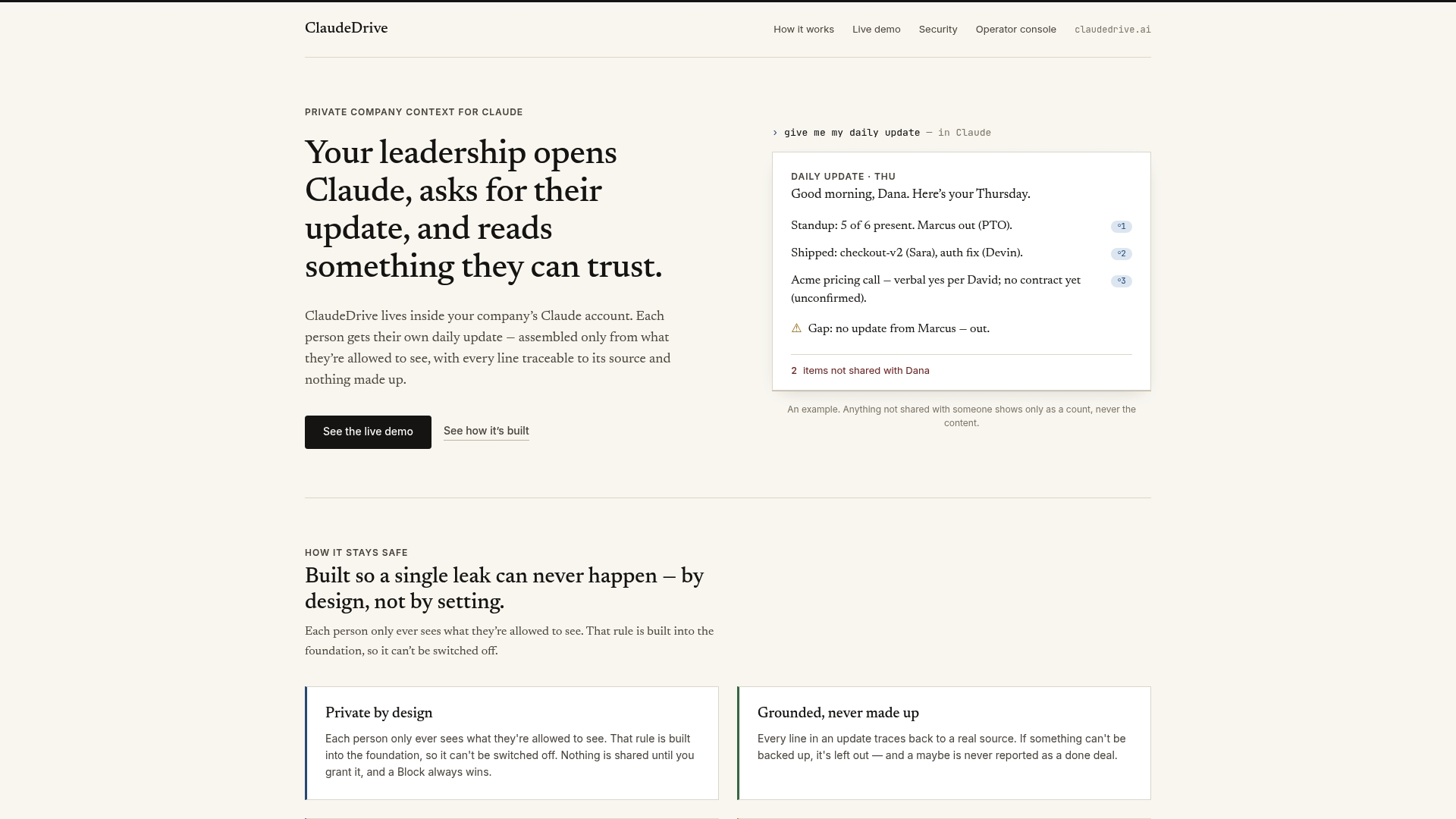
The ClaudeDrive Console handles multi-audience tailoring, scheduling, and source traceability in one place. There is no dashboard to learn and no wiki to maintain. If your organization is spending hours each week on update preparation, or if your stakeholders are receiving inconsistent information across channels, talk to us about a pilot and see what a trusted daily briefing actually looks like in practice.
FAQ
What is an automated company update?
An automated company update is a system-generated briefing built from a single source of business data and delivered to stakeholder groups in audience-specific formats on a scheduled cadence. It replaces manual drafting with a transformation layer that adapts the same underlying data for executives, boards, investors, teams, and customers.
How much time do automated updates actually save?
Automated update workflows reduce manual writing time from one to two hours per update down to ten to fifteen minutes of refinement. Leaders report that this reduction makes consistent weekly or monthly update cadences achievable where manual effort made them impractical.
What is the difference between automated communication and a manual update?
Manual updates depend on a drafter’s time, memory, and consistency. Automated communication pulls directly from connected data sources, applies audience-specific transformation rules, and delivers on a fixed schedule, producing traceable, consistent outputs that manual processes cannot reliably replicate at scale.
How do automated updates improve stakeholder trust?
Automated updates deliver information before stakeholders ask for it, which reduces inquiry volume and signals organizational transparency. Proactive automated communication cuts support inquiries by 20 to 30 percent during high-incident periods, and consistent update cadences build the kind of long-term confidence that reactive communication cannot.
What tools are used for automated company update workflows?
Platforms like ClaudeDrive connect existing business tools such as project trackers, calendars, and code repositories to generate tailored briefings for each stakeholder group. The key capability is audience-specific transformation: one data pull produces multiple distinct communications without additional manual effort.