AI Update Traceability for Business Leaders: 2026 Guide
Discover what is AI update traceability and why it’s crucial for business leaders in 2026. Learn to build operational trust today.
ClaudeDrive
A Yungsten Tech product

AI Update Traceability for Business Leaders: 2026 Guide

AI update traceability is defined as the practice of capturing structured, verifiable records that link every AI output back to its exact inputs, model versions, prompts, and decision steps so any AI action can be reconstructed and audited. The industry term for this practice is AI decision lineage, and it sits at the center of every serious AI governance conversation in 2026. Regulations like the EU AI Act now require it by law. Tools from IBM and Snowflake have built entire governance layers around it. For business leaders at growing companies, understanding AI update traceability is no longer optional. It is the foundation of operational trust.
What is AI update traceability and why does it matter?
AI update traceability is the ability to answer one question with evidence: “How did this AI system produce that result?” According to IBM, a trace captures the full execution journey of an AI run, including inputs, tool calls, and outputs, not just raw logs. IBM frames a trace as dashcam footage of an AI run, and the trace layer as the searchable archive that lets teams replay any run to find root cause quickly.
Without a dedicated trace layer, teams cannot prove what their AI agents did or fully understand what led to specific outcomes. That gap creates real risk: regulatory exposure, failed audits, and decisions made on outputs no one can verify. For a COO or chief of staff, that is not an abstract concern. It is a liability sitting inside every AI-assisted workflow.
The importance of AI traceability grows with the complexity of the system. A single model answering a simple question is easy to review. A multi-agent pipeline that calls external tools, retrieves documents, and routes decisions across services is not. Traceability is the mechanism that makes complex AI operations reviewable by people who were not in the room when the system ran.

What components make up a complete AI traceability system?
A complete AI traceability framework captures five categories of structured data for every AI run.
- Inputs and prompts. The exact text, data, or query the system received, including any system-level instructions.
- Model identity. The specific model version invoked, including any fine-tuned variants or configuration parameters.
- Tool calls and parameters. Every external call the agent made, including the tool name, inputs, and outputs returned.
- Decision logic and reasoning steps. The intermediate steps the model took before producing a final output, not just the final answer.
- Outputs and actions. The final response delivered, plus any downstream actions triggered such as sending a message or writing a record.
Logs alone do not deliver traceability. Logs record that something happened. Traceability records why it happened and how each step connected to the next. The difference matters most during an incident investigation, when a regulator asks for evidence, or when a business leader needs to understand why an AI recommendation was wrong.
Tamper-evident records are a non-negotiable component. Audit authorities require append-only storage, cryptographic signatures, or Merkle trees to guarantee that logs have not been altered after the fact. Standard database logs do not meet this bar.
| Component | What it captures | Why it matters |
|---|---|---|
| Input record | Prompt, data, user context | Establishes what the AI was asked |
| Model version | Named model and configuration | Enables reproducibility and version comparison |
| Tool call log | External calls with parameters | Shows what data the AI retrieved or acted on |
| Decision lineage | Reasoning steps and intermediate outputs | Explains how the conclusion was reached |
| Tamper-evident output | Signed, timestamped final result | Satisfies audit and regulatory integrity requirements |
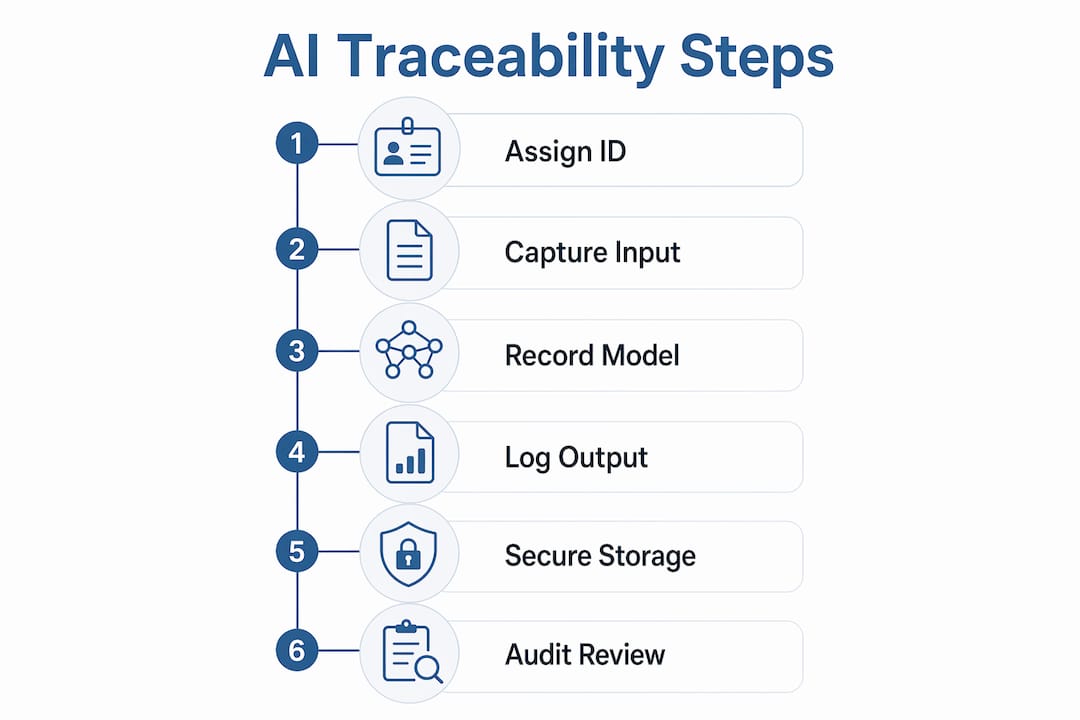
Pro Tip: Assign a stable, globally unique request ID to every AI run at the point of entry and propagate it across every service the run touches. Without this, cross-service causal chains cannot be reconstructed reliably.
How does AI update traceability support audit readiness and compliance?
The EU AI Act Article 12 requires automatic event logging across the full system lifetime, covering training, validation, deployment, inference, and decommissioning phases. The logging level must match the system’s intended purpose and risk classification. Completeness and integrity are the two tests regulators apply. A log that is complete but mutable fails the integrity test. A log that is tamper-evident but missing key decision steps fails the completeness test.
“Traceability is an operational evidence requirement enabling audits, not just a transparency or UI feature.” — Microsoft agent architecture guidance
Post-market monitoring under the EU AI Act also depends on traceability. Regulators expect companies to detect performance drift, unexpected outputs, and safety incidents over time. That detection is only possible if there is a structured record to compare against. Without AI update management practices that capture baseline behavior, drift is invisible until it causes harm.
The business case for compliance is quantitative. An enterprise study found that integrating lineage and traceability controls improved reproducibility to 92%, reduced investigation and audit preparation time by over 60%, and cut compliance findings by 75% over 12 months. Those numbers reflect what happens when traceability is built into the system rather than retrofitted after an audit request arrives.
| Scenario | Without traceability | With traceability |
|---|---|---|
| Regulatory audit | Cannot reconstruct decision steps | Full audit trail available on demand |
| Incident investigation | Root cause unknown, guesswork required | Replay the run, identify the failure point |
| Compliance reporting | Manual reconstruction, high error risk | Automated, structured evidence package |
| Post-market monitoring | No baseline to compare against | Continuous comparison against recorded behavior |
Pro Tip: Article 12 requires defining use-case specific risk-relevant events before you start logging. Logging without scope focus captures noise and misses the evidence regulators actually need.
What are the common pitfalls in implementing AI update traceability?
Most traceability failures are not technology failures. They are design failures that show up only when someone tries to use the trace for something real.
- Missing request ID propagation. When a unique request ID is not passed across every service in a pipeline, the causal chain breaks. Teams end up with fragments of evidence that cannot be stitched together. This is the single most common failure point in complex AI deployments.
- Capturing technical events but not semantic content. A log that records “model invoked” without capturing the prompt, the retrieved context, and the tool call parameters cannot explain what the AI actually did. Semantic trace data is what answers the operational question, not the technical timestamp.
- Partial trace coverage. Tracing the model invocation but not the preprocessing or postprocessing steps leaves gaps. Effective traceability captures the full causal chain: input arrival, preprocessing, model invocation with named version, postprocessing, and any downstream actions.
- Mutable logs. Standard database logs can be edited or deleted. Mutable logs fail audit integrity requirements and create legal exposure when a regulator questions the record.
- Privacy and performance trade-offs ignored. Capturing full prompts and retrieved content at scale raises data retention and privacy questions. Teams that do not address these trade-offs early end up either over-capturing sensitive data or under-capturing the evidence they need.
The operational lesson is that understanding AI updates at the system design stage is far cheaper than retrofitting traceability after a compliance gap is discovered.
What strategies and tools make AI update management work?
Effective AI update management starts with embedding traceability requirements into the AI lifecycle before the first model goes into production. Retrofitting is expensive and incomplete. The following steps reflect what enterprise teams with mature AI governance programs actually do.
- Define the trace scope before deployment. Identify which events are risk-relevant for each use case. A customer-facing recommendation engine has different evidentiary requirements than an internal document summarization tool. Scope drives what you capture and how long you retain it.
- Standardize on structured trace formats. Unstructured logs are hard to query and harder to present to auditors. Structured formats with defined fields for model version, request ID, prompt, tool calls, and output make traces searchable and comparable across runs.
- Automate trace collection at the infrastructure level. Manual trace capture fails at scale. IBM’s trace layer approach and Snowflake’s AI governance features both operate at the infrastructure level, capturing data automatically without requiring individual teams to instrument every workflow.
- Implement tamper-evident storage from day one. Append-only storage with cryptographic integrity checks is the minimum standard for audit-grade records. This is not a feature to add later. It must be part of the initial architecture.
- Assign ownership of the trace layer to a named role. Traceability without accountability is a filing cabinet no one maintains. A chief of staff, COO, or AI governance lead needs to own the trace layer as an operational asset, not a technical artifact.
IBM’s trace layer and Snowflake’s AI governance platform are two widely deployed examples of enterprise-grade traceability infrastructure. Both operate on the principle that AI model tracking must be continuous, structured, and independently verifiable to carry weight in an audit or investigation.
Pro Tip: Treat the trace layer as a business intelligence asset, not just a compliance checkbox. Teams that query their traces regularly find model drift, prompt failures, and tool call errors before they become incidents.
Key Takeaways
AI update traceability requires structured, tamper-evident records that link every AI output to its inputs, model version, and decision steps to satisfy both operational and regulatory demands.
| Point | Details |
|---|---|
| Core definition | Traceability links AI outputs to inputs, model versions, prompts, and decision steps for full reconstruction. |
| Regulatory requirement | The EU AI Act Article 12 mandates complete, integrity-guaranteed logs across the full AI system lifetime. |
| Proven business impact | Lineage controls reduced audit prep time by over 60% and cut compliance findings by 75% in enterprise deployments. |
| Most common failure | Missing stable request IDs across services breaks the causal chain and makes traces unusable. |
| Leadership action | Assign a named owner for the trace layer and define trace scope before any model goes into production. |
Why traceability is the governance question leaders keep avoiding
Most business leaders I speak with treat AI traceability as an engineering problem. They delegate it to the technical team, assume it is handled, and move on. That is the wrong call, and it tends to surface at the worst possible moment: during an audit, after an incident, or when a regulator asks for evidence of how a decision was made.
The leaders who get this right treat the trace layer the same way they treat financial controls. They do not build the accounting system themselves, but they own the outcome. They ask whether the records are complete, whether they are tamper-evident, and whether someone is responsible for maintaining them. That ownership posture is what separates companies that pass audits from companies that scramble through them.
The trend line is clear. Regulatory pressure from the EU AI Act is tightening. Multi-agent AI systems are becoming standard at growing companies. The complexity of those systems makes informal oversight impossible. Traceability is not a feature you add when you are ready. It is the foundation you build before the system matters enough to audit.
My recommendation is simple: before you deploy any AI system that touches a customer, a financial record, or a compliance-sensitive process, ask one question. Can you reconstruct exactly what the system did and why? If the answer is no, you do not have a traceability problem. You have a governance gap.
— Paul
How ClaudeDrive supports traceable AI updates for leaders
ClaudeDrive is built for exactly this problem. Every briefing a leader reads inside Claude is traceable to a real source. Nothing is made up. Nothing crosses a permission line it should not. Connect meeting notes, GitHub, and the calendar, and each person gets a private view of what happened, with every line tied to a verifiable input.

For operations leaders who need traceable AI updates without a new platform to deploy or a dashboard to maintain, ClaudeDrive delivers that inside the Claude account your team already uses. Built by Yungsten Tech, it is the company-context layer that feeds Claude, not another tool to adopt. See the live demo or talk to us about a pilot at claudedrive.ai.
FAQ
What is AI update traceability in plain terms?
AI update traceability is the practice of recording exactly how an AI system produced a result, linking inputs, model versions, prompts, and decision steps into a structured, reviewable record.
Why does the EU AI Act require traceability?
The EU AI Act Article 12 mandates automatic event logging across the full system lifetime so regulators can verify completeness and integrity during monitoring and incident investigations.
What is the difference between a log and a trace?
A log records that an event occurred. A trace captures the full causal chain, including semantic content like prompts, tool call parameters, and reasoning steps, explaining both what happened and why.
What is the most common reason AI traceability fails?
The most common failure is missing stable, globally unique request IDs that propagate across services. Without them, causal chains across multi-step pipelines cannot be reconstructed.
How does AI traceability support better decision-making for leaders?
Traceability gives leaders verifiable evidence of what their AI systems did, enabling faster incident investigation, reliable audit preparation, and confident decisions based on outputs they can actually trust.