Benefits of Scoped AI Company Updates for Leaders
Discover the benefits of scoped AI company updates. Enhance security, improve decision-making, and exceed ROI expectations for your organization.
ClaudeDrive
A Yungsten Tech product

Benefits of Scoped AI Company Updates for Leaders

Scoped AI company updates are defined as role-filtered briefings that deliver only the information a person is authorized to see, drawn from live company data and traceable to a real source. The benefits of scoped AI company updates are measurable: 96% of organizations with active AI deployments report meeting or exceeding ROI expectations in 2026. That number reflects a shift from AI as experiment to AI as a trusted daily layer inside the business. Platforms like ClaudeDrive, Microsoft Agent 365, and GitLab have each moved in this direction, building scope and permission controls directly into how AI surfaces information to leaders.
1. Benefits of scoped AI company updates for security
Security is the first reason to scope AI updates, not an afterthought. 47% of organizations experienced security incidents involving AI agents, and many took over five hours to detect and respond. That detection gap is the real cost of unscoped AI.
Scoped updates apply the principle of least privilege to every briefing. Each leader or team member sees only what their role permits. Nothing leaks across organizational lines, and every line in the update traces back to a specific source.

Runtime enforcement matters more than static permissions. The Cloud Security Alliance notes that runtime guardrails with explicit ownership, granular access controls, audit logging, and anomaly detection are required to prevent incidents. Static rules set at configuration time cannot catch dynamic permission escalations that happen mid-workflow.
Audit logging is the other half of the security story. When an incident occurs, leaders need to know exactly what the AI accessed, when, and on whose behalf. Scoped updates build that audit trail by design. Tools like ScopeDiff help reviewers spot unexpected permission changes before they reach production, reducing shadow AI risk before it becomes a breach.
- Every AI update is tied to a named source, not a generated summary
- Access is defined by role, not by what the AI can technically reach
- Audit logs capture every retrieval, enabling rapid incident response
- Runtime monitoring catches permission escalations that static rules miss
- Ownership is explicit: each agent and each update has a named responsible party
Pro Tip: Assign a named owner to every AI agent and every update scope before you go live. Ownership without a name is not ownership.
2. Performance gains from limiting AI context
Scoped updates make AI faster and cheaper, not just safer. GitLab’s research shows agents respond up to 11x faster, use 4.5x fewer tokens, and produce up to 45x fewer hallucinations when given scoped context rather than open access to all available data.
The mechanism is straightforward. When an AI agent receives only the context it needs, it does not waste compute sorting through irrelevant data. Smaller, structured context graphs produce faster, more accurate outputs. That speed improvement compounds across every update delivered each day.
Hallucination reduction is the performance gain leaders care about most. An AI briefing that invents a project status or misattributes a decision is worse than no briefing at all. Scoped context prevents hallucinations by giving the model only verified, curated information tied to real sources.
| Metric | Unscoped AI | Scoped AI |
|---|---|---|
| Response speed | Baseline | Up to 11x faster |
| Token consumption | Baseline | 4.5x fewer tokens |
| Hallucination rate | Baseline | Up to 45x fewer |
| Report generation time | Days to weeks | Minutes |
| Human error rate | High | Up to 95% lower |
Field reporting time with scoped AI averages 12 minutes compared to traditional 10-day cycles. That compression is not a marginal improvement. It changes how fast a leadership team can act on real information.
3. Communication clarity and transparency for leadership
Scoped AI updates replace the weekly status email with a daily briefing that is specific to the reader’s role. A CEO sees company-wide signals. A CTO sees engineering progress and blockers. Neither sees what they are not supposed to see. That role-specific filtering is what makes the update worth reading.
AI briefings beat email updates for leaders because they are built from live data, not assembled by hand on Friday afternoon. Companies report increased trust and clarity with AI-generated daily updates compared to weekly reports. The update is current, not a summary of what someone remembered to write down.
Information overload is a real cost at high-growth companies. Leaders at scaling organizations receive more updates than they can process. Scoped updates cut that volume by filtering for relevance before the briefing reaches the reader. The result is fewer meetings called to clarify status, and faster decisions made on accurate information.
The communication improvements from scoped AI updates include:
- Update frequency: Daily briefings replace weekly or monthly reports
- Relevance: Each leader reads only what applies to their scope
- Trust: Every claim traces to a named source, nothing is generated from thin air
- Clarity: Structured formats replace long email threads and meeting recaps
- Speed: Leaders act on current data, not information that is days old
4. How scoped updates reduce hallucinations and errors
Hallucinations in AI outputs are a direct result of unstructured, over-broad context. When an AI model receives more data than it needs, it fills gaps with plausible-sounding but incorrect information. Scoped updates prevent this by providing only the verified context required for the specific briefing.
Context graphs and ontology layers reduce token consumption and minimize hallucinations by giving agents minimal necessary context. This is not a theoretical benefit. In safety-critical industries, scoped AI platforms cut human errors by 95% compared to manual reporting workflows.
For a business leader, the practical implication is trust. A briefing built from scoped, traceable data is one you can act on. A briefing built from open-ended AI access is one you have to verify before acting. The verification step is the hidden cost that scoped updates eliminate.
5. ROI and business growth from scoped AI updates
The ROI case for scoped AI updates is now backed by large-scale data. The 96% ROI satisfaction rate across organizations with agentic AI deployments reflects what happens when AI is embedded in workflows with proper scope controls. Uncontrolled AI deployments produce noise. Scoped deployments produce results.
Company growth with AI updates accelerates when leaders stop spending time on information gathering and start spending it on decisions. The time saved from automated, scoped briefings compounds across a leadership team. A five-person executive team saving two hours each per week on status gathering is ten hours per week redirected to growth work.
Microsoft’s Agent 365 platform demonstrates this at enterprise scale. Agent 365 integrates security, governance, and cost-monitoring tools to deliver trusted AI results inside existing workflows. The pattern is consistent: scope the data, embed the update in the tool leaders already use, and the ROI follows.
6. Comparing scoped AI update platforms
Not every scoped AI update platform fits every business. The right choice depends on your existing tools, your security requirements, and how much your leadership team wants to configure versus consume.
| Platform | Security controls | Workflow integration | Update transparency | Best fit |
|---|---|---|---|---|
| ClaudeDrive | Permission-aware, source-traced | Claude, GitHub, calendar, meeting notes | Every line sourced | High-growth companies, no new app rollout |
| Microsoft Agent 365 | Enterprise governance, cost monitoring | Microsoft 365 suite | Audit-ready outputs | Large enterprises already on Microsoft stack |
| GitLab | Scoped context graphs, runtime controls | Dev workflows, CI/CD | Traceable agent actions | Engineering-led organizations |
ClaudeDrive works inside the Claude account a leader already uses. There is no new dashboard to learn and no wiki to maintain. Connect meeting notes, GitHub, and the calendar, and each person gets a private view of what happened, built only from what they are allowed to see.
Microsoft Agent 365 suits organizations already running the full Microsoft 365 stack. The governance and cost-monitoring integration is mature, and the security controls are enterprise-grade. The tradeoff is complexity: it requires IT configuration and ongoing management.
GitLab’s approach is built for engineering teams. Scoped context graphs reduce hallucinations and token costs at the code and workflow level. It is the right choice when the primary use case is developer productivity and engineering status, not cross-functional leadership briefings.
Pro Tip: Run a two-week pilot with one leadership team before rolling out any scoped AI update platform. Measure time saved on status gathering and the number of decisions made from the briefing alone. Those two numbers tell you whether the platform fits.
Key takeaways
Scoped AI company updates deliver measurable gains in security, speed, accuracy, and leadership clarity by limiting AI access to only the context each role requires.
| Point | Details |
|---|---|
| Security comes first | 47% of organizations had AI agent security incidents; scoped updates with runtime controls prevent most of them. |
| Speed and accuracy improve together | Scoped context produces up to 11x faster responses and up to 45x fewer hallucinations than unscoped access. |
| Leadership communication gets clearer | Role-filtered daily briefings replace weekly email threads and reduce information overload for executives. |
| ROI is well-documented | 96% of organizations with scoped agentic AI deployments met or exceeded ROI expectations in 2026. |
| Platform fit matters | ClaudeDrive, Microsoft Agent 365, and GitLab each serve different business types; pilot before committing. |
Why I think most companies are still underusing scoped updates
The companies I see getting the most from AI are not the ones with the most sophisticated models. They are the ones that decided what each person is allowed to see and built the update around that boundary.
The common mistake is treating AI updates as a broadcast channel. Leaders get the same summary as their direct reports. Engineers see the same briefing as the board. That approach produces updates nobody trusts, because the information is either too broad to be useful or too sensitive to share freely.
The shift I have watched matter most is treating AI agents as identities with audited behaviors, not just tools that run queries. When a company assigns ownership to each agent and each scope, accountability follows. Leaders stop asking “did the AI get this right?” and start asking “what did it find?” That is a meaningful change in how a leadership team relates to its own data.
The practical advice I give to any founder or COO starting this process: define the scope before you define the prompt. Know who sees what, and why, before you connect the first tool. The governance decision is harder than the technical one, and it is the one that determines whether your team trusts the output.
High-growth companies that shift from AI novelty to trusted AI layers embedded in workflows are the ones compounding their advantage. Scoped updates are how that trust gets built, one traceable briefing at a time.
— Paul
ClaudeDrive Console: scoped AI updates inside Claude
ClaudeDrive gives your leadership team a daily update they can trust, built directly inside the Claude account they already use. No new app, no dashboard, no wiki to maintain.
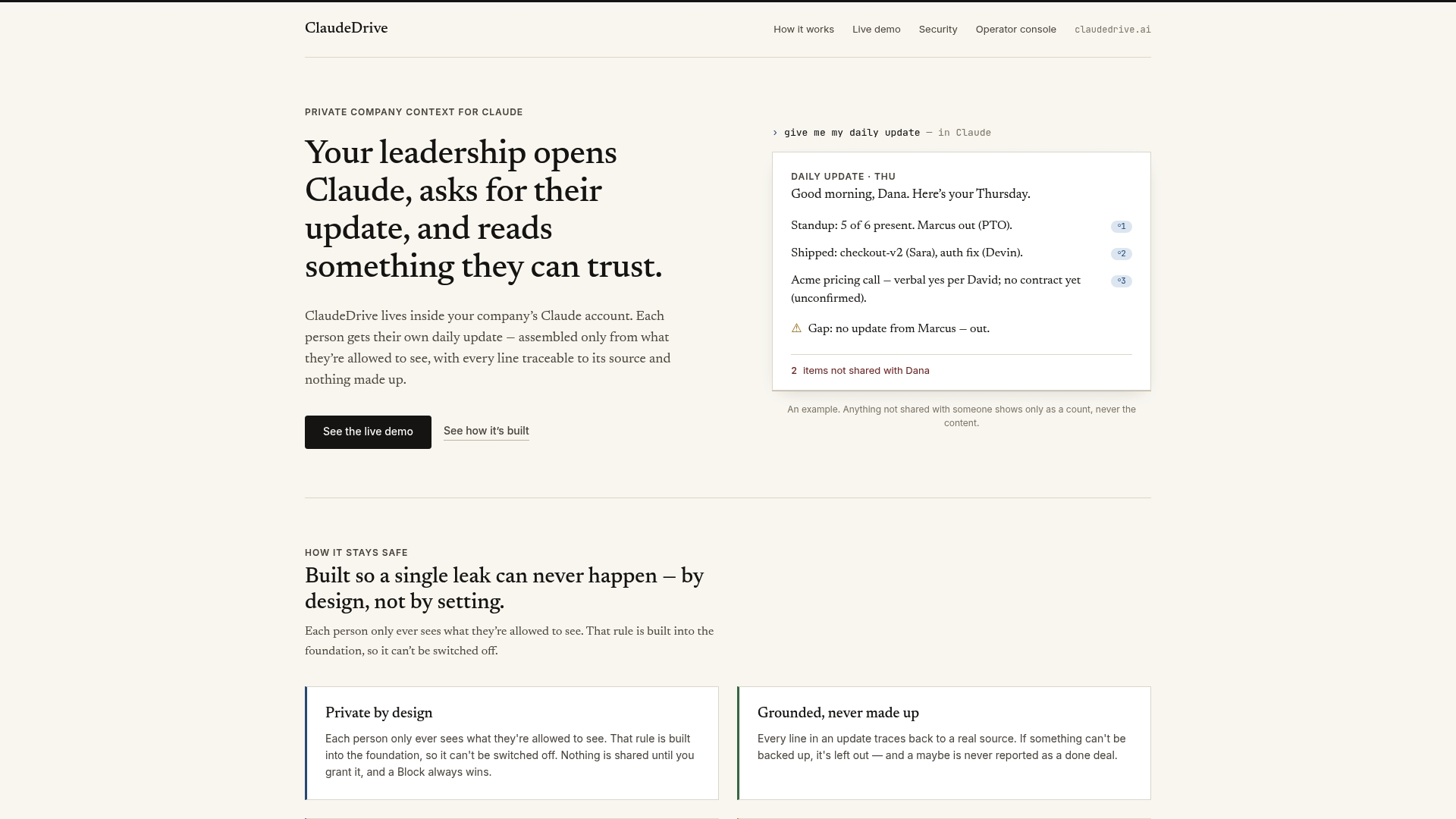
Connect your meeting notes, GitHub, and calendar, and each leader gets a private, permission-aware briefing built only from what they are allowed to see. Every line traces to a real source. Nothing is generated from thin air, and nothing crosses a line it should not. ClaudeDrive is the private company-context layer that feeds Claude, built by Yungsten Tech for leaders who need to act on accurate information every day. See the live demo or talk to us about a pilot at claudedrive.ai.
FAQ
What are scoped AI company updates?
Scoped AI company updates are role-filtered briefings that deliver only the information a person is authorized to see, drawn from live company data and traced to a named source. Each update is built around what the reader is allowed to access, not what the AI can technically retrieve.
How do scoped AI updates improve security?
Scoped updates apply least-privilege access to every briefing and pair it with runtime enforcement and audit logging. The Cloud Security Alliance reports that 47% of organizations experienced AI agent security incidents, most of which runtime guardrails and explicit ownership can prevent.
What performance gains do scoped AI updates deliver?
GitLab’s research shows scoped context produces responses up to 11x faster, uses 4.5x fewer tokens, and generates up to 45x fewer hallucinations compared to unscoped AI access. Those gains apply directly to the quality and speed of leadership briefings.
How do scoped updates differ from regular AI summaries?
Regular AI summaries pull from whatever data the model can access. Scoped updates are built from a defined, permission-controlled context tied to the reader’s role. The difference is traceability: every claim in a scoped update links to a real source.
Which companies benefit most from scoped AI updates?
High-growth companies with multiple leadership roles and sensitive cross-functional data benefit most. Platforms like ClaudeDrive are built specifically for this stage, where leaders need current, role-specific information without the overhead of a new tool or a complex IT rollout.