Build or Buy a Company Context Layer for Claude
Decide to build or buy a company context layer for Claude? Learn why buying offers speed and efficiency without losing control. Explore now!
ClaudeDrive
A Yungsten Tech product

Build or Buy a Company Context Layer for Claude

Buy the platform primitives, own the business model. That is the right call for most leaders deciding how to build or buy a company context layer for Claude today. The reason is straightforward: the engineering plumbing (ingestion, graph engine, governance scaffolding) is a commodity. Your definitions of ARR, your team structure, your decision rules — those are not. Outsourcing the plumbing while keeping the ontology in a version-controlled repo you own gives you speed without surrendering IP.
Quick verdict:
- Buy if you need a trustworthy daily briefing inside Claude within weeks, not quarters.
- Buy if you lack a dedicated platform engineer to maintain ingestion connectors long-term.
- Build the full stack only when your competitive advantage is literally encoded in the ontology, or when regulatory obligations forbid routing certain definitions through a third party.
- ClaudeDrive (by Yungsten Tech) is a ready path to run that pilot inside Claude with permission-aware, source-attributed briefings from day one.
Table of Contents
- Should you build or buy the context layer that feeds Claude?
- What questions must you answer before deciding?
- How to run a 60–90 day pilot for Claude-connected briefings
- What security and governance guarantees should you require?
- When does buying a context-layer platform make the most sense?
- When does building an in-house context layer make sense?
- Key Takeaways
- The case for owning your ontology, whatever you decide
- ClaudeDrive is a direct path to a low-friction pilot
- Selected sources and further reading
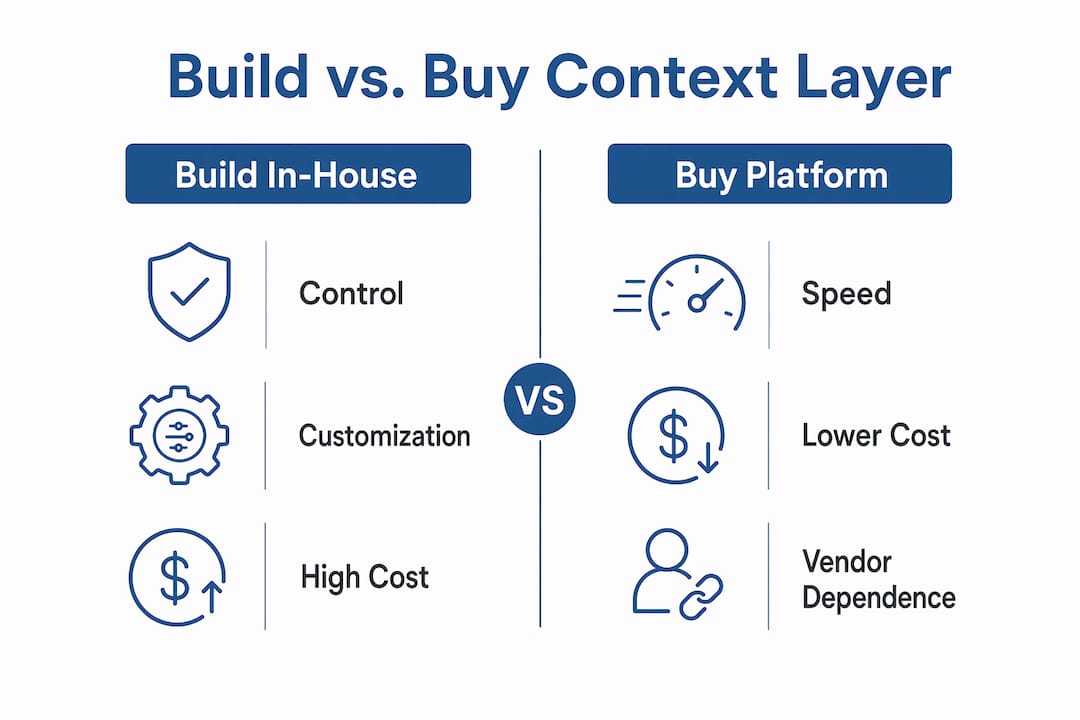
Should you build or buy the context layer that feeds Claude?
| Dimension | In-house build | Buy primitives + own model |
|---|---|---|
| Total cost of ownership | High upfront; ongoing staffing for connectors and maintenance | Lower upfront; ongoing subscription plus ontology ownership cost |
| Time to value | Weeks to months for a basic layer; enterprise-wide coverage is iterative | 1–2 weeks for a minimal layer (three blueprints and two integrations); broad coverage takes longer and is iterative |
| Control and IP | Full stack ownership; risk of over-engineering | Own the ontology and actions; vendor owns the engine |
| Security and data isolation | Fully in-house; you set every boundary | Depends on vendor’s permission model; require per-person access controls |
| Maintenance and staffing | Requires a platform engineer plus data owners | Vendor handles engine; your team governs definitions |
| Claude integration and traceability | Custom; you build the endpoint and source attribution | Vendor provides the endpoint; require per-line source attribution |
| Customizability | Unlimited, but every custom rule is your maintenance burden | High within the model layer; primitives are fixed |
| Vendor lock-in and exit | None; full portability | Low if ontology stays in your repo; portable by design |
The most common executive mistake is treating this as a binary. The real decision is where to draw the line. Port’s implementation data shows context-layer setups cutting per-query agent cost by as much as 80% compared with raw MCP setups. Real examples moved cost from $1.76 to $0.35 per query by pre-joining relations at ingestion time rather than resolving them live. That cost profile is hard to replicate with a hand-rolled build in the first year. Time-to-value is the other lever: a focused buy gets a leader’s daily briefing running in days; a full in-house build rarely delivers a trustworthy first answer inside a month.
What questions must you answer before deciding?
Work through these before you commit budget or engineering time.
- Is this core IP or commodity plumbing? If your definitions of revenue, customer health, or team structure are genuinely proprietary, you need to own the ontology. If you are just wiring meeting notes to Claude, you are buying a utility.
- What is your real TCO horizon? Count the initial build cost, the ongoing staffing for connector maintenance, and the opportunity cost of the engineers you pull off product work.
- How fast does leadership need this? A CEO asking for a daily briefing in two weeks cannot wait for a six-month build.
- What data sensitivity applies? Identify which sources carry restricted information and confirm that any vendor can enforce per-person access controls before a single line of data moves.
- Which tools must be live on day one? Meeting notes, GitHub, and the calendar are the minimum for a useful leadership briefing. Confirm the integration path for each before signing anything.
Pro Tip: Ask your engineering team this question: “Can you write the ten competency questions our context layer must answer correctly?” If they struggle, you do not yet have a clear enough ontology to build. That gap is the strongest signal that you should buy the primitives and model the ontology incrementally.

How to run a 60–90 day pilot for Claude-connected briefings
A timeboxed pilot removes the guesswork. Run it in three gates.
- Days 1–14: Connect and scope. Pick one high-leverage domain (incident triage, sales pipeline, or weekly ops). Connect two live integrations. Model three blueprints — Service, Team, Environment — and expose the endpoint to Claude in read-only mode.
- Days 15–30: First trustworthy briefing. A leader opens Claude and asks for their update. Measure time-to-first-trustworthy-briefing and per-query cost. Every answer must cite its source; flag any answer that cannot.
- Days 31–60: Acceptance testing. Run the ten competency questions against the layer. Score accuracy. Confirm that each leader sees only what they are permitted to see. Record every action for audit.
- Days 61–90: Governance gates and scale decision. Add one self-service action behind an approval gate. Measure user satisfaction. Present cost, accuracy, and adoption metrics to the executive team. Make the go/no-go call.
Staffing the pilot: you need a chief of staff to own the competency questions, one platform engineer for integrations, a data owner per source, and a security reviewer to sign off on permission boundaries. Four people, part-time, is enough to run a clean pilot.
What security and governance guarantees should you require?
Whether you buy or build, hold any solution to these standards before trusting it with leadership data.
- Permission-aware access: each leader sees only the information they are authorized to see. No shared context that leaks across roles or teams.
- Per-line source attribution: every line in a briefing traces back to a real, named source. No answer without a citation.
- No fabrication: the layer surfaces only what exists in connected sources. If the answer is not there, it says so.
- Versioned ontology: store canonical definitions in a repo you control. The vendor reasons over your ontology; it does not replace it as the system of record.
- Exportable audit logs: every agent action is recorded and exportable for SOC 2 review or incident investigation.
- Governance controls: named owners for each definition, a change-approval process, and a clear answer to “who can update this rule?”
“Own the canonical version of your ontology, govern who can read and write to it, and treat it with the same IP protections you’d apply to proprietary source code.” — Sonny Rivera, ThoughtSpot
Paul at ClaudeDrive publishes practical guides and checklists on these governance requirements. They are worth sharing with your security reviewer before the pilot starts.
When does buying a context-layer platform make the most sense?
Most organizations land here. The buy path is right when:
- Leadership needs a daily briefing within weeks and cannot wait for an engineering build cycle.
- The team lacks a dedicated platform engineer to maintain ingestion connectors over 12–24 months.
- The ontology is not a competitive moat — you are connecting standard tools, not encoding proprietary business logic.
- You want the ontology portable and version-controlled in your own repo, with the vendor handling only the engine.
- Measurable wins matter early: faster adoption, lower per-query cost, and centralized governance are easier to demonstrate with a vendor’s primitives than with a hand-rolled build.
When does building an in-house context layer make sense?
The build path is justified in a narrow set of cases.
- Your competitive advantage is literally encoded in the ontology. The definitions, constraints, and reasoning rules are what differentiate you, and you cannot hand that to a third party.
- You have committed engineering resources and a multi-year roadmap that makes this a strategic platform, not a one-time project.
- Regulatory or contractual obligations forbid routing certain definitions or actions through any external system.
Even in these cases, the practical advice holds: keep the ontology in a version-controlled repository you own, even if you eventually buy the primitives underneath it. Owning the meaning and operationalizing the meaning are two separate jobs.
Key Takeaways
Buying the platform primitives while owning the business ontology in a version-controlled repo is the fastest, lowest-risk path to trustworthy Claude briefings for most leadership teams.
| Point | Details |
|---|---|
| Buy primitives, own the model | Outsource the engine; keep definitions, rules, and actions in a repo you control as company IP. |
| Time to value is weeks, not months | A focused buy with several blueprints and integrations can deliver a first trustworthy briefing quickly. |
| Require three non-negotiables | Per-person access controls, per-line source attribution, and exportable audit logs are the floor for any vendor or build. |
| Build only when ontology is your moat | Full in-house builds are justified when competitive advantage is encoded in the definitions, or when regulation demands it. |
| ClaudeDrive as a pilot path | ClaudeDrive connects meeting notes, GitHub, and the calendar to deliver permission-aware, source-attributed briefings inside Claude with no new app to deploy. |
The case for owning your ontology, whatever you decide
The build-or-buy debate tends to get framed as a technology choice. It is actually an IP decision. The engineering primitives — ingestion, graph traversal, endpoint exposure — will commoditize. The definitions your company uses for revenue, customer health, team ownership, and risk will not. Those are the things a senior leader relies on when they ask Claude for an update and need to trust the answer.
The mistake I see most often is leaders who buy a context-layer platform and then let the vendor become the system of record for business logic. The ontology ends up locked in a vendor UI, undocumented, and impossible to audit. When the vendor changes pricing or gets acquired, the company has no portable asset to show for it.
The right posture: treat the ontology like source code. Version it, review changes, and own the canonical copy. Let the vendor’s engine reason over it. That separation is what keeps your briefings trustworthy and your options open.
One practical move you can make this week: write down the ten questions your daily briefing must answer correctly. If you cannot write them, you are not ready to build or buy anything. If you can, you have the seed of your ontology and a clear acceptance test for any pilot.
ClaudeDrive is a direct path to a low-friction pilot
If time-to-value is your constraint, ClaudeDrive removes the setup friction that stalls most pilots. Connect meeting notes, GitHub, and your calendar. Tag who is allowed to see what. Each leader opens Claude, asks for their update, and reads a briefing built only from sources they are permitted to access, with every line traced back to a real document.
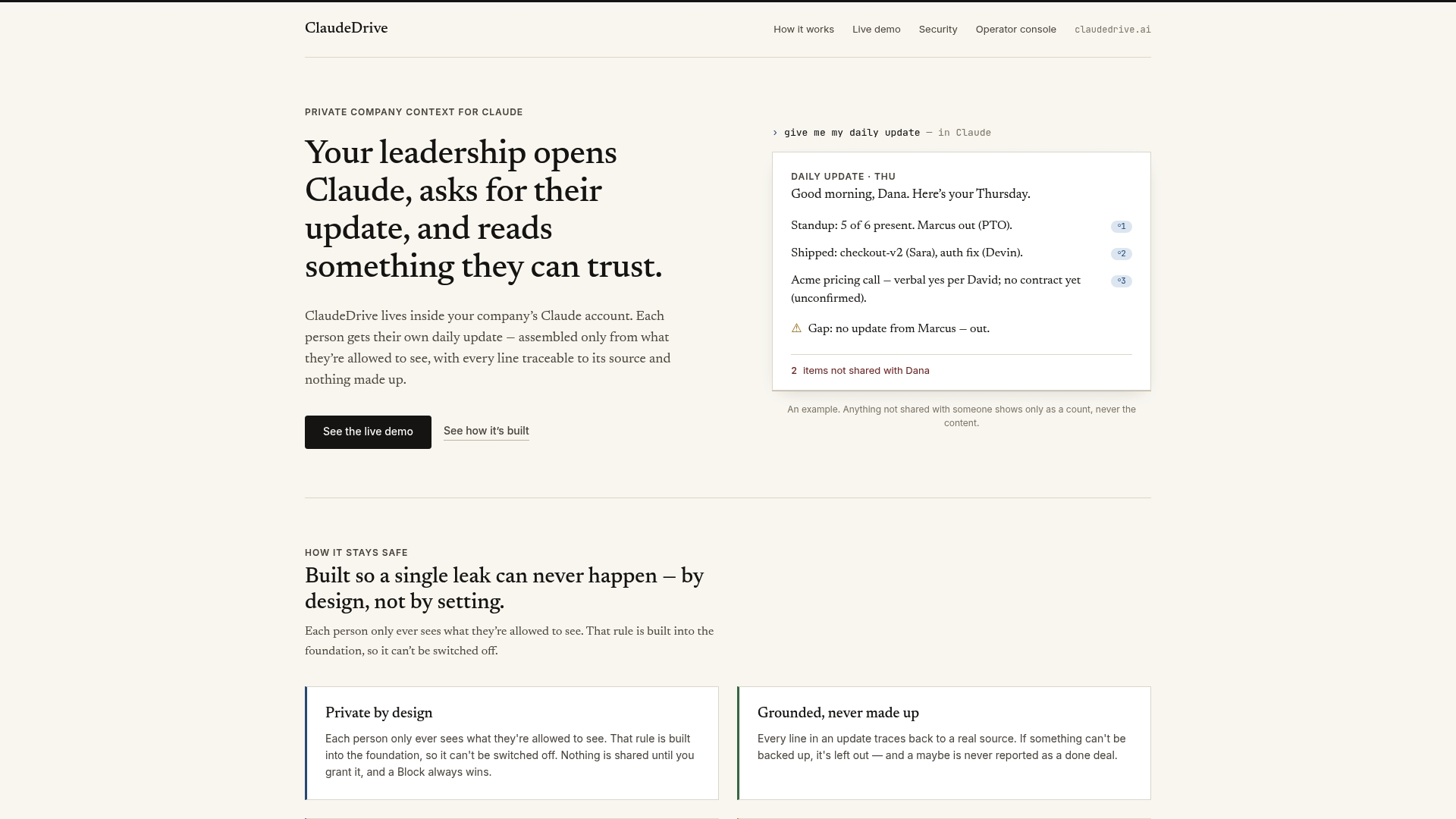
No new app. No dashboard to train anyone on. The guarantees are built in: per-line source attribution, allowed-information-only access, and exportable logs for your security reviewer. The pilot metrics you need — accuracy against competency questions, per-query cost, time-to-first-trustworthy-briefing — are measurable from week two.
See the live demo or talk to us about a pilot to get a leadership briefing running inside Claude on your own data.
Selected sources and further reading
Use these to verify the claims in this article and share with your technical reviewers.
- How to Architect a Clean AI Context Layer — Sonny Rivera, ThoughtSpot. The definitive framework on ontology sovereignty, machine readability, and why the canonical definitions must stay yours. Start here if you are a CTO or CISO.
- Context Layer for AI SDLC — Port. Covers the buy-primitives-own-model framing, the $1.76-to-$0.35 per-query cost reduction, and the three-blueprint fast-start. Start here if you are a CEO or COO focused on time-to-value.
- How to Build Your Business Context Layer in 5 Steps — The Open Letter. Practical guidance on competency questions, single-domain pilots, and the AI-first protocol for filling ontology gaps. Useful for chiefs of staff scoping the pilot.
- Building a native Claude context framework — BASH Consultants. A seven-layer, repository-first approach to making Claude behavior repeatable and auditable. Relevant for governance reviewers.
- Contextium — Generates native Claude files and keeps the repo portable, so rules are not locked to a vendor UI. Useful reference for exit-option evaluation.
- Governed context layer guide — ClaudeDrive. Governance patterns and control gates for any context-layer deployment.
Reminder: when evaluating any vendor, require traceable-source lines and a pilot with measurable accuracy metrics before committing. A vendor who cannot show you a sourced answer in a demo is not ready for leadership briefings.