Governed Context Layer for AI Agents: 2026 Guide
Discover the governed context layer for AI agents in 2026. Learn how it ensures accurate data, identity, and policy enforcement for effective AI.
ClaudeDrive
A Yungsten Tech product

Governed Context Layer for AI Agents: 2026 Guide

A governed context layer for AI agents is the infrastructure that controls what AI systems remember, retrieve, and act upon by enforcing identity, policy, and data currency before any inference call is made. Most enterprise AI failures trace back not to weak models but to weak context. The AI had the wrong information, outdated data, or access it should not have had. A properly built context layer solves all three problems at the infrastructure level, not the prompt level. ClaudeDrive is built on exactly this principle: every briefing a leader reads is drawn from a governed, traceable context layer, not from a model guessing at what it should know.
What is a governed context layer for AI agents?
A governed context layer is the infrastructure tier that sits upstream of AI inference calls to resolve identity, enforce policy, and validate data currency across multiple systems. It is not a prompt template or a retrieval trick. It is persistent, queryable infrastructure that the AI draws from every time it needs organizational knowledge.
The distinction matters because most teams treat context as a model problem. They expand token windows, write longer system prompts, and add more retrieval calls. That approach does not scale. Externalizing context management into a dedicated layer is the architecture decision that separates experimental AI from production AI.
A mature context layer manages three things simultaneously: what the agent knows, who is allowed to know it, and whether the data is still current. Without all three, the agent may be confident and wrong. That combination is the most dangerous failure mode in enterprise AI.

How does a governed context layer differ from context engineering?
Context engineering and context management are two different disciplines that operate at two different levels. Conflating them is the most common implementation mistake technical leaders make.
Context engineering is prompt-layer work. It covers:
- Deciding which retrieved documents go into the model input
- Compacting long conversation histories to fit token budgets
- Structuring prompts to guide model behavior
- Selecting retrieval strategies for a given query type
Context management is infrastructure work. It covers:
- Ensuring data freshness and validity before retrieval
- Resolving user identity and enforcing access controls
- Maintaining audit logs and data lineage records
- Enforcing policy across multiple agents and tenants
The failure scenario that separates the two is instructive. A team can write excellent prompts and still get confidently wrong answers if the underlying data is stale, miscategorized, or pulled from a source the user should not access. Prompt quality cannot compensate for infrastructure failure.
Pro Tip: Assign separate owners for context engineering and context management from the start. When one team owns both, governance work consistently loses to prompt iteration because prompt work produces faster visible results.
Scaling AI across multiple teams or regulated environments requires this separation. A single team cannot maintain prompt quality and data governance simultaneously without one degrading the other. The organizations that get this right treat context management as a data infrastructure function, not an AI function.
What are the core components of a governed context layer?
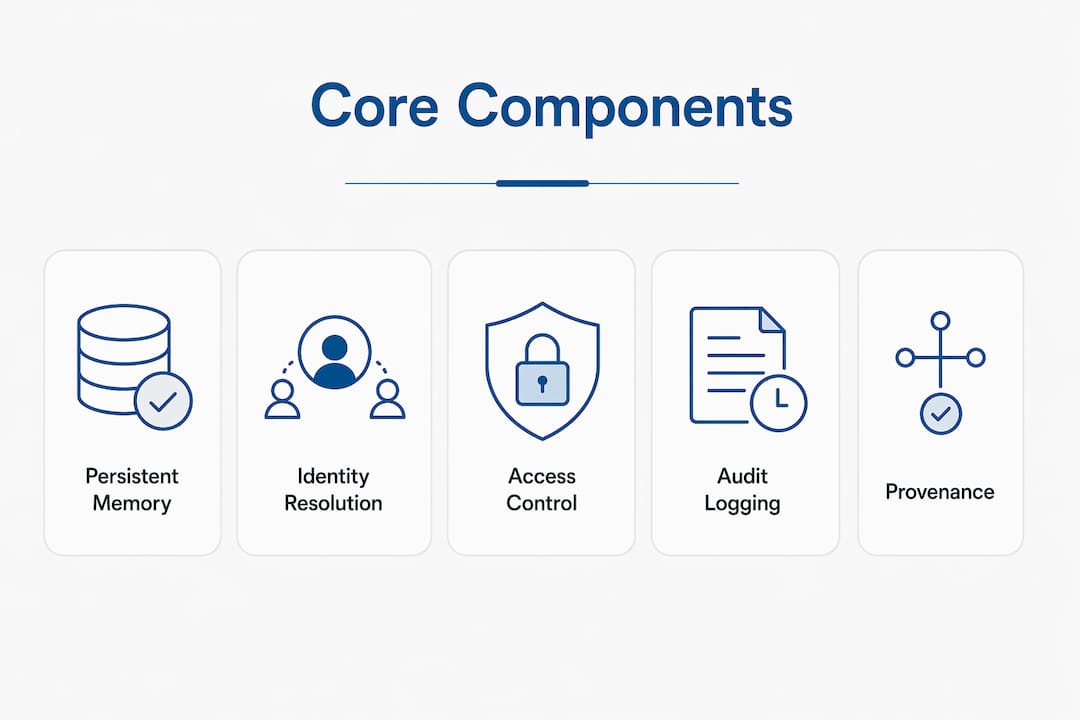
A production-grade context layer has six components. Each one addresses a specific failure mode that emerges at enterprise scale.
-
Persistent cross-session memory. The layer stores what agents have learned or retrieved across sessions. Without persistence, every agent interaction starts from zero, and the organization loses the compounding value of prior work.
-
Structured and semantic retrieval. Combining structured metadata with semantic search enables intent-based retrieval. The agent can find a document by meaning, not just by keyword match. This is the difference between a search engine and a knowledge layer.
-
Identity and tenant isolation. Access controls are enforced at retrieval, not at the application layer. Multi-tenant data isolation prevents one user’s query from surfacing another user’s data. This is non-negotiable for any organization with role-based information boundaries.
-
Provenance and audit logging. Every piece of retrieved context carries a timestamp, a source attribution, and an authorization record. This is what makes AI outputs auditable and defensible in regulated industries.
-
Integration with organizational data catalogs. The context layer connects to existing data governance infrastructure, including business glossaries, data catalogs, and ownership registries. AWS Context demonstrates this pattern by mapping data relationships into a governed knowledge graph accessible by AI agents.
-
Agent communication protocol support. Model Context Protocol (MCP) has become the standard interface for AI agents consuming context layers. A context layer without MCP compatibility creates integration friction as agent frameworks multiply.
| Component | What it prevents |
|---|---|
| Persistent memory | Loss of organizational knowledge between sessions |
| Tenant isolation | Data leakage across roles or teams |
| Provenance logging | Unauditable or unattributable AI outputs |
| Semantic retrieval | Missed context due to keyword-only search |
| MCP support | Agent integration fragmentation |
Pro Tip: Build provenance logging before you need it. Retrofitting audit trails into a live context layer is significantly harder than designing them in from the start. Regulators and security teams will ask for them.
Why is governance critical for AI agent context?
Governance is not a compliance checkbox. It is the mechanism that determines whether an AI agent’s output can be trusted. Without governance, AI agents retrieving context risk producing confidently wrong answers due to stale or inconsistent data sources. The model does not know the data is bad. It answers with full confidence regardless.
The trust signals that make context reliable are:
- Ownership. Who is responsible for this data asset, and is that person still active?
- Lineage. Where did this data originate, and what transformations has it passed through?
- Certification. Has this data been reviewed and approved for use in AI outputs?
- Freshness. When was this data last validated, and does it reflect the current state of the organization?
Each signal is a separate infrastructure concern. None of them can be handled by a system prompt.
Governance in AI agent systems cannot be reduced to prompt instructions. Hard infrastructure controls are the only reliable mechanism for identity resolution and data lineage at scale. A system prompt can ask an agent to “only use verified data,” but it cannot verify the data. The infrastructure layer can.
Multi-tenant environments add another layer of complexity. Agent memory must be governed at both ingestion and retrieval to prevent unauthorized data from crossing tenant boundaries. A leader in one business unit should not receive context drawn from another unit’s confidential pipeline, even if both units use the same AI agent. That guarantee requires permission-aware retrieval controls enforced at the infrastructure level, not the prompt level.
How can technical leaders implement governed context layers?
Implementation starts with a structural decision: separate the teams and responsibilities that own context engineering from those that own context management. This is not an organizational preference. It is an architectural requirement for any AI deployment that needs to scale.
The practical steps for technical leaders are:
-
Prioritize persistent, queryable infrastructure over token window expansion. Expanding context windows costs significantly more than building optimized retrieval infrastructure. The economics favor external context layers at any meaningful scale.
-
Enforce governance at the data layer, not the application layer. Access controls, freshness checks, and lineage records belong in the context infrastructure. Application-layer enforcement breaks down as agent frameworks multiply and new integrations are added.
-
Plan for audit logging from day one. Every retrieved piece of context needs a timestamp, a source, and an authorization record. This is the foundation for compliance reporting and for debugging AI outputs that turn out to be wrong.
-
Adopt MCP for interoperability. Building context layers that speak MCP means any compliant agent framework can consume them. This prevents vendor lock-in and reduces integration cost as the agent ecosystem evolves.
-
Monitor freshness continuously. Stale data is the most common source of confident AI errors. Build freshness monitoring into the context layer so that outdated sources are flagged before they reach the model. For teams building context versioning practices, this monitoring is the operational backbone.
-
Connect to existing data governance infrastructure. A context layer that ignores the organization’s existing data catalog, ownership registries, and business glossaries creates a parallel governance problem. Integration is harder upfront but eliminates drift between AI governance and data governance over time.
Pro Tip: Start with one high-value use case and one data source. Prove that the governance controls work end-to-end before expanding. A narrow, well-governed context layer delivers more value than a broad, ungoverned one.
For organizations working with custom AI workflows in regulated environments, the context layer is often the difference between a proof of concept and a production system. The model is rarely the bottleneck. The data infrastructure is.
Key Takeaways
A governed context layer is the infrastructure foundation that determines whether AI agents produce trustworthy, auditable outputs at enterprise scale.
| Point | Details |
|---|---|
| Governance is infrastructure, not prompts | Identity resolution, lineage, and access controls require hard infrastructure, not system prompt instructions. |
| Separate engineering from management | Context engineering (prompt work) and context management (data infrastructure) need distinct owners to scale. |
| Provenance logging is non-negotiable | Every retrieved context item needs a timestamp, source, and authorization record for compliance and debugging. |
| Persistent memory compounds value | Cross-session memory lets AI agents build on prior organizational knowledge rather than starting from zero each time. |
| MCP enables interoperability | Model Context Protocol support prevents integration fragmentation as agent frameworks multiply across the organization. |
Why I think most teams are solving the wrong problem
Most AI teams I talk to are deep in prompt optimization when their real problem is data infrastructure. They are rewriting system prompts, tuning retrieval parameters, and experimenting with context window sizes. None of that work addresses the root cause: the context their agents consume is ungoverned, unverified, and often stale.
The uncomfortable truth is that a well-governed context layer with mediocre prompts will outperform a poorly governed context layer with excellent prompts. The model can only work with what it receives. If what it receives is wrong, the output will be wrong, and it will be delivered with full confidence.
Leadership teams often underestimate this because the failure mode is invisible until it matters. An AI agent that returns a confidently wrong answer based on a six-month-old data source looks exactly like one that returns a correct answer. The difference only surfaces when someone checks the source, or when a decision made on that output turns out to be wrong.
The organizations that get this right treat context governance as a data infrastructure investment, not an AI investment. They assign data engineering ownership to the context layer, integrate it with existing governance tooling, and audit it the same way they audit any other production data system. That framing changes the conversation from “how do we make the AI smarter” to “how do we make the data the AI reads more trustworthy.” The second question has a cleaner answer.
— Paul
ClaudeDrive as a governed context layer for your organization
ClaudeDrive is the private company-context layer that feeds Claude directly, built for leaders who need a daily briefing they can trust without adopting a new platform.
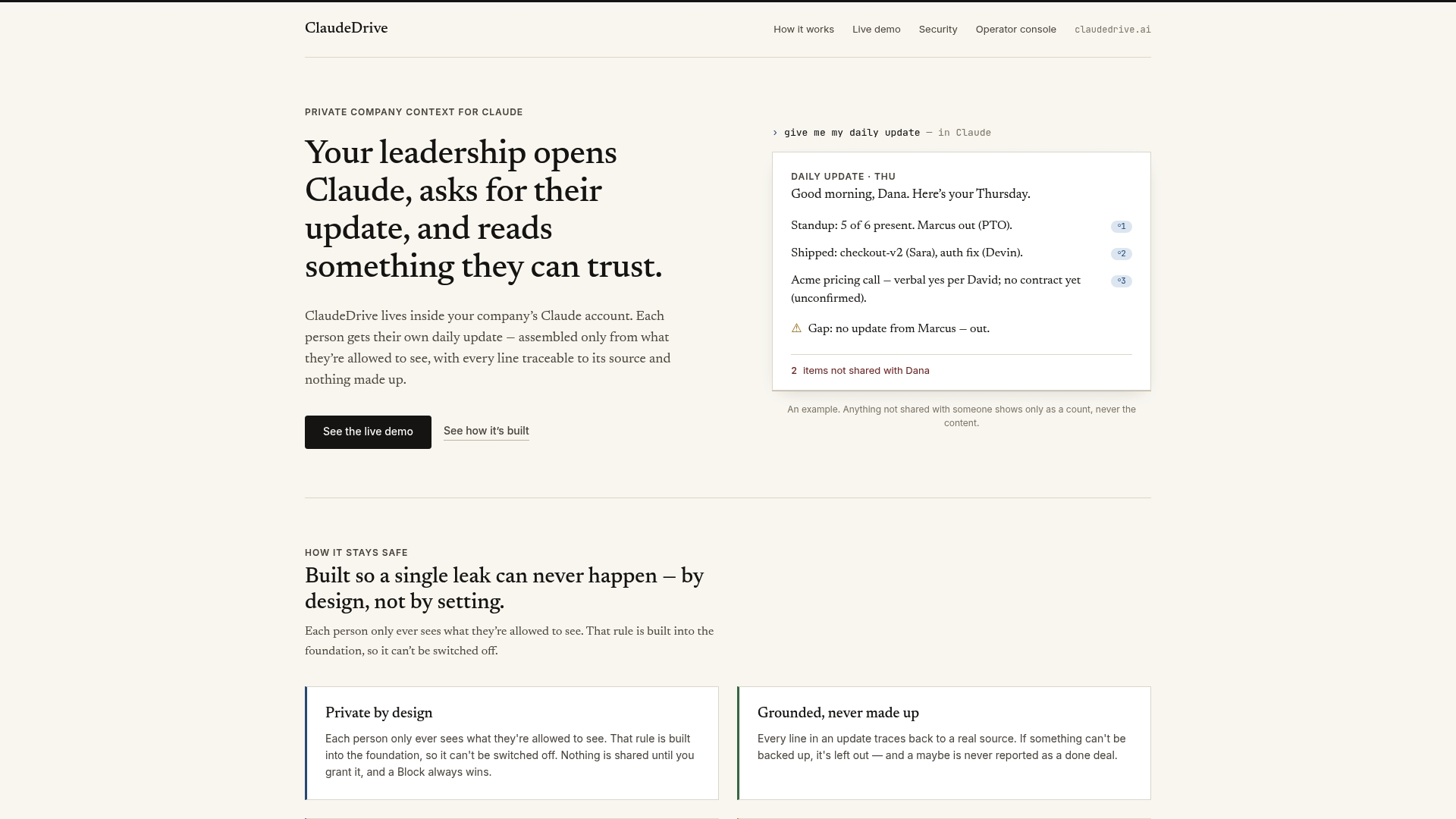
Connect your existing tools, including meeting notes, GitHub, and your calendar, and each leader gets a personalized, permission-filtered view of what happened. Every line in the briefing is traceable to a real source. Nothing crosses an access boundary it should not. The ClaudeDrive Console delivers persistent memory, identity-based access controls, and full source attribution inside the Claude interface your team already uses. No new dashboard. No wiki to maintain. See the live demo or talk to us about a pilot for your organization.
FAQ
What is a governed context layer for AI agents?
A governed context layer is infrastructure that manages what AI agents remember, retrieve, and act upon by enforcing identity, access controls, and data freshness before any inference call is made. It operates upstream of the model, not inside the prompt.
How does context management differ from context engineering?
Context engineering is prompt-level work: deciding what goes into the model input. Context management is infrastructure work: ensuring data is valid, fresh, and authorized before retrieval. The two disciplines require separate ownership to scale effectively.
Why can’t system prompts handle AI governance?
System prompts can instruct an agent to use verified data, but they cannot verify the data themselves. Hard infrastructure controls are the only reliable mechanism for enforcing identity resolution, access boundaries, and data lineage at scale.
What role does MCP play in a context layer?
Model Context Protocol is the standard interface that allows AI agents to consume context layers uniformly. MCP compatibility prevents integration fragmentation as organizations deploy multiple agent frameworks across different workflows.
How does ClaudeDrive implement a governed context layer?
ClaudeDrive connects to organizational tools and delivers permission-filtered, source-attributed briefings inside Claude. Each leader sees only what they are authorized to see, with every output traceable to a real source and nothing fabricated or cross-contaminated.