Define Glean: Quick Definition and Usage Guide for Learners
Understanding how to define glean helps you gather knowledge effectively. Discover its meanings and practical usage in this concise guide.
ClaudeDrive
A Yungsten Tech product

Define Glean: Quick Definition and Usage Guide for Learners

Glean (verb, /gliːn/, rhymes with “seen”) means to gather information, knowledge, or material gradually and often with effort, usually collecting it bit by bit from multiple partial sources. Literally, it means to pick up leftover grain after a harvest. Merriam-Webster lists both senses, and the verb shows up at roughly 2 occurrences per million words in written English, making it a common but not everyday choice. A simple example: “She gleaned what she could about the merger from three different emails.”
Key Takeaways
Glean means to gather information or material gradually and with effort, most often from partial or scattered sources, and it traces back to the literal practice of collecting leftover grain after a harvest.
| Point | Details |
|---|---|
| Core definition | Glean means to obtain information or material bit by bit, often with difficulty, per Merriam-Webster. |
| Two main senses | Literal: gathering leftover crops. Figurative: piecing together information from partial sources. |
| Common pattern | Use the structure “glean something from somebody or something,” most often with information, insight, or data. |
| Not the same as gather | Glean implies effort and incomplete sources; gather and collect are more neutral and routine. |
| Avoid confusing with gleam | Gleam means to shine faintly; glean means to gather gradually, and the two are unrelated in meaning. |
Company leaders face a version of this same challenge every day: turning scattered meeting notes, GitHub activity, and calendar entries into something a team can actually trust. ClaudeDrive was built for exactly that problem. It connects to the tools your team already uses, respects who’s allowed to see what, and delivers a daily update inside Claude with every line traceable to a real source, nothing invented, and nothing crossing a line it shouldn’t. No new dashboard to roll out, no wiki to maintain. If you want to see what a sourced, permission-aware update actually looks like, see the live demo.
Table of Contents
- What does glean mean? The main senses
- How do you pronounce glean, and what are its forms?
- How is glean used in a sentence? Grammar and collocations
- Example sentences that show glean in context
- What are the best synonyms for glean, and how is it different from gleam?
- Where does the word glean come from?
- Is there a biblical meaning of glean?
- How can you remember and use glean correctly?
- Where can you verify the definition of glean?
- Frequently asked questions about glean
- Sources
What does glean mean? The main senses
The word carries a handful of related meanings, and dictionaries generally group them into two main camps.
- Literal sense: to gather leftover grain or crops left behind after a harvest. Example: “Villagers used to glean the fields once the wheat was cut.”
- Figurative sense: to obtain information, insight, or material bit by bit, often piecing it together from scattered or incomplete sources. Cambridge Dictionary defines it as collecting information “in small amounts and often with difficulty.” Example: “Reporters gleaned details of the deal from unnamed sources.”
- Extended sense: to sift through remnants or leftovers of any kind, not just grain or facts, looking for anything useful. Example: “He gleaned a few usable planks from the demolition site.”
The Oxford English Dictionary records seven distinct meanings for the verb, two of which it labels obsolete, along with earliest evidence in Middle English around 1350. Most modern usage sticks to the two senses above.
How do you pronounce glean, and what are its forms?
Say it as one syllable: /gliːn/, like “clean” with a G. Stress falls naturally on that single syllable since there’s nowhere else for it to go.
The verb conjugates the regular way, with no irregular surprises:
- Base form: glean (“Analysts glean patterns from raw data.”)
- Third person singular: gleans (“She gleans updates from scattered notes.”)
- Past tense: gleaned (“We gleaned the key facts from old reports.”)
- Present participle: gleaning (“He’s gleaning insights from customer calls.”)
How is glean used in a sentence? Grammar and collocations
The standard pattern is glean something (from somebody or something). You almost always need an object, and that object is usually abstract: information, insight, data, evidence, or figures. Merriam-Webster and the Oxford Advanced Learner’s Dictionary both confirm this frame and flag “information” and “insight” as the most frequent partners.
A few patterns worth memorizing:
- Glean information from a report, interview, or document
- Glean insight from a conversation or dataset
- Glean evidence from scattered records
- Glean data from multiple, often incomplete, sources
The word implies effort. You don’t glean something that was handed to you directly; you glean it by working through partial or messy material. That’s the detail that separates it from a flatter verb like “collect.”
Example sentences that show glean in context
Formal report: “The audit team gleaned the discrepancy from three unrelated ledgers.” (Figurative; effort across sources.)
News sentence: “Journalists gleaned new details about the negotiation from leaked memos.” (Figurative; classic journalism usage.)
Academic sentence: “Researchers gleaned behavioral patterns from years of scattered field notes.” (Figurative; synthesis over time.)
Casual conversation: “I gleaned from her tone that she wasn’t happy about the schedule.” (Figurative; reading between the lines.)
Literal usage: “The children spent the afternoon gleaning apples the pickers had missed.” (Literal; the original agricultural sense.)

Each example fits because the subject is working through something partial, whether that’s old records, a leaked memo, or a tone of voice, rather than receiving information cleanly and directly.
What are the best synonyms for glean, and how is it different from gleam?
Close synonyms exist, but none of them match glean’s specific flavor exactly.
- Gather: broader and more neutral; doesn’t necessarily imply difficulty or partial sources.
- Collect: even more neutral, often used for routine or systematic acquisition.
- Pick over: closer in spirit, emphasizing the sorting-through element, but less common in professional writing.
- Extract: implies deliberate, sometimes forceful removal, rather than patient accumulation.
Glean beats gather or collect when the process involves effort, incompleteness, or secondary sources. “She gathered the reports” is neutral. “She gleaned the trend from the reports” tells you she had to work for it, piecing together a signal that wasn’t stated outright.
One common mix-up: glean versus gleam. Gleam is a completely different word, meaning to shine faintly or give off light (“the lake gleamed in the moonlight”). Writing “She gleaned with excitement” instead of “gleamed” is a spelling slip that changes the meaning entirely, so keep the two apart.
Where does the word glean come from?
Glean traces back to Old French glener, itself rooted in late Latin glennare. English absorbed the word during the Middle English period, with the Oxford English Dictionary recording earliest evidence around 1350. Its original job was strictly agricultural: describing the practice of collecting grain stalks left behind after a formal harvest.
That agricultural root explains the nuance the word still carries. Gathering leftover grain took patience, careful attention, and a willingness to work with scraps rather than the main crop. When the figurative sense of “gathering information” developed, it kept that same connotation of picking through partial material with care rather than sweeping up everything at once.
Is there a biblical meaning of glean?
Yes. Gleaning appears in biblical texts, most notably in the Book of Ruth, where landowners were expected to leave grain stalks in the field for widows, the poor, and travelers to collect. It functioned as an early form of structured social welfare rather than an accident of harvesting. Landowners left remnants deliberately so that people without their own land could still gather food.
That historical practice is why the figurative sense of glean still carries the idea of finding value in what’s left over, not in the main harvest itself. When you glean insight today, you’re doing the modern equivalent: working through partial, secondary, or overlooked material to find something useful that a quick glance would miss.
How can you remember and use glean correctly?
Tie it to the image of someone walking a harvested field, picking up stray stalks by hand. That’s the memory trick: glean means slow, deliberate collection from leftovers, not a clean grab from the main pile.
For leaders writing briefings, reserve glean for moments when insight came from synthesizing scattered or partial sources, not from a routine data pull. If your team just exported a report, say you collected the figures. If they pieced together a trend from five disconnected conversations, that’s when you glean it. Pro Tip: Save “glean” for briefings where the value came from connecting dots across sources; overusing it for routine downloads makes your writing sound inflated.
That distinction matters more than it seems for anyone reporting up the chain. A trustworthy AI briefing works the same way; it’s only credible when every line traces back to something real, not when it’s dressed up to sound like deeper synthesis than it is.
Where can you verify the definition of glean?
For further reading, consult Merriam-Webster for the standard American English entry, Cambridge Dictionary for a learner-friendly phrasing, the Oxford English Dictionary for full etymology and historical senses, Dictionary for additional examples, and Oxford Learner’s Dictionary for collocation guidance.
Frequently asked questions about glean
What does glean mean in simple terms? It means to collect information or material slowly and with some effort, often piecing it together from more than one source rather than receiving it all at once.
Is glean a formal word? It leans formal to neutral. You’ll see it often in journalism, academic writing, and business reports, less often in casual chat, though the casual example above shows it still works there.
What’s the difference between glean and gather? Gather is neutral and doesn’t imply difficulty. Glean specifically suggests working through partial, scattered, or secondary material to extract something useful.
Can glean be used for literal harvesting today? Yes, though it’s less common now. The literal sense (collecting leftover crops) still appears in agricultural and historical writing, and in charitable gleaning programs that collect surplus produce for food banks.
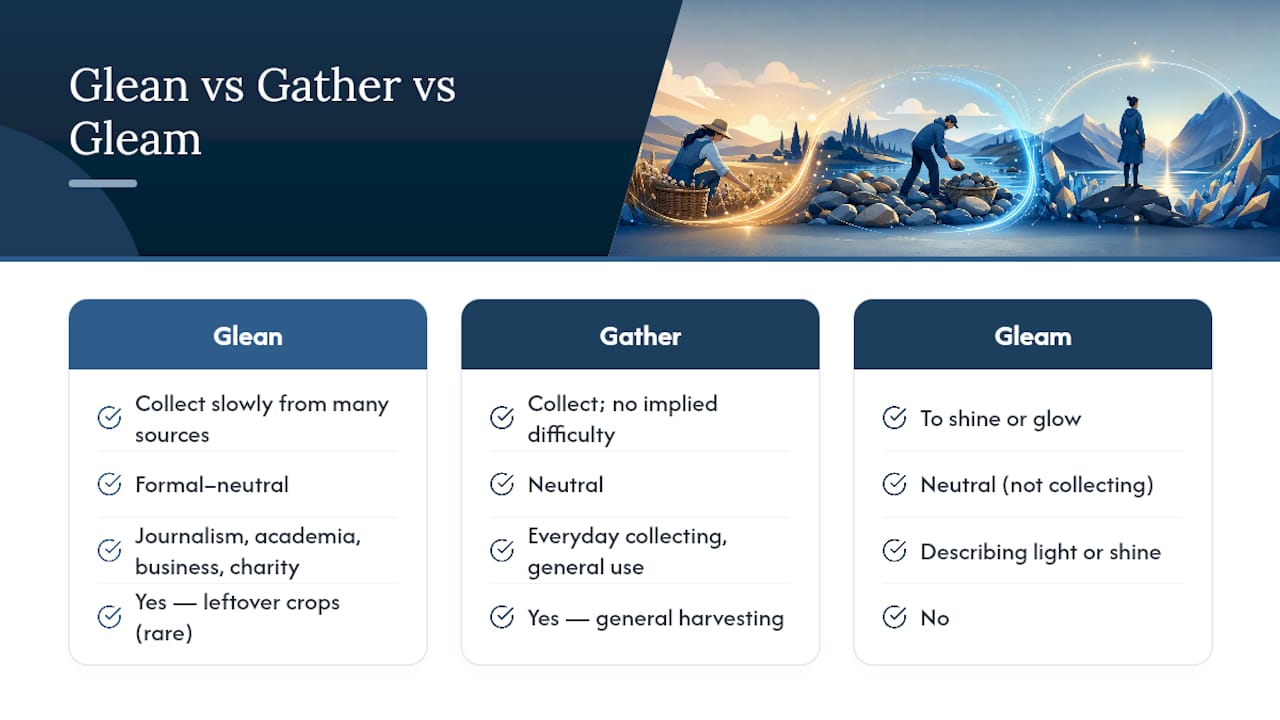
Why do people confuse glean and gleam? They look and sound similar, but gleam means to shine or glow. Mixing them up is a spelling error that changes the sentence’s meaning entirely, so it’s worth double checking before you hit send.
Sources
- GLEAN | definition in the Cambridge English Dictionary
- glean, v. meanings, etymology and more | Oxford English Dictionary
- Dictionary
- glean verb - Oxford Advanced Learner’s Dictionary