Enterprise RAG Access Control: A 2026 Guide for Leaders
Discover how enterprise RAG access control ensures data security and compliance. Learn why it's crucial for AI trust and risk management.
ClaudeDrive
A Yungsten Tech product

Enterprise RAG Access Control: A 2026 Guide for Leaders

Enterprise RAG access control is the practice of enforcing precise, source-consistent permissions during data retrieval so that every AI-generated response contains only information the requesting user is authorized to see. The industry term for this is permission-aware retrieval, and it sits at the intersection of identity management, data governance, and AI system design. Standards like SOC 2 and ISO 27001 require strict access enforcement and regular reviews, making this a compliance obligation, not just a security preference. For technical decision-makers at mid-sized companies, getting this right determines whether an AI knowledge system earns trust or creates liability.
How does enterprise RAG access control enforce permissions during retrieval?
The core guarantee is simple: a user should never receive information they could not access in the original source system. Enforcing this at the retrieval layer is the only way to deliver that guarantee. Application-layer enforcement alone is insufficient for enterprise security because it leaves the retrieval mechanism itself unguarded.
The failure mode is specific and serious. When access control lives outside the retrieval call, it becomes a suggestion rather than enforcement. A language model that receives unauthorized documents in its context window can synthesize that information into a response, even if a downstream filter tries to remove the citation. Post-retrieval filtering does not prevent leakage because the model has already processed the content. The only safe position for access control is inside the retrieval call itself.
Access control in a well-designed system spans four stages:
- Ingestion: Source permissions are extracted and stored alongside each document or chunk.
- Indexing: Permission metadata is attached to every retrievable unit in the vector index.
- Retrieval: The system filters results against the requesting user’s live identity and permissions before any content reaches the model.
- Generation: The model receives only pre-authorized content, so its output is bounded by what the user is allowed to know.
Pro Tip: Never treat retrieval-layer access control as a feature to add later. Retrofitting permission filters into an existing index is significantly harder than building them in from the start.
What access control models work best for enterprise RAG systems?
Three models dominate enterprise access policy design, and each suits a different level of complexity.

Role-Based Access Control (RBAC) assigns permissions to roles, and users inherit those permissions by role membership. RBAC is easy to manage in small organizations with stable job functions. It becomes a liability in dynamic enterprise environments where a single document may be accessible to some members of a team but not others, or where permissions change frequently.
Relationship-Based Access Control (ReBAC) models the relationship between a user and a specific document or container. ReBAC is increasingly adopted in enterprise RAG because it mirrors how permissions actually work in systems like SharePoint and Google Drive, where a file can be shared with an individual, a group, or inherited from a parent folder. This inheritance model maps directly onto the chunk-level granularity that RAG systems require.
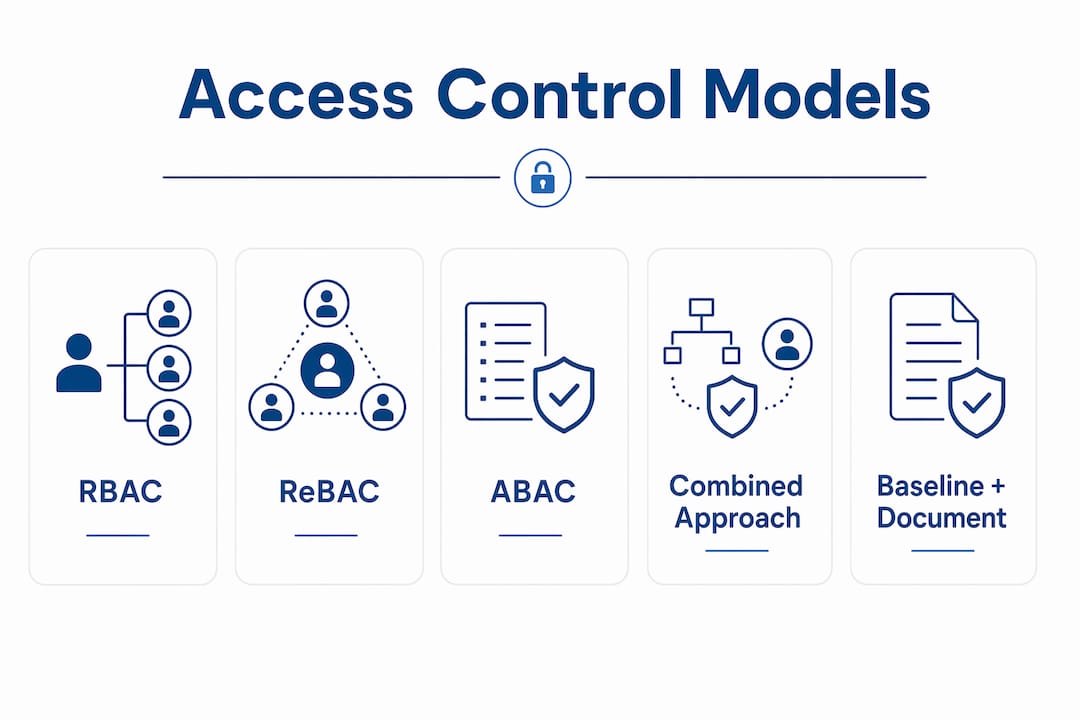
Attribute-Based Access Control (ABAC) evaluates policies against user attributes, document metadata, and environmental context at query time. ABAC handles the most complex scenarios, such as restricting access based on data classification level combined with the user’s department and location.
| Model | Best for | Limitation |
|---|---|---|
| RBAC | Stable roles, simple hierarchies | Too coarse for document-level control |
| ReBAC | Inherited permissions, multi-source data | Requires relationship graph maintenance |
| ABAC | Complex, attribute-driven policies | Higher policy management overhead |
Most mature enterprise deployments combine RBAC for baseline role assignment with ReBAC for document-level permission inheritance and ABAC for sensitive data classification rules.
Pro Tip: Use list-objects APIs from your authorization provider to retrieve the full set of documents a user can access at query time. This approach is orders of magnitude faster than checking permissions per document in a loop.
What are the key failure modes in enterprise RAG permission systems?
Access drift is the most common and least visible failure. Drift occurs when authorization semantics diverge across pipeline layers over time. A document indexed six months ago may carry permissions that no longer reflect the source system’s current state. The index says the document is accessible; the source system says it is not. The RAG system resolves that conflict in favor of the stale index, and a user retrieves content they should not see.
Stale group membership compounds this problem. Enterprise identity systems update group memberships continuously as people join teams, change roles, or leave the company. An index that captures group membership at ingestion time will drift from reality within days. The solution is query-time resolution: the system checks live group membership against the authorization provider at the moment of retrieval, not at the moment of indexing.
Effective policy must be attached to every retrievable unit, preserving complex nested permissions across the pipeline. A single gap in that chain is enough to create a hidden data leak that standard testing will not catch.
Incomplete permission extraction creates a third failure mode. When a document’s access control list cannot be fully parsed during ingestion, the system faces a choice: index the document without complete permissions, or quarantine it. Quarantining content with incomplete ACL information is the correct answer. Indexing it without complete permissions risks inadvertent exposure. Quarantine holds the document out of retrieval until permissions are resolved.
Multi-tenant environments introduce a fourth risk. Logical filters within a shared index can fail under certain query patterns. Physical partitioning, where each tenant’s data lives in a separate index or namespace, eliminates the risk of cross-tenant data leakage that filter-based separation cannot fully prevent.
How do enterprises design access policies and maintain compliance for RAG systems?
A production-ready access control policy combines three layers: role assignments for baseline access, attribute rules for data classification, and relationship graphs for inheritance. Maintaining consistent access control across all three layers requires deliberate governance, not just initial configuration.
SOC 2 and ISO 27001 set specific operational requirements. Privileged access reviews must occur quarterly, with revocation completed within 24 hours of a finding. Non-privileged access reviews must happen at least annually, with unauthorized accounts removed within 10 business days. These timelines apply to both human users and AI agent identities operating within the RAG pipeline.
Operational controls that support compliance include:
- Least privilege enforcement: Every user and AI agent receives the minimum access required for their function, reviewed at each access certification cycle.
- Multi-factor authentication: MFA is required for all accounts with access to the RAG system’s data sources and administration interfaces.
- Emergency revocation playbooks: A documented process for revoking access within the required window, tested at least annually.
- Drift monitoring: Automated comparison of index-level permissions against source system permissions, with alerts on divergence.
Audit logging is non-negotiable for compliance. Audit logs must capture the user or AI agent identity, the action taken, the data sources accessed during retrieval, and the policy version in effect at the time. Those logs support both compliance reporting and forensic investigation if a data exposure event occurs. Teams can review their approach to auditing AI updates as a starting point for building this capability.
Enterprise RBAC frameworks provide a structured foundation for defining and managing these role and permission structures across complex organizations.
Pro Tip: Treat AI agent identities with the same rigor as privileged human accounts. An AI agent that can query your entire knowledge base is a privileged account, and it needs the same quarterly review cycle.
Key Takeaways
Effective enterprise RAG access control requires enforcement at the retrieval layer, not after it, because post-retrieval filtering cannot prevent a language model from incorporating unauthorized content it has already processed.
| Point | Details |
|---|---|
| Enforce at retrieval, not after | Access control inside the retrieval call is the only position that prevents unauthorized content from reaching the model. |
| Match source system permissions | Use auth inheritance so a user cannot retrieve a chunk they could not open in the original SharePoint or Drive file. |
| Combine RBAC, ReBAC, and ABAC | No single model covers all enterprise scenarios; layering them handles inheritance, roles, and attribute-based rules together. |
| Quarantine on incomplete permissions | Content with unresolved ACLs must be held out of retrieval until permissions are confirmed, not indexed with partial controls. |
| Review access on a compliance schedule | SOC 2 and ISO 27001 require quarterly privileged reviews and annual non-privileged reviews, applied to AI agents as well as humans. |
Why identity is the control plane, not an afterthought
The teams I see struggle most with RAG deployments share one pattern: they built the retrieval pipeline first and planned to “add security later.” Later never arrives cleanly. By the time the system is in production, the index structure, the chunking strategy, and the query architecture are all locked in. Retrofitting permission filters at that point means rebuilding core components, not adding a configuration flag.
The harder lesson is about AI agent identities. Without foundational identity controls governing both human and AI agent access, organizations create over-privileged “shadow AI” paths that bypass the access policies applied to human users. An AI agent that runs on a service account with broad read permissions is a privileged account. Treat it that way from day one.
Access control failures are the primary reason RAG deployments stall in production. Not model performance, not latency, not cost. The system works technically, but the organization cannot trust what it returns because they cannot verify that every response respects the access boundaries they set. That trust gap is what kills adoption at the leadership level.
The fix is architectural discipline: identity as the control plane, permissions attached to every retrievable unit, and drift monitoring running continuously. That is not a complex system. It is a disciplined one.
— Paul
ClaudeDrive brings permission-aware retrieval to your leadership team
ClaudeDrive enforces fine-grained access control across the full retrieval pipeline, so every leader who opens Claude reads a briefing built only from what they are authorized to see. Each line traces back to a real source, and nothing crosses an access boundary it should not.
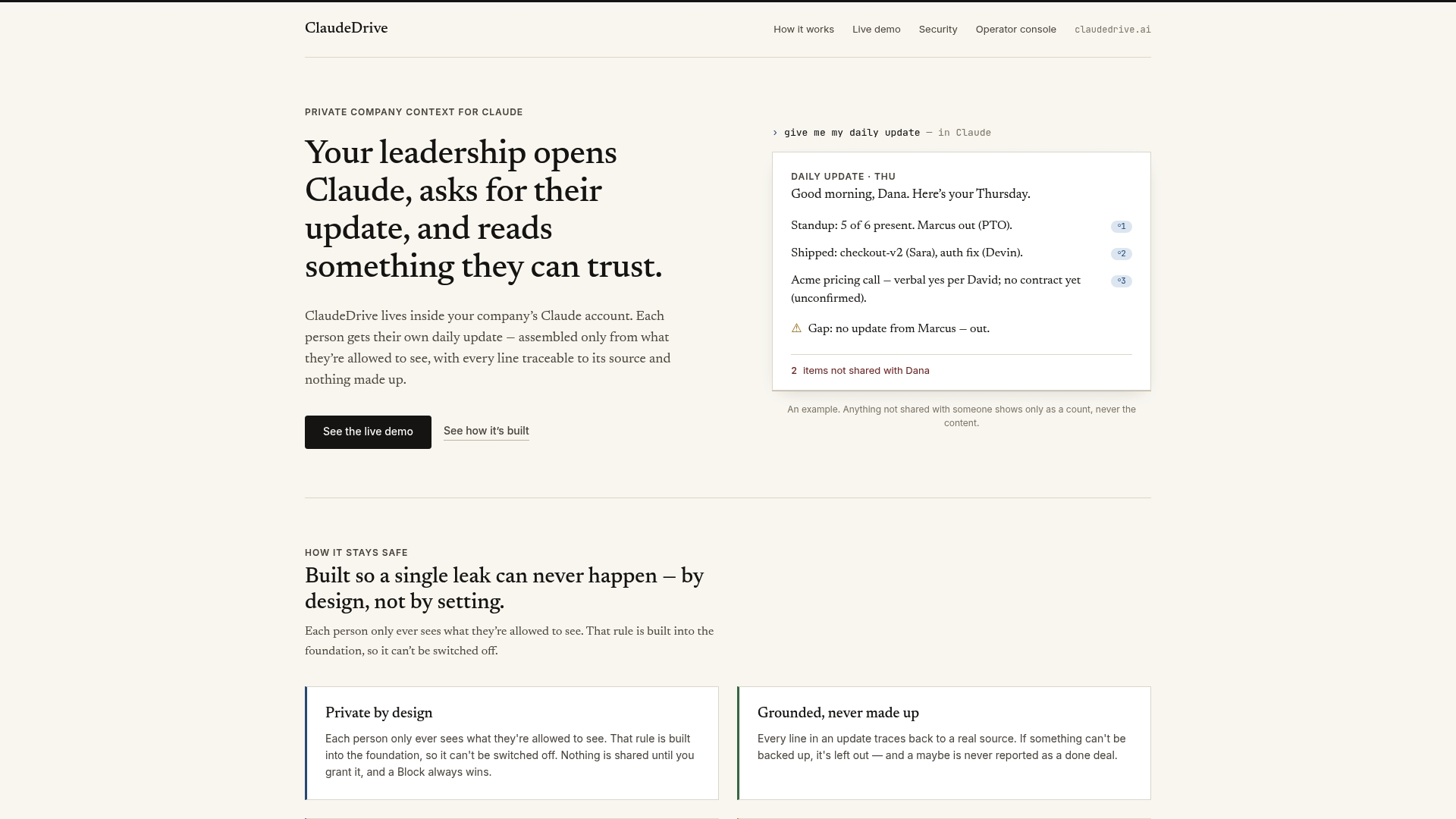
Connect your existing tools, meeting notes, GitHub, and calendar, and ClaudeDrive gives each person their own private view of what happened, with real-time permission enforcement and full audit logging built in. Access recertification and compliance reporting are part of the platform, not add-ons. Mid-sized enterprises use ClaudeDrive to prevent data leaks and enforce least privilege without rolling out a new app or maintaining a separate dashboard. Visit ClaudeDrive to see the live demo or talk to us about a pilot.
FAQ
What is enterprise RAG access control?
Enterprise RAG access control is the practice of enforcing user-specific permissions at the data retrieval layer of an AI system, so responses contain only information the requesting user is authorized to see. It aligns retrieval policies with source system permissions to preserve data governance.
Why is post-retrieval filtering not enough?
Post-retrieval filtering does not prevent leakage because a language model processes all retrieved content before any filter can act on it. The model can incorporate unauthorized information into a response even if the citation is later removed.
What compliance standards apply to RAG access control?
SOC 2 and ISO 27001 both require access reviews and revocation timelines. Privileged accounts must be reviewed quarterly with revocation within 24 hours, and non-privileged accounts must be reviewed at least annually.
What is access drift in a RAG system?
Access drift occurs when the permissions stored in a retrieval index diverge from the current permissions in the source system. It causes users to retrieve documents they are no longer authorized to access, and it requires continuous drift monitoring to detect.
How should enterprises handle documents with incomplete permissions?
Documents with incomplete or unresolvable access control information should be quarantined and excluded from retrieval until permissions are confirmed. Indexing them without complete permissions risks inadvertent data exposure.