How AI Makes Updates Relevant for Business Leaders
Discover how AI makes updates relevant for business leaders by ensuring accurate, timely information. Enhance your decision-making today!
ClaudeDrive
A Yungsten Tech product

How AI Makes Updates Relevant for Business Leaders

AI makes updates relevant by continuously assessing the timeliness, factual accuracy, and contextual value of content through freshness signals and personalized filtering. This process, known in the industry as semantic freshness evaluation, goes far beyond checking a publish date. AI systems read structural markers, corroborate claims against recent sources, and match content to the specific context of the person asking. For business leaders managing teams, understanding how AI makes updates relevant is the difference between trusting what you read and second-guessing every briefing you receive.
What are the key freshness signals AI uses to evaluate update relevance?
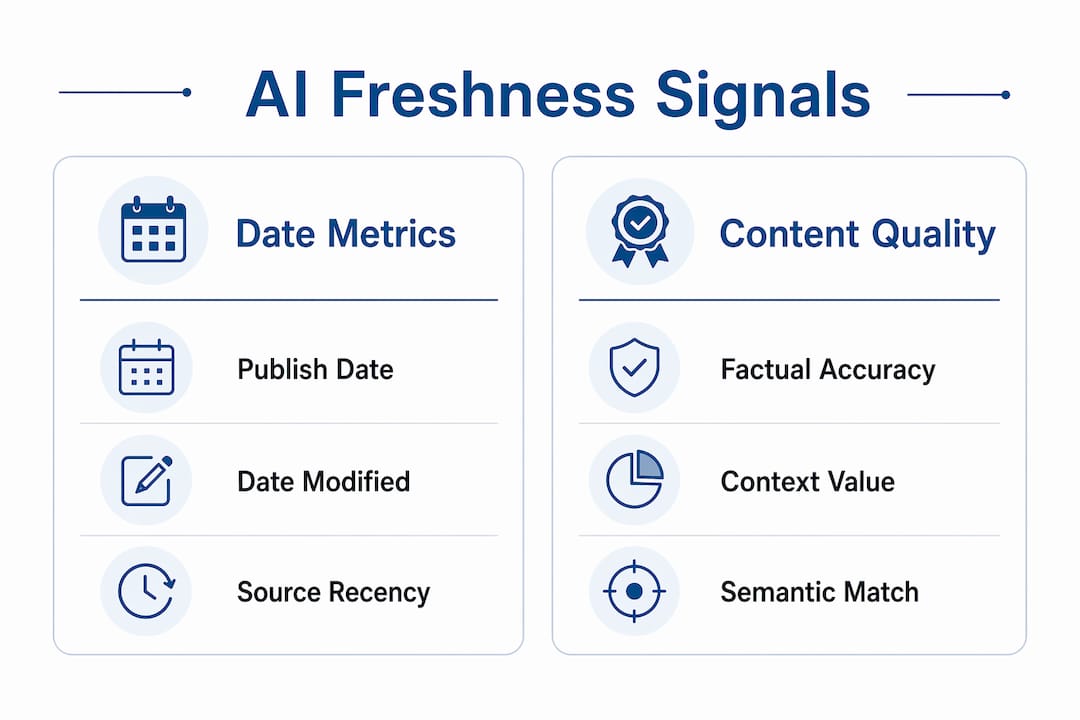
AI evaluates update relevance through a composite of signals, not a single timestamp. Content freshness is a layered measure that includes publish date, recency of cited references, factual accuracy, visible freshness markers, and corroboration from current sources. Each layer carries weight, and AI engines combine them to judge whether a piece of content is worth surfacing.
The four signals that matter most are:
- Semantic freshness. Has the core claim actually changed in reality? AI checks whether the underlying facts are still accurate, not just whether the page was touched recently.
- Structural freshness. Does the page carry a recent
dateModifiedtimestamp backed by real content changes? Pages with recent dateModified signals and substantive updates are cited 2.4x more frequently by AI than identical content without modification signals. That gap is significant enough to change whether a briefing gets included at all. - Evidence freshness. Are the sources cited within the content recent? AI checks the recency of references, not just the page itself.
- Corroboration. Does more than one current source confirm the same claim? AI triangulates across multiple recent sources before treating a fact as reliable.
The distinction between datePublished and dateModified matters here. AI models prioritize dateModified over the original publish date when evaluating recency. A page published three years ago but substantively updated last month ranks as fresher than a page published last week with no corroboration.
Pro Tip: When you review briefings or reports from your team, check whether the sources cited are recent and whether the core claims have been updated, not just whether the document has a new date on it.
How does AI filter and personalize relevant updates for teams and leaders?
AI filters updates by reasoning across multiple data points before deciding what to surface. This is not keyword matching. It is contextual judgment applied at scale, and it is what separates a useful briefing from an inbox full of noise.
The filtering process works in four stages:
- Continuous monitoring. AI information agents track specific topics around the clock. Google’s AI Information Agents, launched in june 2026, monitor topics and only notify users when genuinely new, relevant information surfaces. The key word is “genuinely.” The system filters noise before it reaches the leader.
- Personal intelligence. AI uses context from internal tools, such as calendar entries, meeting notes, and project documentation, to understand what a specific person or team needs to know. Connecting internal tools to AI agents creates private intelligence layers that improve update relevance for individual teams. A product leader gets different updates than a finance director, even from the same data sources.
- Noise reduction. AI reasons across multiple signals before generating a notification. If a development is not new, not corroborated, or not relevant to the team’s current priorities, it does not surface.
- Decision support. The output is a filtered briefing, not a raw feed. Leaders receive what they need to act, not everything that happened.
For managers, this filtering function solves the core problem of information overload. AI-driven update customization means a CEO reading a morning briefing sees only what is relevant to their role and access level, with every claim traceable to a source.
Pro Tip: The more context you give an AI system about your team’s priorities and tools, the more precisely it can filter. Connecting your calendar, project tracker, and meeting notes is not optional setup. It is what makes the filtering work.

Why substantive updates matter more than cosmetic date changes
AI detects when content has not actually changed, even if the timestamp says otherwise. This mechanism, called semantic fingerprinting, compares the actual substance of content against its claimed freshness signals. A mismatch causes AI to downgrade the page’s relevance. The practical implication for business leaders is direct: a weekly status report that recycles the same language with a new date is not a fresh update. AI treats it as stale.
The behaviors that harm relevance scores are predictable:
- Updating only the “last modified” date without changing any content
- Rephrasing sentences without adding new data, revised claims, or updated examples
- Citing the same sources from prior periods without checking whether newer evidence exists
The behaviors that build relevance are equally clear. Effective freshness requires new statistics, updated sources, and revised claims. A quarterly business review that adds new performance data, revises forward projections based on current conditions, and cites recent market sources carries genuine freshness weight.
Scheduled content refreshes that include substantive changes outperform cosmetic updates by a factor of 3.7x in AI citation rates, according to research on content freshness strategies.
The business communication implication is worth stating plainly. Leaders who want their teams to produce updates that AI systems treat as credible need to build a culture of substantive revision, not just regular publishing. The cadence matters less than the depth of change.
How does AI retrieval differ from traditional search for update relevance?
Retrieval-augmented generation, or RAG, is the process AI uses to synthesize answers from multiple recent sources rather than returning a ranked list of links. Understanding this distinction helps leaders set the right expectations for how AI-driven briefings are built.
Traditional search ranks pages based on authority signals accumulated over time. A page with strong historical backlinks can outrank a more current page on the same topic. AI retrieval works differently. RAG applies freshness as a structural filter at the retrieval step, meaning content that fails recency and corroboration tests gets bypassed regardless of its historical authority. This is why formerly dominant sources can disappear from AI-generated answers when they stop updating.
The table below shows how the two approaches differ in practice:
| Evaluation factor | Traditional search | AI retrieval |
|---|---|---|
| Freshness weight | Moderate, varies by query type | High, applied across all query types |
| Corroboration requirement | Not required | Required for factual claims |
| Personalization | Limited to query and location | Tied to user context and internal tools |
| Source authority | Historical backlink signals | Recency plus corroboration |
| Update response time | Days to weeks for re-indexing | Near real-time for connected sources |
AI retrieval also triangulates claims by checking whether multiple recent sources agree before including a fact in a synthesized answer. A single source making a claim, even a credible one, carries less weight than three recent sources confirming the same point. For leaders building internal knowledge systems, this means the quality of the source network matters as much as the quality of any individual document.
Structured data formats, such as FAQ sections and version labels, significantly improve AI’s ability to parse and value content freshness. Content structured for AI saw 47% higher citation rates in visibility studies. That is not a marginal improvement. It reflects a fundamental difference in how AI reads structured versus unstructured content.
Key Takeaways
AI makes updates relevant through a combination of semantic freshness, corroborated sourcing, and personalized context filtering, not through timestamps alone.
| Point | Details |
|---|---|
| Freshness is composite | AI weighs publish date, source recency, factual accuracy, and corroboration together. |
| dateModified beats datePublished | Pages with substantive updates and recent dateModified signals are cited 2.4x more often. |
| Semantic fingerprinting catches fakes | AI detects date-only changes and downgrades content that lacks real substance. |
| Personal context drives filtering | Connecting internal tools like calendars and meeting notes sharpens what AI surfaces for each leader. |
| RAG bypasses stale authority | AI retrieval filters out historically strong sources that fail recency and corroboration tests. |
What I’ve learned about trusting AI updates in real leadership contexts
The hardest thing to accept, when you first start relying on AI-generated briefings, is that the system is more honest about staleness than most human-produced reports. A team member who spent three hours on a status update will not tell you it contains no new information. AI will simply not surface it.
I have watched leaders get frustrated when an AI briefing omits something they expected to see. Almost every time, the missing item came from a source that had not been updated with real substance. The document existed. The date was current. But the content had not changed, and the AI knew it.
The practical shift this requires is not technical. It is editorial. Leaders need to hold their teams to a standard of substantive revision, not just regular cadence. A weekly update that adds new numbers, revises a projection, or flags a changed condition is worth ten updates that restate the same position with a new header.
The other thing I would tell any executive considering AI-driven briefings: the filtering is only as good as the context you feed it. An AI that does not know your team’s current priorities, active projects, or access boundaries will surface generic information. Connect the tools. Define the scope. The filtered update delivery you get from a well-configured system is qualitatively different from a raw AI summary.
The leaders who get the most value from AI updates are not the ones who trust the system blindly. They are the ones who understand what the system is doing and hold their information sources to the same standard the AI does.
— Paul
How ClaudeDrive delivers trusted, relevant updates for leadership teams
ClaudeDrive is built for exactly the problem this article describes. Leaders open Claude, ask for their update, and read one clear briefing built only from sources they are authorized to see. Every line is traceable. Nothing is fabricated. Nothing crosses an access boundary it should not.
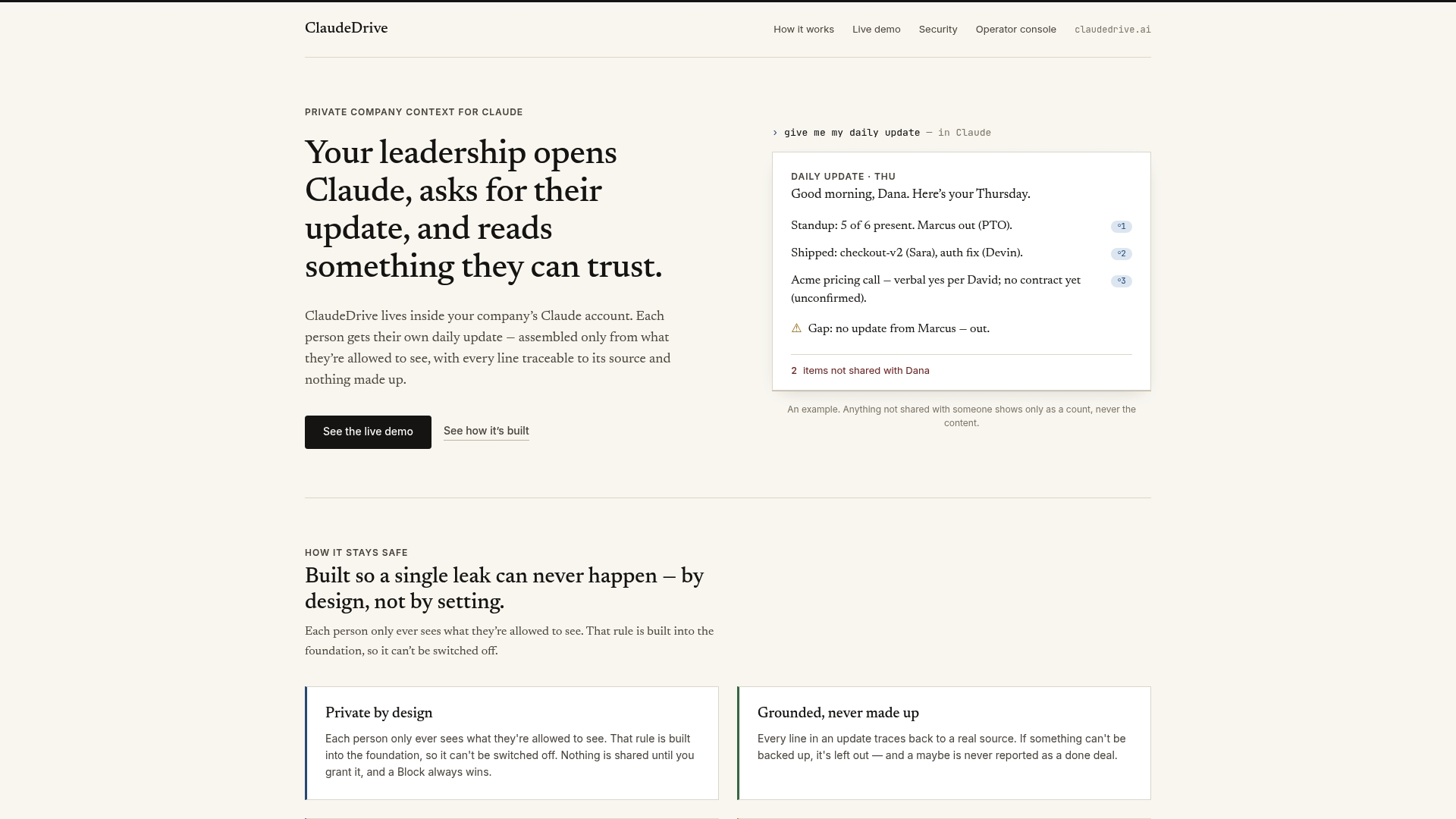
Connect your meeting notes, GitHub, and calendar, and each person on your leadership team gets their own private view of what happened, filtered to their role and context. There is no new app to learn and no dashboard to maintain. ClaudeDrive acts as the private company-context layer that feeds Claude directly. If you want to see how relevant, permission-aware updates work in practice, see the ClaudeDrive Console or talk to us about a pilot for your team.
FAQ
How does AI determine if an update is truly fresh?
AI checks a combination of signals including the dateModified timestamp, recency of cited sources, and whether the core claims have actually changed. A date change without substantive content revision does not register as fresh.
What is semantic fingerprinting in AI content evaluation?
Semantic fingerprinting is the process AI uses to detect mismatches between a claimed update date and the actual content. If the substance has not changed, AI downgrades the content’s relevance regardless of the timestamp.
How does AI personalize updates for different leaders on the same team?
AI uses personal intelligence drawn from connected tools such as calendars, meeting notes, and project documentation to tailor what each person sees. A personalized team update reflects the individual’s role, access level, and current priorities.
What is retrieval-augmented generation and why does it matter for updates?
Retrieval-augmented generation (RAG) is the process by which AI pulls from multiple recent sources and synthesizes a single answer. It applies freshness as a structural filter, meaning stale content gets bypassed even if it was historically authoritative.
How often should teams update internal documents to stay relevant to AI systems?
Frequency matters less than substance. Research shows scheduled refreshes with real content changes, such as new data, revised claims, or updated sources, outperform cosmetic updates by a factor of 3.7x in AI citation rates.