AI-Generated Company Updates for Business Leaders
Discover what is AI-generated company update and how it transforms business communication. Streamline updates for effective decision-making today!
ClaudeDrive
A Yungsten Tech product

AI-Generated Company Updates for Business Leaders

An AI-generated company update is an automated briefing produced by AI agents that pulls data from multiple internal sources and delivers tailored summaries to specific audiences, including executives, boards, investors, and teams. Unlike a manually assembled report, these updates compile signals from tools like GitHub, Slack, CRM systems, and meeting notes into a single structured output. The result is a consistent, traceable communication that replaces hours of manual formatting. For leaders managing complex organizations, this shift from ad hoc reporting to automated business updates represents a fundamental change in how information flows from operations to decision-makers.
What is an ai-generated company update, exactly?
An AI-generated company update is the industry’s informal term for what practitioners more precisely call a stakeholder communication agent output. The formal concept covers any structured briefing where an AI agent ingests raw operational data and produces audience-specific narratives without manual assembly.
The mechanism works in one direction: connect your data sources, define your audiences, and the agent generates multiple documents from a single automated run. One unified data source can produce an executive summary, a board pack, an investor update, a team briefing, and a customer email simultaneously. That means your board sees risk assessments while your engineering team sees implementation details, all drawn from the same underlying facts.
Named tools already doing this work include Claude, CoChat, and GitHub-based board pack agents. These are not experimental prototypes. They are production workflows used by founders and chiefs of staff today to replace the Sunday-night reporting grind.
How do AI updates collect and customize data for different audiences?
Data ingestion is the foundation of every reliable AI-driven corporate communication. Agents connect to sources like GitHub for engineering progress, Stripe for revenue metrics, PostHog for product analytics, Slack for team signals, and Circleback for meeting notes. CoChat agents compile these metrics into concise leadership briefings using natural language commands for scheduling, whether daily, weekly, or monthly.

The customization layer is where the real value appears. A single data pull produces different framings for different readers:
| Audience | Content Focus | Primary Value |
|---|---|---|
| Executive team | Business impact and operational status | Fast situational awareness |
| Board of directors | Risk assessment and governance metrics | Oversight and accountability |
| Investors | Financial metrics and pipeline coverage | Confidence and transparency |
| Internal teams | Implementation details and task progress | Alignment and coordination |
| Customers | Product updates and service changes | Trust and retention |
Each audience receives only what is relevant to their role. An investor does not need to read sprint velocity. A team lead does not need to see churn attribution by segment. The agent applies these filters automatically based on rules you define once.
Pro Tip: Configure your agent to filter updates through a specific strategic lens, such as business impact or risk exposure, rather than asking it to summarize everything. Filtered AI delivery produces updates that drive decisions. Generic summaries produce updates that get skimmed.
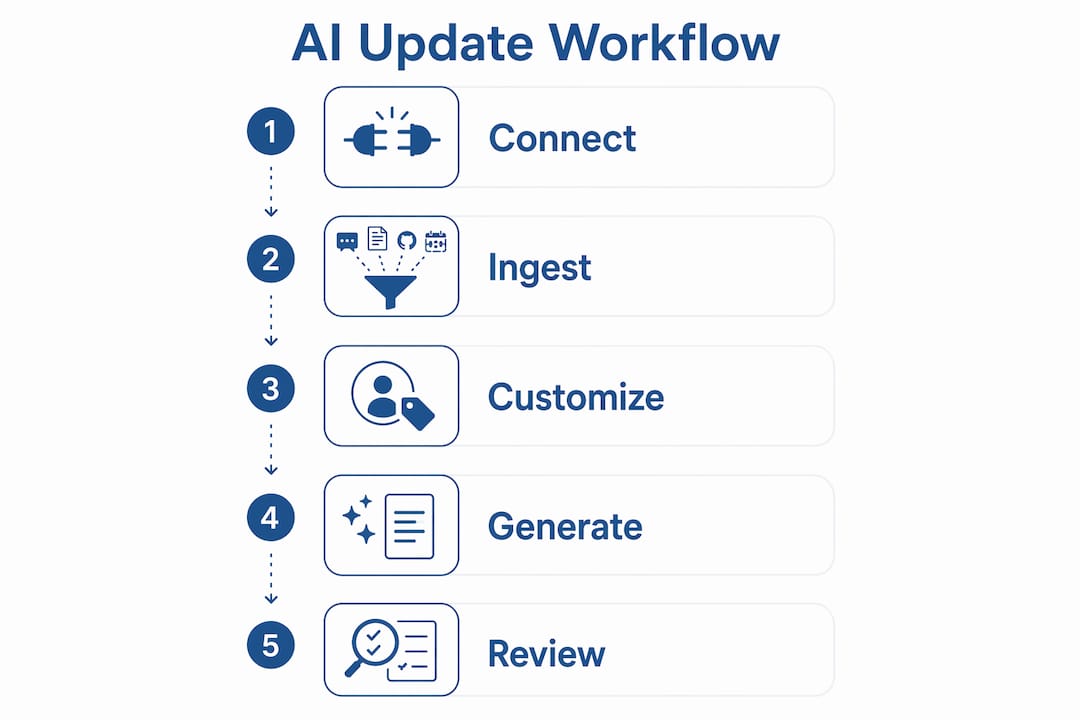
Scheduling is handled through natural language triggers. You define the cadence, the agent runs on time, and a brief human review replaces what used to be a multi-hour manual process.
What are the benefits and limitations of AI company updates?
The efficiency case for machine-generated company reports is straightforward. Scheduled updates run daily, weekly, or monthly and deliver consistent communication with roughly an hour of review instead of dozens of manual hours. That time returns to the leader as thinking time, not formatting time.
Consistency is the second major benefit. Manual reports vary in structure, depth, and tone depending on who wrote them and when. AI-generated updates follow the same schema every time. Investors and boards learn where to find critical data, which reduces the back-and-forth that follows inconsistent reporting.
The limitations are real and worth naming directly:
- Empathy gaps. AI-generated corporate statements with high AI confidence scores lack the human judgment needed for crisis communication. A layoff announcement, a product failure, or a leadership change requires a human voice.
- Hallucination risk. Without verified business context and writing rules, agents can generate inaccurate or off-brand statements. Governance matters.
- Perceived impersonality. Stakeholders who receive frequent AI-authored updates may notice the absence of a human perspective over time, particularly in investor relationships built on personal trust.
“The goal is not to remove the leader from the communication. The goal is to remove the leader from the data assembly.”
Human review is not optional. It is the quality gate that keeps AI-driven corporate communications credible. The agent drafts. The leader approves. That division of labor is what makes the system work.
Pro Tip: Never use an AI update as your sole communication during a crisis or sensitive announcement. Write that message yourself. Use the AI update to handle the routine operational context around it.
How do leaders implement and trust ai-generated updates?
Trust in AI-generated updates comes from structure, not from faith in the technology. Leaders who build reliable update workflows follow a consistent set of practices.
- Define a standardized schema. Every update should open with an upfront summary, followed by pipeline coverage, churn reasons, and key risks. Standardized schemas reduce cognitive load for investors and boards by putting critical data in the same place every time.
- Separate metrics from narrative. GitHub-based board pack agents keep deterministic KPI data separate from the AI-generated narrative. Raw numbers are calculated precisely. The agent writes the context around them. This separation creates an audit trail.
- Build a brand kit. A centralized set of writing rules, verified business context, and tone guidelines tells the agent what your company sounds like. Without this guidance, agents risk generating off-brand or misleading statements.
- Use AI to surface what you would skip. Founders using AI updates to report on skipped topics like real churn reasons build more investor trust than those who only highlight wins. The agent has no incentive to omit bad news. That objectivity is a feature.
- Run a brief human review before every send. Fifteen minutes of review catches errors, adds context, and keeps the leader’s voice present in the final communication.
| Implementation Step | What It Prevents |
|---|---|
| Standardized schema | Inconsistent structure across updates |
| Metrics separated from narrative | Inaccurate numbers buried in AI prose |
| Brand kit with writing rules | Off-brand tone and hallucinated claims |
| Human review before send | Errors reaching stakeholders |
The AI team update tools that earn leadership trust are the ones built with these guardrails from day one, not added after a mistake.
How do AI updates compare with traditional manual reporting?
Manual reporting has one advantage: a human wrote it. That means it carries implicit judgment, tone, and relationship awareness. It also means it takes hours, arrives inconsistently, and reflects whoever had time to write it that week.
AI-generated updates invert that trade-off. The table below shows where each method wins and where it falls short.
| Characteristic | Manual Reporting | AI-Generated Updates |
|---|---|---|
| Time to produce | Hours per report | Minutes plus brief review |
| Consistency | Varies by author and week | Identical structure every time |
| Customization by audience | Requires separate drafts | Automatic from single data run |
| Authenticity and empathy | High | Lower without human review |
| Scalability across audiences | Low | High |
| Auditability | Depends on process | Built in when metrics are separated |
The right answer for most organizations is not a choice between the two. AI briefings handle routine operational updates. Human-authored communications handle sensitive moments. That division keeps reporting efficient without sacrificing the relationship quality that stakeholders expect when it matters most.
Key takeaways
AI-generated company updates deliver consistent, audience-specific briefings from a single data source, but they require structured governance and human review to remain credible.
| Point | Details |
|---|---|
| Core definition | AI agents compile internal data into tailored briefings for executives, boards, investors, and teams. |
| Audience customization | One data run produces multiple outputs, each filtered to the relevant audience’s needs. |
| Human review is required | AI handles drafting; a leader’s review before sending maintains accuracy and tone. |
| Structured schemas build trust | Consistent update formats reduce cognitive load and improve stakeholder confidence. |
| Limitations are real | Crisis and sensitive communications require human authorship, not AI drafts. |
What i’ve learned after watching leaders adopt AI updates
The leaders who get the most from AI-generated updates are not the ones who trust the technology most. They are the ones who trust it least at first and build in enough structure to verify it.
The common mistake is treating an AI update as a finished product. It is a first draft with excellent data recall and no judgment. The moment a leader stops reviewing before sending, the quality drifts. Not dramatically. Gradually. And by the time a stakeholder notices, the damage to credibility is already done.
What I find genuinely useful about these systems is the discipline they impose. When you define a schema, you have to decide what matters. When you separate metrics from narrative, you have to own the numbers. When you build a brand kit, you have to articulate what your company actually sounds like. That process makes leaders better communicators, not just faster ones.
The mindset shift that matters is this: the agent is your chief of staff for data assembly. You are still the author of the communication. That distinction keeps the human relationship with stakeholders intact while recovering the hours that used to disappear into spreadsheets and formatting.
— Paul
How ClaudeDrive delivers trusted AI updates inside claude
ClaudeDrive is built for exactly this workflow. You connect your internal tools, define who sees what, and each leader receives a private briefing built only from sources they are permitted to access. Every line is traceable to a real source. Nothing is invented.
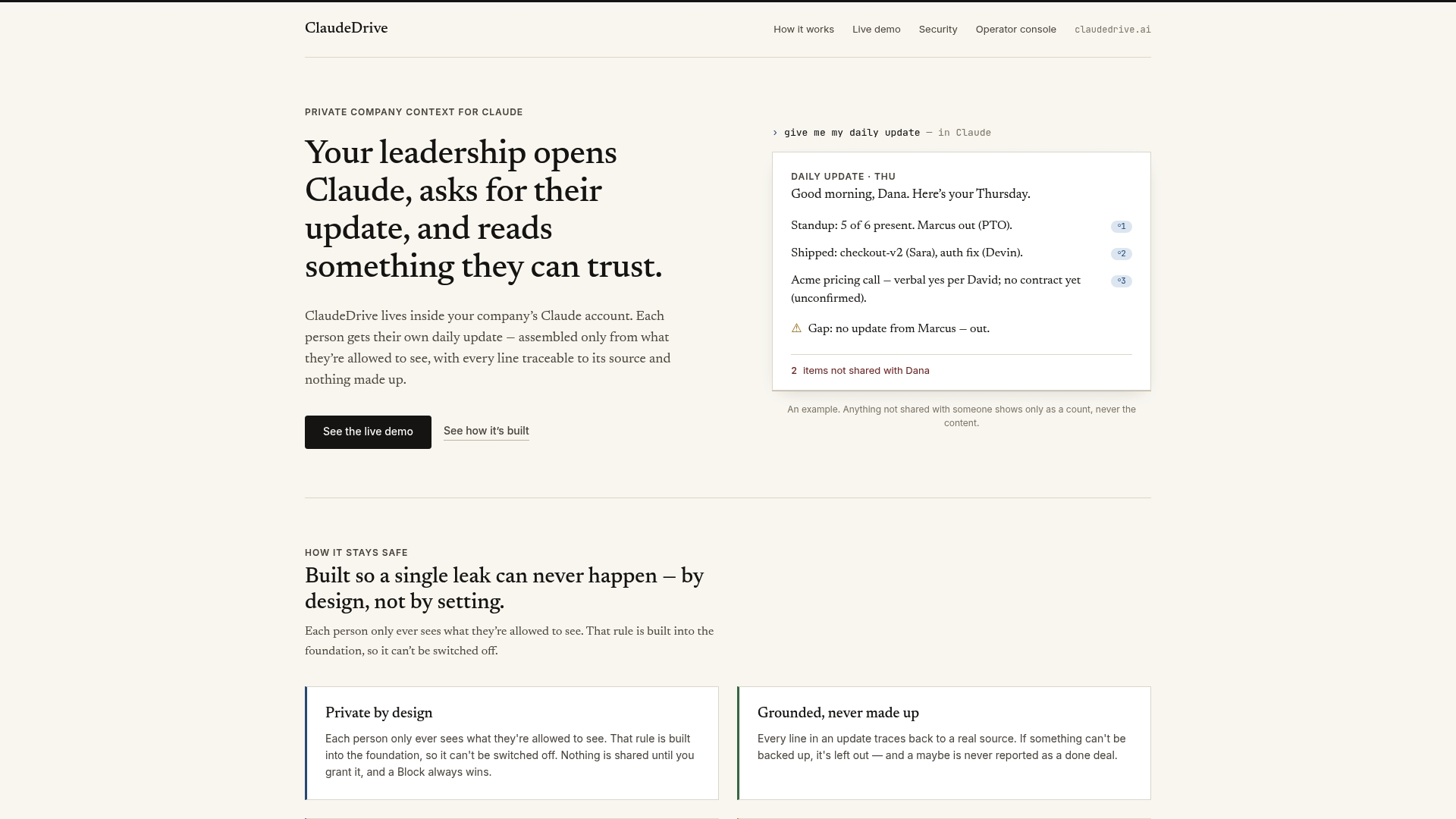
ClaudeDrive runs inside the Claude account your team already uses. There is no new dashboard to learn and no wiki to maintain. Scheduled agents generate executive summaries, board packs, investor updates, and team briefings on your cadence. The ClaudeDrive Console gives you full control over audience targeting, update structure, and permission boundaries. See the live demo or talk to us about a pilot.
FAQ
What is an ai-generated company update?
An AI-generated company update is an automated briefing produced by AI agents that compiles data from internal sources like GitHub, Slack, and CRM systems into tailored summaries for specific audiences such as executives, boards, and investors.
How does an AI update differ from a manual report?
AI updates are produced in minutes from a single data run and follow a consistent structure every time. Manual reports take hours and vary in quality depending on the author and available time.
Can AI updates be trusted for investor communications?
Yes, when structured correctly. Separating raw metrics from AI-generated narrative and running a human review before sending keeps investor updates accurate and credible.
When should a leader write a communication manually instead of using AI?
Crisis communications, layoff announcements, leadership changes, and any message requiring empathy or personal relationship context should be written by a human. AI updates are best suited for routine operational reporting.
How do AI agents avoid generating inaccurate or off-brand content?
A centralized brand kit with writing rules and verified business context prevents hallucinated claims and keeps the agent’s output consistent with the company’s voice and facts.