Keep Board Info Out of Engineering in AI
Learn how to keep board info out of engineering in AI with effective strategies. Ensure strict access control and gain peace of mind.
ClaudeDrive
A Yungsten Tech product

Keep Board Info Out of Engineering in AI

The guarantee every leader should demand is simple: if a user is not explicitly authorized, the AI system returns nothing. Not a redacted summary. Not a partial answer. Nothing. That is the baseline for keeping board and executive materials out of engineering AI contexts, and anything short of it is a policy gap waiting to become a breach.
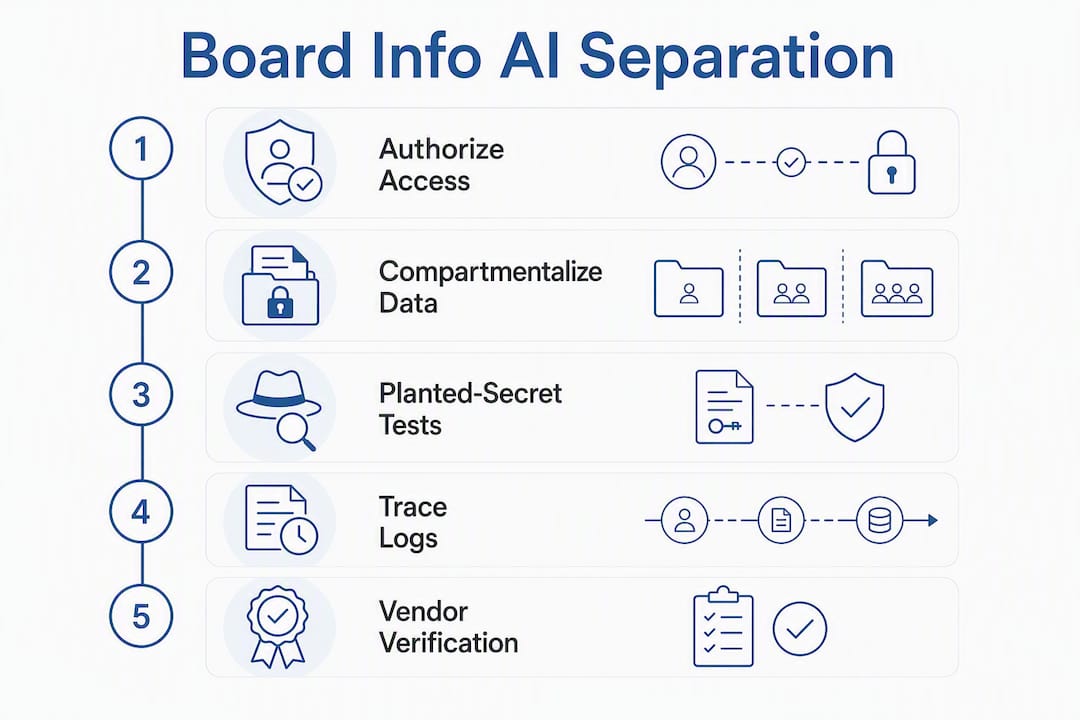
Three pillars make that guarantee real. First, permission-aware retrieval that filters by caller identity before the model ever sees a document. Second, least-privilege roles for every AI agent that mirror your existing permission model. Third, immutable audit logs stored in write-once, read-many (WORM) storage that record who asked what, which files were used, and when.
Before you trust any AI briefing with executive context, ask your team three things:
- Can you show me a planted-secret test where an engineer persona retrieved zero results for a board document?
- Can you demonstrate instant offboarding — access cut in under two minutes?
- Can you surface a log entry that links a specific prompt to a specific user and a specific source file?
If the answer to any of those is “not yet,” you have work to do.
Table of Contents
- What governance policies actually keep board materials separate?
- What should you demand from vendors and internal platform teams?
- How do you monitor for accidental inference and oversharing?
- Your 30–90 day implementation plan
- U.S. legal and privilege considerations
- Key Takeaways
- Why permission-aware briefings are the right design
- ClaudeDrive Console maps directly to this checklist
- Sources and further reading
What governance policies actually keep board materials separate?
Compartmentalization is the organizing principle. RAND’s guidance on securing high-value insights is direct: limit where complete strategic information can exist and restrict access to those with a genuine need to know. For AI systems, that means board and executive materials live in a separate collection, never pooled with engineering indices.
The policies that make this concrete:
- Classify before ingestion. Every document must carry a sensitivity label (public, internal, confidential, restricted) before it enters any AI pipeline. Labels alone are not enough — when documents are chunked, fragments often lose their original restrictions. Classification must be enforced at ingest so permissions travel with every fragment.
- Assign a data owner and an executive-level approver for any AI access to restricted categories. Approvals should be time-bound and purpose-limited, not open-ended.
- Mirror your permission model in AI roles. AI agents get only the minimal scope required for their task. An engineering assistant has no business touching board collections, and the system should enforce that structurally, not by policy memo alone.
- Embed offboarding in the process. When someone leaves or changes role, AI access is cut immediately, not at the next quarterly review.
- Require human-in-the-loop gates for any AI action touching legal or financial obligations tied to executive decisions.
Executive assistants are an underused control here. EA gatekeeping — managing ingestion approvals, triaging AI outputs, and controlling what enters the executive briefing pipeline — shifts AI from a liability to a controlled resource.
Pro Tip: Require a quarterly planted-secret red-team test. Plant a document with a unique, fictional data point in the board collection, then run queries as an engineering persona. The only acceptable result is zero retrieval. If anything surfaces, treat it as an incident.

What should you demand from vendors and internal platform teams?
This is the checklist to bring into procurement reviews or internal platform audits. Non-technical language, but the guarantees are specific.
- Permission-aware retrieval at query time. The vendor must demonstrate that every query carries the caller’s identity and that retrieval filters results by that identity before the model sees anything. Authorization enforced at retrieval time is the requirement — post-retrieval redaction is not equivalent.
- Chunk-level permissions. Permissions and classification labels must travel with document fragments from ingest onward. A document marked “restricted” must produce restricted chunks, not untagged ones.
- Immutable WORM audit logs that capture user identity, prompt text, model version, exact chunk and file sources used, and a response fingerprint. These logs must be tamper-proof and available for forensic review.
- Redaction before the model. Sensitive fields — compensation figures, M&A content, personal data — are masked before reaching the model or any log, unless explicitly approved.
- Prompt-injection defenses. Retrieved content is treated as untrusted data and cannot override system-level instructions. This is a structural requirement, not a configuration option.
- Instant offboarding and ephemeral credentials. Time-bound tokens, immediate revocation flows, and a demonstrable test showing access cut in real time.
- Planted-secret proof. The vendor should run a live test during procurement and hand you the log showing zero leakage to an unauthorized persona.
“If a user is not authorized, the system must return no results — not a redacted version. Permissions must be enforced during retrieval, not after.” — Vibe Engines system design guidance
Confirm that your chosen platform — ClaudeDrive Console or otherwise — can produce these test artifacts on request. If a vendor cannot demonstrate the planted-secret result, that is your answer.
How do you monitor for accidental inference and oversharing?
Direct file access is not the only risk. AI can reconstruct sensitive plans from many innocuous fragments — a scheduling note here, a budget line there — stitched into an inference that no single document would have revealed. Monitoring must be inference-aware, not just file-access aware.
Minimum log fields to require from your platform team:
- Actor identity and session ID
- Model name and version
- Full prompt text
- Response hash or fingerprint
- Document IDs, chunk IDs, and file hashes used in retrieval
- Timestamp and alert severity
Traceability to exact chunk IDs lets you map any generated sentence back to the source fragments that produced it. That capability is what makes post-incident proof of non-exposure possible.
Alerts to configure:
| Alert Type | Trigger Condition | Required Action |
|---|---|---|
| Restricted tag access | Any retrieval touching a restricted label without explicit approval | Immediate triage |
| Cross-collection stitch | Finance + HR + strategy fragments in one response | Security review |
| Pattern queries | Repeated queries trending toward board topics from a non-executive persona | Escalate to CISO |
| Honeytoken hit | Any retrieval of a planted canary document | Treat as incident |
Feed logs into a SIEM for correlation and retention. Define a triage SLA — how quickly an alert becomes an investigation — and maintain a playbook that includes immediate access revocation and retrospective proof of non-exposure.
Your 30–90 day implementation plan
Weeks 0–4: Inventory and classify
- Map every data flow that touches executive or board materials.
- Apply sensitivity labels to all documents before any AI ingestion begins.
- Stop ingestion of any document that lacks permissions metadata.
- Plant canary secrets in board collections and document their location.
Weeks 4–8: Deploy and verify controls
- Deploy a permission-aware retrieval gateway tied to your enterprise identity system.
- Enable ephemeral credentials for ingestion jobs.
- Demonstrate instant revocation: cut a test account’s access and confirm it in under two minutes.
- Run the first planted-secret test and record the result.
Weeks 8–12: Harden and measure
- Enable redaction and pre-processing for sensitive fields before they reach the model.
- Run red-team retrieval tests across all restricted collections.
- Integrate logs into WORM storage and your SIEM.
- Measure false positives and negatives in blocking; tune thresholds.
Pilot success metrics:
- Planted-secret pass rate: 100% blocked, no exceptions.
- Time-to-revoke: under two minutes.
- Briefings with source citations: target 100%.
- Audit log completeness: all required fields present in every entry.
Leader sign-off checklist:
- [ ] Classification complete for all executive/board collections
- [ ] Permission-aware gateway enforced at retrieval
- [ ] Redaction active for sensitive fields
- [ ] Logs immutable and feeding SIEM
- [ ] Red-team planted-secret test passed
Keep engineering indices separate throughout. Expand scope only with documented approvals.
U.S. legal and privilege considerations
A few points to raise with corporate counsel before finalizing your AI governance posture:
- Privilege and discovery. Provenance logs and access records support attorney-client privilege claims. Keep them intact. Consider separate storage and stricter retention windows for materials that carry legal privilege.
- Breach reporting. If AI-assisted access results in an unauthorized disclosure, U.S. breach notification rules may apply depending on the data type and state. Document the event timeline and response actions immediately.
- Retention and custodians. Immutable logs satisfy regulators and auditors, but you need defined retention windows and named custodians for those logs. “We have logs” is not the same as “we can produce them on demand.”
- Vendor contracts. Confirm that vendor agreements permit immutable logging, incident response access, and forensic review. Verify data residency requirements when your board materials cannot leave specific jurisdictions.
This is operational guidance, not legal advice. Involve corporate counsel for binding decisions and privilege assessments.
Key Takeaways
Keeping board materials out of engineering AI contexts requires permission-aware retrieval, compartmentalized collections, immutable audit logs, and planted-secret testing — all verified before any executive briefing goes live.
| Point | Details |
|---|---|
| Permission-aware retrieval | Demand that the system returns nothing to unauthorized users — relevance and permission must both be satisfied at query time. |
| Compartmentalize collections | Board and executive materials must live in separate, classified collections, never pooled with engineering data. |
| Immutable WORM audit logs | Logs must capture user identity, prompt, chunk IDs, and response fingerprint, stored in tamper-proof storage. |
| Planted-secret testing | Run quarterly red-team tests; the only acceptable result is 100% blocking for unauthorized personas. |
| ClaudeDrive Console | ClaudeDrive enforces permission-aware retrieval, per-chunk access metadata, immutable audit trails, and source-linked briefings inside Claude, with instant offboarding and no new apps to adopt. |
Why permission-aware briefings are the right design
The conventional approach to AI security focuses on labeling documents and hoping the system respects those labels. That is the wrong frame. Labels get stripped when documents are chunked. Permissions need to be enforced at the moment of retrieval, not applied as an afterthought.
ClaudeDrive is built around a different premise: each leader opens Claude, asks for their update, and reads a briefing built only from what they are authorized to see. Every line traces back to a real source file. Nothing is fabricated. Nothing crosses a permission boundary. That design is not a feature — it is the architecture.
What makes this practical for leadership teams is that it requires no new app, no dashboard, and no wiki to maintain. Connect meeting notes, GitHub, and the calendar. Tag who is allowed to see what. Each person gets their own private view. The operational overhead is low; the governance guarantee is real.
The piece most leaders underestimate is inference leakage. An engineer does not need to read a board document to reconstruct its contents — they need enough adjacent fragments. A permission-aware system that monitors for cross-collection stitching and maps every output to its exact source chunks is the only architecture that catches that risk before it becomes an incident.
ClaudeDrive Console maps directly to this checklist
ClaudeDrive Console gives leadership teams the specific guarantees this checklist demands: permission-aware retrieval enforced at query time, per-chunk access metadata that travels from ingest onward, immutable audit trails, instant offboarding, and source-linked briefings inside the Claude account your team already uses.
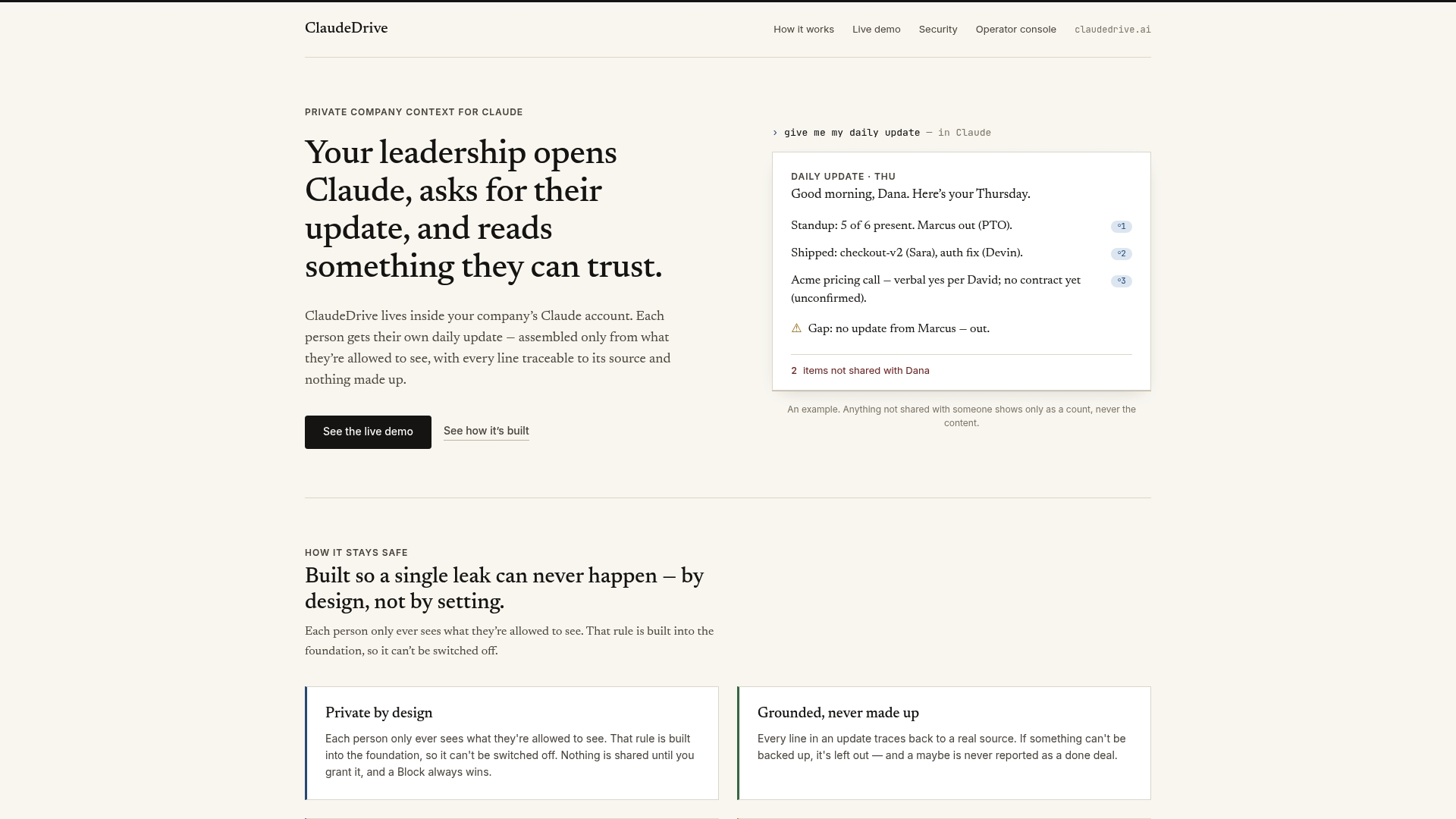
On the procurement checklist: ClaudeDrive supports planted-secret testing, ephemeral ingestion credentials, redaction pipelines for sensitive fields, and WORM-ready logs that can feed your SIEM. Board and executive collections stay separate from engineering indices by design. No new app to roll out. No dashboard to learn.
If you want to verify these guarantees before committing, the right next step is a live demonstration against your actual collections. Talk to us about a pilot focused on your board and executive materials — we will run the planted-secret test with you and hand you the log.
Sources and further reading
Share these with your security and legal teams when validating vendor claims or designing internal tests.
- Securing AI Algorithmic Insights — RAND: RAND’s guidance on compartmentalization and limiting where strategic insight can reside; use this to justify isolated executive collections.
- Why a File Marked “Confidential” Won’t Stop AI Leaks — Fast Company: Explains how chunking strips permissions and how inference leakage works; share with platform teams designing ingest pipelines.
Suggested internal follow-ups: Ask your platform team for planted-secret test outputs, SIEM ingestion proof, and a WORM log snapshot before signing off on any AI deployment that touches executive collections. Share the legal considerations section with corporate counsel when defining privilege and retention policies.