Nothing Made Up, Every Line Sourced: A Leader's Guide
Discover how "nothing made up every line sourced" standards empower leaders to make informed decisions with solid evidence and clear documentation.
ClaudeDrive
A Yungsten Tech product

Nothing Made Up, Every Line Sourced: A Leader’s Guide

Content where nothing is made up and every line is sourced means exactly what it says: every factual claim traces back to a specific, named, retrievable source. No paraphrased-from-memory statistics. No confident-sounding assertions that came from an AI model’s training data. No figures that “sound right.” Each assertion either has a visible path to its origin or it does not belong in the document.
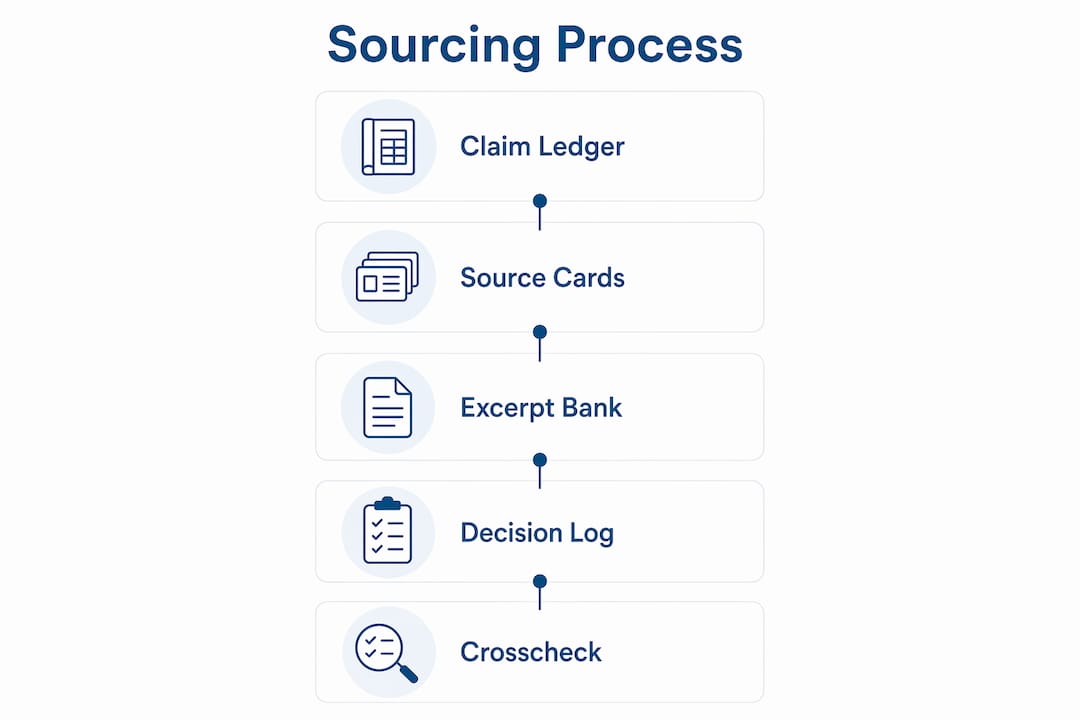
For company leaders reading daily briefings, this standard is the difference between a decision made on solid ground and one built on plausible noise. The core mechanisms that make it work are:
- Claim ledger: a short list of the key assertions a document must be able to defend
- Source cards: notes capturing title, link, and the specific passage used
- Excerpt bank: exact quoted text, preserved to prevent paraphrase drift
- Reasoning notes: the “because, therefore” chain behind any derived conclusion
- Decision log: one sentence explaining why each claim was included or cut
When these five artifacts travel with a document, any reader can audit it. When they are missing, even well-intentioned writers lose the source trail as the draft grows.
How to make sure every line is sourced
1. Build the claim ledger before you write a word

Start with a short list of the assertions your document must defend. For each one, record what you are claiming, why it serves the document’s purpose, and what type of support backs it: a named source, a concrete example, or a reasoning chain you can restate. Any paragraph that does not serve a ledger claim is probably drift.
2. Make source cards fast to retrieve
A source card captures title, author or organization, link, the specific section used, and the exact point taken from it. That is enough. The goal is retrieval speed under pressure, not a comprehensive summary of everything the source contains.
3. Build an excerpt bank to stop paraphrase drift
Paraphrase drift happens when you restate something from memory and the meaning shifts, often subtly. An excerpt bank holds the exact words you plan to cite. When you draft, you pull from the bank and then interpret. The reader sees the difference between the source’s words and yours.
4. Find the source first, then write the claim
The order matters more than most writers admit. Writing a number and then hunting for a source to justify it tempts you to accept a weak match. Verification-first practitioners like Pravin Kumar insist on a stricter rule: no claim without a source you have actually opened and read this session. Not one you remember. Not one that sounds right.
Pro Tip: Reverse the usual workflow. Locate the primary source first, read what it actually says, then write the claim to fit the source. This one change eliminates the most common path from honest writing to fabricated pages.
5. Confirm three things about every statistic
A number needs a named publication, a year, and confirmation that you have seen the original. If you cannot find the primary source, do not soften the claim to “studies show.” Cut it. A vague statistic is a fabrication in a different font.
6. Archive source URLs at the moment you use them
Links break. Pages update. Archiving source URLs to a service like the Wayback Machine at the time of publication preserves the original content for future verification. A verbatim quote of 25 words or fewer from the source is the highest-leverage defense against link rot.
7. Keep a decision log for scope discipline
One sentence per major choice: why a claim was included, or why it was cut. This prevents scope creep and gives editors a clear audit trail when they question a gap.
8. Treat AI-generated claims as unverified leads
AI models state fabricated citations with the same grammatical confidence as verified ones. Every figure or source name a model produces is a lead to check against the real document, not a fact to publish. The verification step belongs to the writer, and it does not get skipped because the model sounded certain.
What goes wrong when content is not fully sourced
9. AI hallucination produces confident false claims
AI systems can state something false with total confidence, and the output reads identically to a verified fact. The failure mode is not obvious hedging. It is a clean, plausible-sounding sentence with a plausible-sounding source that does not exist.
10. Surface verification misses the real errors
Writers often conflate surface and deep verification. Surface checks catch spelling errors and broken links. Deep verification traces a statistic to its original study, reads the methodology section, and checks sample size and scope. A document can pass every surface check and still rest on a fabricated core claim.
Statistic: Content passages with at least one numeric figure and one named source tend to be cited more often by AI summarization systems than purely speculative content.
11. Unsourced content loses AI search visibility
Major AI search providers use hallucination detection that down-ranks content lacking verifiable attributions or primary source links. Inaccurate content does not just fail to be cited. It actively reduces a domain’s citation probability over time as user feedback accumulates.
12. False balance degrades truth
Mixing one well-sourced claim with one unverified claim and presenting both as equivalent is its own form of fabrication. Ten outlets repeating one anonymous source is not ten independent confirmations. Circular attribution, where A cites B and B cites A, inflates false confidence without adding evidence.
13. Legal and reputational exposure from fabricated data
Publishing a statistic that does not exist, or attributing a quote to someone who never said it, creates liability that no disclaimer fully neutralizes. The reputational cost compounds: a single retraction signals to readers and AI systems alike that the domain’s accuracy cannot be trusted.
Expert frameworks that prevent fabrication
PolitiFact’s verification checklist treats tracing every claim to its primary source as a mandatory step, not a best practice. That means finding the original study, not a secondary article citing it, and checking sample size, scope, and publication date before treating a conclusion as settled.
Candid Creative’s framework requires that every objective claim carry a named source, a publication date, a verbatim quote of 25 words or fewer, and a confidence label from a seven-tier taxonomy: Verified, Industry-consensus, Single-source, Estimated, Author’s view, Contested, or Stale. The confidence label is what separates honest disclosure from false certainty.
Pravin Kumar’s reverse verification method, covered earlier, pairs with a second discipline: treating AI citations as leads that require manual confirmation before publication. A confident citation from a model is a hypothesis.
Brian Hopkins at Facts N Sense adds the declaring-knowns-versus-unknowns discipline. If a document cannot find a primary source, it says so. If evidence is mixed, it says so. False balance is not neutrality. Scoring evidence each claim actually has, rather than splitting the difference for symmetry, is what responsible disclosure looks like.
Independent corroboration across ecosystems is the final test. When outlets across different political or institutional ecosystems independently confirm the same fact, that convergence is a reliability signal. When only one ecosystem carries a claim, that is a flag, not a confirmation.
Pro Tip: Categorize every sentence before you cite it. Evidence-demanding claims (statistics, attributed quotes, regulatory specifics) need a source. Prose that states general context does not. Distinguishing claim types reduces citation clutter and makes the citations that do appear carry more weight.
ClaudeDrive applies this standard to the daily briefings it delivers inside Claude. Every line in a ClaudeDrive update traces to a real source from the tools a leader has already connected: meeting notes, GitHub, the calendar. Nothing crosses a permission line it should not. Leaders who rely on traceable internal updates make decisions from a verified record, not from a plausible-sounding summary.
How to manage citations without losing your mind
Citation management fails when writers treat it as an afterthought. The fix is structural, not effortful.
A running source log, even a simple spreadsheet with columns for claim, source name, URL, and access date, gives you a verification chain you can defend in 60 seconds. If you cannot trace a published claim to a specific URL and access date that fast, the chain is already broken.
Not every sentence needs a citation. General context, logical connectives, and prose that restates common knowledge do not deserve a source tag. Citing everything equally is as misleading as citing nothing, because it obscures which claims actually rest on evidence. The discipline is knowing the difference.
For claims that matter, cross-check against at least two independent authoritative sources. Primary research and government data carry the highest citation trust. Official regulatory sources rank next. Academic journals follow. Company blog posts and press releases sit near the bottom and should never serve as the sole support for a factual claim.
Project Chimera demonstrates what automated citation enforcement looks like at scale: every claim linked to a verified source with URL, timestamp, and excerpt, with uncited factual claims blocked before they ship. The Misfit Caucus manga project sourced 100% of its dialogue from archived, verified public posts, assigning each entry a confidence tier and refusing to place any unverified entry into a panel. Both examples show that “nothing made up, every line sourced” is an operational standard, not an aspiration.
Key Takeaways
Fully sourced content requires a claim ledger, source cards, an excerpt bank, and a decision log working together before a single sentence is published.
| Point | Details |
|---|---|
| Build the claim ledger first | List every assertion the document must defend before drafting begins. |
| Find sources before writing claims | Locating the primary source first prevents weak-match rationalization and fabrication. |
| Archive URLs at publication time | Wayback Machine snapshots preserve verifiability when original pages change or disappear. |
| Fact-dense content earns more citations | Passages with a named source and a numeric figure are cited 5x more often by AI systems. |
| Declare what you do not know | Labeling unknowns honestly prevents false balance and protects reader trust. |
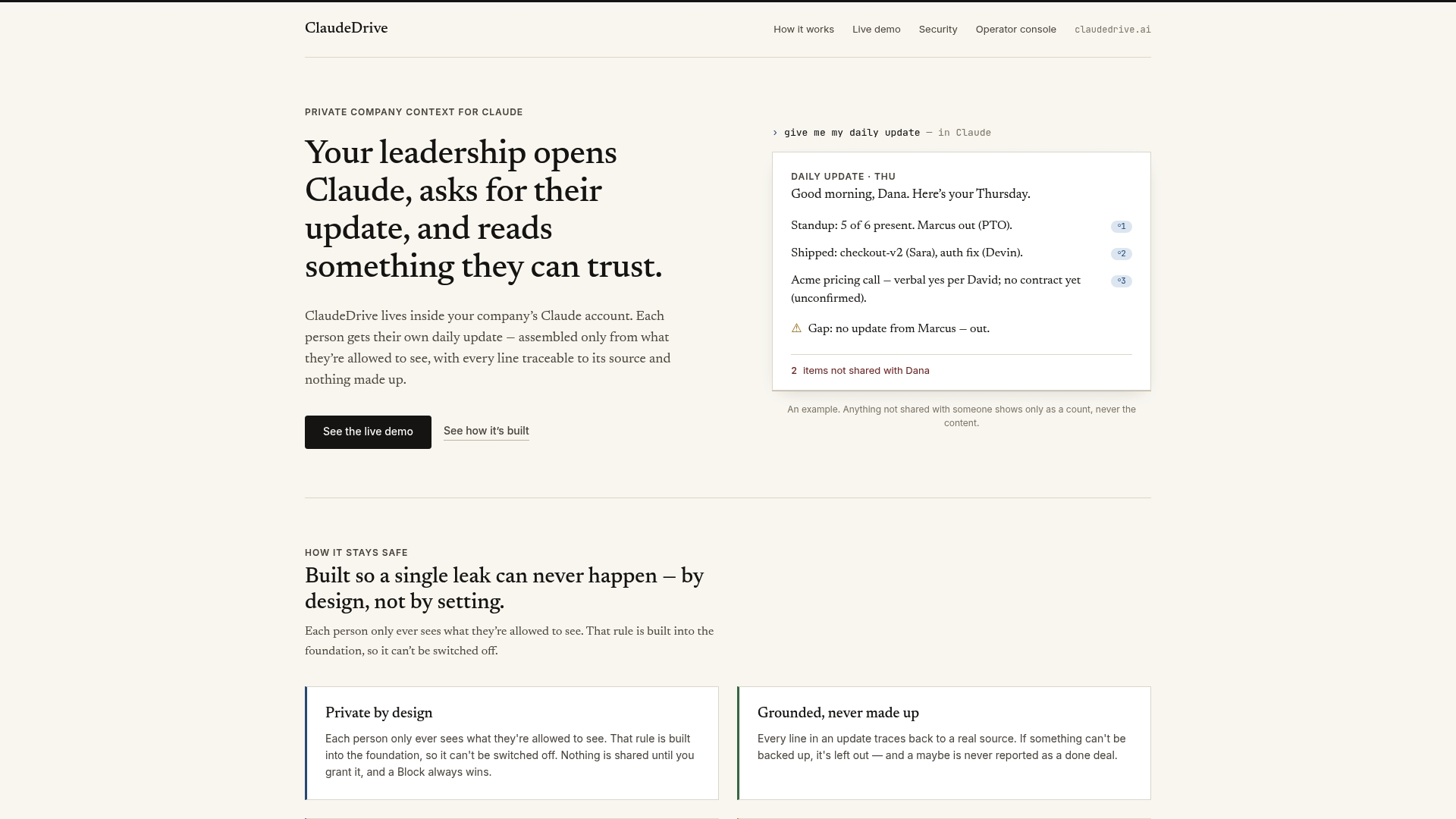
ClaudeDrive delivers exactly this standard inside the Claude account your leadership team already uses. Every briefing is built only from sources each person is permitted to see, with every line traceable and nothing invented. Talk to us about a pilot at claudedrive.ai.