RAG vs Fine-Tuning: How Enterprise Leaders Should Decide
Discover how enterprise leaders can choose between retrieval-augmented generation and fine-tuning for optimal AI performance and accuracy.
ClaudeDrive
A Yungsten Tech product

RAG vs Fine-Tuning: How Enterprise Leaders Should Decide

Use retrieval-augmented generation when you need current, auditable answers. Use fine-tuning when you need consistent behavior, tone, or output format. Use both when your application demands accuracy and polish at the same time, which is most of the time in production enterprise systems.
That is the short version of RAG vs fine tuning, and it holds up whether you are building a customer support assistant, an internal knowledge tool, or a compliance-facing chatbot. Retrieval-augmented generation and fine-tuning solve different problems. One updates what a model knows. The other changes how a model behaves. Confusing the two is the most common reason enterprise AI projects miss their budget or their deadline.
- Pick RAG if: your data changes often and you need every answer traceable to a real document, with source attribution that lets someone verify the response instead of trusting it blindly.
- Pick fine-tuning if: you need a model to consistently format output, adopt a specific voice, or perform a narrow specialized task where prompting alone produces inconsistent results.
Neither decision is final without testing. Run a small pilot, measure it against real metrics, and only then commit engineering budget to scale it.
Key Takeaways
The right choice between RAG and fine-tuning depends on whether your priority is current, traceable information or consistent, specialized behavior, and most production systems eventually need both.
| Point | Details |
|---|---|
| Match the tool to the problem | Use RAG for current, auditable knowledge and fine-tuning for consistent format or behavior. |
| Hybrid is common, not exotic | Fine-tune for behavior and pair it with RAG for facts when accuracy and citations both matter. |
| Evaluate before you scale | Use RAGAS or ARES to measure context relevance, faithfulness, and answer relevance before committing budget. |
| Budget differently for each | RAG carries recurring infrastructure costs; fine-tuning carries a large upfront training cost with periodic refreshes. |
| Permissioning is a design choice | ClaudeDrive shows how permission-aware retrieval can deliver sourced, auditable daily updates without a new dashboard. |
Table of Contents
- RAG vs Fine Tuning: What Retrieval-Augmented Generation Actually Does
- RAG vs Fine Tuning: What Fine-Tuning Changes and Why It’s Different
- Comparing RAG and Fine-Tuning Across the Decisions That Matter
- The Real Cost of Each Approach: Budget, Latency, and Maintenance
- Measuring What Actually Works: RAG Eval Metrics and Fine-Tuning Checks
- Why Most Enterprise Systems End Up Using Both
- A Leader-Facing Example: Permission-Aware Updates Inside Claude
- What I’d Actually Do First
- Get Trusted, Permissioned Updates Without Building a Retrieval Pipeline
- Sources
RAG vs Fine Tuning: What Retrieval-Augmented Generation Actually Does
Retrieval-augmented generation works in three steps: index your documents, retrieve the relevant ones when a question comes in, and hand those documents to the model as context before it answers. The model isn’t guessing from memory. It’s reading source material you gave it, in real time, then writing a response grounded in that material.
This matters for one reason above all others: traceability. A fine-tuned model bakes information into its weights during training, and once it’s trained, tracing a specific answer back to a specific source document is nearly impossible. RAG keeps the source document separate from the model, so every answer can point back to the exact passage it came from, and fine-tuned models often struggle to provide that kind of traceable reference at all.
The operational pieces behind RAG are not exotic, but they do need to work together:
- A vector database stores document chunks as numerical embeddings so the system can find semantically similar content, not just keyword matches.
- An embedding model converts text into those numerical representations, and the choice of model affects retrieval quality more than most teams expect.
- A chunking strategy decides how documents get split before indexing. Cut too small and you lose context; cut too large and retrieval gets noisy.
- A retrieval and ranking layer picks the best-matching chunks for a given query and passes them to the model as context.
Consider a finance team building a system to answer questions about quarterly filings. The filings change every quarter. Auditors need to see exactly which paragraph an answer came from. A fine-tuned model would need retraining every quarter and still couldn’t point to source text. RAG handles both requirements natively, because the underlying documents can be swapped out without touching the model at all.
Pro Tip: Before you build a custom retrieval pipeline, test with a small, well-organized document set first. Bad chunking on 50 documents is a two-hour fix. Bad chunking on 50,000 documents discovered after launch is a multi-week rebuild.
RAG vs Fine Tuning: What Fine-Tuning Changes and Why It’s Different
Fine-tuning takes a pre-trained model and continues training it on a narrower, task-specific dataset, adjusting the model’s internal weights so its default behavior shifts. Where RAG hands the model new information at query time, fine-tuning changes what the model does automatically, without needing that information handed to it. This is the core distinction inside fine-tuning vs pre-training: pre-training builds the model’s general capability, and fine-tuning specializes it.
Most enterprise fine-tuning today uses parameter-efficient techniques like LoRA (Low-Rank Adaptation), which update a small fraction of a model’s parameters instead of retraining the whole thing. This cuts compute costs substantially compared to full fine-tuning, though it still demands a carefully curated dataset. Parameter-efficient methods reduce the hardware bill, but they don’t remove the need for rigorous dataset engineering to avoid encoding unwanted bias into the model’s behavior.
Fine-tuning earns its cost in a specific set of situations:
- Consistent formatting the model must produce every time, such as a fixed JSON schema or a legal document template.
- Brand voice that’s hard to specify fully in a prompt but easy to demonstrate through hundreds of labeled examples.
- Structured or specialized output, like code generation in a proprietary internal framework, or classification tasks with company-specific categories.
- Narrow, repeatable tasks where the model performs the same kind of work thousands of times a day and small quality gains compound.
The tradeoff shows up in currency and cost. Fine-tuning is not cheap to refresh: every time your underlying knowledge changes meaningfully, you need to curate new training data and run another training job. That upfront compute cost, plus the ongoing retraining cadence, is the single biggest reason fine-tuning struggles with fast-moving information. A model fine-tuned on last quarter’s product catalog doesn’t know about this quarter’s price changes until someone retrains it.
Fine-tuning also carries its own hallucination risk profile. A model trained to sound confident on a narrow task will sound just as confident when it’s wrong, because nothing in its architecture forces it to check its answer against a live source. That’s the tradeoff leaders need to weigh against RAG’s traceability advantage before locking in a build plan.
Comparing RAG and Fine-Tuning Across the Decisions That Matter
Here’s how the two approaches stack up across the dimensions that actually drive enterprise decisions, not the ones that dominate engineering blog posts.
| Dimension | RAG | Fine-Tuning |
|---|---|---|
| Primary benefit | Current, source-grounded answers | Consistent behavior, tone, and format |
| Best for | Frequently updated knowledge, compliance-sensitive answers | Narrow tasks, structured output, brand voice |
| Update frequency | Near-instant. Swap documents, no retraining | Slow. Requires new training run to refresh knowledge |
| Auditability | High. Every answer traces to a source document | Low. Answers come from weights, not a citable source |
| Engineering cost | Moderate upfront (retrieval pipeline), lower ongoing | High upfront (training runs), recurring for refreshes |
| Latency and cost per query | Extra retrieval step adds latency and per-query cost | Often faster and cheaper per query after training |
| Failure modes | Weak retrieval returns wrong context; answer only as good as the search | Confident wrong answers with no traceable source; risk of stale knowledge |
A few patterns jump out once you lay it out this way. RAG wins decisively on auditability and freshness, which is why it’s the default for any customer-facing or compliance-adjacent use case. Fine-tuning wins on per-query economics and consistency once it’s trained, which is why it fits high-volume, narrow tasks like structured data extraction or tone-controlled customer replies.
- A compliance team answering “what does our current refund policy say” needs RAG. The policy changes, and every answer needs a citation.
- A customer support team classifying tickets into 40 fixed categories, thousands of times a day, benefits more from fine-tuning’s speed and consistency per query.
- Both teams, in the same company, might reasonably choose different approaches, and that’s normal.
Comparative testing shows both approaches improve performance on domain-specific tasks, and combining them tends to outperform either one alone, which is why the comparison table above isn’t really an either-or choice for most enterprise deployments.
The Real Cost of Each Approach: Budget, Latency, and Maintenance
The sticker price conversation usually starts in the wrong place. Teams ask “which is cheaper” before asking “cheaper at what stage, and cheaper for whom.”
RAG’s costs are mostly ongoing and operational: a vector database subscription, embedding API calls, and a retrieval layer that adds a small amount of latency to every single query. Fine-tuning’s costs are mostly upfront and lumpy: a training run that can take anywhere from hours to days depending on model size and dataset volume, followed by validation, and then silence until the next refresh is needed. If your budget cycle favors predictable monthly spend, RAG is easier to forecast. If your budget cycle can absorb a large one-time cost in exchange for lower per-query expense afterward, fine-tuning can pay off, particularly at high query volumes where retrieval’s added latency and compute add up.
Monitoring looks different too. A RAG system needs ongoing attention to index quality and data freshness. If someone stops updating the source documents, the system quietly starts giving stale answers with confident citations attached, which is arguably worse than no citation at all. A fine-tuned model needs monitoring for drift: does its behavior on new inputs still match what you validated at training time, or has the world moved past what it learned?
- Budget for RAG as a recurring line item: retrieval infrastructure, embedding costs, and index maintenance.
- Budget for fine-tuning as a project cost with a defined refresh cycle, not a one-time expense.
- Watch retrieval quality metrics continuously; watch model drift on a slower, scheduled cadence.
- Treat permissioning as a design decision, not an afterthought. Retrieval systems that surface documents a person isn’t authorized to see create real exposure, and permission-aware retrieval design needs to be built in from day one, not patched in after a security review flags it.
Pro Tip: If your team has never operated a vector database in production, budget extra time for the first index refresh cycle. Most surprises with RAG show up not on day one, but the first time source documents change significantly.
Security and access control shape this decision more than most technical writeups admit. A model fine-tuned on sensitive internal data effectively memorizes that data into its weights, permanently, for every user who queries it. RAG keeps the sensitive data external and lets you enforce permission checks at retrieval time, which is a meaningfully different risk profile for any enterprise system handling access-controlled information.
Measuring What Actually Works: RAG Eval Metrics and Fine-Tuning Checks
Neither approach earns trust from a demo. It earns trust from measurement, and RAG evaluation now has real, purpose-built frameworks behind it rather than ad hoc spot-checks.
- Context relevance asks whether the retrieval step pulled the right documents in the first place. If retrieval fails, nothing downstream can fix it.
- Answer faithfulness asks whether the generated response is actually grounded in the retrieved context, or whether the model wandered off and hallucinated despite having the right source material in front of it.
- Answer relevance asks whether the response actually addresses the question asked, separate from whether it’s factually grounded.
Frameworks like RAGAS evaluate all three without requiring hand-labeled ground-truth answers, which matters because building a large labeled evaluation set is often the slowest part of any AI project. ARES goes further by combining LLM-as-judge scoring with a small human-validated sample to produce statistical confidence intervals, so you get a measurable error bound instead of a vague sense that “it seems to work.”
Fine-tuning evaluation looks different because there’s no retrieval step to isolate. You need task-specific benchmarks that mirror production inputs, plus human review focused specifically on behavior fidelity: does the model consistently follow the format, tone, and structure it was trained on, across edge cases the training set didn’t explicitly cover?
A practical evaluation pipeline for either approach follows the same shape: generate synthetic question-answer pairs from your actual documents, build a small human-annotated validation set (a few hundred examples is usually enough to start), run an LLM-as-judge pass for scale, and periodically true that judge against the human set to catch drift in the judge itself. For production monitoring, sample continuously rather than in one-off audits. A system that scored well at launch can degrade silently as source documents age or query patterns shift.
Why Most Enterprise Systems End Up Using Both
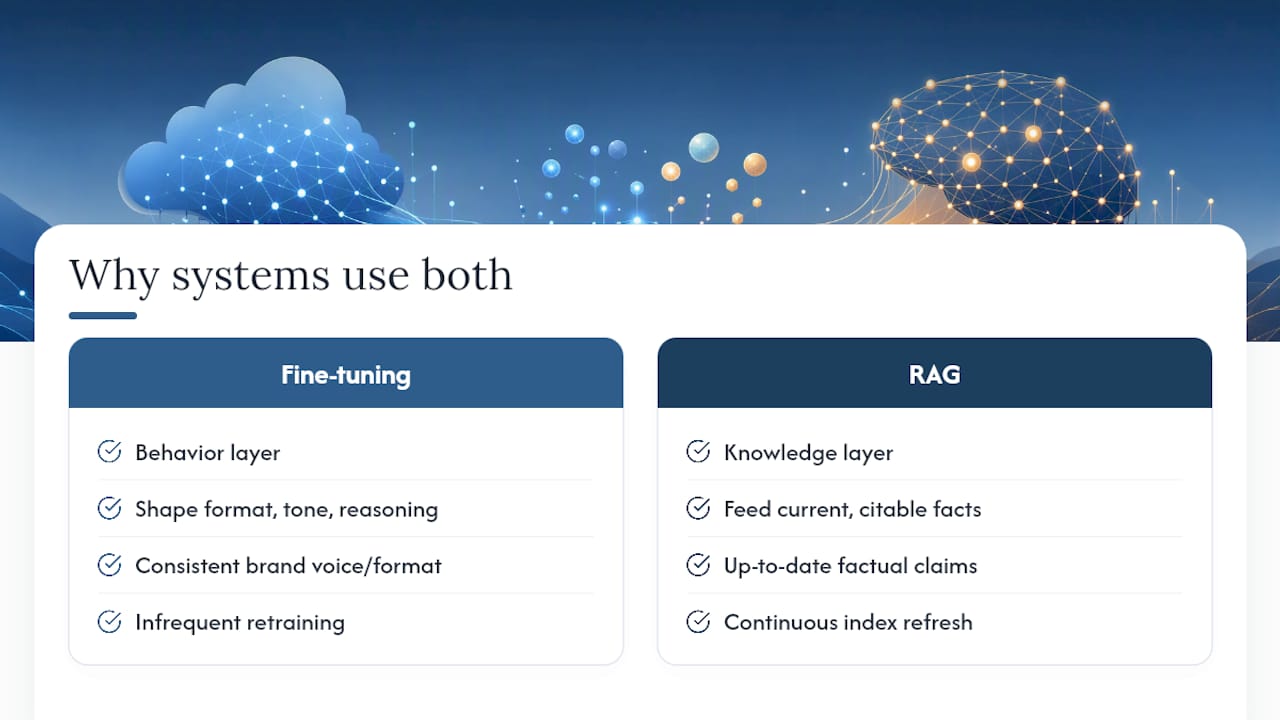
The cleanest way to think about this: fine-tuning shapes the behavior layer, RAG feeds the knowledge layer, and production systems needing both properties typically end up combining them rather than picking one permanently.
A common pattern: fine-tune a model to consistently produce a specific output format, tone, or reasoning style, then pair it with RAG so its factual claims stay current and citable. The model always sounds like your brand. Its facts always come from this week’s documents, not last year’s training snapshot.
Hybrid architectures become necessary once regulation, legal exposure, or customer-facing accuracy raises the stakes of a wrong or uncited answer. Engineering experiments confirm the two methods produce additive accuracy gains when combined, though it does demand more upfront dataset work and a clear update workflow: fine-tune infrequently for behavior, refresh the retrieval index continuously for facts, and keep the two update cycles decoupled so a documentation change never requires a full retraining run.
A Leader-Facing Example: Permission-Aware Updates Inside Claude
Most RAG discussions focus on retrieval quality. Fewer address who’s allowed to see what once retrieval is running across real company documents, which is exactly where enterprise deployments run into trouble.
ClaudeDrive addresses that gap directly. It connects a company’s existing tools, meeting notes, GitHub, the calendar, and builds a permissioned, sourced daily update inside the Claude account leaders already use. Every line traces back to a real source. Nothing gets made up, and nothing crosses a line a given person isn’t allowed to see.
- Permission checks happen before information ever reaches the person asking, not as a filter applied after the fact.
- Every update stays auditable and source-linked, so a CTO or COO can verify a claim instead of taking it on faith.
- No new dashboard, no new app to roll out, no wiki to maintain. The update shows up where leaders already work.
- It fits the decision framework above squarely on the RAG side: current information, traceable sources, permissioned by design.
A leader evaluating this space should pilot exactly this kind of system on one high-value information flow before committing to a broader build. See the live demo, or talk to us about a pilot.
What I’d Actually Do First
Skip the framework debate and run a pilot. Pick one recurring, high-value question your team asks repeatedly, build a small RAG flow around it, and evaluate it with ARES or RAGAS before you decide whether fine-tuning adds anything.
Three mistakes I see leadership teams make: skipping evaluation because the demo looked convincing, fine-tuning before testing whether better prompting or retrieval would have solved it more cheaply, and treating permissioning as a later cleanup task instead of a day-one design requirement.
— Paul
Get Trusted, Permissioned Updates Without Building a Retrieval Pipeline
ClaudeDrive is the alternative to building your own retrieval-augmented generation stack when the actual job is simpler: giving leaders a daily update they can trust. Instead of standing up a vector database, an embedding pipeline, and a permission layer from scratch, connect a few tools, meeting notes, GitHub, the calendar, and each person gets a private, source-linked briefing inside the Claude account they already use.
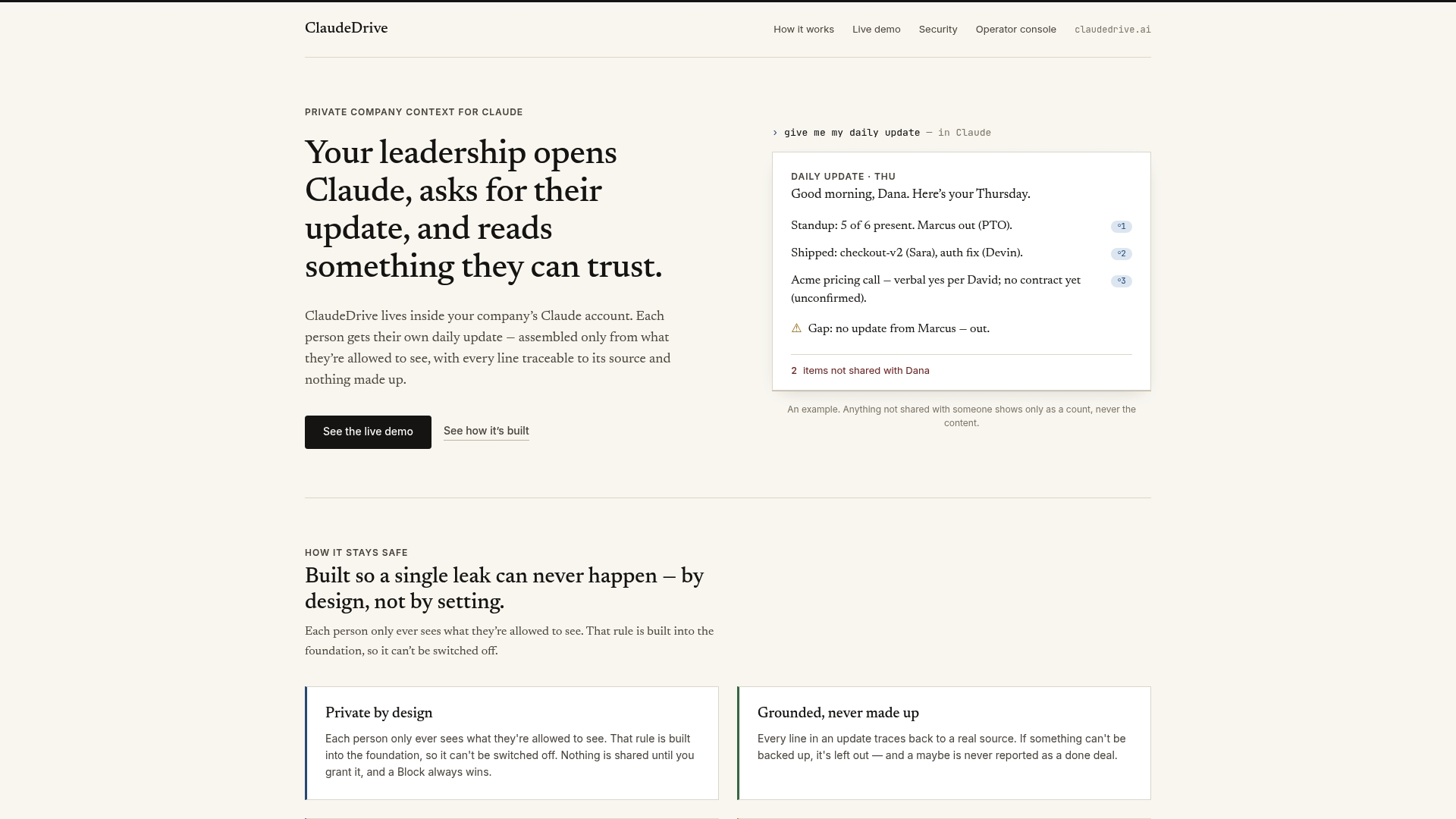
CTOs, COOs, founders, and chiefs of staff at fast-growing teams typically bring this in once cross-functional updates start slipping through the cracks, and once “who said what in which meeting” becomes a real time cost. ClaudeDrive answers that with sourced lines, nothing made up, and access controls enforced at the point information gets retrieved, not bolted on afterward. There’s no new dashboard to learn and no wiki to keep current. See the live demo at ClaudeDrive Console, or talk to us about a pilot for your team.
Sources
- RAG vs Fine-Tuning: Enterprise Decisions for AI Models and AI Systems — Databricks Blog
- Comparing Retrieval Augmented Generation and fine-tuning — AWS Prescriptive Guidance