Multi-Venture Context Separation in AI: A Leader's Guide
Discover the critical steps for multi-venture context separation in AI. Ensure security and prove authorization as you scale your teams.
ClaudeDrive
A Yungsten Tech product

Multi-Venture Context Separation in AI: A Leader’s Guide

If you run more than one venture or team and your people are using AI for daily briefings, the single most important question is not which AI to use. It’s whether each person sees only what they’re authorized to see, and whether you can prove it. The answer to both must be yes before you scale.
The verdict: require user-scoped retrieval, document-level permission enforcement at query time, per-query audit logs, and source-linked citations. Adopt a permission-aware company-context layer that propagates user identity into every retrieval event and logs each one with document identifiers, user identity, and a timestamp. Then run a focused pilot connecting a small number of sources across a few ventures, validate the audit logs, and confirm that offboarding works before you expand.
BCG’s research on AI for CEOs confirms that executives are using agentic, context-aware systems to compress large volumes of information into decision-ready inputs, shifting from document review to high-level judgment. The guarantee that makes that shift safe is isolation: each venture’s documents stay in their own lane, and nothing crosses without explicit permission.
Table of Contents
- What guarantees and features must you insist on?
- What does a trustworthy architecture look like?
- What governance controls do you need to enforce?
- What does a 90-day pilot look like?
- How do you evaluate vendors?
- Key Takeaways
- The part most vendors won’t tell you upfront
- ClaudeDrive delivers this out of the box
- Useful sources
What guarantees and features must you insist on?
The non-negotiables fall into two groups: retrieval-time enforcement and operational controls. Both matter. One without the other creates gaps.
Retrieval-time enforcement:
- User-scoped retrieval: the AI uses only documents the asking user is already authorized to access. This requires identity propagation at retrieval time, not a post-generation filter. OpenNash’s analysis documents the risk clearly: many deployments run retrieval under one shared service account, which flattens all access controls and creates a large blast radius if anything goes wrong.
- Document-level permission enforcement: permissions are checked at the moment of retrieval, not after an answer is generated. AWS’s implementation guidance shows that document-level metadata reduces reindexing scope when permissions change, which matters in dynamic, multi-venture environments.
- Source-linked citations: every briefing line should carry a link to the exact source passage and its owner or approval status. No citation, no trust.
Operational controls:
- Per-query audit logs that record user identity, document IDs consulted, the permission decision, and a timestamp for each retrieval event
- Least-privilege tool scopes: narrow, read-only credentials for each connector, not one over-privileged service account
- Policy-as-code for who can create knowledge bases, which connectors are allowed, and what encryption and retention settings apply
- Instant offboarding with a logged revocation timestamp
Pro Tip: Ask any vendor to show you a sample audit log entry before you sign. If it doesn’t include user identity, document ID, and a permission-check timestamp, it won’t satisfy a SOC 2 auditor or an internal forensics request.
What does a trustworthy architecture look like?
You don’t need to understand the engineering details. You do need to recognize the pattern that delivers the guarantees above.
The flow runs in one direction: your Claude interface sends a query to an orchestration layer, which routes it to a permissioned retrieval layer. That retrieval layer checks the user’s identity against the document’s access rules before returning anything. Only permitted content reaches the model. The model then generates a briefing from that content and attaches source citations.
IBM’s watsonx Orchestrate implementation demonstrates this pattern in practice: orchestration is separated from retrieval, and SharePoint permissions from Entra ID are preserved and enforced at retrieval time. The Origin Digital pilot using this architecture kept governance intact while delivering leader briefings.
The retrieval layer is where isolation either holds or fails. If the retrieval layer doesn’t check identity before returning content, every other control downstream is cosmetic.
Each document chunk in the retrieval store carries its source metadata and access rules. When a query arrives, the retriever filters by the asker’s identity and returns only permitted passages. An audit ledger records every retrieval event. An admin console lets you manage connectors, roles, and policies.
| Layer | What it does | What you verify |
|---|---|---|
| Orchestration | Routes queries, coordinates connectors | Cannot bypass retrieval-time checks |
| Retrieval | Filters by user identity before returning content | Logs show permission decision per query |
| Audit ledger | Records user, document ID, timestamp, decision | Exportable for SOC 2 or HIPAA review |
| Admin console | Manages roles, connectors, policy-as-code | Offboarding takes effect immediately |
Aspiro’s enterprise AI analysis makes the point plainly: tenant isolation must be enforced simultaneously at network, identity, compute, and storage layers. Enforcing three of four is not enough.
What governance controls do you need to enforce?
Governance is the operational layer that keeps the architecture honest over time. The controls that matter most:
- Policy-as-code: translate your access policies into machine-enforced rules. Tetrate’s enterprise deployment guidance covers namespace isolation and policy-as-code as the foundation for scaling across multiple teams without manual oversight.
- RBAC and SSO integration: your identity provider (Okta, Azure AD, Google Workspace) syncs role claims into the retrieval layer. When someone’s role changes, their retrieval scope changes automatically.
- Change control for knowledge bases: any new document repository or ACL change goes through an approval workflow, with versioned records and an audit trail.
- Compliance mapping: your per-query audit logs and documented approvals are the evidence package for SOC 2 Type II, HIPAA, and similar U.S. regulatory reviews. Sphere Inc.'s guidance recommends logging user identity, document identifier, and permission-check timestamp for every retrieval interaction.
- Offboarding proof: run a test. Remove a user, then query as that user. The audit log should show the revocation timestamp and zero successful retrievals after that moment.
| Control | What it prevents | How you verify it |
|---|---|---|
| Policy-as-code | Unauthorized knowledge base creation | Review policy files in version control |
| SSO/RBAC sync | Stale permissions after role changes | Query as a recently changed user |
| Approval workflow | Unreviewed ACL changes | Audit trail shows approver and timestamp |
| Offboarding test | Ghost access after termination | Audit log shows zero retrievals post-revocation |
What does a 90-day pilot look like?
A focused pilot answers the three questions that matter: does retrieval stay scoped to the right user, does the audit log hold up, and do leaders actually trust the briefings?
- Weeks 3–6: connect sources, enable identity propagation, and run sample queries as different users. Red-team it: query as a user who should not see Venture B’s documents and confirm the log shows a denied retrieval. See AI company context update examples for connection patterns.
Success criteria: every briefing line is traceable to a named source, permissioned retrieval is confirmed in logs, zero cross-venture leaks during red-team testing, and at least two leaders approve expanding to additional sources.
Pro Tip: Do the offboarding test in week 11, not after go-live. It’s the one control that’s hardest to retrofit and the one auditors ask about first.
How do you evaluate vendors?
Use these questions in every procurement conversation:
- How do you propagate user identity into retrieval? (Acceptable answer: via SSO token or identity claim passed at query time, not a shared service account.)
- Do you enforce document-level permissions at query time or after generation? (Acceptable: at query time.)
- What does your audit schema capture? (Required: user identity, document ID, timestamp, permission decision.)
- Can you demo immediate offboarding? (Required: yes, with a log entry showing the revocation moment.)
- Can you show source-linked citations in a sample briefing? (Required: yes.)
Accept signals:
- Vendor shows per-query logs with all four required fields
- SSO/RBAC mapping is supported and documented
- Source ACLs are preserved on resync, not flattened
- Admin policy-as-code controls are available and versioned
Reject signals:
- Retrieval runs under one broad service account
- Vendor cannot produce per-query audit logs
- Document-level permissions are not enforced at retrieval time
- Offboarding demo is unavailable or delayed
Weight your scoring: security and auditability first, source coverage second, leader UX (briefings into Claude) third. A beautiful briefing that cannot be audited is a liability.
| Criterion | Weight | Accept signal | Reject signal |
|---|---|---|---|
| Security and auditability | High | Per-query logs, SSO, least-privilege | Shared service account, no logs |
| Source coverage | Medium | Connectors for your actual sources | Limited to generic integrations |
| Leader UX | Medium | Briefings in Claude, source citations | New app or dashboard required |
Key Takeaways
Per-venture permission-aware context separation is the governance foundation that makes AI briefings trustworthy at scale: enforce it at retrieval time, log every event, and validate it before you expand.
| Point | Details |
|---|---|
| Enforce at retrieval time | Permissions must be checked before content reaches the model, not after an answer is generated. |
| Four required audit fields | Every retrieval log must capture user identity, document ID, timestamp, and the permission decision. |
| 90-day pilot scope | Start with 1–3 ventures and 1–3 sources; validate offboarding and red-team tests before scaling. |
| Buy vs. build for small teams | Companies with 15–80 people typically lack the engineering bandwidth to maintain permission mirroring long-term. |
| ClaudeDrive | Feeds Claude directly with permission-scoped, source-linked briefings and per-query audit logs, with no new app to adopt. |
The part most vendors won’t tell you upfront
The gap between a vendor’s security marketing and what their audit logs actually capture is wider than most leaders expect. A system that generates beautiful, well-organized briefings but runs retrieval under one service account is not a permissioned system. It’s a fast search tool with a nice summary layer on top. The permission enforcement happens at retrieval, or it doesn’t happen at all.
The second thing leaders underestimate: offboarding is the real test. Any vendor can claim isolation. Very few can show you a log entry with a revocation timestamp and zero successful retrievals after that moment. Make that the first demo you request, not the last.
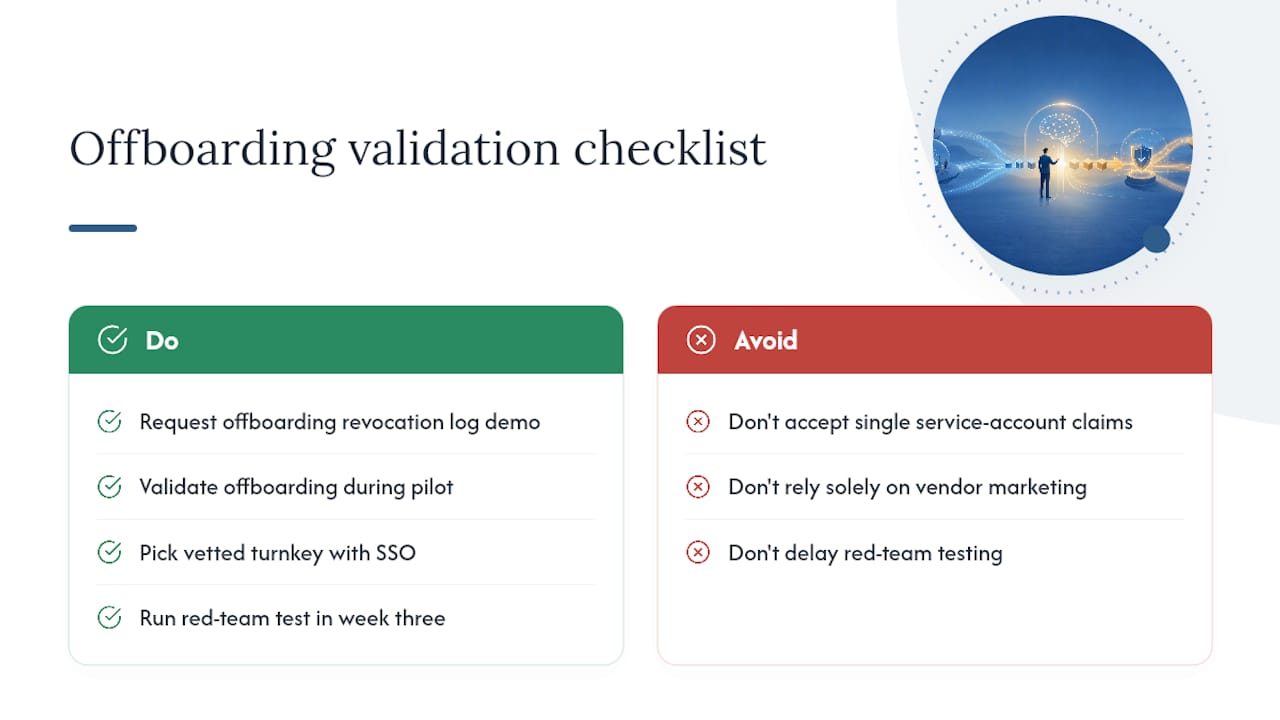
If speed matters and your engineering team is already stretched, pick a vetted turnkey with SSO integration and an explicit offboarding guarantee. Then validate it yourself during the pilot. Don’t take the vendor’s word for it. Run the red-team test in week three, not week eleven.
ClaudeDrive delivers this out of the box
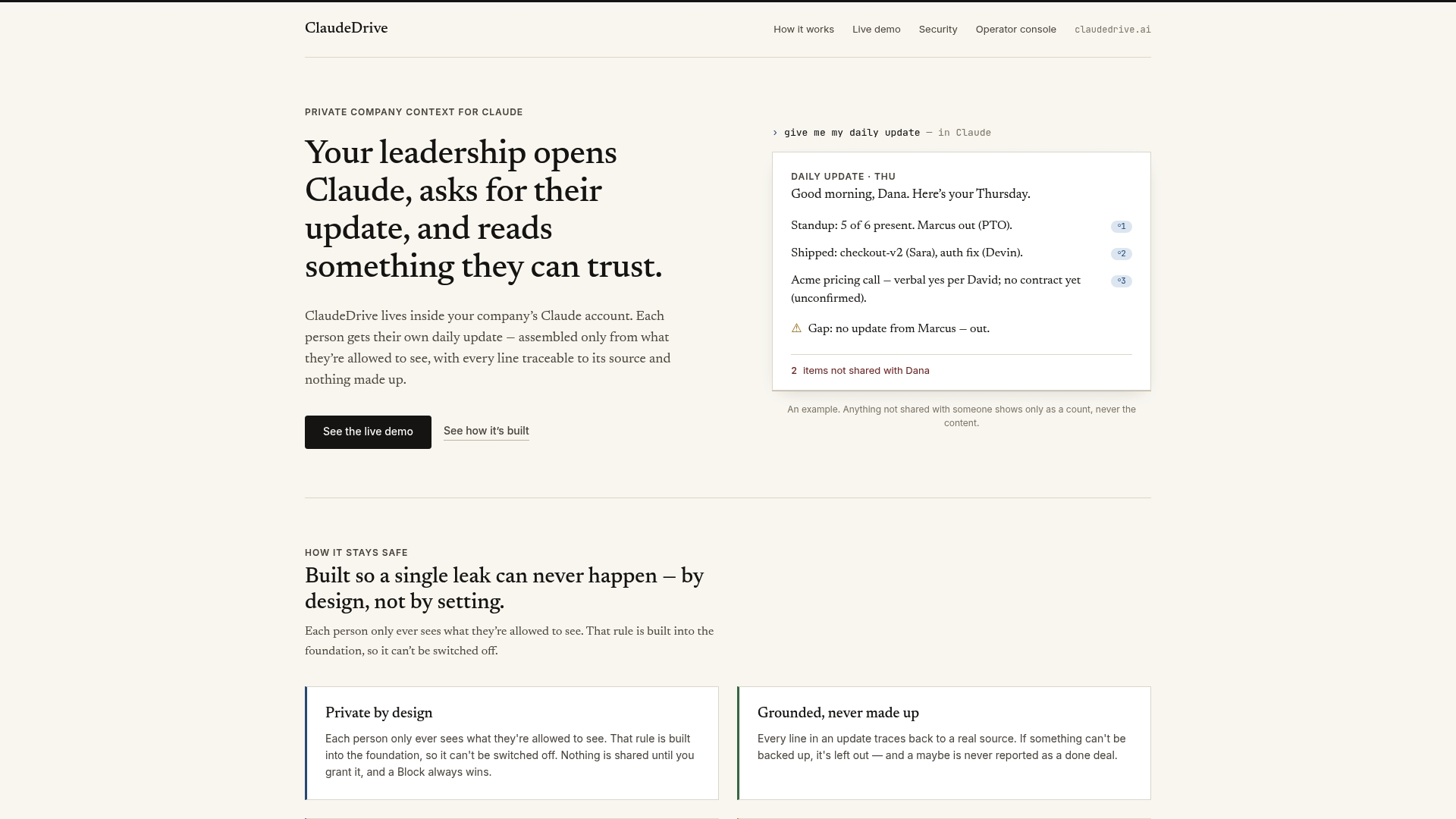
ClaudeDrive is the permission-aware company-context layer that feeds Claude directly, with no new app, no dashboard, and no wiki to maintain. Connect meeting notes, GitHub, and your calendar. Tag who’s allowed to see what. Each leader opens Claude and reads a private briefing built only from their permitted sources, with every line traceable to a real document.
Per-query audit logs capture user identity, document ID, and timestamp for every retrieval. Offboarding takes effect immediately, with a logged revocation event. ClaudeDrive is built with SOC 2 and HIPAA readiness in mind, and the ClaudeDrive blog covers implementation patterns and traceability best practices for leaders who want to go deeper before committing.
Talk to us about a pilot at claudedrive.ai.
Useful sources
- AI for CEOs: Amplifying Time and Judgment at the Top | BCG
- Building a permission-aware knowledge assistant with IBM watsonx Orchestrate
- Permission-Aware AI Agents: Controlling Who Sees What Data | OpenNash Blog
- Restrict access to sensitive documents in your Amazon Quick knowledge bases for Amazon S3
- Model Context Protocol enterprise deployment patterns | Tetrate
- Permission-Aware RAG for Enterprise AI | Sphere Inc
- Enterprise AI: Hubs, harnesses, and tenant isolation | Aspiro AI Studio
- Most organizations can’t use AI agents across teams—here’s why | AWS