Why AI Transparency Builds Trust in Daily Executive Briefings
Discover how AI transparency enhances trust in executive briefings, ensuring every claim is traceable and compliant with evolving standards.
ClaudeDrive
A Yungsten Tech product

Why AI Transparency Builds Trust in Daily Executive Briefings

A permissioned, source-traceable AI briefing earns trust for one reason: every line can be traced back to a real document, a real timestamp, and a person with the right to see it. That is the whole mechanism. When a CEO or CTO reads a daily update built this way, there is no leap of faith involved. Look for four signals when you evaluate any system: traceable source links on every claim, an immutable audit trail or attestation of how the output was produced, identity and permission checks enforced before anything reaches a screen, and a measurable source-match rate you can audit later. Under the EU AI Act’s Article 50, transparency obligations are becoming a compliance baseline, not a nice-to-have, and firms like ClaudeDrive are built around this exact model.
- Every claim links to a named source and paragraph
- Access is enforced before the briefing is generated, not after
- A log exists showing who saw what and when
Pro Tip: Start with a closed internal pilot, one team, three connected tools, before considering anything customer-facing. Controlled scope makes provenance easier to verify and mistakes cheaper to fix.
Key Takeaways
Permissioned, source-traceable briefings build trust because every claim can be audited back to an identified source, an identity, and a timestamp.
| Point | Details |
|---|---|
| Trust comes from traceability | Every claim in a briefing should link to a specific, checkable source, not a general reference. |
| Start with a contained pilot | One team, three connected sources, and a defined executive sponsor produce a faster, cleaner signal than a broad rollout. |
| Measure the right things | Track source-match rate, discrepancy rate, and time-to-verify weekly during any pilot. |
| Calibrate disclosure, don’t maximize it | Full transparency internally does not require full disclosure externally; set levels per claim. |
| ClaudeDrive fits the checklist | It delivers permission-aware, source-linked daily briefings inside Claude with audit trails and no new app to roll out. |
Table of Contents
- Why Transparency Matters for Internal Daily Briefings
- What Every Trustworthy Briefing Must Include
- How Transparency Cuts Hallucination and Audit Risk
- A 90-Day Pilot Roadmap for Source-Traceable Briefings
- What to Measure and How to Govern It Long-Term
- Balancing Transparency With Privacy and IP Protection
- The Impact of AI Transparency on Regulatory Compliance
- How Transparency Shapes Trust Beyond the Engineering Team
- Explaining AI Transparency to Non-Technical Stakeholders
- Common Challenges in Achieving AI Transparency and How to Fix Them
- How ClaudeDrive Meets the Transparency Checklist
- Frequently Asked Questions
- Sources
Why Transparency Matters for Internal Daily Briefings
Internal briefings are a different animal than public-facing AI. The audience is known, the data sources are fixed, and legal review moves faster because nothing leaves the building. That containment is exactly why internal briefings make the best first step for any transparency program: fewer variables, faster sign-off, lower stakes if something goes wrong.
The payoff shows up in three places. Decisions move faster because leaders no longer have to chase down the underlying document before acting on a claim. Audit trails become defensible: when a board member asks where a number came from, you have an answer instead of a shrug. And rework drops, because a claim tied to a bad or outdated source gets caught before it shapes a decision instead of after.
Most organizations still lack full visibility into how AI is being used across their own environments, which is precisely what makes provenance hard to reconstruct after the fact.
Picture two versions of the same Monday briefing. Only one of those survives a board-level follow-up question.
- Faster decisions because claims are pre-verified
- Cleaner audit trails for regulators, boards, and acquirers
- Less time spent re-checking numbers that turned out to be stale
What Every Trustworthy Briefing Must Include
A transparent briefing is not a vague promise. It is a checklist you can hold a vendor to.
- Source links on every claim — click-through to the exact paragraph, cell, or message, not a generic “see attached.”
- Source-quality labels — a visible tag distinguishing a confirmed board document from a Slack message someone half-remembered.
- Data lineage records — a record of where an input came from and what happened to it before it reached the briefing. An approach research on ML pipeline provenance shows can be built without redesigning the underlying models.
- Attestations on key steps — a signed record confirming a transformation happened the way it claims to have happened. The Transparency Record Protocol draft at the IETF describes exactly this kind of signed metadata trail.
- Identity and permission checks — enforced before generation, so a person only ever sees what they are cleared to see.
- Change history — a record of who edited what, and when, with an audit mode available on demand.
The common failure mode is stopping at item one. A source link with no lineage behind it just moves the trust problem one step downstream instead of solving it.
- Source links: present or absent, no in-between
- Lineage: traceable from raw input to final line
- Permissions: enforced at generation, not after
How Transparency Cuts Hallucination and Audit Risk
Forcing every output to link to a real source does something simple but powerful: it removes the model’s ability to assert something it cannot back up. That constraint alone catches a large share of the confident-but-wrong statements that plague ungrounded AI tools. ETSI’s framework describes this pairing as transparency plus explicability, being open to examination while also being able to show your work, and that combination is what makes an output non-repudiable in a dispute.
Three metrics tell you whether it’s working: source-match rate (the share of claims tied to an exact, verifiable source), discrepancy rate (claims that get corrected after review), and time-to-verify (how long it takes a reviewer to confirm a claim). A pilot that starts with a low source-match rate and climbs steadily over several weeks tells you the system is learning your data, not just producing plausible sentences. Sample-level provenance research shows this kind of tamper-evident tracking is achievable without touching the underlying model architecture.
| Metric | What it tells you | Direction you want |
|---|---|---|
| Source-match rate | Share of claims tied to a real, checkable source | Up |
| Discrepancy rate | Claims corrected after audit review | Down |
| Time-to-verify | Minutes a reviewer needs to confirm a claim | Down |
- Provenance turns a disputed claim into a five-minute lookup instead of a week-long investigation
- Attestations give you a defensible record if a regulator or auditor asks how an output was produced
A 90-Day Pilot Roadmap for Source-Traceable Briefings
You don’t need a company-wide rollout to prove this works. A tight, 90-day pilot with one team is enough to generate a real answer.
- Weeks 0 to 2: Pick one team, connect three sources (meeting notes, a code repository, and a calendar), define success metrics, and name an executive sponsor.
- Weeks 3 to 6: Connect the tools inside your own environment, sync permissions so access rules carry over automatically, and build briefing templates that label each claim by source strength.
- Weeks 7 to 10: Run the pilot. Track source-match rate, actual usage (are leaders opening and acting on it?), and correction rate. Hold a short weekly review of anything flagged as weak evidence.
- Weeks 11 to 12: Review the results with the sponsor, pull a sample from the audit log, run a short executive demo, and decide: scale it, adjust the scope, or stop.
Running connectors inside your own perimeter rather than sending raw data out to a third party is the deployment pattern most guidance on internal AI search recommends, and it matters just as much for a briefing tool as for search.
Assign five roles before you start: an executive sponsor who owns the go/no-go call, a data steward who manages connectors and permissions, a compliance reviewer, a product owner running the pilot day to day, and one executive-facing reviewer who reads every briefing critically for the full 90 days. Skip any one of these and the pilot tends to drift.
- Scope small: one team, three sources, one clear owner
- Measure weekly, not just at the end
- Decide explicitly: scale, adjust, or stop, don’t let it linger unreviewed
What to Measure and How to Govern It Long-Term
Once a pilot proves out, five numbers keep it honest at scale: source-match rate, usage rate (are leaders still opening and acting on it weeks in, not just during the demo), discrepancy rate, time-to-verify, and audit log completeness.
- Set an evidence-labeling policy so every claim carries a visible confidence tag, not just a link.
- Review access and identity permissions on a fixed cadence, monthly for high-growth teams, not “whenever someone remembers.”
- Set record-retention rules that match your compliance obligations, not just your storage budget.
- Build a correction loop: when a claim turns out wrong, log it, fix the source mapping, and track whether the same error recurs.
For boards and auditors, a short dashboard covering these five metrics, backed by a sample-review audit mode, beats a lengthy narrative report every time. Auditors want to spot-check, not read a summary.
- Track usage as closely as accuracy, an accurate briefing nobody opens has failed too
- Keep the audit log queryable, not just archived
Balancing Transparency With Privacy and IP Protection
Full transparency and full disclosure are not the same thing, and conflating them is where most programs stumble. A briefing can be completely traceable internally while still withholding sensitive detail from anyone not cleared to see it. Research on transparency and trust makes this point directly: transparency builds trust, but it has to be calibrated by context, not applied uniformly to every audience.
Practical mitigations exist for this: set disclosure levels per claim rather than per document, encrypt provenance records so only verifiers can inspect the full chain, and route sensitive claims through a restricted reviewer role instead of a general audience. Full disclosure is rarely right for anything customer-facing or for data licensed from a third party, where the goal is proving accountability without exposing the underlying secret.
- Set disclosure levels per claim, not per document
- Restrict who can see the full provenance chain, not just the final line
- Keep external-facing content on a stricter disclosure setting than internal briefings
Pro Tip: Use two evidence lanes, A for act on now, B for monitor before acting, so leaders don’t overreact to a single unverified signal buried in an otherwise solid briefing.
The Impact of AI Transparency on Regulatory Compliance
Regulators are moving in one clear direction: they want to see the receipts, not just the output. The EU AI Act’s transparency provisions formalize what many boards were already asking their teams for informally, a documented, auditable trail behind any AI-assisted decision that touches finance, hiring, or risk.
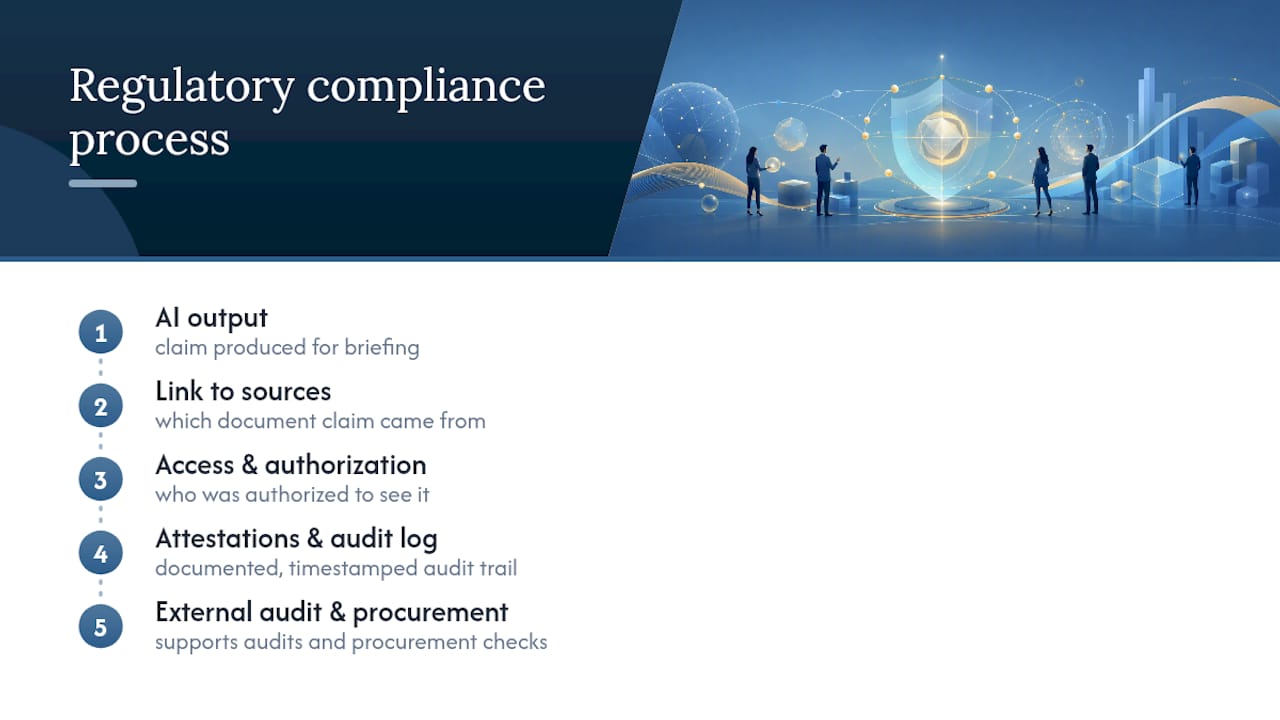
For an internal briefing tool, this changes what “compliant” looks like. It’s no longer enough to say the output is probably accurate. You need a record showing which document a claim came from, who was authorized to see it, and when the claim was generated. That record is what a compliance officer hands to an external auditor, and it’s what protects an executive who acted on a briefing in good faith.
This has a direct procurement effect too. Legal and compliance teams increasingly ask vendors for evidence of provenance and access control before signing anything, not after an incident. A tool with attestations and audit logs baked in clears that review faster than one that treats them as an add-on. If your legal team is building an internal framework around this, a resource like this AI governance framework overview is a useful starting reference for boards setting policy. Firms in regulated sectors face a stricter bar still: financial services compliance standards already expect this kind of traceability for anything touching client data or reporting, and that expectation is spreading to other industries.
How Transparency Shapes Trust Beyond the Engineering Team
Transparency isn’t just an engineering concern. It shapes how customers, partners, and investors read your company’s judgment.

A customer who hears that internal decisions are backed by traceable, permissioned data infers something about how the company is run generally: carefully, with controls that hold up under scrutiny. A partner evaluating a joint venture asks similar questions before signing anything involving shared data. And investors, particularly at the due diligence stage, increasingly treat AI governance as a proxy for operational maturity. A founder who can show a clean audit trail behind AI-assisted reporting looks like someone who has their house in order.
The reverse is just as visible. A leadership team that cannot explain where an AI-generated number came from, in a board meeting, a funding round, or a customer escalation, raises a flag that has nothing to do with the accuracy of that specific number. It signals a control gap, and control gaps get remembered longer than isolated errors do.
None of this requires exposing raw data to outside audiences. It requires being able to say, credibly, “here’s how we know this is right,” and having the audit trail to back it up if someone asks twice.
Explaining AI Transparency to Non-Technical Stakeholders
Boards, customers, and non-technical executives don’t need architecture diagrams. They need three plain answers: where did this come from, who was allowed to see it, and can I check it myself.
Translate technical guarantees into outcomes instead of mechanisms. Don’t explain how retrieval or access filtering works. Say instead: “Every line in this briefing links to a real source, and no one sees information they’re not cleared for.” That sentence does more work in a board meeting than a diagram of the pipeline ever will.
Use a live example instead of a slide. Open a briefing, click a source link in front of the room, and show the underlying document. That thirty-second demonstration convinces more skeptics than a written explanation of provenance ever does.
Keep the vocabulary consistent across every audience. If you call it a “daily update” with your leadership team, don’t call it a “retrieval-augmented output” in the board deck. Consistent, plain language is itself a transparency signal, since jargon-switching reads as obfuscation even when nothing is actually being hidden.
Common Challenges in Achieving AI Transparency and How to Fix Them
The most common failure isn’t technical. It’s treating “transparency” as a synonym for “make everything visible to everyone,” which creates exactly the privacy and IP exposure that makes leadership teams nervous in the first place. The fix is disclosure calibrated by audience, not blanket openness.
The second common problem is source links that point to something real but stale, a document that existed once but has since been superseded. That requires lineage tracking, not just a link, so the system knows when a source has been replaced and flags claims built on outdated inputs.
Third, permission sprawl: as teams grow, who’s allowed to see what drifts out of sync with actual roles, and a briefing quietly starts leaking information across boundaries it shouldn’t cross. Regular access reviews, not a one-time setup, are the only durable fix here.
Last, teams frequently skip the audit trail early because it feels like overhead during a pilot. That’s a mistake that compounds. Retrofitting provenance onto a system already in production is far harder than building it in from week one.
Author perspective: a short, first-person note on why leaders should act now
Leaders who run a real pilot, even a small one, tend to be surprised less by what the technology can do and more by how quickly a source-match rate exposes weak internal documentation. The most common mistake I see is treating transparency as a synonym for openness, publishing everything to everyone instead of building a permissioned trail that different audiences can trust for different reasons. Fix that distinction early. If you want to see what a permissioned, source-linked briefing actually looks like in practice, see the live demo.
How ClaudeDrive Meets the Transparency Checklist
ClaudeDrive is built around exactly the checklist above, not as a separate product to learn, but as the layer that feeds the Claude account your team already uses. Connect meeting notes, GitHub, and your calendar, and each person gets a private daily update built only from what they’re permitted to see. Every line traces back to a real source. Nothing is invented, and nothing crosses a permission boundary.
That maps directly onto what a leader needs to evaluate: per-line source links instead of vague summaries, evidence labeling so you can tell strong sources from weak ones at a glance, permission-aware views enforced automatically as your team changes, and a full audit trail you can hand to compliance without extra work. There’s no dashboard to roll out and no wiki to maintain, since ClaudeDrive delivers inside Claude itself. That’s a meaningful difference from standing up a separate assistant your team has to learn on top of the tools they already use. A pilot can start scoped to one team and three connected sources, with governance templates ready from day one. If you’re weighing a pilot against building this internally, talk to us about a pilot.
Frequently Asked Questions
Why does AI transparency build trust for internal briefings specifically? Because the audience and data sources are fixed and contained, making it possible to verify every claim against a real, permissioned document rather than an open-ended web of external sources.
What’s the difference between transparency and explainability? Transparency means the system is open to examination. Explainability, as ETSI’s framework puts it, means the system can show its work, both matter for a claim to hold up under audit.
How long should a transparency pilot run before deciding to scale? A 90-day window, split into scoping, deployment, active measurement, and review, gives enough data on source-match rate and usage to make an informed call.
Does more transparency always mean more disclosure? No. You can be fully transparent internally, with a complete audit trail, while still restricting what any given audience is allowed to see.
What metric should a leader watch first? Source-match rate, the share of claims tied to an exact, verifiable source, since it’s the clearest early signal of whether the system is grounded or guessing.
Sources
- ETSI TR 104 224: Transparency and explicability considerations for AI systems
- Digital Provenance: Can You Prove Where Your AI Outputs Came From?
- Transparency Record Protocol (TRP) draft — IETF
- Capturing end-to-end provenance for machine learning pipelines (FG-Trac and related work)