AI Update with Per-Person Privacy: 2026 Guide
Discover the AI update with per-person privacy. Tailor responses while keeping your data secure. Learn how your information stays yours!
ClaudeDrive
A Yungsten Tech product

AI Update with Per-Person Privacy: 2026 Guide

The most important shift in AI right now is not a new model. It’s a new guarantee: your data stays yours, even when AI uses it. An AI update with per-person privacy means the system draws on your personal context to give you a relevant, tailored response, but that context is never absorbed into the shared model, never visible to other users, and never retained beyond the scope of the task.
The 2026 direction is clear: scoped, permission-aware access rather than permanent data injection. A few examples anchor this shift:
- OpenAI privacy filters mask personally identifiable information before it reaches training pipelines, separating what the model learns from what you share.
- Gemini Personal Intelligence connects your Gmail, Photos, and YouTube to personalize responses, while keeping personal data out of core model training.
- 1Password for Claude injects credentials at task runtime without ever exposing them to the model or Anthropic’s systems.
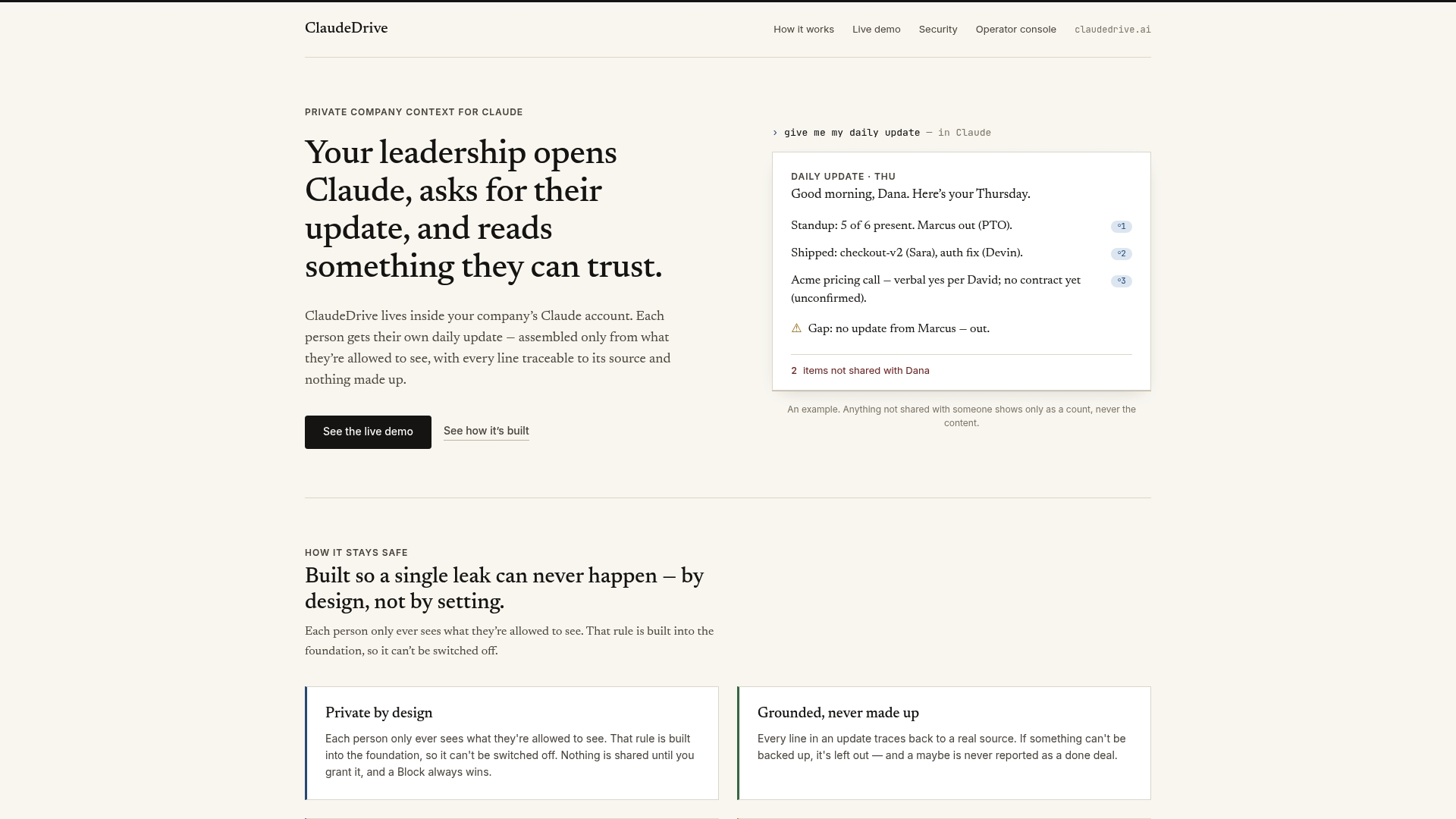
- ClaudeDrive delivers each leader a daily briefing built only from sources they are approved to see, with every line traceable and nothing invented.
The common thread: personal context is used just-in-time, then released. Nothing leaks across the line.
What the regulatory landscape now demands from AI teams
An increasing number of AI laws were passed in 2025 alone, reflecting accelerating regulatory pressure. For compliance officers, that number translates directly into audit exposure, not just policy reading.
The EU AI Act’s prohibited practices provisions took full effect in February 2025, banning real-time biometric surveillance and social scoring systems. Enforcement timelines for high-risk AI categories extend into 2026 and 2027, giving organizations a window to align, but regulators are already scrutinizing data governance practices now. In the US, no single federal AI privacy law has passed yet, but state-level frameworks, the FTC’s expanded enforcement posture, and sector-specific rules under HIPAA and GLBA collectively create a patchwork that compliance teams must map against every AI deployment.
What regulators across jurisdictions share is an emphasis on individual data rights: the right to know what was collected, the right to correct it, and the right to have it deleted. AI systems that permanently absorb personal data into model weights make those rights nearly impossible to honor. That is why the shift toward per-person, scoped AI updates is not just a product trend. It is a compliance posture.
Key regulatory pressure points for US organizations:
- Shadow AI deployments that bypass approved tools create undocumented data flows that are nearly impossible to audit after the fact.
- Data subject requests require organizations to locate, produce, and sometimes delete individual records, a task that grows exponentially harder when personal data has been used in model training.
- Transparency obligations increasingly require organizations to explain what data an AI system used and why, which demands traceable, permissioned data access from the start.
How current technology actually enforces per-person data protection
The architecture behind personalized AI privacy has matured considerably. Three approaches now define the field.

Personalized Federated Learning keeps raw personal data on the user’s own device. The model trains locally, then shares only aggregated updates with a global model, never the underlying records. A 2026 IEEE review covering over 39 peer-reviewed studies confirms this approach enables what researchers call a “Sovereign Data Ecosystem,” where calendar entries, health records, and email stay local while the model still improves. Low-Rank Adaptation techniques allow this local fine-tuning without requiring cloud access.
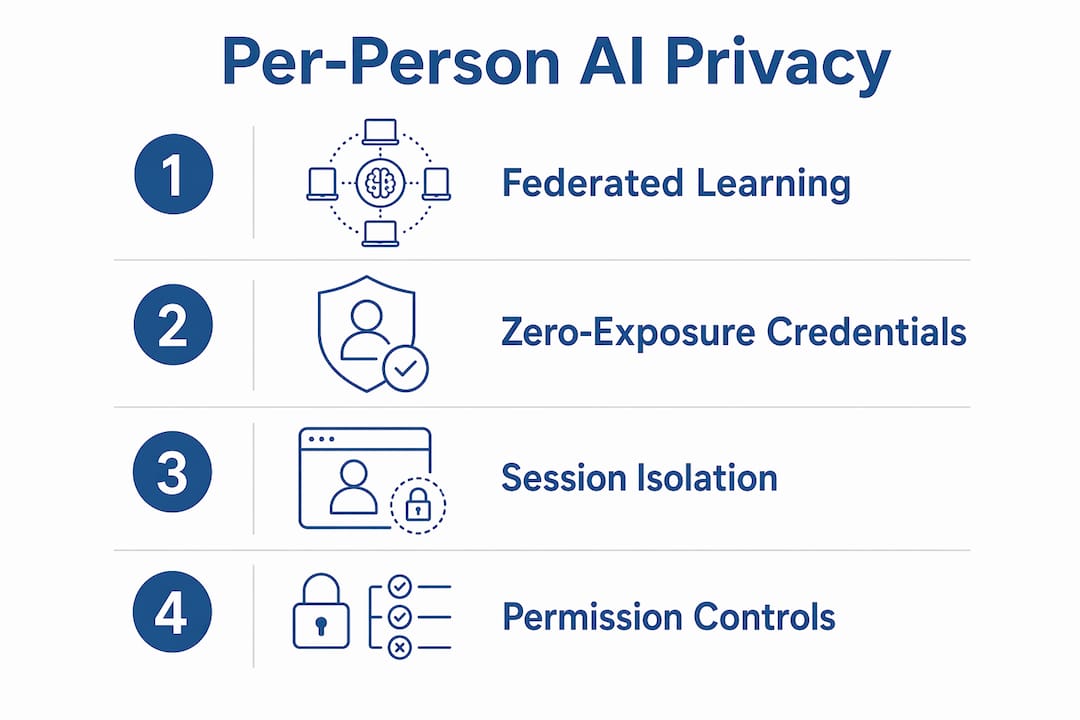
Zero-exposure credential frameworks solve a different problem: how an AI agent completes real tasks without holding your passwords. 1Password for Claude injects credentials directly into the target system at the moment of use, outside the model’s context entirely. The model knows it used your login. It never sees the password or the one-time code. Access is granted per session and scoped to a specific approved set of items, with no carryover to future sessions.
Session isolation and sandboxing prevent data from one user’s session contaminating another’s. Perplexity’s SPACE platform wraps agent sessions in isolated sandboxes where credentials are never stored inside the environment and users supply their own encryption keys. If a key is revoked, new sandboxes cannot read the data.
Pro Tip: When evaluating any AI privacy tool, ask one question first: where does the credential or personal context live at the moment the AI uses it? If the answer is “inside the model’s context window,” the exposure risk is real regardless of what the marketing says. Prioritize solutions where secrets are injected at the application layer, outside the model, with biometric-prompted, per-task authorization.
Document-level permission controls add another layer, ensuring that even within a single organization, each person’s AI view is scoped to what they are approved to access.
Privacy risks that AI updates introduce, and how to manage them
Stanford HAI researchers make a point that most compliance frameworks miss: AI can infer sensitive facts from combinations of non-sensitive data points. You do not need to share your medical history for a model to infer health conditions from your search patterns, location data, and purchase history. Individual data rights, the right to delete or correct a single record, do not address this inference risk.
The practical compliance challenges compound from there:
- Shadow AI is the most common gap. Employees use consumer AI tools for work tasks, uploading meeting notes, contracts, or customer data to systems outside the organization’s approved stack. The data flows are invisible until something goes wrong.
- Manual data subject request management is expensive and error-prone at scale. When personal data has been used in model training, fulfilling a deletion request may be technically impossible without retraining the model.
- Model inversion attacks allow adversaries to reconstruct training data from model outputs, meaning that data you believed was anonymized may be recoverable.
- Correlated inference means that even properly anonymized datasets can be re-identified when combined with external data sources, a risk that grows as AI systems connect more data streams.
The tactical response for organizations: audit every AI tool in use, not just the approved ones. Map where personal data enters each system, whether it persists, and whether it can be deleted on request. For AI updates specifically, permission-aware retrieval architectures that scope each query to approved sources are far easier to audit than systems that absorb data permanently.
How ClaudeDrive delivers per-person privacy for company leadership
ClaudeDrive applies these principles at the leadership layer, where the stakes for data confidentiality are highest. A CEO, COO, or chief of staff opens Claude, asks for their update, and reads a briefing built only from sources they are approved to see. Every line is traceable to a real source. Nothing is invented. Nothing crosses a permission boundary.
The permission-aware update model works because ClaudeDrive acts as a private context layer feeding Claude, not a new application to learn or a dashboard to maintain. Connect meeting notes, GitHub, and the calendar. Tag who is allowed to see what. Each person gets their own private view of what happened, scoped to their role.
What this means in practice for leadership teams:
- No cross-line leaks. The CFO’s briefing does not surface engineering roadmap details the CFO is not cleared to see, and vice versa.
- No invented content. Every claim in the briefing links back to a real source document, so leaders can verify rather than trust blindly.
- No new tools to adopt. ClaudeDrive feeds Claude directly, so the interface leaders already use stays the same.
For compliance officers, the audit trail is built in. Because every update is scoped and sourced, demonstrating what data was used, by whom, and for what purpose is straightforward rather than a forensic exercise.
How US AI privacy frameworks compare
Three frameworks shape how US organizations approach individual data protection in AI systems.
The NIST AI Risk Management Framework (AI RMF), released in 2023 and updated in 2024, provides a voluntary but widely adopted structure. Its GOVERN, MAP, MEASURE, and MANAGE functions map directly onto privacy obligations: identify what data the AI uses, assess the risk to individuals, and document controls. Federal agencies increasingly reference the AI RMF in procurement requirements.
State privacy laws, led by California’s CPRA and followed by Virginia, Colorado, Connecticut, and others, impose individual rights obligations that apply to AI systems processing personal data. The California Privacy Protection Agency has signaled that automated decision-making and AI profiling are enforcement priorities for 2026.
Sector-specific rules under HIPAA (health data), GLBA (financial data), and FERPA (education records) predate general AI privacy frameworks but apply fully to AI systems processing covered data. An AI tool that ingests patient records for a hospital system is a HIPAA business associate, regardless of how the vendor markets the product.
The practical gap between these frameworks: none of them yet mandate the technical architecture of per-person privacy. They require outcomes, not methods. That means organizations have flexibility in how they implement individual data protection, but they bear the burden of proving the outcome was achieved.
Where AI per-person privacy is heading
The research directions that will define the next two to three years are already visible.
Federated Agent Swarms extend personalized federated learning from single-user models to networks of AI agents that collaborate without pooling raw data. The 2026 IEEE review on personalized federated learning identifies this as a primary future research direction, with implications for enterprise AI deployments where multiple agents handle different data domains for the same organization.
Cryptographic privacy guarantees are moving from research into production. Differential privacy, which adds calibrated noise to model updates to prevent individual data reconstruction, is already used by major AI providers. Secure aggregation protocols allow model updates to be combined without any single party seeing individual contributions.
Consent infrastructure is becoming a product category. As AI systems connect more data sources, the question of which connections a user has authorized, and for how long, requires active management. Gemini Personal Intelligence’s opt-in, per-app connection model is an early version of what will become standard: granular, revocable, auditable consent at the data-source level.
Agentic AI privacy is the frontier with the least settled practice. When an AI agent acts over hours or days on a user’s behalf, the session isolation and credential management challenges multiply. The 1Password Agentic Mode and Perplexity’s SPACE platform are early answers, but the standards for long-running agent privacy are still forming.
Stanford HAI’s position is that structural solutions, not just individual data rights, are required to address AI’s inference capabilities. That framing is gaining traction in policy circles and will likely shape the next generation of US AI privacy regulation.
Key Takeaways
AI updates with per-person privacy require scoped, just-in-time data access, traceable sourcing, and permission boundaries that hold across every user and every session.
| Point | Details |
|---|---|
| Regulatory pressure is accelerating | 145 AI laws passed in 2025; US compliance teams must map state, federal, and sector rules against every AI deployment. |
| Architecture determines privacy | Federated learning, zero-exposure credential injection, and session isolation are the methods that make per-person privacy technically enforceable. |
| Shadow AI is the biggest gap | Unapproved AI tool use creates data flows that are invisible to compliance teams until a breach or audit surfaces them. |
| ClaudeDrive scopes every update | Each leader sees only approved sources, with every line traceable, making audit and compliance straightforward rather than forensic. |
| Inference risk requires structural fixes | Individual deletion rights do not address AI’s ability to infer sensitive facts from linked non-sensitive data, per Stanford HAI research. |
ClaudeDrive is built for leaders who need to trust what their AI tells them. See the live demo at claudedrive.ai.