Defend Briefs With Provenance: Document Chunking Strategy for Leaders
For leaders: chunk documents as governance. Require per claim provenance, named owners, and 2–4 evidence bullets to keep briefs decision ready.
ClaudeDrive
A Yungsten Tech product

Defend Briefs With Provenance: Document Chunking Strategy for Leaders

The right document chunking strategy gives you daily briefings you can actually rely on: one clean update inside Claude where every line traces back to a real source, no fabricated numbers, and no content crossing lines it shouldn’t. Each item is a discrete, evidence-backed decision unit rather than a raw text dump. A tool like ClaudeDrive can implement this as a working system rather than a manual process.
TL;DR:
- Document chunking must be based on discrete decision units, each backed by two to four verifiable evidence points that can be traced to sources.
- A clear briefing charter should specify audience, cadence, scope, decision window, owner, length limit, and exclusion rules to ensure relevant and manageable updates.
- Source links and metadata must be consistently maintained, with each claim linked to an accessible, current source, and source validation tested before distribution.
- Briefs should follow strict review processes with source owner verification, and sign-off to prevent inaccuracies, fabrications, or scope creep.
- Using a structured, minimal, and accountable approach improves decision speed and trustworthiness, especially when integrated with tools like ClaudeDrive that enforce permissions and provenance.
Table of Contents
- What Belongs in a Briefing Charter for Document Chunking Strategy?
- How Do You Chunk and Tag Documents for a Leader-Ready Brief?
- What Permission and Provenance Guarantees Should Leaders Demand?
- How Often Should Briefs Run, and What Proves They’re Working?
- How Do You Pilot a Document Chunking Strategy Without Overbuilding It?
- Overview of Chunking Methodologies for Leadership Briefs
- How Big Should a Chunk Be, and Where Should It Break?
- What Tools Actually Help With This Kind of Chunking?
- What Goes Wrong Most Often, and How Do You Fix It?
- How Do You Connect Chunked Briefs to Existing Knowledge Systems?
- How Do Different Industries Apply This Chunking Approach?
- Treat Chunking as Governance, Not Formatting
- See How ClaudeDrive Puts This Playbook to Work
- Sources
What Belongs in a Briefing Charter for Document Chunking Strategy?
Before you touch a single document, you need a charter. Without one, chunking becomes a technical exercise divorced from what leaders actually need to decide. An AI-augmented executive workflow should be governed by explicit rules covering audience, cadence, and scope before anyone starts feeding it source material.
The charter should nail down:
- Audience: who reads this brief and at what seniority level
- Cadence: daily, weekly, or event-triggered
- Decision window: how much time the reader has before acting
- Scope: which systems, projects, or departments are in bounds
- Exclusions: topics, teams, or document types explicitly left out
- Thresholds: what magnitude of change warrants inclusion
- Owner: the named person accountable for accuracy
- Length limit: a hard cap so the brief stays skimmable
A morning daily brief for a COO might use a same-day decision window. An incident brief triggered by a production outage needs a different rule: distribute promptly after detection, regardless of the regular cadence. Teams that standardize this decision frame see measurably better decision readiness and lower prep effort than teams that leave it ad hoc. Set a target of reducing time-to-decision by a meaningful margin and tracking a significant share of flagged items that get closed out within the stated window.
How Do You Chunk and Tag Documents for a Leader-Ready Brief?
Forget the technical definition of a chunk. For your purposes, a chunk is one decision or one discrete piece of evidence: a headline, the facts backing it, and a pointer to where it came from. Nothing more, nothing less.
Here’s the format that works:
- Write a one-sentence headline stating the material change. “Q3 renewal risk increased on the Meridian account” beats “Update on Meridian.”
- Attach two to four evidence bullets, each with its own source pointer. Every fact needs a place a reviewer can click to verify it.
- Name an owner. Someone specific, not a department, is accountable for that item’s accuracy.
- Recommend a next step. Not a summary of the situation. What should the reader actually do?
- Tag minimal metadata: source ID, reporting period, extraction time, owner, and sensitivity level.
Naming conventions matter more than people expect. A folder structure like briefs/2026-03-daily/meridian-renewal-risk.md beats a generic file called notes.txt because anyone auditing the brief months later can find the source without asking around. Detailed field lists for briefing charters and source-tracking checks consistently point to this kind of minimal, consistent metadata as the difference between a trustworthy brief and a plausible-sounding one.
If a date, owner, or figure is missing, mark it [UNCLEAR] rather than guessing. Routine, healthy signals belong in an appendix. The main brief stays exception-led, covering only what changed enough to warrant a decision.
Pro Tip: Run a “source click test” before your first real distribution: pick five random claims in the draft brief and confirm each one leads to a document a human can actually open. If any link is dead or the source doesn’t say what the headline claims, the chunking process has a gap worth fixing before it reaches anyone senior.
What Permission and Provenance Guarantees Should Leaders Demand?
Trust in a daily brief comes down to two questions: was the reader allowed to see this, and can every claim be traced to something real? Both need to be enforceable, not just promised.
Insist on retrieval-time access checks, meaning content only surfaces if the specific reader is authorized to see it, not just because it exists somewhere in a connected tool. Per-claim provenance should include the source ID, the source owner, extraction time, a snapshot or version reference, and a direct link. That level of detail is what separates a brief you can defend in a board meeting from one you have to hedge on.
Every brief delivery should leave an audit trail covering:
- Who received the brief and when
- What sources were queried to build it
- Which claims a human reviewer edited or removed before distribution
- What sensitivity flags were applied and by whom
A named owner review gate matters here. Automation can handle assembly and drafting, but owners and facilitators need to review decision-sensitive content and verify source links before anything goes out. Sensitive items, like compensation data or unreleased financials, should route to a stricter approval path than routine status updates.
The privacy guarantees worth demanding are simple: no new app for your team to learn, nothing that exfiltrates company data to train someone else’s model, and instant offboarding when someone leaves. If a vendor can’t state these plainly, that’s the gap to press on. Detailed document-level permission structures make this enforceable rather than aspirational.
How Often Should Briefs Run, and What Proves They’re Working?
Cadence should match decision urgency, not calendar convenience. A daily morning briefing works for routine operational decisions. Incident-driven briefs fire on a trigger, not a schedule. A weekly deep-dive covers slower-moving strategic questions that don’t need daily attention.
Every brief should pass through two reviews before distribution:
- Pass one: the source owner confirms the evidence is accurate and current
- Pass two: a named executive reviewer signs off that the brief is ready for its audience
Four metrics tell you if the system is earning its keep:
- Time-to-decision on flagged items
- Action-closure rate, meaning how many recommended next steps actually get resolved
- Review-defect frequency, tracking how often reviewers catch errors before distribution
- An informal owner-trust score, gauged by whether recipients act on the brief without double-checking it elsewhere
Exception-led main items keep the brief short. Anything routine, stable, or unremarkable moves to an appendix rather than crowding out what actually needs a decision this week.
How Do You Pilot a Document Chunking Strategy Without Overbuilding It?
Start small and specific. Pick one recurring decision forum, like a weekly leadership sync, and assign a single process owner for the pilot.
- Scope the pilot tightly: one briefing, roughly five decision items per cycle, mandatory source links on every claim, and a 30-day observation window before judging results.
- Set up a plain folder structure before anyone drafts a single brief: something like
briefs/[year-month]/[topic-slug].md, with a short guardrail file (commonly called a SKILL.md) spelling out exact section headings and naming rules so output stays consistent across contributors. - Run trigger tests. Feed the system a known change and confirm the brief correctly flags it, sources it, and routes it to the right reviewer.
- Add a human verification pass on every early cycle. Catch invented details or misattributed sources now, while the pilot is small enough to fix cheaply.
- Expand only after the brief consistently drives faster decisions. Pilot sizing guidance recommends holding scope tight until the format proves itself, not scaling on hope.
If review-defect rates climb instead of dropping, pause and redesign the charter rather than pushing the pilot to more teams. A starter SKILL.md pattern built for weekly leadership updates is a reasonable template to adapt for this kind of guardrail file.
Overview of Chunking Methodologies for Leadership Briefs
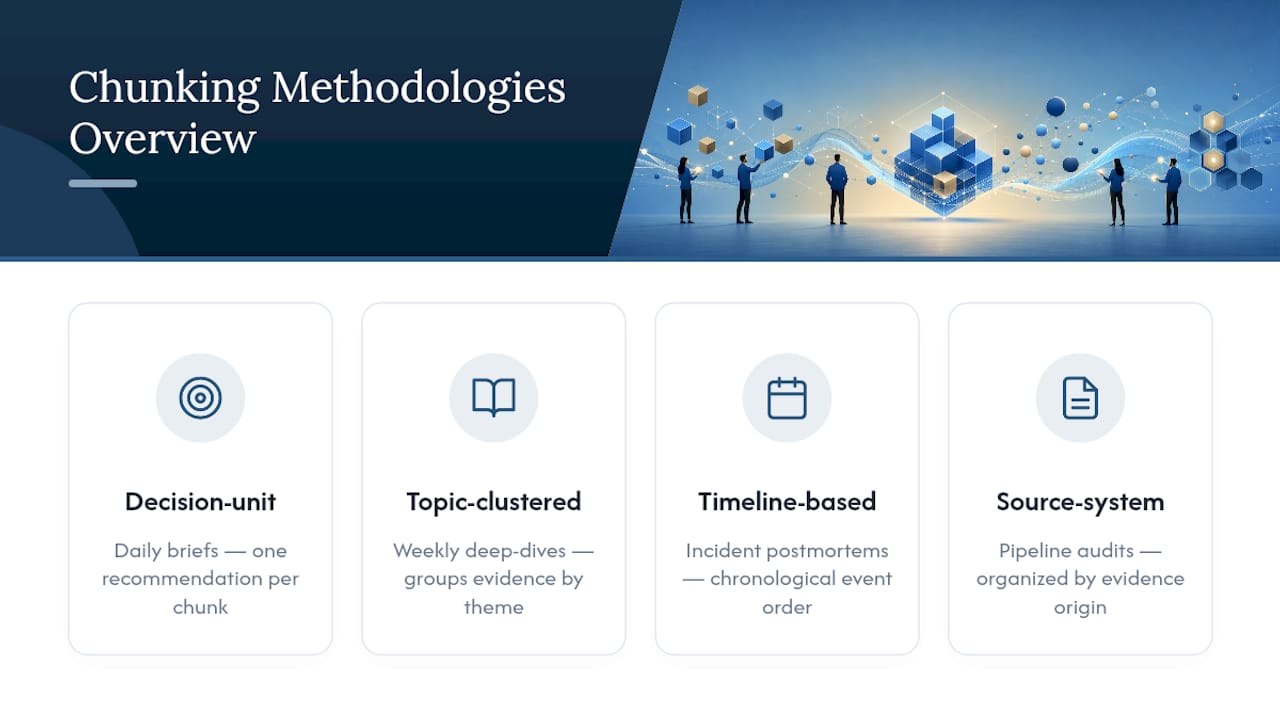
Different methods suit different governance needs. A decision-unit method, where each chunk maps to one recommendation or one material change, works best for daily operational briefs where the reader needs to act fast. It’s the format most of this guide has focused on because it maps directly to what a busy executive scans for.
A topic-clustered method groups related evidence under a shared theme, useful for weekly deep-dives where a reader wants context before a single decision. It sacrifices some scan speed for narrative coherence.
A timeline-based method orders chunks chronologically, which suits incident postmortems or anything where sequence matters more than category. If a system outage unfolded over six hours, a leader reviewing it afterward needs the order of events, not a thematic grouping.
A source-system method organizes chunks by where the evidence originated, meeting notes, code repositories, calendar events, which suits organizations still building trust in the pipeline itself and wanting to audit by source rather than by topic.
Most organizations end up blending two of these: decision-unit chunking for the daily brief, topic-clustered for the weekly review. The mistake is picking one method and forcing every use case through it. A two-pass extraction-then-synthesis pattern, where facts get pulled out first and only synthesized into a narrative afterward, tends to preserve auditability regardless of which method sits on top.
How Big Should a Chunk Be, and Where Should It Break?
Size discipline is where most briefs go wrong. Too broad, and one chunk buries three unrelated facts under a single headline, making it impossible for a reviewer to verify each claim independently. Too narrow, and the reader gets fragments without enough context to act.
The working rule: one chunk should carry exactly one decision-relevant claim, backed by two to four evidence points, and nothing else. If you find yourself writing a fifth evidence bullet, that’s usually a signal the chunk has actually become two chunks wearing one headline.
Boundaries should follow natural decision lines, not document structure. A 40-page quarterly report might yield exactly three chunks for the daily brief, because only three items in it cross the threshold for “leaders need to know this now.” The other 39 pages of context stays in the appendix or in the source document itself, linked but not restated.
Length limits matter at the brief level too. If a daily update runs past what a reader can scan in two or three minutes, the chunking process failed regardless of how accurate each individual item is. Set a hard cap, five to eight main items is a reasonable starting point, and force anything beyond that into the appendix rather than letting the main brief creep.
What Tools Actually Help With This Kind of Chunking?
You don’t need custom engineering to do this well, but you do need the right layer connecting your source systems to Claude. A permission-aware retrieval layer, the kind that checks access rights before content ever reaches a brief, is the foundational piece; without it, chunking discipline doesn’t matter because the wrong content can still leak to the wrong reader.
Custom skill files, guardrail documents that tell an AI system exactly which section headings to use and how to mark missing data, keep output consistent across contributors and time. A systematic extraction quality checklist built for research synthesis offers a useful model for the kind of verification discipline that translates well to executive briefing, even though it was built for a different field.
Beyond that, most of what you need is process rather than software: a shared folder convention, a named review owner, and a habit of checking source links before anything gets distributed. The tools that matter most are the ones enforcing permissions and preserving provenance automatically, not the ones generating prose faster.
What Goes Wrong Most Often, and How Do You Fix It?
The most common failure is scope creep inside a single chunk. Someone drafting a brief adds “while we’re at it” context that isn’t tied to a decision, and within a few cycles the brief bloats back into the document dump it was supposed to replace. The fix is mechanical: enforce the evidence-bullet cap at review time, not just at drafting time.
The second failure is provenance decay. A source link works on day one, then the underlying document gets moved, renamed, or archived, and six weeks later nobody can verify a claim that once had a perfectly good link. Snapshot or version references, captured at extraction time rather than at review time, prevent this from becoming a recurring cleanup job.
Third, and probably the costliest: chunks with no accountable owner. When something goes wrong in a brief, and eventually something will, “the system” isn’t an answer. A named owner per chunk means someone can explain the reasoning behind a claim months after the fact.
Fourth, over-automation without a review gate. Assembly and summarization are fine to automate. Sign-off on sensitive or decision-critical content isn’t, and skipping that step is how fabricated or stale claims slip into a brief a CEO is about to act on.
How Do You Connect Chunked Briefs to Existing Knowledge Systems?
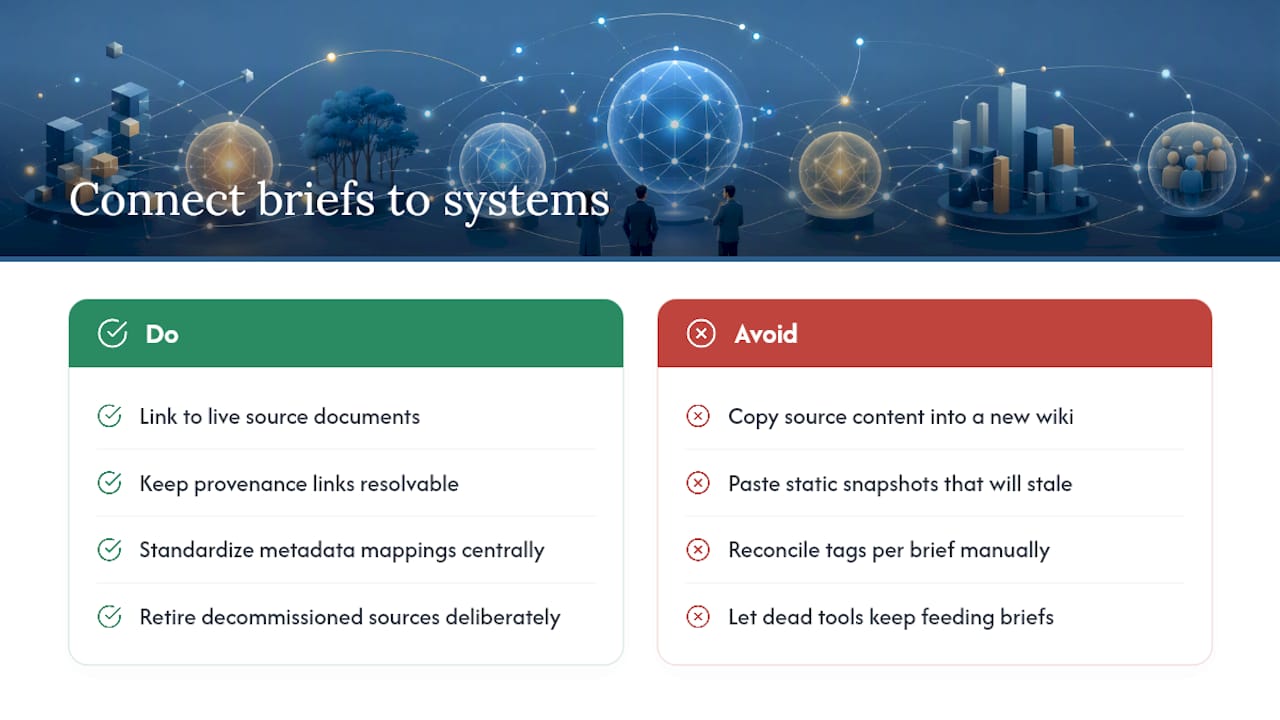
A chunking strategy fails if it becomes its own isolated silo. The goal is for briefs to reference your existing systems, meeting notes, code repositories, project trackers, rather than duplicating them into a new wiki nobody maintains.
Link, don’t copy. Every chunk should point back to the live source document rather than pasting a static snapshot that goes stale. When source content updates, the brief’s provenance link should still resolve to something current, or at minimum to the exact version referenced at extraction time.
Keep metadata schemas consistent across whatever systems feed the brief. If your calendar tool tags meetings differently than your code repository tags commits, standardize the mapping once at the integration layer rather than asking each brief to reconcile it manually. Guidance on enterprise access control design covers this kind of cross-system permission mapping in more depth.
Retire dead sources deliberately. When a tool gets decommissioned or a project closes, its chunks should stop feeding new briefs, and old briefs referencing it should stay archived with a note explaining why the source no longer updates. That discipline is what keeps a knowledge system trustworthy years into its life, not just in the first pilot month.
How Do Different Industries Apply This Chunking Approach?
A software company’s engineering leadership might chunk around deployment events: one headline per production change, evidence pulled from commit history and incident logs, owner set to whoever merged the code. The decision window is often measured in hours, not days.
A professional services firm might chunk around client account health: one item per account showing risk signals, evidence from meeting notes and billing data, owner set to the account lead. Cadence tends toward weekly rather than daily, since account risk rarely shifts hour to hour.
A healthcare operations team might chunk around compliance deadlines and staffing gaps, with stricter sensitivity tagging given the regulatory weight of the underlying data. Review gates there tend to require two named approvers rather than one, given the stakes of getting it wrong.
A manufacturing operation might chunk around supply chain disruptions: one item per delayed shipment or quality flag, evidence from vendor systems and inspection logs, owner set to the procurement lead. The common thread across all four: the format stays the same (headline, evidence, owner, next step), but the source systems, cadence, and sensitivity rules shift to match how fast that industry actually needs to move.
Treat Chunking as Governance, Not Formatting
The organizations that get this right treat chunking as an accountability structure, not a formatting exercise. A chunk without a named owner is a liability waiting to surface at the worst possible moment, usually in a meeting where someone asks “where did this number come from” and nobody has an answer.
The balance that’s easy to miss: more evidence per item isn’t automatically better. A brief stuffed with six-bullet chunks reads as thorough and gets ignored because nobody has time to parse it. Two to four tight evidence points, matched to what the decision actually requires, beats exhaustive documentation every time.
Measure against outcomes, not activity. If time-to-decision isn’t improving after a few pilot cycles, the charter needs revision before the rollout needs expansion.
— Paul
See How ClaudeDrive Puts This Playbook to Work
Everything in this guide, the briefing charter, the owner sign-off, the per-claim source links, the audit trail, describes what ClaudeDrive builds directly into Claude. Connect your meeting notes, GitHub, and calendar, and each person on your team gets a private daily update built only from what they’re authorized to see. Every line in the brief carries a source link back to the original document, access checks run before anything is retrieved, and nothing gets invented to fill a gap. There’s no new app to roll out and no dashboard to learn: your team opens Claude, asks for their update, and reads something built on the exact governance model this guide describes.
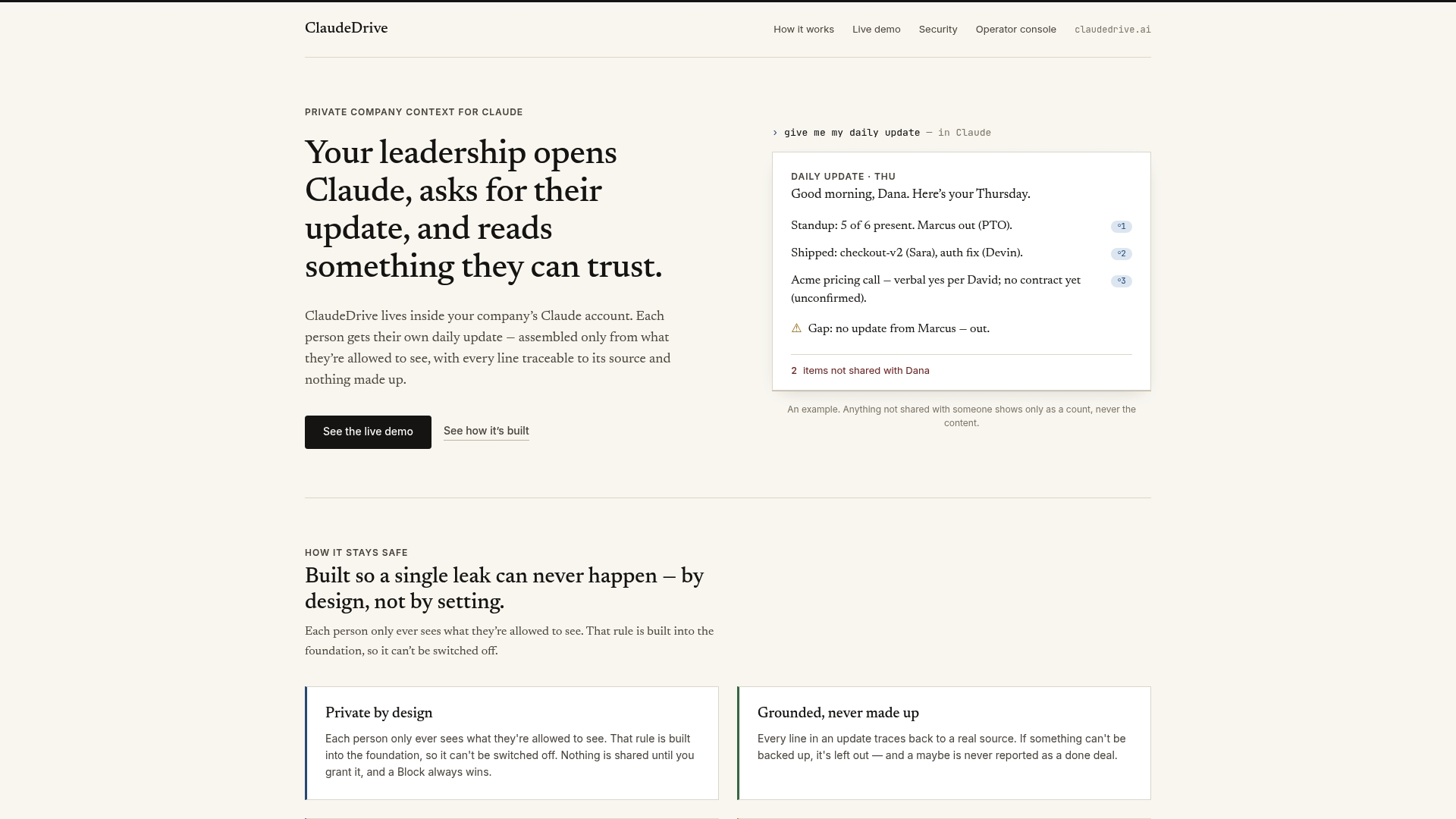
If your leadership team is still stitching together updates from five different tools, see the live demo or talk to us about a pilot scoped to one recurring decision forum, the same tight scope this guide recommends starting with.
Sources
- AI-Augmented Executive Workflow Design | AILD
- Leadership Meeting Brief Generation Rollout with Decision-Ready Automation | Chestnuts Intelligence
- AI Executive Briefing Workflow: From Signals to a Reviewed Brief | CellCog