Company Context Layer for Claude Leadership: A Practical Guide
Unlock the power of the company context layer for Claude leadership. Transform meeting notes into private, traceable briefings for effective decision-making.
ClaudeDrive
A Yungsten Tech product

Company Context Layer for Claude Leadership: A Practical Guide

A company context layer turns your meeting notes, calendars, decision records, and repo signals into a permissioned, traceable source Claude can use to produce a private daily briefing for each leader. You open Claude, ask for your update, and read something built only from what you’re allowed to see. Every line traces back to a real source. Nothing is made up.
The fastest way to validate this: run a 30-day pilot with ClaudeDrive, wire two or three tools, and measure how often your team acts on the briefing without double-checking it. That number is your trust score, and it’s the metric that matters.
The short version for scanning leaders:
- Claude’s default is a blank slate. It knows nothing about your company without a context layer.
- A context layer gives Claude institutional memory: active projects, adjudicated decisions, who owns what.
- ClaudeDrive delivers this as a private, source-linked daily briefing inside Claude. No new app, no new dashboard.
- Start with one bounded domain that has a clear decision owner and a measurable outcome. Expand from there.
Table of Contents
- What blank-slate Claude costs leaders, and what a context layer fixes
- How a context layer actually feeds Claude
- Why governance determines whether your context layer stays trustworthy
- Your 30-day pilot checklist
- Should you build your own context layer or use ClaudeDrive?
- What a leader’s daily briefing actually looks like inside Claude
- Security, compliance, and offboarding: what to require before you approve
- How to keep data synchronized across your enterprise tools
- Where context layers for AI leadership are heading
- Key Takeaways
- What running context-layer pilots has taught us about leadership readiness
- ClaudeDrive gives leaders a daily briefing they can trust inside Claude
- Useful sources
What blank-slate Claude costs leaders, and what a context layer fixes
Every time you open Claude without a context layer, it starts from zero. It doesn’t know your Q3 priorities, the decision your exec team made last Tuesday, or which engineer owns the deployment blocker. You either paste in context manually or get a generic answer. Neither is useful at 7 AM before a board call.
A company context layer solves this by giving Claude institutional awareness: organizational norms, active project statuses, and decision history. The result is a briefing that reads like something a well-briefed chief of staff wrote, not a hallucinated summary of documents Claude has never seen.
The direct benefits for leaders:
- Personalized daily briefings built only from sources the leader is permitted to see
- Source-linked lines so that every claim in the briefing traces to a real document, meeting note, or commit
- Permission-aware answers so nothing leaks across organizational lines
- Fewer status meetings because the briefing answers the questions those meetings were called to answer
- Faster decisions because the context is already adjudicated, not raw and contradictory
The leading success metric is trust: measured as the share of AI-generated answers a decision-maker acts on without human verification. Track this as your primary KPI from day one.
How a context layer actually feeds Claude
The flow is simpler than it sounds. Connect key sources, index and tag what each person is allowed to see, capture adjudicated conclusions in persistent state files, and Claude consumes that context to produce a briefing. No new interface for your team to learn.

What to connect first: meeting notes, your calendar, a repository like GitHub for engineering signals, and a small set of decision records or state files that capture what your team has actually concluded. Raw document retrieval alone isn’t enough. Plain similarity search retrieves fragments without relationships or timestamps, which means Claude can average contradictory sources and produce a confident-sounding wrong answer. Provenance, time, and adjudication status have to be part of what Claude receives.
Persistent, file-backed context that updates daily compounds in value. Ephemeral chat memory resets. A state file that records “the team decided X on March 4, owner: Sarah, status: in-flight” doesn’t reset. That’s the difference between a briefing you can act on and one you have to verify.
Pro Tip: Start with the smallest bounded domain that has a clear decision owner and a measurable outcome. The current quarter’s roadmap for one product squad is a better pilot scope than “all company knowledge.”
Why governance determines whether your context layer stays trustworthy
Installing a context layer is the easy part. Keeping it accurate as your organization grows is the governance problem, and most teams skip it.
A governed discovery process that maps decision authority and adjudication roles is the single biggest operational determinant of a context layer’s long-term reliability. That means assigning three roles explicitly: who may assert a fact into the context, who may suggest a change, and who adjudicates conflicts. Without that structure, the context drifts and the briefings become unreliable.
Five principles every leader should insist on:
| Principle | What it means in practice |
|---|---|
| Native to model | Context is structured for Claude to consume, not just dumped as raw files |
| Provenanced | Every line traces to a named source with a timestamp |
| Temporal | Decisions carry dates; outdated conclusions are flagged, not silently retained |
| Human-reviewable | Any leader can inspect the source behind any briefing line |
| Adjudicated | Conflicts between sources are resolved by a named person before Claude sees them |
Ongoing maintenance means a weekly or biweekly adjudication meeting, a documented review-and-approve process for new assertions, and a cadence for context health checks. Assign a named owner. Without one, the layer can become stale within a couple of months.
Track your trust metric from the start: set a baseline for the share of AI-generated answers acted on without human verification and a target for improvement over time. That number tells you whether the governance is working.
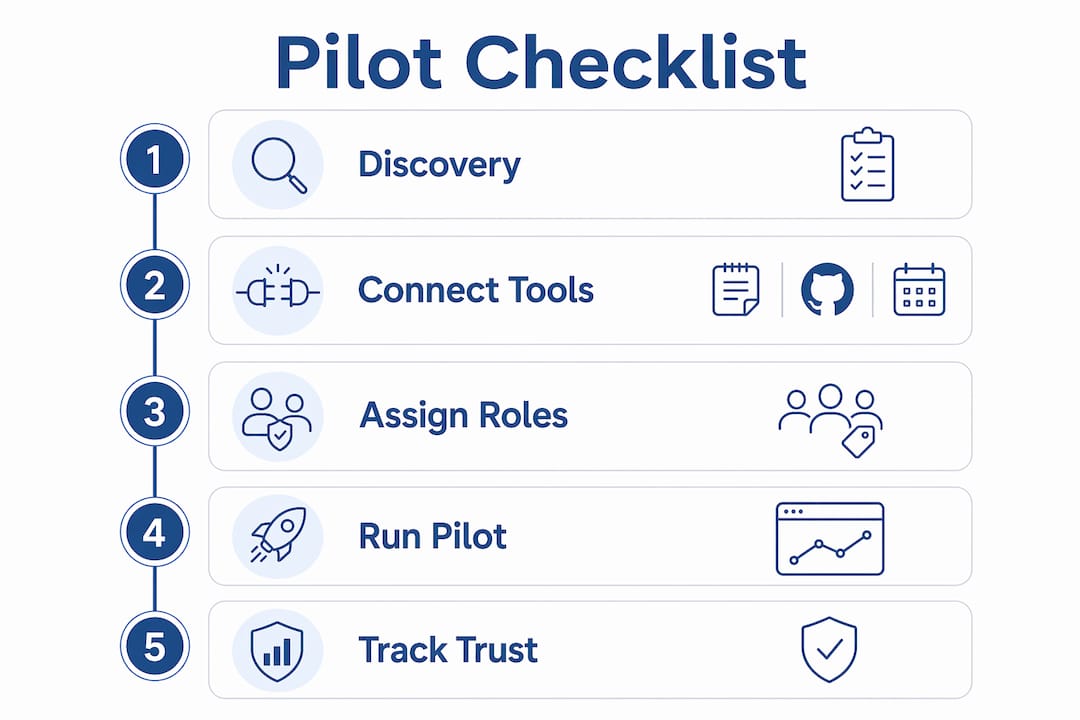
Your 30-day pilot checklist
Pick one bounded domain: a single product squad, one OKR, or a recurring executive decision. Don’t try to wire everything at once.
- Week 1: Discovery and role mapping. List the five to eight sources that drive decisions in your chosen domain. Assign assertion, suggestion, and adjudication roles. Document the decision owner.
- Week 2: Connect sources and create one state file. Wire meeting notes and calendar. Write one persistent state file that captures current decisions, owners, and statuses for the domain.
- Week 3: Capture provenance and run trial briefings. Confirm every briefing line carries a source and timestamp. Run briefings with two or three leaders and collect feedback on accuracy and trust.
- Week 4: Measure, adjudicate, and decide on rollout. Calculate your trust score. Hold one adjudication session to resolve any conflicts surfaced. Make a go/expand/stop decision based on the data.
| Success metric | Baseline | 30-day target |
|---|---|---|
| Trust score (share of answers acted on without human verification) | Measure in week 1 | Set a realistic improvement target |
| Briefing open rate | — | Target daily use by pilot leaders |
| Decisions accelerated vs. baseline | Qualitative | At least two documented examples |
Running multiple decision lenses in parallel inside the context layer, such as pre-mortem and cost-benefit analyses, surfaces disagreements leaders can act on. The disagreement itself becomes a signal, not a problem to hide.
Should you build your own context layer or use ClaudeDrive?
The honest answer depends on four things: how much internal engineering capacity you have, how quickly you need results, how mature your governance thinking is, and how sensitive the data is.
| Decision factor | Build internally | Use ClaudeDrive |
|---|---|---|
| Time to first briefing | Months | Days to weeks |
| Engineering required | Significant | Minimal |
| Governance patterns | You design from scratch | Proven patterns included |
| Traceability guarantees | You build and maintain | Built in |
| Cost shape | High upfront, ongoing maintenance | Subscription, predictable |
| Pilot path | Long | 30-day structured pilot |
Building makes sense when you have strong in-house platform engineering, a long runway, and specific integration requirements that no existing solution covers. For most 15–80 person teams using Claude Team or Enterprise, the faster path is adopting a solution with governance and traceability already built in. The buyer checklist ClaudeDrive publishes is worth reviewing before any procurement conversation.
What a leader’s daily briefing actually looks like inside Claude
A well-structured briefing has five sections: top-line decisions with source links, what changed since yesterday, upcoming risks and blockers, one recommended action, and linked evidence for each line.
Each leader’s briefing looks different because it’s built from what they’re permitted to see. The CPO’s briefing includes product squad signals. The CFO’s includes budget state files. Neither sees the other’s unless their permissions overlap. That’s not a technical detail; it’s the governance guarantee that makes the briefing trustworthy. For concrete daily briefing formats and sample templates, ClaudeDrive’s published examples show the range of what’s possible.
Security, compliance, and offboarding: what to require before you approve
Three guarantees are non-negotiable:
- Permission enforcement at retrieval time. Access is checked when Claude pulls context, not just when files are uploaded. A leader cannot receive information they’re not permitted to see, even if that information exists in the system.
- Full audit trails. Every briefing line is logged with its source, timestamp, and the retrieval event that produced it. You can reconstruct any briefing after the fact.
- Instant offboarding. When someone leaves, their access is revoked and their context is purged immediately. No residual access, no delayed cleanup.
Before approving any context layer, get written answers to: Where is data stored? Who holds adjudication authority? How are external collaborators and contractors handled? What is the documented offboarding runbook?
Per-person privacy and permissioning is the control that makes the briefing safe to deploy across a leadership team with different access levels.
How to keep data synchronized across your enterprise tools
The most common integration failure is treating synchronization as a one-time event. Data goes stale, briefings become unreliable, and trust scores drop.
Synchronization best practices for enterprise systems:
- Set a sync cadence per source type. Meeting notes sync after each meeting. Calendar syncs nightly. Repository signals sync on merge or close. State files sync after adjudication events, not on schedule.
- Use event-driven updates where possible. A merge to main in GitHub should trigger a context update immediately, not wait for a nightly batch.
- Log every sync event. If a sync fails, the briefing should flag the gap rather than silently use stale data.
- Treat schema changes as governance events. When a tool changes its data structure, a named person reviews the impact on context before the next briefing runs.
The goal is a context layer that a leader can trust even when they haven’t thought about the plumbing in weeks.
Where context layers for AI leadership are heading
The current state is connectors and daily briefings. The near-term direction is more interesting.
Proactive signals. Context layers will move from answering questions to flagging anomalies before a leader asks. A budget variance that crosses a threshold, a stalled dependency that’s been blocked for more than three days, a decision that was supposed to be made by Friday and wasn’t. The briefing surfaces it without being asked.
Multi-agent adjudication. As organizations run more AI agents in parallel, the context layer becomes the shared ground truth those agents write to and read from. Adjudication becomes a workflow, not a meeting.
Contextual intelligence as a leadership competency. Research on leadership effectiveness increasingly treats context-reading as a meta-competency: the ability to interpret organizational signals and align decisions with local reality. A well-governed context layer operationalizes that competency at scale, giving every leader in the organization the same quality of situational awareness that previously required a large staff.
The leaders who build the governance muscle now will have a compounding advantage as these capabilities mature.
Key Takeaways
A company context layer for Claude leadership delivers trusted, source-linked daily briefings by connecting your tools to a governed, permission-aware layer Claude reads directly inside your existing account.
| Point | Details |
|---|---|
| Trust is the primary KPI | Measure the share of briefing lines acted on without human verification; set a baseline in week 1 of your pilot. |
| Start with one bounded domain | One product squad or one recurring executive decision is the right pilot scope, not all company knowledge. |
| Govern early, not later | Assign assertion, suggestion, and adjudication roles before the first briefing runs, not after trust erodes. |
| Sync cadence determines reliability | Event-driven updates for repositories, post-meeting sync for notes; stale context kills trust scores. |
| ClaudeDrive as the pilot path | ClaudeDrive provides permission enforcement, full audit trails, instant offboarding, and a structured 30-day pilot inside Claude. |
What running context-layer pilots has taught us about leadership readiness
The pattern that shows up consistently: organizations that treat the context layer as a technical installation fail within 90 days. The ones that treat it as a governance capability, with named owners, adjudication meetings, and a defined trust metric, compound in value month over month.
The most common pitfall isn’t a bad connector or a missing integration. It’s skipping the adjudication step because it feels like overhead. When two sources contradict each other and no one resolves it, Claude averages them. The briefing sounds confident and is wrong. A leader acts on it once, loses trust, and stops opening the briefing. That’s the failure mode to design against.
Start with discovery. Map who owns each domain of knowledge before you wire a single tool. Keep state files persistent and updated after every adjudication event, not just when someone remembers. Expect the first two weeks to feel slow and the value to compound after week six.
ClaudeDrive gives leaders a daily briefing they can trust inside Claude
ClaudeDrive connects your meeting notes, GitHub, calendar, and files to produce a private, source-linked daily briefing inside the Claude account your team already uses. Every line traces to a real source. Nothing crosses a permission line. When someone leaves, their access is revoked instantly.
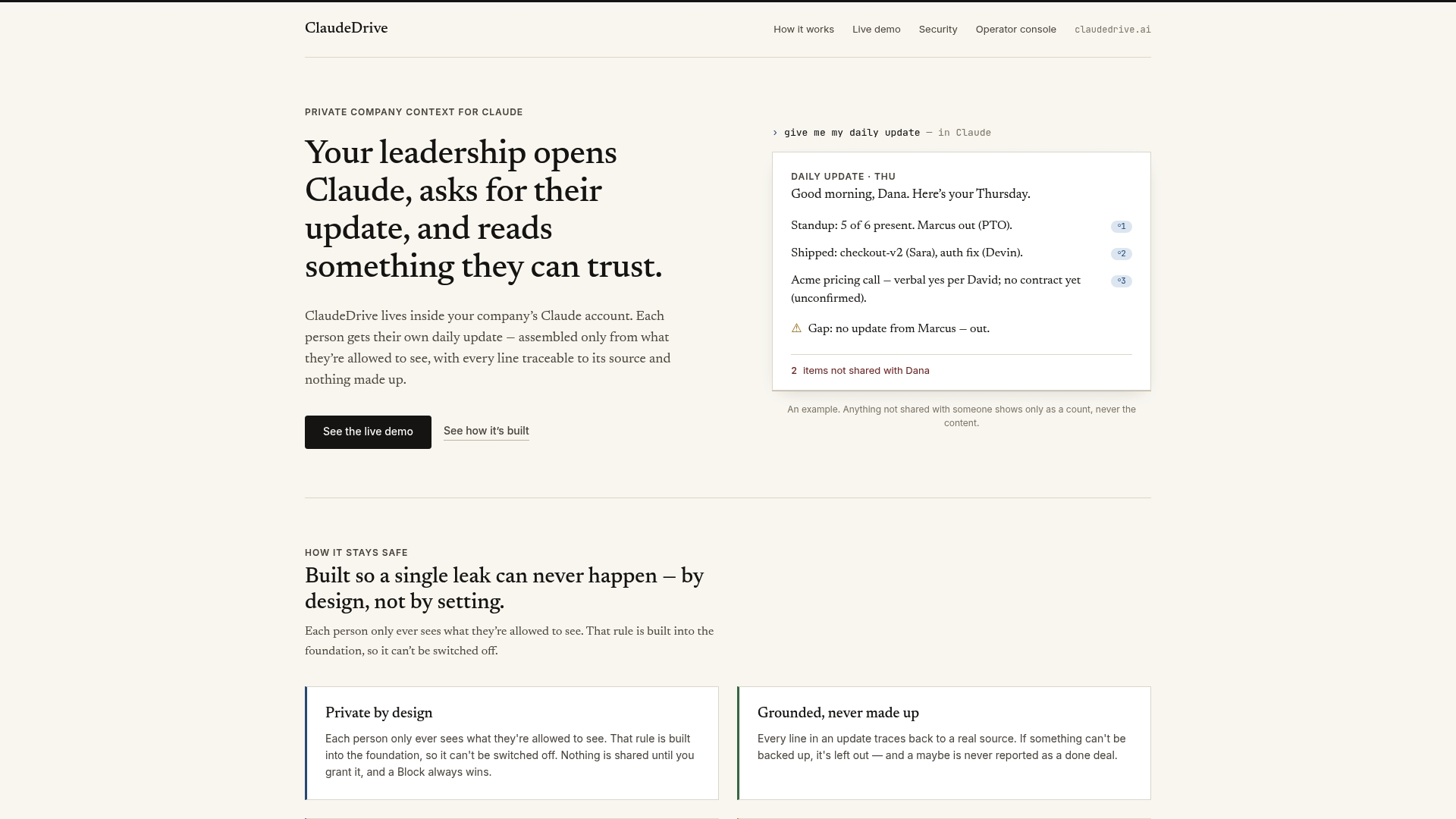
The pilot path is a structured engagement lasting about a month: wire two or three tools, assign adjudication roles, run briefings with a small leadership group, and measure your trust score at the end. No new app for your team to adopt, no dashboard to maintain, no wiki to keep current. Built by Yungsten Tech.
Talk to us about a pilot or see the live demo to review a sample briefing and the governance setup behind it.
Useful sources
The claims in this article draw on the following primary references:
| Source | What it contributes |
|---|---|
| Fifty One Degrees: What Is a Context Layer? | Governance principles: the five properties (native, provenanced, temporal, human-reviewable, adjudicated) and the discovery process |
| Monte Carlo: Trusted Analyst for Your Company | Trust metric definition, pilot patterns, and the governed organizational skill model |
| AdamSomers/lead-skill on GitHub | Management operating system pattern for persistent state files and daily context updates |
| Claude Decision Evaluation Framework Plugin | Multi-lens decision frameworks (pre-mortem, OODA, cost-benefit) for surfacing leadership disagreements |
| Contextual Intelligence as a Meta-Competency | Research grounding for context-reading as a leadership capability |
| ClaudeDrive: AI Briefing Executives Can Trust | Practical guide to context-aware executive briefings without new dashboards |
| ClaudeDrive: Governed Context Layer Guide | Best practices for evolving and governing context layers as organizations scale |
For a live walkthrough of a sample briefing and the governance setup behind it, talk to the ClaudeDrive team about a pilot.