How to Prevent AI Data Leaks Without Slowing Your Team Down
Learn three key steps to prevent AI data leaks effectively without hindering your team's productivity. Protect sensitive information now!
ClaudeDrive
A Yungsten Tech product

How to Prevent AI Data Leaks Without Slowing Your Team Down

The fastest way to prevent AI data leaks is a three-step opening move: find every AI tool your team already uses, turn on detect-only prompt inspection to see what’s actually leaving your organization, and require sanctioned tools with corporate single sign-on before anyone touches sensitive data again. These three steps close most of the prompt-based exposure inside a normal quarter, and they buy you the evidence to move from detect-only to blocking without guessing. ClaudeDrive fits into this picture as a permission-aware layer that keeps sourced, auditable updates flowing without opening a new leak path.
TL;DR:
- Discover and log all existing AI tools within your organization, using SaaS, endpoint, and developer insights to identify shadow AI activity.
- Prioritize turning detect-only prompt inspection on at least five sensitive data classes, tracking match volume, tool adoption, and flagged prompts over 90 days.
- Use prompt inspection tools (endpoint, browser, or proxy) in detect-only mode initially, then move to blocking once baseline thresholds are established to prevent false positives.
- Implement strict access controls and anonymization techniques on embeddings and model logs, with ongoing re-identification checks and controlled retrieval safeguards.
- Build a clear acceptable-use policy requiring SSO authentication, quick exception approval, and quarterly reviews, supported by role-based and least-privilege access to AI systems.
Table of Contents
- Prioritized Checklist: What to Fix in 30, 90, and 180 Days
- How Do You Find Shadow AI Before It Finds Your Data?
- Why AI DLP Matters More Than Your Existing Data Loss Tools
- Keeping Training Data and Embeddings From Leaking Back Out
- Building an Acceptable-Use Policy That Employees Actually Follow
- Who Should Actually Have Access to Your Models and Logs?
- What to Log, What to Watch, and What to Do When Something Leaks
- What Tools Actually Fit Together in an AI Data Protection Stack
- How ClaudeDrive Fits Into Your AI Data Protection Program
- The Trade-off Most Leaders Get Wrong
- See a Permission-Aware Way to Keep AI Updates Trustworthy
- Sources
Prioritized Checklist: What to Fix in 30, 90, and 180 Days
Most leaders don’t need a five-year AI security roadmap. They need to know what to fund first, what to measure, and what can wait. The sequence below converts policy intentions into working controls, in the order that actually reduces risk fastest.
- Days 1 to 30: Run a shadow AI discovery pass using existing proxy and SaaS logs, publish an interim acceptable-use notice, and stand up one sanctioned AI tool with corporate SSO so employees have a legitimate option instead of a workaround.
- Days 31 to 90: Turn on detect-only prompt inspection at the endpoint or gateway layer, tag your top five sensitive data classes, and start tracking three numbers: detect-only match volume, sanctioned-tool adoption rate, and the count of prompts flagged for PII or source code.
- Days 91 to 180: Move your highest-risk data classes from detect-only to block, anonymize any dataset headed toward embedding, and formalize an incident response runbook tied to your existing SIEM.
The quick wins live in step one. Discovery and a single sanctioned tool require almost no new engineering, yet they eliminate the single riskiest behavior: employees pasting confidential data into personal, unmanaged AI accounts because no approved alternative exists.
How Do You Find Shadow AI Before It Finds Your Data?
You can’t govern what you can’t see, and most companies underestimate how many AI tools their employees already use without IT’s knowledge. Visibility work starts with the logs you already have and expands from there.
DNS and proxy logs reveal every AI domain your network has touched, even from tools nobody officially approved. SaaS management platforms flag AI apps connected through OAuth, which is often the first sign an employee linked a personal AI account to a work Google Drive or Slack workspace. Endpoint agents catch what network logs miss entirely: clipboard pastes into browser-based chat windows that never touch a corporate proxy. A short, anonymous developer survey rounds out the picture, since engineers frequently adopt AI coding assistants weeks before security teams notice the API calls.
Once you know which tools are in use, map your sensitive data classes, customer PII, source code, financial forecasts, HR records, to the people who own them and the paths most likely to leak them: copy-pasted prompts, uploaded attachments, and embedded vector data. Cloudflare’s guidance on securing training data frames this correctly: visibility, classification, and pipeline controls have to move together, not in sequence.
- Pull DNS, proxy, and SaaS OAuth logs monthly to catch new AI domains and connected apps.
- Run a lightweight developer survey each quarter, since coding assistants change faster than any inventory tool tracks.
- Assign a named owner to each sensitive data class so leak paths have someone accountable, not just a policy document.
- Set a 90-day review cadence for the AI-app inventory; anything unreviewed past that window gets flagged for a compliance check.
Pro Tip: Check your calendar and video-conferencing app marketplace, not just your browser extensions. Meeting transcription bots are one of the most common shadow AI tools, and they routinely have access to entire meeting histories before anyone in security notices the integration.
Why AI DLP Matters More Than Your Existing Data Loss Tools
Traditional data loss prevention was built to catch files leaving through email attachments and USB drives. It was never built to catch a sentence typed into a chat box, which is exactly the gap AI-specific data loss prevention closes. AI DLP inspects prompts and uploads before they reach a model, and it works alongside legacy DLP rather than replacing it.
The scale of the gap is bigger than most security teams assume. A majority of employees paste data into generative AI tools, and much of that activity happens through unmanaged, personal accounts that no corporate policy governs and no corporate log captures. That statistic alone justifies prompt-level inspection as a distinct budget line, not a feature bundled into an existing DLP renewal.
Three architectural approaches handle prompt inspection, each with real trade-offs:
- Endpoint agents catch clipboard-paste and local file uploads before they hit any network boundary, which matters because browser-based chat traffic often bypasses network-level inspection entirely.
- Browser extensions offer faster rollout than endpoint agents but only cover browser-based AI use, missing desktop apps and API calls from custom scripts.
- Centralized proxy or gateway inspection gives the cleanest audit trail and per-channel policy control, at the cost of added latency and a harder initial deployment.
The rollout sequence matters as much as the tool choice. Start every new policy category in detect-only mode, let it run long enough to generate a real baseline of matches, then tune thresholds before flipping to block. Teams that skip detect-only and jump straight to blocking generate a wave of false positives that trains employees to route around the control entirely, usually straight back to the unmanaged personal accounts you were trying to eliminate.
Keeping Training Data and Embeddings From Leaking Back Out
Prompts aren’t the only leak path. Once sensitive data gets embedded into a vector store for retrieval-augmented generation, it can resurface through a nearest-neighbor search weeks or months later, long after anyone remembers what went in. Anonymizing data before embedding is the reliable defense against this kind of semantic leakage, and the technique you choose depends on what the downstream system actually needs to do with the data.
- Format-preserving masking keeps a value looking like a real Social Security number or account ID structurally, useful when downstream systems validate format but don’t need the real value.
- Pseudonymization swaps identifiers for consistent tokens, letting you track a customer’s activity across documents without ever storing their real name in the vector store.
- Generalization rounds specific values into ranges, useful for analytics use cases where exact figures aren’t necessary.
- Nulling removes a field outright when no downstream process needs it at all, the simplest and lowest-risk option when it applies.
- Synthetic data replaces real records entirely for model testing and development, so no real customer data ever touches a non-production environment.
Anonymizing before embedding is close to non-negotiable for high-risk data classes, because once personally identifiable information is embedded, it can potentially surface through nearest-neighbor retrieval in a way that’s much harder to trace back and delete than a row in a relational database.
Vector store protections don’t stop at anonymization. Access controls on the vector database itself matter as much as access controls on the source documents. Run periodic re-identification tests, querying the store with known PII strings to see if anything resurfaces, and set retention policies that actually delete stale embeddings rather than letting them accumulate indefinitely. For retrieval-augmented generation specifically, sanitize what gets retrieved before it reaches the model, preserve provenance so you know which document a fact came from, and filter model outputs for anything that looks like it leaked from a source the requesting user shouldn’t see.

Building an Acceptable-Use Policy That Employees Actually Follow
Technical controls only work if the policy behind them is clear enough that people don’t need to guess. An acceptable-use policy for AI tools needs a few concrete elements: which tools are sanctioned, what data classes are off-limits in any AI prompt, who approves exceptions, and how fast that approval turns around.
Microsoft’s staged model, discover AI apps, block unsanctioned ones, prevent sensitive data flowing to sanctioned apps, and govern what does flow, gives leaders a sequence to build policy around instead of writing rules in a vacuum. It also matches what actually works in practice: pairing a network-level block with an approved alternative keeps employees from migrating to unmanaged tools out of frustration.
- Require corporate single sign-on for every sanctioned AI tool, so access can be revoked instantly when someone leaves.
- Publish a short, named exceptions process, so a legitimate business need doesn’t turn into six months of shadow AI use while waiting for an answer.
- Set training cadence quarterly, not annually, since the tool landscape shifts faster than most compliance calendars.
- Use detect-only logs to target training content at real behavior instead of generic warnings nobody remembers.
For teams building out these policy documents, ClaudeDrive’s guide to acceptable-use policies and approved AI tools walks through the training and incident-response cadence in more depth.
Pro Tip: Skip the generic annual security training video. Pull your three most common detect-only matches from the last quarter and build a five-minute session around exactly those patterns. Specific beats comprehensive every time.
Who Should Actually Have Access to Your Models and Logs?
Every AI system introduces a new set of things that need access control: the training data, the model itself, the vector store, and the logs that record every prompt and response. Treating all four with the same least-privilege discipline you apply to production databases closes a gap most teams don’t think about until an audit forces the question.
- Enforce role-based access control as the default, and layer in attribute-based access control where a role alone doesn’t capture the right boundary, such as project-specific data segmentation.
- Grant just-in-time access to high-risk data classes rather than standing permissions, so a compromised account has a narrower window of exposure.
- Treat pseudonymization and token maps as sensitive artifacts in their own right. Per-call reversible token maps preserve conversational quality while keeping originals off third-party model providers, but the map itself has to be encrypted, rotated, and scoped per session, because a leaked map defeats the entire anonymization strategy.
- Store credentials in a centralized secrets vault with automatic rotation, and issue short-lived tokens for any service connecting to a model API.
- Restrict model log access to the smallest group that genuinely needs it for debugging or audit, since logs frequently contain the exact prompts your DLP program was trying to protect.
What to Log, What to Watch, and What to Do When Something Leaks
Detection only works if the logging underneath it is built for audit, not just debugging. Every AI call should generate a per-call verdict log, capturing what was flagged, what policy applied, and what action was taken, then feed into your existing SIEM rather than sitting in a separate silo. Retain those logs long enough to satisfy your regulator’s audit window, which for most compliance regimes means well beyond the 90 days many teams default to.

Three signal types deserve real-time attention: high-confidence PII matches in outbound prompts, anomalous retrieval patterns from vector stores (a sudden spike in queries touching one customer’s records, for instance), and prompt patterns that look like an attempt to extract training data through repeated, slightly varied questions. Nearest-neighbor searches on known PII strings double as both a proactive test and a detection method once a vector store is in production.
When something does leak, the response order matters:
- Contain the exposure immediately, which usually means revoking the specific account or API key involved, not shutting down the whole AI program.
- Investigate using the per-call logs to establish exactly what data left, through which tool, and whether it reached a third party.
- Remediate the underlying gap, whether that’s a missing anonymization step or a policy that never got moved from detect-only to block.
- Notify affected parties and, where required, regulators, on the timeline your data class and jurisdiction demand.
- Iterate on the policy or control that failed, and add the incident’s signature to your detect-only rules so the same pattern gets caught earlier next time.
What Tools Actually Fit Together in an AI Data Protection Stack
Procurement conversations get easier once you separate AI data protection tools into categories instead of shopping for a single silver-bullet product. Local PII detectors catch sensitive data on the device before it ever leaves, which suits device-bound or highly regulated data. Privacy proxies with reversible token maps sit centrally, scrubbing PII in transit and restoring it only for authorized local use. Endpoint DLP agents and per-call gateway inspection cover the prompt-level channel legacy tools miss, and vector-store access controls close the embedding gap.
Integration patterns generally split three ways: a central gateway for organization-wide policy enforcement, local-first scrubbing for data that legally can’t leave a device, and a hybrid model for flows where latency matters and a full round-trip to a central gateway isn’t practical. When comparing options, weigh per-channel policy flexibility, audit fidelity of the logs produced, added latency, and how much engineering effort the rollout actually takes.
- Local PII detectors: lowest latency, best fit for regulated, device-bound data.
- Privacy proxies with token maps: strong audit trail, moderate latency, good fit for chat-based workflows.
- Endpoint DLP agents: catch clipboard and local uploads that network tools miss entirely.
- Per-call gateways: highest audit fidelity, best for enterprise-wide policy consistency.
How ClaudeDrive Fits Into Your AI Data Protection Program
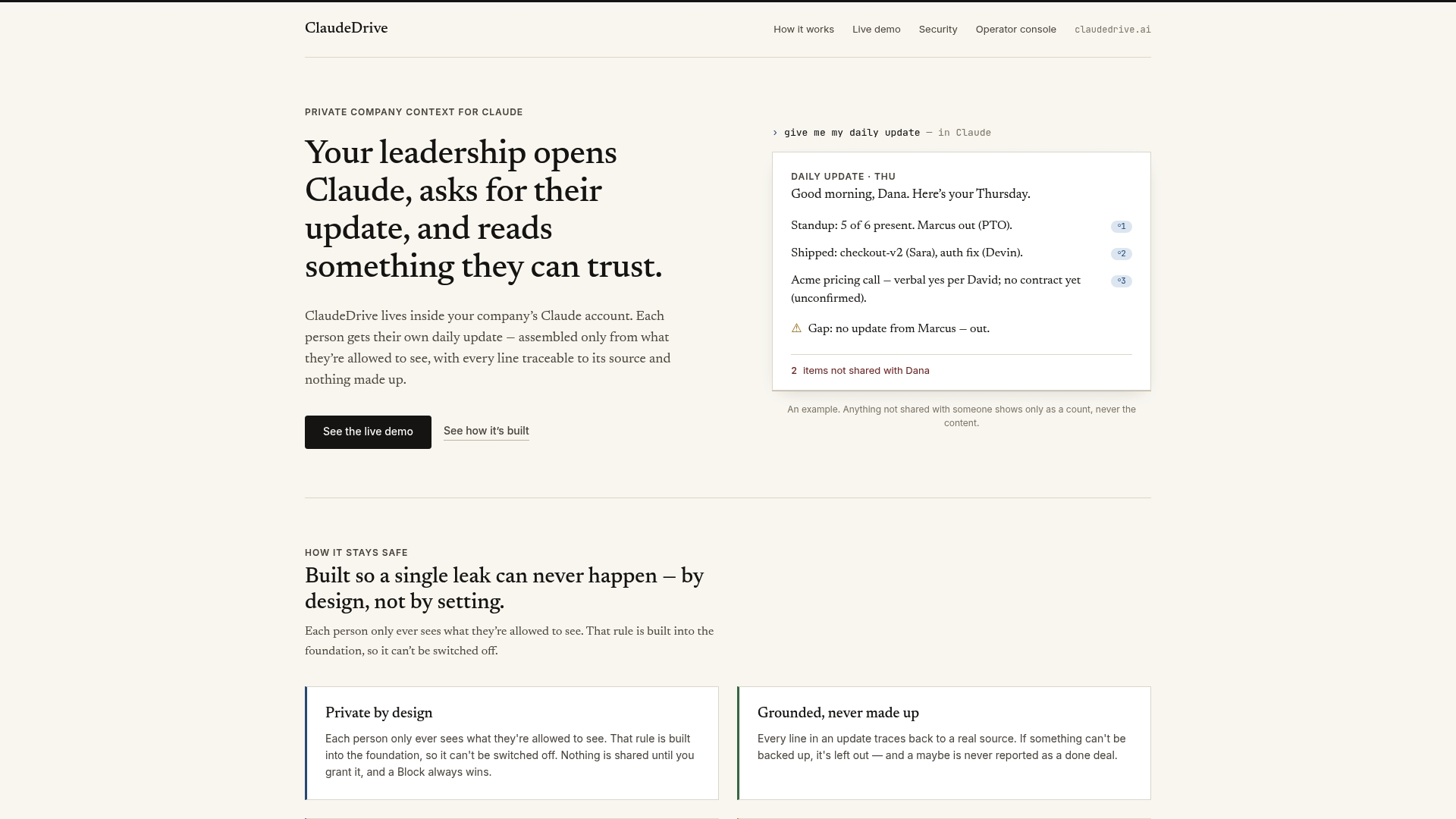
Every control above assumes leaders can trust what an AI tool tells them, and that trust breaks down fast if the tool surfaces information someone shouldn’t see. ClaudeDrive addresses that specific gap. It delivers daily updates inside the Claude account your team already uses, built only from documents and tools each person is allowed to see, with every line traceable to a real source and nothing invented.
That matters for your broader program because permission enforcement happens at the moment information is retrieved, not after the fact through a policy document. Connect meeting notes, GitHub, and a calendar, and each person gets a private update reflecting exactly what they’re cleared to know. It complements the discovery and prompt-level controls covered above by closing the retrieval side of the risk: document-level permissions enforced at the point of retrieval rather than left to trust alone.
The Trade-off Most Leaders Get Wrong
Most leaders fund the AI security control that feels most technical first, usually a prompt inspection gateway, and skip the unglamorous discovery step that actually reveals where the risk lives. That’s backward. You can’t tune a gateway’s policy correctly until you know what shadow tools are already carrying your data, and skipping discovery means the first 90 days of any new DLP tool get spent chasing ghosts. Fund discovery this week. Everything else gets easier once you know what you’re actually protecting against.
— Paul
See a Permission-Aware Way to Keep AI Updates Trustworthy
ClaudeDrive gives leadership teams a daily briefing inside Claude that respects the same access boundaries your organization already enforces elsewhere, so nothing a person shouldn’t see ends up in their update. Where prompt inspection and anonymization protect data going into AI tools, ClaudeDrive protects the other direction: what comes back out, and who’s allowed to read it. Every line in the update traces to a real source, connected in minutes from tools like meeting notes, GitHub, and a shared calendar, with no new dashboard for anyone to learn.
If your team runs on Claude and you’re responsible for making sure AI-generated updates never cross a line they shouldn’t, see the live demo at ClaudeDrive or talk to us about running a pilot with your leadership team.
Sources
- How to stop sensitive data leaking into ChatGPT, Copilot and other GenAI tools — Acronis blog
- Prevent data leak to shadow AI — Microsoft Learn
- How to anonymize PII in LLM pipelines — Red-Gate