Keep Investor and HR Info Private in AI: A Leader's Guide
Learn how to keep investor and HR info private in AI by enforcing vital data protections. Secure your sensitive data with these essential steps.
ClaudeDrive
A Yungsten Tech product

Keep Investor and HR Info Private in AI: A Leader’s Guide

To keep investor and HR info private in AI, require four non-negotiable guarantees from any tool you deploy: permissioned retrieval enforced at query time, a redaction-first pipeline that masks sensitive fields before the model ever sees them, tamper-evident audit logs that cannot be rewritten, and FIPS-validated encryption in transit and at rest. Every other control flows from these four.
TL;DR — demand these from any vendor or internal team:
- Stop all uploads of investor MNPI or HR medical records to public AI tools immediately.
- Require a signed no-training clause and a subprocessor list before any vendor touches sensitive data.
- Enforce tiered data classification: deal MNPI and medical records get the strictest controls; public documents get the lightest.
- Map every role to a specific access level and revoke access the moment someone leaves or changes roles.
- Produce an examiner-ready evidence bundle: FIPS certificates, immutable log exports, and delegation chain records.
US law sets the floor. HIPAA, ADA, and FMLA require strict confidentiality for employee health and leave records. SEC Regulation S-P and Rule 204-2 govern investor data and AI-generated advisory records. ClaudeDrive is built to map directly to these obligations for leaders who want a daily briefing they can trust.
Table of Contents
- How do you keep investor and HR info private in AI?
- What does a 90-day implementation roadmap look like?
- What operational risks break these controls in practice?
- How does ClaudeDrive implement these controls for leaders?
- Key Takeaways
- The case for governance over checkbox security
- Ready to see a permission-aware daily briefing in action?
- Authoritative sources leaders and compliance teams should reference
How do you keep investor and HR info private in AI?
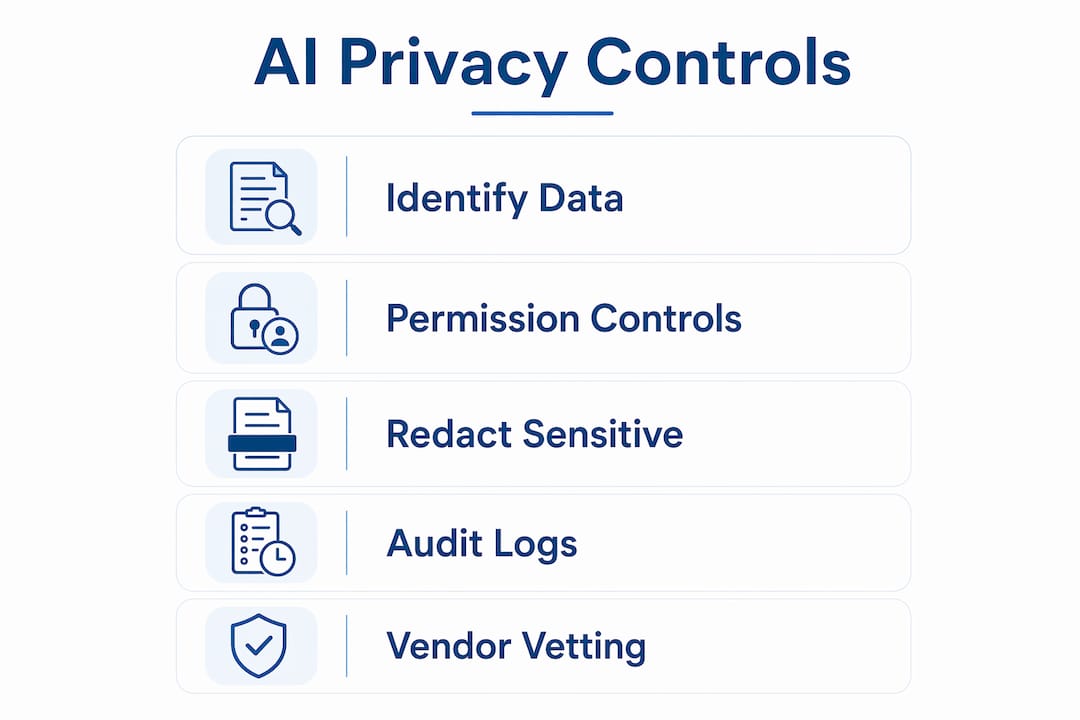
The answer is architecture, not policy. A written governance document without enforced technical controls is a compliance liability, not a safeguard. SEC examiners now expect tamper-evident logs and FIPS-validated encryption as proof that governance disclosures reflect reality.
Data classification: know what you’re protecting
Start with four sensitivity tiers:
- Tier 1 (highest risk): Deal MNPI, medical records, ADA accommodation files. Require zero-retention processing and private model instances. PE and asset managers treat this tier as requiring ephemeral environments where data is never written to disk.
- Tier 2: Board materials, financial projections, compensation data.
- Tier 3: LP and investor contact data, fund performance summaries.
- Tier 4: Internal policies, public filings, general announcements.
US legal obligations under HIPAA, ADA, and FMLA require that Tier 1 HR records stay separate from regular personnel files and reach only those with a documented need to know.
Permissioned retrieval and redaction

Permissions must be enforced at the moment of retrieval, not set once at upload and forgotten. An employee who moves from HR to finance should lose HR access the same day. A redaction-first pipeline goes further: it tokenizes sensitive fields before the model processes them, replacing SSNs, salaries, and investor names with placeholders like “Investor_A_01.” The model gets what it needs; the raw identifier never leaves the secure layer.
Audit trails and cryptography
Every AI access event must produce a non-rewritable log entry showing who authorized it, which records were read, and when. Rule 17a-4 requires broker-dealers to store electronic records in a non-erasable format. Standard writable databases do not satisfy that requirement. FIPS 140-3 validated encryption covers data in transit and at rest; ask vendors for the validation certificate, not just the claim.
Vendor diligence checklist
Before signing any contract, require:
- Signed no-training clause (your data never trains the model)
- Named subprocessor list with data residency details
- SOC 2 Type II report or ISO 27001 certificate
- DPIA template for high-risk processing
- Documented incident response SLA (notification window, scope, remediation)
Pro Tip: Ask the vendor for a sample immutable log export and a screenshot of their deletion-proof architecture before the contract stage. A vendor who cannot produce these in a sales conversation will not produce them during an SEC examination.
What does a 90-day implementation roadmap look like?
Days 1–7: decisions and stop-gaps
- Appoint an executive sponsor (COO or CTO) and legal sign-off authority.
- Ban all Tier 1 and Tier 2 data from public AI tools immediately. This is the single highest-impact action.
- Define scope: which investor workflows and HR processes will use AI first?
- Select vendor criteria from the checklist above.
Weeks 2–4: classify and redact
- Inventory every system holding investor or HR records.
- Apply the four-tier classification to all documents.
- Enforce the redaction-first pipeline for Tier 1 and Tier 2 data before any model access.
- Collect vendor attestations and no-training clauses.
Document-level permissions must be set at this stage, not retrofitted later.
Weeks 5–8: identity and access
- Integrate permissioned retrieval with your identity provider using SSO and phishing-resistant MFA.
- Map every role to a specific access tier. Run an initial access-review sprint to catch any existing over-provisioning.
- Shift from user-granted permissions to role-based access controls with automated expiry for temporary grants. Quarterly reviews catch drift that accumulates between sprints.
Weeks 9–12: logging, incident response, and communications
- Enable tamper-evident logging with retention periods that meet Rule 204-2’s five-year requirement for AI-generated advisory records.
- Run a tabletop incident response exercise specifically for an AI data access scenario.
- Update employee privacy notices and HR handbooks to reflect how AI processes their data. SHRM guidance treats this as a regulatory expectation, not optional.
- Assemble the examiner-ready evidence bundle: FIPS certificates, delegation chain records, ABAC policy logs, immutable audit trail exports.
Rough cost drivers leaders should budget for: private model instances for Tier 1 data, FIPS module licensing, extended log retention storage, and legal review of vendor contracts. These are order-of-magnitude decisions, not line items, but skipping any one of them creates a gap an examiner will find.
What operational risks break these controls in practice?
Controls fail in predictable ways. Knowing the failure modes is more useful than knowing the controls.
Internal misuse. Privileged users can exfiltrate data by crafting AI prompts that return unscoped exports. Watch for log entries showing unusually broad queries, bulk record retrievals, or access outside normal working hours.
Permission creep. A time-limited grant for a project becomes permanent when no one revokes it. Quarterly access reviews and automated expiry for temporary grants are the only reliable fix. Role-based controls reduce drift more than named-user grants because a role change triggers an automatic permission update.
Vendor AI washing. A vendor who claims “governed AI access” while operating through a shared service account has no attribution chain. SEC enforcement specifically targets governance disclosures that outpace actual technical controls. Ask for the ABAC policy log, not the marketing deck.
Integration gaps. AI outputs that bypass your archive system create a Rule 204-2 gap for every record produced. Service accounts that generate AI outputs without a named human authorizer produce records with no attribution chain. Both are exam findings waiting to happen.
Red flags in procurement and post-deployment:
- No immutable log export available on request
- No-training clause absent or qualified with carve-outs
- Instant revocation not technically enforced (only policy-stated)
- No FIPS validation certificate, only a general “encryption” claim
- Vendor cannot name subprocessors or data residency locations
Pro Tip: For Tier 1 data, prioritize controls that eliminate the risk category entirely. Ephemeral processing, where data is never written to disk, means there is no historical record to steal even if the system is breached. That is a stronger guarantee than any deletion policy.
How does ClaudeDrive implement these controls for leaders?
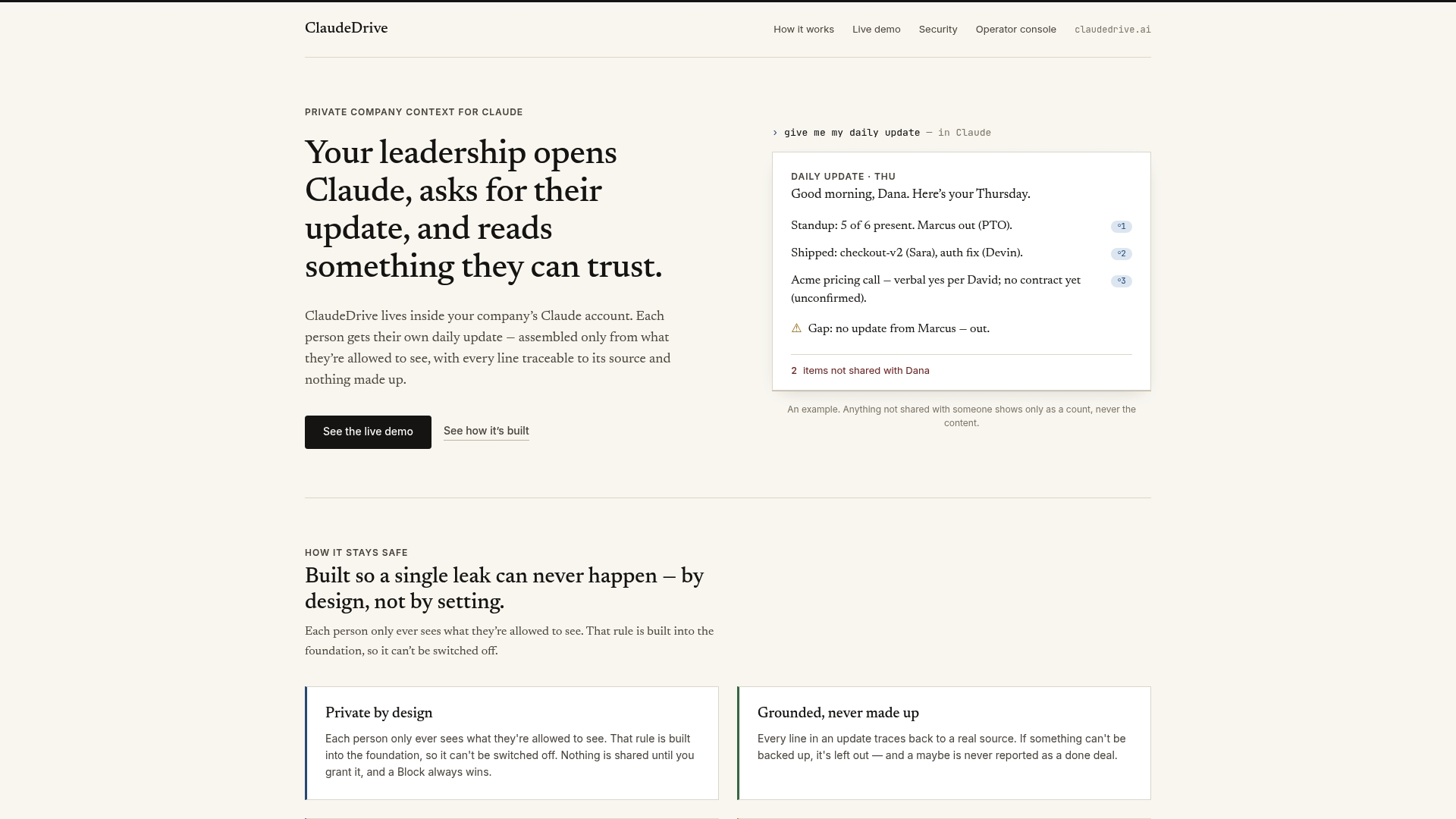
ClaudeDrive maps directly to the controls above. Leaders open Claude, ask for their update, and read a briefing built only from what they are authorized to see. Every line traces back to a real source document. Nothing is inferred from data outside the permitted scope.
Feature-to-control mapping:
- Permissioned retrieval at query time: access is evaluated at the moment of each request, not set once at upload. A leader who loses access to a document stops seeing it in their briefing immediately.
- Document-level permissions: each file carries its own access rules. Connecting meeting notes, GitHub, or calendar data does not expose those sources to users who lack permission.
- Instant offboarding: remove a user and their access ends. No manual cleanup of shared links or folder permissions.
- Tamper-evident audit trails: every retrieval is logged with the source, the authorized user, and the timestamp. Leaders can audit AI updates and produce that log on demand.
- Source-linked outputs: every briefing line cites the document it came from. No hallucinated claims, no unattributed summaries.
- Identity integration: ClaudeDrive works with existing SSO and MFA, so access controls inherit your identity governance without a new system to manage.
Proof requests to make of any vendor, including ClaudeDrive: ask for a sample audit trail export, the FIPS validation statement, a contract clause example showing the no-training commitment, and a plain-language description of how ephemeral processing works for Tier 1 data.
See the live demo or talk to us about a pilot.
Key Takeaways
Keeping investor and HR data private in AI requires enforced architecture: permissioned retrieval, redaction-first pipelines, tamper-evident logs, and FIPS-validated encryption — governance documents alone do not satisfy regulators or protect the business.
| Point | Details |
|---|---|
| Stop public AI uploads now | Ban Tier 1 and Tier 2 data from any public AI tool before any other step. |
| Require a no-training clause | Every vendor contract must prohibit training on your investor or HR data. |
| Enforce role-based access | Quarterly access reviews and automated expiry prevent permission creep. |
| Build the evidence bundle | Produce FIPS certificates, delegation chain records, and immutable log exports before an examiner asks. |
| ClaudeDrive for daily briefings | ClaudeDrive delivers permission-aware, source-linked updates inside Claude with instant offboarding and full audit trails. |
The case for governance over checkbox security
The conventional wisdom treats AI privacy as a procurement checklist: get the SOC 2 report, sign the DPA, move on. That framing misses the actual risk. The gap that creates regulatory exposure is not a missing certificate. It is the distance between what a governance document says and what the architecture actually enforces.
Regulators are now reading that gap as an enforcement signal. A firm that discloses “governed AI access” while running queries through a shared service account has produced a misleading disclosure, not just a technical shortcoming. The evidence package matters because it is the only way to close that gap on demand.
For leaders, the practical implication is this: daily AI briefings are worth the investment precisely because they accelerate decisions. But that speed only holds if the briefing is trustworthy. A briefing that might contain data the reader was not supposed to see is not a briefing; it is a liability. Permission-aware updates, with every line sourced and every access logged, are what make the speed defensible.
Ready to see a permission-aware daily briefing in action?
ClaudeDrive gives leaders a daily update they can trust, built only from what each person is authorized to see, delivered inside the Claude account they already use. No new dashboard, no new app, no wiki to maintain.
Before a pilot conversation, bring these four things: the data tiers you want to cover (investor, HR, or both), a sample of the evidence you will need (audit trail format, encryption proof), two or three test cases that represent real leader workflows, and your success metrics (briefing accuracy, access-review time, examiner readiness). That scoping conversation takes thirty minutes and produces a clear pilot plan.
Talk to us about a pilot or see the live demo to watch a permission-aware briefing built from real connected tools.
Authoritative sources leaders and compliance teams should reference
Primary US legal and regulatory touchpoints:
- SHRM: Confidentiality in HR — baseline HR confidentiality obligations and FMLA/ADA exceptions
- SEC Rule 204-2, Regulation S-P, and Rule 17a-4 — recordkeeping, client data safeguarding, and tamper-evidence requirements for investment advisers and broker-dealers
- HIPAA, ADA, FMLA — federal floor for employee health and leave record confidentiality
- NIST AI Risk Management Framework (AI RMF) — governance and risk categorization for AI systems
Vendor diligence and implementation guidance:
- DPIA templates for high-risk AI processing (available from your legal counsel or the IAPP)
- SOC 2 Type II and ISO 27001 audit reports from any AI vendor touching sensitive data
- FIPS 140-3 validation certificates from the vendor’s cryptographic module provider
- Examiner-ready audit trail guidance for AI workflows
Data tier to law mapping:
| Data tier | Example records | Governing law or rule |
|---|---|---|
| Tier 1: HR medical / leave | ADA accommodations, FMLA certifications, medical exams | HIPAA, ADA, FMLA |
| Tier 1: Deal MNPI | Unpublished deal terms, material non-public financials | SEC Reg S-P, Rule 204-2 |
| Tier 2: Board / compensation | Board minutes, salary bands, equity grants | State fiduciary law, SEC |
| Tier 3: LP / investor data | Fund performance, LP contact records | SEC Reg S-P, Rule 17a-4 |
| Tier 4: Public / internal | Published filings, general policies | General data governance |
This article is general information, not legal or compliance advice. Confirm current rules with your legal counsel or the relevant regulatory authority for your specific situation.