Product Roadmap Updates AI Digest: 2026 Guide
Discover the benefits of the product roadmap updates AI digest in our 2026 guide. Transform your product management with real-time insights!
ClaudeDrive
A Yungsten Tech product

Product Roadmap Updates AI Digest: 2026 Guide

A product roadmap updates AI digest is a structured, automated briefing that synthesizes roadmap signals, user research, and engineering telemetry into a single, confidence-ranked summary for product leadership. Traditional roadmap reviews consumed weeks of analyst time and still delivered stale conclusions. AI digest reports compress that cycle to hours, with every claim traceable to a source. Tools like Perspective AI, Salesforce Agentforce, and the training-loop method developed by Lazarev.agency now give product managers a validated, real-time view of where their roadmap stands and what needs to change.
What does an AI product roadmap updates digest require?
The output is only as good as the infrastructure behind it. Before any AI digest can produce reliable roadmap AI insights, three foundational layers must be in place.
The 12-week training loop
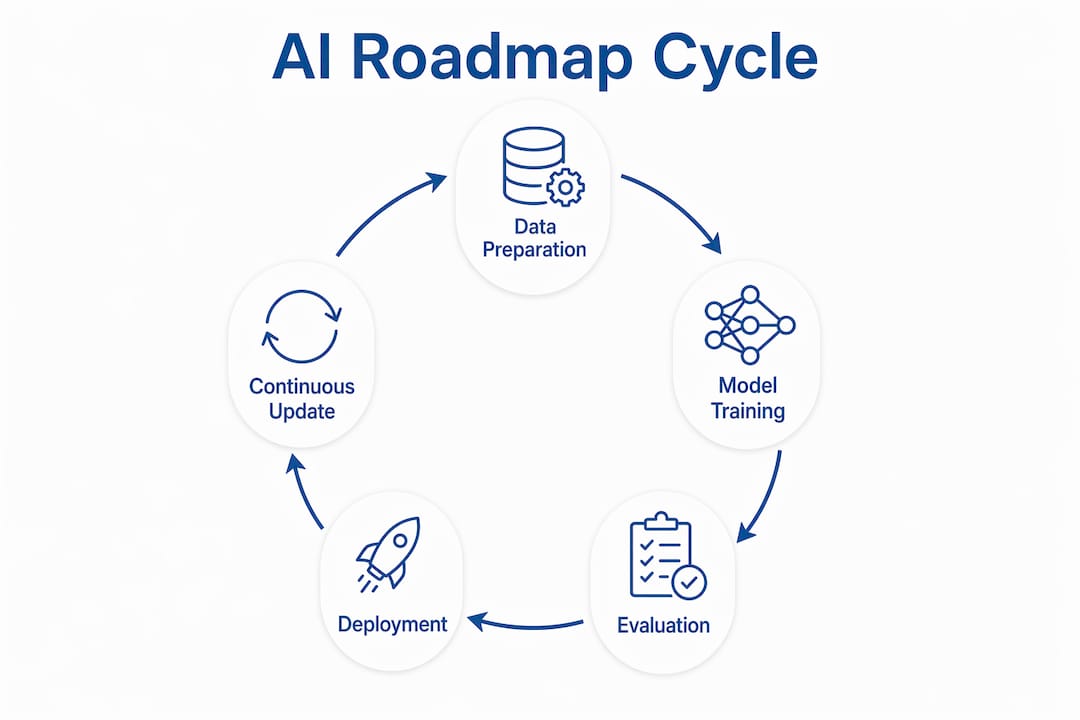
The first AI roadmap iteration should follow a 12-week training loop that sequences model milestones, data pipeline readiness, and evaluation cadence monitored against production telemetry. That 90-day structure is not arbitrary. It gives teams enough cycles to catch regressions, calibrate confidence thresholds, and confirm that the model behaves consistently in production before any autonomous capability goes live.

Context milestones and reliability gates
Prioritizing context acquisition before building new AI features is the single most overlooked prerequisite in roadmap planning. A reliability gate is a defined threshold, such as a completion rate or user override frequency, that an AI feature must pass before it advances from supervised to autonomous operation. Skipping this step is the primary reason AI features erode user trust after launch.
The dual-track roadmap
A dual-track roadmap separates deterministic product and UX work from probabilistic AI capabilities, each with its own timeline logic. The product track uses fixed deadlines. The model track uses confidence ranges instead of calendar dates. This separation prevents the most common planning failure: holding an AI feature to a ship date when the underlying model has not yet passed its eval thresholds.
- Data pipeline readiness: Confirm that training data is clean, labeled, and versioned before scheduling model milestones.
- Eval infrastructure: Treat evaluation metrics as primary success indicators, not post-launch audits. See AI context versioning practices for a practical framework.
- Cross-functional sync: Successful AI roadmap updates require cross-functional collaboration among AI research, UX design, data engineering, and product management.
- Reliability gates: Define pass/fail thresholds explicitly before any autonomous feature enters the roadmap.
Pro Tip: Treat your eval infrastructure as a product lane, not a backend chore. Teams that version their evaluation metrics alongside feature milestones catch regressions two to three sprints earlier than teams that audit after launch.
How do you integrate AI digest tools into your roadmap cycle?
The integration follows a four-step sequence. Each step produces an artifact that feeds the next.
-
Run AI-moderated customer research. Perspective AI enables product managers to validate roadmap themes against 75–150 customer conversations in 48–96 hours. That replaces a traditional recruitment and synthesis process that consumed 80% of project time. The output is a ranked list of validated themes with direct customer language attached.
-
Synthesize telemetry and feedback into a digest. Feed production telemetry, support tickets, and research outputs into your AI digest layer. The digest ranks each roadmap item by confidence level, flags items where user evidence contradicts internal assumptions, and surfaces the “why now” context that traditional status reports miss. Research cycles now run in hours instead of weeks, and the depth of insight increases because the AI captures constraint patterns across hundreds of conversations simultaneously.
-
Apply multi-agent orchestration for pipeline updates. Salesforce’s Summer '26 release introduces Agentforce multi-agent orchestration starting june 15, 2026, enabling proactive agents to manage pipeline and sales data autonomously. The implication for product leaders is direct: the same orchestration model applies to roadmap data. One agent monitors GitHub commits, another tracks customer feedback volume, and a third updates the roadmap digest without manual intervention.
-
Deliver role-filtered briefings to leadership. The final digest reaches each leader filtered by what they are authorized to see. No raw data dumps. No cross-team information leakage. Just the update relevant to their scope.
Comparison: Traditional vs. AI-Driven Roadmap Update Cycles
| Factor | Traditional Cycle | AI-Driven Cycle |
|---|---|---|
| Research validation time | 4–8 weeks | 48–96 hours |
| Customer conversations per cycle | 10–20 | 75–150 |
| Update frequency | Quarterly | Weekly or continuous |
| Confidence scoring | Manual, subjective | Automated, threshold-based |
| Leadership briefing format | Slide deck | Role-filtered AI digest |
Pro Tip: Do not wait for a full quarterly cycle to run your digest. Set a weekly cadence for the AI synthesis layer and reserve human review for items where confidence scores fall below your defined threshold.
What are the biggest pitfalls in AI roadmap update adoption?
Most failures trace back to three decisions made before the first feature ships.
Treating AI features like deterministic software
Traditional date-driven roadmaps are ineffective with AI development cycles because timelines are probabilistic. A model that passes eval in week eight may regress in week ten after a data pipeline change. Committing to a public ship date before reliability gates are passed creates pressure to launch features that have not earned user trust.
Skipping the eval-as-product mindset
Experienced product managers treat evaluation metrics, such as completion rates and user override frequency, as primary success indicators rather than shipping dates alone. Teams that skip this step discover regressions in production rather than in testing. By then, the cost is user trust, not just engineering time.
Deploying autonomous features without human-in-the-loop surfaces
Salesforce’s guidance on Agentforce is explicit: enterprise leaders must design human-in-the-loop surfaces to maintain trust alongside AI agents rather than deploying opaque autonomous tools. This applies directly to AI digest systems. Every automated update should include a traceable source link so any leader can verify the claim in thirty seconds.
“Every autonomous AI feature should pass reliability gates before launch, defined explicitly in the context of end-user workflows.” — Dench Blog on AI Roadmap Principles
- Update cadence: AI capabilities evolve unpredictably, so roadmap reviews should happen more frequently than traditional quarterly cycles.
- Confidence ranges: Replace fixed dates on the model track with outcome confidence ranges. “70% confidence by Q3” is more honest and more useful than “ships in August.”
- Regression monitoring: Build a regression alert into your digest layer. If a metric drops below threshold, the digest flags it before the next leadership briefing.
- Transparency by default: Every AI-generated summary should name its source. Leaders who cannot trace a claim will stop trusting the digest within two cycles.
How does an AI digest change leadership communication?
The shift is from status reporting to outcome validation. Traditional status reports answer “what shipped.” AI digest reports answer “what is working, what is not, and what the data says to do next.”
AI-generated, permission-aware update digests are preferred by modern leadership over traditional status reports because they reduce noise and deliver insights filtered by role. A CPO sees roadmap confidence scores and user validation data. A CFO sees cost-per-feature and pipeline impact. Neither sees information outside their scope.
The practical benefits for executive teams are concrete:
- Reduced noise: Leaders receive one briefing per day instead of monitoring five tools.
- Faster pivots: When a digest flags a confidence drop, the leadership team can redirect resources in the same week rather than waiting for the next quarterly review.
- Improved trust: Every line in the digest links to a source. Leaders stop second-guessing the data because they can verify it instantly.
- Role-specific depth: Each leader’s digest reflects their permissions and priorities, not a generic company-wide summary.
AI digest updates shift product leadership focus from feature delivery timelines to outcome validation and user acceptance metrics. That shift is not cosmetic. It changes what gets prioritized, what gets cut, and how quickly the team responds to market signals. For a practical look at how daily update formats work in practice, the AI daily update format examples from ClaudeDrive show how briefings can be structured for different leadership roles without adding a new tool to the stack.
Key takeaways
Effective AI digest integration requires infrastructure first, automation second, and role-filtered delivery last.
| Point | Details |
|---|---|
| Build infrastructure before features | Complete the 12-week training loop and set reliability gates before scheduling autonomous capabilities. |
| Use confidence ranges, not dates | Replace fixed ship dates on the model track with outcome confidence ranges to reflect probabilistic timelines. |
| Validate fast with AI research | Perspective AI compresses customer validation from weeks to 48–96 hours across 75–150 conversations. |
| Keep humans in the loop | Every automated digest entry must link to a traceable source so leaders can verify claims directly. |
| Update roadmaps more frequently | AI capability shifts require weekly or continuous digest cycles, not traditional quarterly reviews. |
Why most teams are still one step behind on this
The honest observation after watching product teams adopt AI digest workflows is that the tooling is not the bottleneck. The bottleneck is organizational habit. Teams that have run quarterly roadmap reviews for five years do not naturally shift to weekly digest cycles, even when the infrastructure supports it.
The teams that move fastest share one trait: they treat evaluation as a continuous product activity, not a post-launch audit. They assign ownership to eval metrics the same way they assign ownership to features. Someone is accountable for the completion rate. Someone is accountable for the user override frequency. When those numbers move, the digest surfaces it, and a named person responds.
The second pattern I see in high-performing teams is that they blend human judgment with AI synthesis rather than replacing one with the other. The AI digest handles volume and pattern recognition. The product leader handles interpretation and context. Neither works well without the other. Teams that automate too aggressively lose the interpretive layer. Teams that automate too little drown in raw data.
My recommendation is to pilot an AI digest on a single roadmap track for one quarter before rolling it out company-wide. Pick the track where you have the cleanest data and the clearest eval metrics. Use that quarter to calibrate your confidence thresholds, test your permission filters, and build leadership trust in the format. The workflow for product innovation frameworks available in 2026 make this kind of phased rollout straightforward. The cultural shift takes longer than the technical setup. Plan for that honestly.
— Paul
How ClaudeDrive delivers daily roadmap digests leaders trust
ClaudeDrive is built for exactly this use case. Leaders open Claude, ask for their update, and read one clear briefing built only from sources they are authorized to see. Every line is traceable. Nothing is fabricated. Nothing crosses a permission boundary.
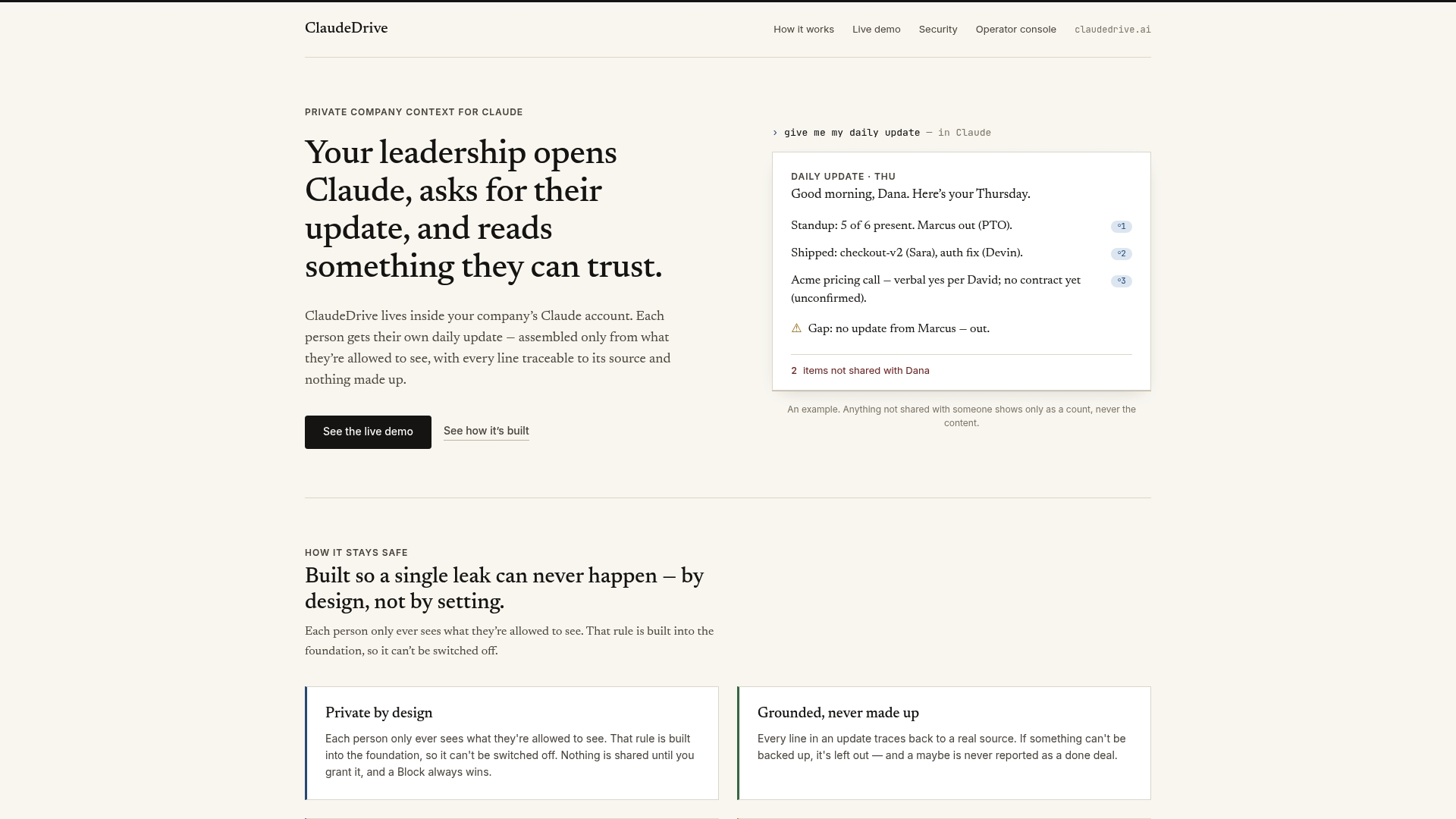
Connect meeting notes, GitHub, and your calendar, and each leader gets their own private view of what happened on the roadmap overnight. No new dashboard to learn. No wiki to maintain. ClaudeDrive is the permission-aware digest platform that feeds Claude with your company’s context, not another assistant to adopt. If you want to see how it handles roadmap update summaries for your team, see the live demo or talk to us about a pilot.
FAQ
What is a product roadmap updates AI digest?
A product roadmap updates AI digest is an automated briefing that synthesizes roadmap signals, user research, and telemetry into a confidence-ranked summary for leadership. It replaces manual status reports with traceable, role-filtered updates delivered on a continuous or weekly cadence.
How fast can AI validate roadmap themes with customer research?
AI-moderated research tools like Perspective AI validate roadmap themes across 75–150 customer conversations in 48–96 hours, compared to 4–8 weeks for traditional research cycles.
Why should AI roadmaps use confidence ranges instead of ship dates?
AI features are probabilistic, meaning a model can pass evaluation in one sprint and regress in the next. Confidence ranges on the model track reflect that uncertainty honestly and prevent teams from committing to dates before reliability gates are passed.
How often should an AI product roadmap be updated?
AI capabilities shift unpredictably, so roadmap reviews should run on a weekly or continuous cycle rather than the traditional quarterly cadence. The digest layer handles the synthesis; human review focuses on items where confidence scores fall below threshold.
What makes an AI digest trustworthy for executive leadership?
Trust comes from two features: permission filtering and source traceability. Permission-aware digests deliver only what each leader is authorized to see, and every claim links to a verifiable source so leaders can audit the briefing in seconds.