What Is AI Update Engagement? A Guide for Leaders
Discover what is AI update engagement and why it matters for leaders. Transform decisions with actionable insights from AI-generated briefings.
ClaudeDrive
A Yungsten Tech product

What Is AI Update Engagement? A Guide for Leaders

AI update engagement is the degree of meaningful interaction leaders have with AI-generated briefings that inform and support business decisions. It goes well beyond counting how many times someone opens a report. The real measure is whether those briefings change what a leader does next. Only 40% of product teams measure AI ROI through business outcomes like retention or revenue growth. That gap explains why so many AI update programs feel busy but deliver little. ClaudeDrive is built around closing that gap, giving leaders a daily briefing they can act on, not just read.
What is AI update engagement and why does it matter?
AI update engagement is defined as the quality and frequency of meaningful user interactions with AI-generated update briefings, measured by whether those interactions lead to better decisions. The term sits at the intersection of two established disciplines: AI product measurement and internal communications effectiveness. Both fields agree that volume alone tells you almost nothing useful.
The distinction matters because most organizations default to counting. They track daily active users, prompt submissions, or time spent. These numbers feel reassuring. They are also easy to game and easy to misread. A leader who opens a briefing, finds it confusing, and submits three follow-up prompts shows high engagement volume. That same pattern signals a failure, not a success.

The standard industry term for this broader concept is AI product engagement quality, and it covers resolution rates, task completion, and outcome alignment alongside raw activity counts. Understanding AI updates through this lens means asking a harder question: did the briefing help someone make a faster, better-informed call?
ClaudeDrive approaches this directly. Every briefing it generates is traceable to a real source, scoped to what each leader is permitted to see, and built to answer the question a leader actually asked. That design philosophy is what separates engagement that produces value from engagement that produces noise.
What metrics and signals define successful AI update engagement?
Successful AI update engagement is measured by outcome-based signals, not activity counts. The most reliable indicators are resolution rate, task completion, and escalation rate. These tell you whether the briefing answered the question or sent someone searching for more information.
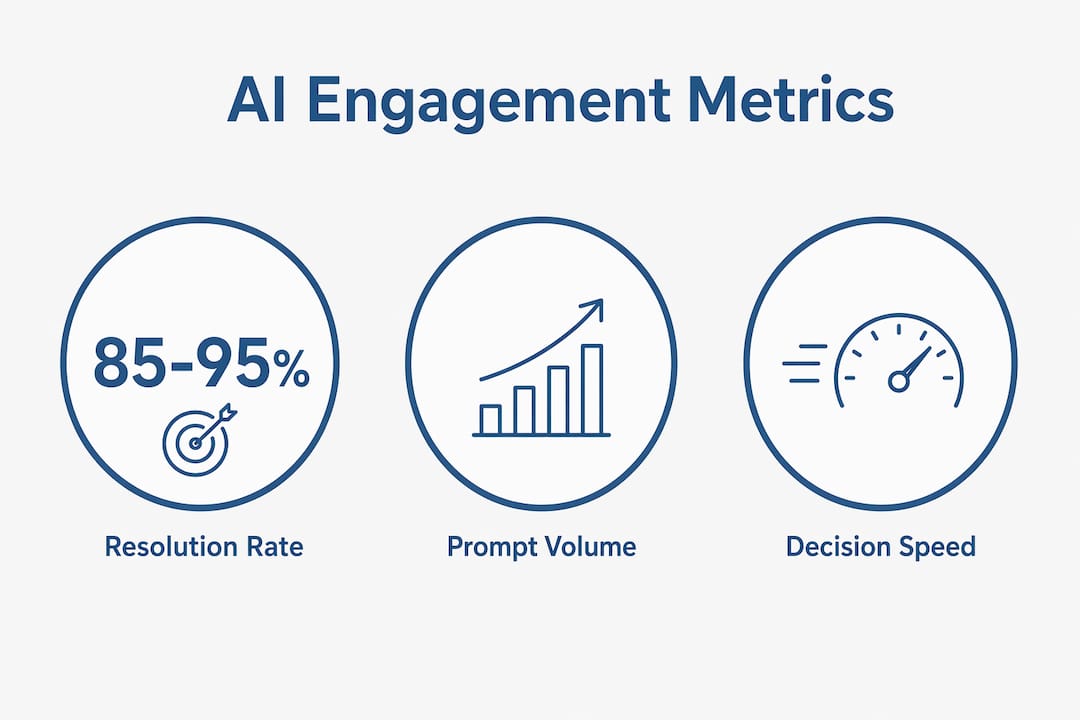
Industry benchmarks for AI agent resolution rates on structured tasks range from 85–95%. Drops below 80% signal adoption failures, not user preference. That benchmark gives leaders a concrete floor: if your AI update system resolves fewer than 8 in 10 queries without follow-up, the system is underperforming.
Prompt submissions are a useful signal of active intent, but only when read carefully. Engagement spikes can be misleading: higher prompt volumes may indicate repeated retries due to failure rather than genuine engagement. Near-duplicate detection, which flags when a user submits nearly identical prompts in sequence, separates productive exploration from frustration retries.
Traditional click-based tracking fails for AI systems because engagement is a conversation flow, not a series of discrete clicks. Sequence reconstruction, which groups prompt refinements into conversation patterns, gives a far more accurate picture of whether a leader reached a resolution or gave up.
Key metrics worth tracking:
- Resolution rate: Did the briefing answer the question without requiring escalation?
- Prompt sequence depth: Are follow-up prompts exploring new ground or repeating the same ask?
- Escalation rate: How often does an AI briefing trigger a human review or override?
- Time to decision: Does the briefing shorten the time between question and action?
Pro Tip: When you see an engagement spike, check whether resolution rate moved in the same direction. If volume went up but resolution stayed flat or dropped, users are retrying failed queries, not finding new value.
How AI update engagement impacts communication and decision-making
AI update engagement directly improves the speed and clarity of internal communication when the briefings are personalized and scoped correctly. A CEO who receives a single briefing covering engineering progress, sales pipeline movement, and calendar conflicts in one place makes faster calls than one who reads three separate reports. The briefing format itself is an engagement driver.
AI accelerates personalized communications but is limited for trust-building scenarios. That finding carries a practical implication: AI is the right tool for volume-heavy update workflows like compiling meeting notes, summarizing GitHub activity, or flagging calendar conflicts. It is not the right tool for delivering sensitive performance feedback or managing a crisis communication.
AI engagement metrics also surface organizational alignment gaps. When leaders in different functions consistently ask the same follow-up questions after receiving their briefings, that pattern reveals a communication gap in the underlying data, not a failure of the AI. The briefing becomes a diagnostic tool, not just an information delivery mechanism.
Effective AI-driven update strategies share three characteristics:
- Scoped access: Each leader sees only what they are permitted to see. Nothing leaks across organizational lines.
- Source traceability: Every claim in the briefing links back to a real document, meeting note, or data point.
- Consistent cadence: Briefings arrive on a predictable schedule, which trains leaders to rely on them rather than seek out information ad hoc.
Pro Tip: Pair your AI engagement metrics with a simple outcome log. Each week, note three decisions that were faster or better because of a briefing. That log becomes your ROI case without requiring a complex attribution model.
The importance of AI engagement grows when leaders treat briefings as a feedback loop. A briefing that generates a follow-up question tells you what the system missed. That signal, tracked over time, improves both the briefing quality and the underlying data connections.
What are the risks in measuring and trusting AI update engagement?
The primary risk in AI update engagement is mistaking high activity for high value. Naive engagement metrics, particularly daily active user counts and raw prompt volumes, can mask a system that is failing its users. Leaders who rely on these numbers alone will over-invest in a system that looks healthy on paper and underperforms in practice.
The proliferation of AI-to-AI interactions reduces human intelligibility. When automated update systems pass information between AI components without a human checkpoint, the reasoning behind a briefing becomes opaque. Leaders lose the ability to audit why a particular conclusion appeared in their update. That opacity is a governance failure, not just a technical one.
Security threats are concrete and documented. Agentjacking is an AI security threat where malicious markdown injections in error reports trick AI coding agents into executing harmful commands. In an automated update pipeline, this means a compromised input source could alter what a leader reads and trusts. Manual review protocols and sandboxed input processing are the direct countermeasures.
Risks worth monitoring in any AI update system:
- Metric inflation: Volume metrics rise when the system fails, not just when it succeeds.
- Opacity creep: Automated AI-to-AI handoffs reduce the ability to trace a claim to its source.
- Injection attacks: Malicious content in connected data sources can corrupt briefing outputs.
- Over-reliance: Leaders who stop questioning briefings lose the critical oversight that keeps AI aligned with organizational reality.
“Businesses must prioritize accountability and transparency alongside capability in automated update systems to maintain alignment.” — Science, 2026
The accountability standard for any AI update system is simple: every line in a briefing must be traceable to a named source, and a human must be able to review that trace on demand. Systems that cannot meet this standard should not be trusted for leadership decision-making.
Best practices for auditing and optimizing AI update engagement
The most effective approach to AI update engagement optimization starts with defining what success looks like before measuring anything. Leaders who set outcome-based success criteria, such as a target resolution rate or a reduction in escalation frequency, get far more useful data than those who track activity by default.
Auditing AI update quality requires checking three things: source traceability, permission scope, and briefing relevance. A briefing that cites real sources, stays within each leader’s access boundary, and answers the question that was actually asked passes the audit. One that fails any of these three checks needs to be corrected before it erodes trust.
Automating update cadence responsibly means setting a fixed delivery schedule and resisting the urge to increase frequency without a clear reason. More frequent briefings do not produce more engagement value. They produce more noise. The right cadence is the one that matches the decision rhythm of the leader receiving it.
| Practice | Common pitfall |
|---|---|
| Track resolution rate as primary metric | Tracking DAU or prompt volume as primary metric |
| Scope briefings to each leader’s access level | Sending uniform briefings to all leadership roles |
| Trace every claim to a named source | Publishing briefings without source attribution |
| Set a fixed, predictable update cadence | Increasing frequency without measuring value |
| Review engagement anomalies manually | Accepting engagement spikes as positive signals |
Permission-aware AI updates are the governance foundation of a trustworthy system. When each leader’s briefing is built only from sources they are authorized to access, the system earns trust by design rather than by policy.
Pro Tip: Connect your AI update engagement data to your existing business intelligence system quarterly. Look for correlations between briefing resolution rates and decision cycle times. That connection makes the case for continued investment in concrete terms.
Key Takeaways
AI update engagement produces real leadership value only when measured by outcome-based metrics like resolution rate, source traceability, and decision speed, not by raw activity counts.
| Point | Details |
|---|---|
| Define engagement by outcomes | Resolution rate and decision speed matter more than prompt volume or daily active users. |
| Audit for traceability | Every claim in an AI briefing must link to a named, verifiable source. |
| Scope access by role | Each leader’s briefing should contain only what they are authorized to see. |
| Watch for metric inflation | Engagement spikes often signal retry failures, not genuine adoption growth. |
| Maintain human oversight | Manual review checkpoints prevent security threats and opacity from corrupting trusted briefings. |
Why I think most teams are measuring AI engagement backwards
Most organizations I have observed start with the metrics their analytics tools already collect. They count users, sessions, and prompts because those numbers are easy to pull. Then they report upward that AI engagement is strong. What they have actually measured is activity, and activity is not the same as value.
The uncomfortable truth is that a leader who submits five prompts to get one useful answer is less well-served than a leader who submits one prompt and acts immediately. The first pattern looks better in every standard dashboard. It is worse by every meaningful standard.
The security dimension is underappreciated at the leadership level. Most executives think of AI security as an IT concern. Agentjacking and injection attacks in automated update pipelines are a leadership concern. If the briefing a CEO reads on monday morning was shaped by a malicious input in a connected data source, the downstream decisions are compromised. That is not a hypothetical.
The leaders I have seen get the most from AI update systems share one habit: they treat every briefing as a draft, not a verdict. They ask follow-up questions, flag anomalies, and push back when a claim does not match what they know. That behavior keeps the system honest and keeps the leader in control. AI update engagement, done right, is a discipline, not a feature.
— Paul
ClaudeDrive gives leaders briefings they can trust
Leaders who want to move from activity metrics to outcome-based AI engagement have a direct path with ClaudeDrive. The ClaudeDrive Console is built for exactly this: daily briefings scoped to each leader’s access level, every line traceable to a real source, delivered inside the Claude account your team already uses.
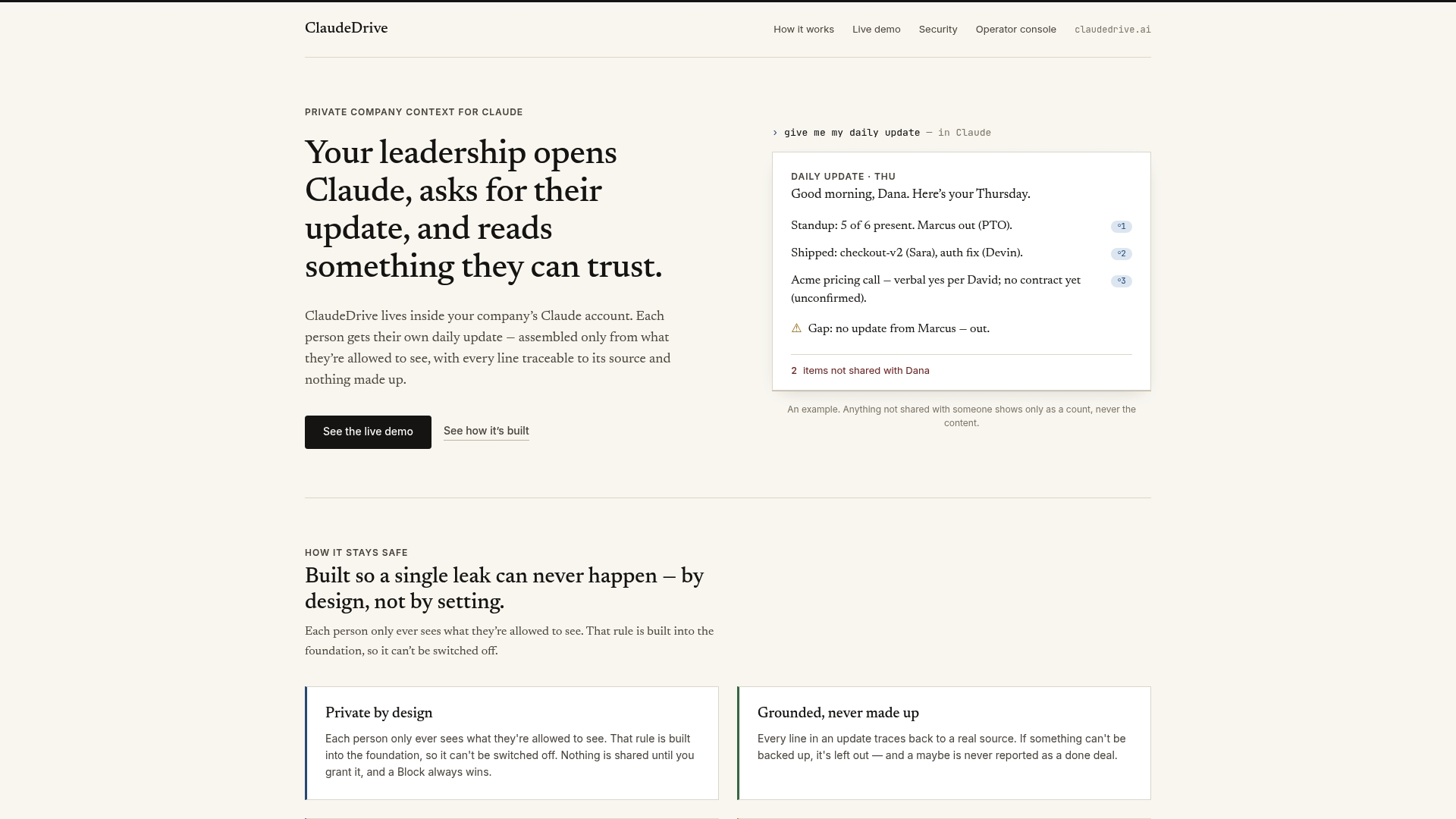
Connect your meeting notes, GitHub, and calendar. Each leader gets their own private view of what happened, with nothing crossing lines it should not. No new app, no dashboard to learn. ClaudeDrive is the context layer that feeds Claude, not another tool to manage. Talk to us about a pilot and see what trustworthy AI update engagement looks like in practice.
FAQ
What is AI update engagement in plain terms?
AI update engagement is the quality and frequency of meaningful interactions leaders have with AI-generated briefings. It is measured by whether those briefings lead to faster, better-informed decisions, not by how often someone opens them.
Why do standard engagement metrics fail for AI update systems?
Traditional click-based tracking fails because AI engagement is a conversation flow, not a series of discrete clicks. High prompt volume can signal failure rather than success when users are retrying queries that did not resolve.
What resolution rate should leaders expect from AI update briefings?
Industry benchmarks for AI agent resolution rates on structured tasks range from 85–95%. A rate below 80% signals an adoption or quality failure that warrants review.
How do leaders protect against security risks in automated update pipelines?
The direct countermeasure to threats like agentjacking is manual review protocols and sandboxed input processing. Every automated input to an update pipeline should be verifiable before the AI processes it.
How does ClaudeDrive support trustworthy AI update engagement?
ClaudeDrive builds each briefing only from sources a leader is authorized to see, traces every claim to a named source, and delivers the result inside Claude without requiring a new app or dashboard. That design makes auditability the default, not an add-on.