Private Company Context Layer for Leadership: 2026 Guide
Discover how a private company context layer for leadership streamlines updates directly in Claude, ensuring trusted, role-based insights.
ClaudeDrive
A Yungsten Tech product

Private Company Context Layer for Leadership: 2026 Guide

A private company context layer for leadership can deliver trusted, permissioned daily updates directly inside Claude — no new app, no dashboard, no wiki to maintain. Leaders open Claude, ask for their update, and read a clear briefing built only from what they are authorized to see, with every line traceable to a real source.
Here is what that means in practice:
- Trusted daily briefing inside the ClaudeDrive Console, formatted for the leader’s role and scope
- Private, role-based views so each executive sees only what their access allows
- Per-line source traceability back to the original meeting note, doc, or calendar entry
- No new tool to adopt — it feeds Claude, the account leaders already use
- Built by Yungsten Tech, ClaudeDrive is the vetted vendor option for a leader pilot
The research backs the premise. MIT Sloan identifies contextual effectiveness as a core leadership task: map the environment, establish a shared mindset, communicate clearly. Leadership Lyceum’s Three Altitudes framework adds that leaders who fail to shift altitude — from functional mastery to enterprise stewardship — create organizational friction. A private context layer gives each leader the right altitude-appropriate signal, daily, without asking them to go find it.
Table of Contents
- What does a private company context layer actually do for leaders?
- How does a private context layer produce a daily update inside Claude?
- What decisions do leaders need to make before adopting?
- A practical pilot checklist and realistic timeline
- How do you measure whether the pilot is working?
- What security and compliance guarantees should leaders demand?
- ClaudeDrive: what it offers leaders and where to start
- Key Takeaways
- The part most leaders get wrong about context layers
- Daily trusted updates inside Claude, without another tool to manage
What does a private company context layer actually do for leaders?
Think of it as a background layer that collects, curates, and exposes only the allowed, sourced lines from your internal systems into Claude. Each leader gets a private briefing shaped to their role. The CEO sees one view; the COO sees another; the chief of staff sees a third. Nothing leaks across those lines.

Why does this matter now? Contextual leadership research consistently shows that context shapes leadership outcomes more than most leaders expect. Yet most executives still synthesize their daily picture manually — scanning Slack, email, meeting notes, and project tools before they can form a view. That synthesis takes time and introduces error.
A private context layer solves the daily update problem by doing the synthesis automatically, privately, and with sourced lines. The result is a briefing leaders can trust rather than one they have to verify.
A private context layer does not replace leadership judgment. It removes the noise that obscures it — giving each leader a clear, sourced picture of what happened, scoped to what they are allowed to see.
The sources it draws from are the ones already in use: meeting notes, calendars, selected documents, and engineering signals like GitHub. No new data warehouse. No new process.
Pro Tip: Start the pilot with three source types only — meeting notes, calendar, and one project tracker. A narrow scope produces a cleaner briefing and makes traceability easier to verify.
How does a private context layer produce a daily update inside Claude?
The flow is straightforward: connect a few sources, define who sees what, let the layer curate and version the context, then ask Claude for your update.
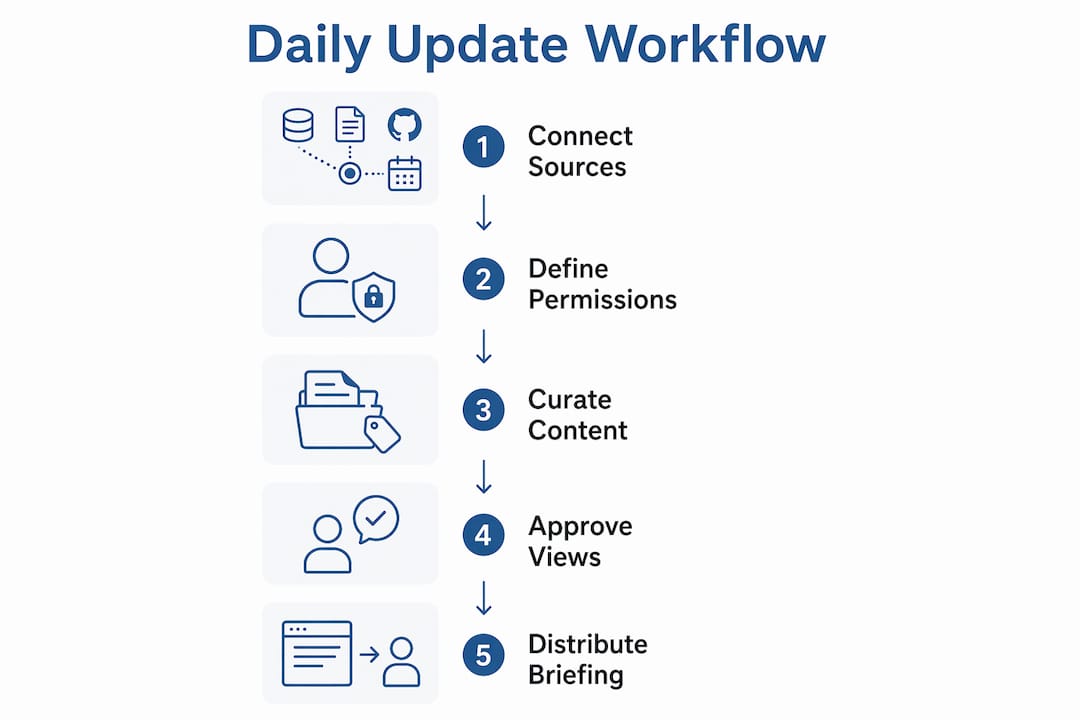
What the leader does: choose the source scope and approve who gets which view. What the layer does: curate, permission, and version the context so Claude can respond with a private, sourced briefing. The leader never touches the curation logic.
The privacy guarantee works at three levels. First, role-based views mean each leader’s briefing is built only from sources their access level permits. Second, per-line traceability means every assertion in the briefing links back to the original document or note. Third, no cross-tenant leaks means one leader’s private view never surfaces in another’s.
A useful mental model: three boxes. Sources (meeting notes, GitHub, calendar) feed into the Private Context Layer, which feeds Claude. Claude returns a private briefing. That is the entire flow.
Pro Tip: Require a short source attribution line on every briefing item — one click back to the original note or doc. If a vendor cannot show you that during the demo, keep looking.
What decisions do leaders need to make before adopting?
Governance is not an engineering question. It is a leadership decision. Before a pilot goes live, the CEO or chief of staff needs to answer five questions:
- Who receives daily updates? Name the specific roles — CEO, COO, chief of staff, and which functional heads.
- Which sources are in scope? List the tools and teams. Explicitly name what is excluded (HR systems, legal files, board materials).
- What must be cited? Define the traceability policy: every briefing line needs a source, or only flagged items?
- What are the retention and versioning rules? How long is context stored, and who can audit it?
- What is the escalation path for sensitive items? Define who reviews an alert before it reaches the briefing.
The authorization model that works best is leader-first: the chief of staff or VP of Operations signs off on scopes and reviewers before any connector goes live. Engineering executes; leadership decides. The buyer checklist from ClaudeDrive formalizes these questions into a governance document leaders can sign.
Pro Tip: Define a three-tier visibility model upfront — private (individual leader only), leadership-only (C-suite), and executive-plus-board. Run the pilot strictly within the lower two tiers.
A practical pilot checklist and realistic timeline
A four-week pilot is enough to validate the briefing quality and governance model before any scaling decision.
Pilot checklist:
- Select participants: CEO or chief of staff plus two additional executives
- Pick three source types: meeting notes, calendar, one project tracker
- Set permissions and define the three-tier visibility model
- Define two or three success metrics before week one (see KPIs below)
- Schedule a structured review at the end of week four
| Week | Focus | Owner |
|---|---|---|
| 1 | Discovery and scoping: finalize sources, permissions, and briefing format | Chief of staff |
| 2 | Integration and governance: connect sources, confirm traceability, test role-based views | Technical lead + chief of staff |
| 3 | Pilot run: leaders ask Claude for daily updates, log feedback | All pilot participants |
| 4 | Review and scale decision: assess KPIs, governance gaps, and next steps | CEO + chief of staff |
For the pilot script, leaders ask Claude: “Give me today’s update” or “What are the open items from yesterday’s leadership sync?” Then verify: pick three briefing lines at random and trace each one back to its source document. If any line has no source, flag it as a governance issue before scaling. The implementation guide for technical leaders covers the connector setup in detail.
How do you measure whether the pilot is working?
Three primary KPIs tell you what you need to know:
- Briefing adoption rate: how many pilot leaders regularly read their daily update
- Decision cycle time: duration from issue identification to documented decision, compared to the baseline before the pilot
- Source-trace rate: how many briefing lines include a verifiable source link
Operational signals worth tracking alongside those: number of escalations that were caught in the briefing before they became surprises, and time saved per leader per week on manual synthesis.
The measurement instruments are simple. A two-question leader feedback survey at the end of each week (“Was today’s briefing accurate? Was it complete?”), a time-to-decision log kept by the chief of staff, and a weekly spot audit of ten random briefing lines for source traceability. Strategic contextual leadership research frames decision speed and alignment as the right outcomes to measure for top teams — these KPIs map directly to that.
What security and compliance guarantees should leaders demand?
Four plain-language guarantees are non-negotiable:
- Role-based access: each leader’s briefing is built only from sources their access level permits, and that boundary is enforced at the data level, not just the display level
- Per-line source traceability: every assertion in the briefing links to an original document, with no generated lines that cannot be verified
- Audit logs: access events and edits are logged and available for internal audit or external counsel review
- Clear retention and deletion policies: the vendor states explicitly what is stored, for how long, and who can delete it
The G20/OECD Principles of Corporate Governance anchor these requirements in established governance norms: accountability, transparency, and clear information rights for boards and management. The governed context layer guide from ClaudeDrive translates those principles into executable templates.
For verification, request three things during vendor evaluation: an architecture overview that shows where data is stored and who controls it, a sample audit log from a live environment, and an independent security attestation when available.
Pro Tip: Ask the vendor for a one-page “leader-facing security summary” that states plainly what is stored in their environment versus what your team controls. If they cannot produce it, that is the answer.
ClaudeDrive: what it offers leaders and where to start
ClaudeDrive is the private company context layer that feeds Claude with permissioned, traceable context so leaders get daily trusted updates inside their existing Claude account. Built by Yungsten Tech, it is designed for the leader who wants a briefing they can trust, not another tool to manage.
What leaders get with ClaudeDrive:
- ClaudeDrive Console: the leader-facing interface where daily updates appear inside Claude
- Published governance playbooks and implementation checklists leaders can review before committing to a pilot
- Native integrations for meeting notes, calendar, selected documents, and engineering signals like GitHub — each surfaced as a private leader view with per-line attribution
- Role-based private views so each executive’s briefing is scoped to their access level
ClaudeDrive does not replace Claude. It gives Claude the private, sourced company context that turns a general-purpose assistant into a trusted daily briefing for each leader on your team.
The AI company context update examples on the ClaudeDrive blog show what a real leader briefing looks like and what makes it trustworthy. The buyer checklist covers the governance questions to ask before signing anything.
Pro Tip: Before the demo, send ClaudeDrive three sample briefing items from your current manual process. Ask them to show you how those items would appear in Claude with source attribution. That single test tells you more than any feature list.
Key Takeaways
A private company context layer works when it is governed, permissioned, and traceable — and when leaders define the scope before the first connector goes live.
| Point | Details |
|---|---|
| Define governance first | Answer the five scope and permission questions before any technical setup begins. |
| Start narrow | Three source types and a four-week pilot is enough to validate briefing quality and trust. |
| Measure what matters | Track briefing adoption rate, decision cycle time, and source-trace rate as your three primary KPIs. |
| Demand four guarantees | Role-based access, per-line traceability, audit logs, and a clear retention policy are non-negotiable. |
| ClaudeDrive as the pilot option | ClaudeDrive Console delivers daily trusted updates inside Claude, with governance playbooks leaders can review before committing. |
The part most leaders get wrong about context layers
The conventional wisdom says the hard part is the technology. Connect the tools, set the permissions, and the briefing takes care of itself. In practice, the hard part is scope discipline.
Every pilot that stalls does so for the same reason: too many sources, too early. A leader who connects twelve tools in week one gets a briefing that is long, noisy, and hard to verify. When a line in the briefing cannot be traced back to a source in under thirty seconds, trust erodes. Once trust erodes, adoption drops. The technology was never the problem.
The do/don’t list is short:
Do: Define the three-tier visibility model before week one. Start with three sources. Require source attribution on every line from day one.
Don’t: Connect sensitive HR or legal sources in the pilot. Skip the spot audit. Let the technical team define scope without leadership sign-off.
The leaders who get the most from a private context layer are the ones who treat the pilot as a governance exercise first and a technology exercise second. The briefing quality follows from the governance quality, not the other way around.
See the live demo or talk to us about a pilot.
Daily trusted updates inside Claude, without another tool to manage
Most leaders already use Claude. The gap is not the assistant — it is the private, sourced company context that makes the assistant’s output trustworthy for daily decisions. ClaudeDrive closes that gap by feeding Claude the permissioned, traceable context each leader is allowed to see, scoped to their role, with every line pointing back to a real source.
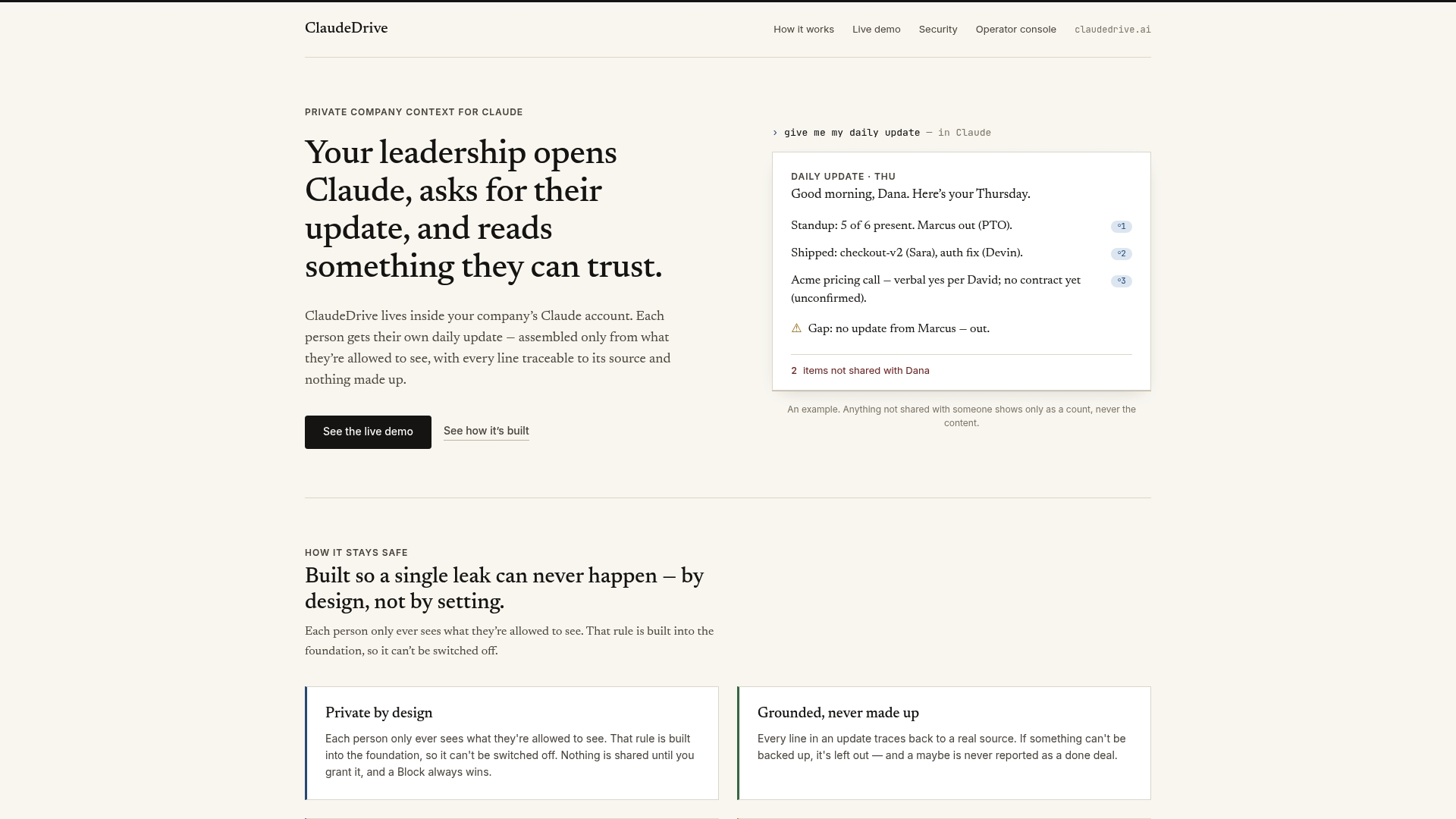
No new dashboard. No wiki to maintain. No app rollout. The ClaudeDrive Console sits inside the Claude account your team already uses, and the governance playbooks give your chief of staff a clear path from pilot approval to daily briefing in four weeks.
The pilot is low-friction by design: three source types, four weeks, a structured review, and a clear set of KPIs to judge the result. If the briefing is accurate, traceable, and adopted, you scale. If it is not, you know exactly why.
See the live demo or talk to us about a pilot.