Cut RAG Hallucinations in 30/90/180 Days for Enterprise Leaders
Enterprise playbook to cut RAG hallucinations: set baseline metrics (hallucination rate, groundedness), enforce freshness and provenance, and deploy a...
ClaudeDrive
A Yungsten Tech product

Cut RAG Hallucinations in 30/90/180 Days for Enterprise Leaders

Retrieval-Augmented Generation reduces hallucinations, but it does not eliminate them. Even well-built pipelines leave a residual error rate that typically runs from the single digits into the low double digits, depending on task complexity and retrieval quality. The first move for any team serious about this problem is establishing a baseline hallucination rate and a groundedness score, then layering in a recency check before touching anything else. Enterprise tools like ClaudeDrive treat that freshness check as a first-class requirement, not an afterthought.
TL;DR:
- Lightweight heuristics like token entropy and citation checks filter obvious hallucinations, reducing the load on more expensive detection tiers.
- Recency-weighted retrieval and hybrid search significantly improve freshness, preventing outdated documents from influencing answers.
- External knowledge bases enhance accuracy but introduce complexity, requiring synchronization of updates and conflict resolution controls.
- Continuous feedback from user reports, combined with detection and rewriting pipelines, rapidly decreases hallucination rates over time.
- Prioritizing retrieval quality and freshness monitoring yields better results than solely investing in larger models or prompt constraints.
Table of Contents
- What Detection Methods Actually Catch Hallucinations in RAG?
- Where in the Pipeline Should You Fix Hallucinations?
- How Do You Measure Whether Hallucination Reduction Is Working?
- How Do You Build Durable Governance Into a RAG System?
- A 30/90/180-Day Plan for Cutting Hallucinations
- What Does Cutting-Edge Hallucination Research Show?
- Why Do RAG Systems Still Hallucinate?
- How Do External Knowledge Bases Change Hallucination Risk?
- How Should User Feedback Improve Hallucination Detection Over Time?
- How Does RAG Compare to Other Hallucination Mitigation Approaches?
- What Do Real Hallucination Reduction Deployments Show?
- What Should Leaders Actually Fund and Require?
- How ClaudeDrive Delivers Permission-Aware, Source-Linked Updates
- Sources
What Detection Methods Actually Catch Hallucinations in RAG?
Detection works best as a cascade, not a single filter. You start cheap and fast, and only escalate to expensive, slow methods when the cheap ones flag something suspicious. Running every response through a full LLM-based classifier is accurate but expensive at scale, and most enterprise deployments cannot afford that latency tax on every single query.
The cascade generally has three tiers. The first tier uses lightweight heuristics: token entropy scores that flag unusually uncertain generations, and simple citation-absence checks that catch answers making claims without pointing to a retrieved source. These run in milliseconds and cost almost nothing computationally. They will not catch subtle hallucinations, but they catch the obvious ones, and they filter out a meaningful share of traffic before anything expensive runs.
The second tier applies semantic-similarity filters. Here you compare the embedding of the generated answer against the embeddings of the retrieved chunks it claims to be grounded in. If the cosine similarity between the answer and its supporting evidence falls below a set threshold, the answer gets flagged for review or blocked outright. This tier is where most of the real detection work happens because it directly measures whether generated text and retrieved evidence actually align, rather than just checking for the presence of a citation.
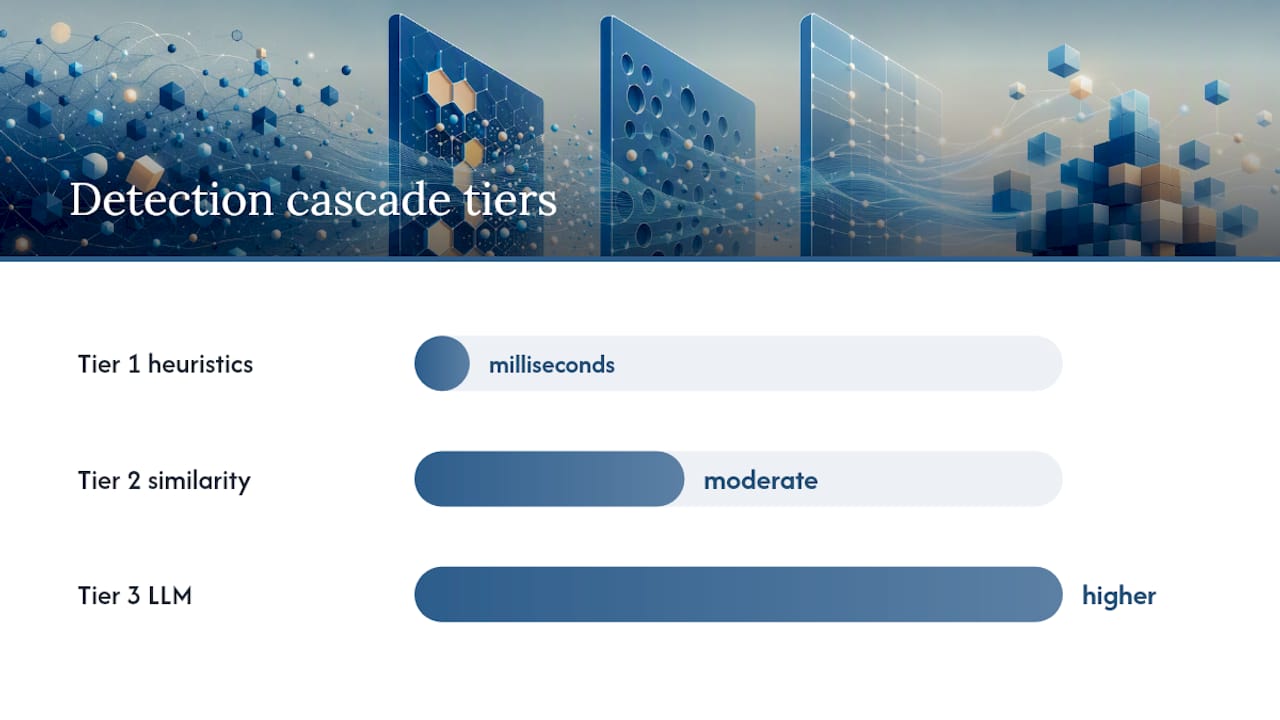
The third tier is the LLM-based classifier itself: a second model prompted specifically to judge whether a candidate answer is supported by the retrieved context. AWS’s guidance on detecting hallucinations for RAG-based systems recommends this layered cascade specifically because prompt-based LLM detection carries success rates typically exceeding 75% in enterprise settings, but at meaningfully higher latency and cost than the earlier tiers. Running it on all queries wastes money on cases the cheaper filters already resolved with confidence.
A working detection prompt for the LLM tier looks something like this: give the model the retrieved passages, the generated answer, and a direct instruction to output a binary judgment (SUPPORTED or UNSUPPORTED) along with a one-line justification citing the specific passage or the specific gap. Keep the output format rigid. Free-text explanations are harder to parse programmatically and slower to review at volume.
Here is how the tiers typically divide labor in production:
- Token-entropy and citation-absence checks filter out a meaningful share of queries before any semantic comparison runs, at near-zero added latency.
- Semantic-similarity thresholds commonly set within a moderate range catch most of the remaining cases where an answer drifts from its cited source, tuned per domain.
- LLM-based classification handles the residual cases where similarity scores sit in an ambiguous middle band, typically 5 to 15 percent of total volume, and produces the highest-confidence judgment at the highest cost.
Pro Tip: Set your similarity threshold slightly loose at first (favoring false positives over false negatives), then tighten it over two to three weeks once you have enough flagged cases to see where legitimate answers get caught in the net. Starting too strict trains your review team to distrust the system and start ignoring flags.
The false-positive problem deserves direct attention because it is where most teams get the cascade wrong. The fix is not a single perfect threshold. It is routing flagged answers to a fast human-review queue rather than blocking them outright, and using flagged-case data to retrain your similarity threshold on a rolling basis. Treat the detector as a triage tool, not a gatekeeper, until you have enough production data to trust its precision at your specific similarity cutoff.
Where in the Pipeline Should You Fix Hallucinations?
Every hallucination has a point of origin, and that point determines which fix actually works. Chasing hallucinations with generation-side patches when the real problem is a stale index is a common and expensive mistake. Map your controls to the stage where the failure actually happens.
1. Data lifecycle controls (the foundation most teams skip). Most production RAG failures trace back to stale or superseded content sitting in the index, not to the generator making things up from nothing. Operational reviews of failed enterprise RAG deployments point to this as the single most common root cause. The fix is unglamorous but effective: tombstone deleted documents so they cannot be retrieved after removal, version chunks so old content does not silently overwrite the retrieval index, use content hashes to detect when a source document changed without triggering re-indexing, and re-embed incrementally rather than on a slow batch schedule. A document that changed on Monday and gets re-embedded on Friday is a four-day window where your system confidently cites outdated information.
2. Retriever improvements: hybrid search, filters, and recency priors. Pure semantic search retrieves what is topically similar, not necessarily what is current or authoritative. Hybrid search, combining keyword matching with embedding similarity, catches cases where exact terminology matters and semantic search alone drifts toward the wrong document. Metadata filters (document type, department, publication date) narrow the candidate pool before ranking even starts.
The more interesting lever is recency-weighted reranking. Research on freshness-aware retrieval demonstrates that fusing semantic similarity with a half-life decay function, where a document’s relevance score decays over time unless it is repeatedly reinforced by recent access or updates, corrects a specific and common failure mode: retrieving an outdated document that is semantically similar to the query but has since been superseded. In one experiment, a fused semantic-temporal score using this decay function achieved perfect accuracy on a latest-document retrieval task, while a cosine-similarity-only baseline failed to consistently surface the current version. That is not a marginal improvement. That is the difference between a system that knows what changed last week and one that does not.
3. Prompt constraints: making the model say “I don’t know.” The generation layer needs explicit permission and instruction to refuse an answer when evidence is thin. This is the ICE pattern: Instructions (state exactly what the model should do with retrieved context), Constraints (state exactly what it must not do, such as inferring beyond the provided passages), and Escalation (give it an explicit fallback, such as “if the retrieved passages do not answer the question, say so rather than guessing”). Guidance on strengthening guardrails against hallucination recommends forcing citations for factual claims and building in that explicit refusal path, because a model given no graceful way to say “I don’t know” will often fabricate a plausible-sounding answer instead. Pair this with a deterministic or low temperature setting for factual queries. Creative variance is the enemy of groundedness.
4. Semantic cache and verified-answer layers. Not every question needs to go through the full generation pipeline. For high-frequency queries with a known, verified answer, a semantic cache layer can intercept the query before it ever reaches the LLM. One documented pattern using Amazon Bedrock Knowledge Bases routes queries above an 80% similarity match directly to a curated, pre-validated answer, skips generation entirely, and routes queries in the 60 to 80% band to the LLM with few-shot guidance drawn from similar verified cases. The reported effect is lower latency, lower cost, and a meaningful cut in hallucination risk, because the highest-volume, highest-stakes queries never touch a generative step at all.
5. Post-processing: rewrite pipelines and hallucination-aware fine-tuning. The most sophisticated layer catches what slips through everything above and corrects it after the fact. Detection-and-rewrite pipelines flag a hallucinated span, pass it to a stronger model for correction against the retrieved evidence, and log the correction for later fine-tuning. Combining this with preference-based fine-tuning, specifically Direct Preference Optimization (DPO) trained on pairs of hallucinated versus corrected answers, produces a model that hallucinates less on its own over time rather than relying purely on external correction. The RAG-HAT pipeline demonstrates this end-to-end approach, and reports measurable reductions in hallucination rate along with improved answer precision when detection labels, automated rewriting, and DPO training are combined into one continuous loop.
Prioritize in this order if you are resource-constrained: data lifecycle controls first, because they fix the highest volume of real-world failures at the lowest engineering cost. Prompt constraints second, because they are a configuration change, not an infrastructure build. Recency-weighted retrieval third. Semantic cache fourth. Post-processing and fine-tuning last, because they require the most data and infrastructure maturity to do well.
How Do You Measure Whether Hallucination Reduction Is Working?
You cannot manage what you do not measure, and hallucination reduction is one of the easiest efforts to fool yourself about if you are not tracking the right numbers. Two metrics anchor everything else.
Hallucination rate is the percentage of generated responses containing at least one claim unsupported by the retrieved context. Measure it with a combination of automated LLM grading (using the same detector-classifier pattern described earlier) run against a large sample, backed by periodic human annotation on a smaller, randomly selected subset to catch cases where the automated grader itself is wrong. Never rely on automated grading alone. The grader has its own error rate, and without a human check you cannot tell whether your hallucination rate improved or your grader just got worse at catching problems.
Groundedness score measures how directly a generated answer’s claims map back to specific passages in the retrieved context, scored on a continuous scale rather than a binary pass/fail. A high hallucination rate with a high average groundedness score usually points to a narrow set of edge cases causing most of the damage. A low groundedness score across the board points to a systemic prompt or retrieval problem.
Beyond those two, three supporting signals round out a monitoring dashboard:
| Metric | What it measures | Why it matters |
|---|---|---|
| Hallucination rate | Share of responses with unsupported claims | Primary outcome metric; track over time and by query category |
| Groundedness score | How directly claims trace to retrieved passages | Diagnoses whether failures are isolated or systemic |
| Stale-citation rate | Share of citations pointing to superseded or outdated documents | Flags retrieval freshness problems before users notice |
| Relevance score | How well retrieved passages match query intent | Distinguishes a generation problem from a retrieval problem |
| User trust score | Direct or inferred user confidence in answers (feedback, repeat-query rate) | Captures real-world impact that automated metrics can miss |
The evaluation workflow itself should run in three stages. Start with a baseline test: run your full query set through the current pipeline and record hallucination rate, groundedness, and stale-citation rate before changing anything. Then move to incremental A/B validation: change one variable at a time (a new reranker, a new similarity threshold, a new prompt constraint) and measure the delta against baseline on the same query set, not a different one. Finally, establish an ongoing sampling cadence: a fixed percentage of production traffic, reviewed weekly by an automated grader and monthly by a human annotator, so drift gets caught before it becomes a pattern rather than after.
How Do You Build Durable Governance Into a RAG System?
One-off fixes solve one-off problems. A layered governance model is what turns hallucination reduction from a project into a standing property of the system. Survey research on hallucination mitigation makes this point directly: teams that succeed at durable hallucination control adopt multi-layer governance spanning input, retrieval, generation, and audit, rather than patching individual failures as they surface.
The model has four layers, each catching what the previous one missed:
- Input validation checks the query itself before retrieval starts, flagging ambiguous, out-of-scope, or adversarial queries that are likely to produce unreliable retrieval regardless of how good the downstream pipeline is.
- Retrieval controls enforce the freshness, hybrid-search, and metadata-filtering practices covered earlier, plus access controls that ensure a person retrieves only what they are actually permitted to see.
- Generation constraints apply the ICE prompt pattern, forced citations, and deterministic settings so the model has both the instruction and the incentive to stay grounded.
- Audit and remediation logs every answer with its supporting sources, flags low-groundedness responses for review, and feeds corrected cases back into fine-tuning data.
Provenance is the connective tissue across all four layers, and it is worth treating as a non-negotiable design requirement rather than a nice-to-have. Every answer a leader reads should show the source title, when that source was last modified, and a direct link back to it. Without that, “reducing hallucinations” becomes a claim you cannot actually verify from the outside. Practices for surfacing sourced, auditable answers treat this visibility as core to trust, not an optional debug feature.
The two failure modes that break governance most often are staleness and version drift. A temporal-aware retrieval layer that sits downstream of your existing vector store, applying validity filtering, decay scoring, and event gating, catches staleness without requiring you to rebuild your retrieval stack from scratch. Version drift, where two versions of the same document coexist in the index and get retrieved inconsistently, is solved by the tombstone-and-content-hash pattern from the data lifecycle layer, applied consistently rather than as an occasional cleanup task.
Access-control enforcement deserves its own line item here because it is where governance and trust intersect most directly for enterprise buyers. A retrieval system that surfaces the right answer but the wrong person’s private data has not reduced risk, it has relocated it. Approaches to enforcing access control at the point of retrieval rather than after generation close that gap before it becomes a leak, and permission-aware retrieval design extends the same principle across multi-team organizations where different people are entitled to see different slices of the same underlying knowledge base.
A 30/90/180-Day Plan for Cutting Hallucinations
Trying to fix everything at once is how these projects stall. A staged rollout with measurable checkpoints at each stage keeps the effort visible to leadership and keeps engineering focused on the highest-leverage work first.
- Days 1 to 30: establish the baseline and close the cheapest gaps. Measure your current hallucination rate and groundedness score across a representative query sample before changing anything. Enforce a citation policy in every generated answer, requiring the model to point to the specific retrieved passage behind each factual claim. Add the cheapest detection tier, token-entropy and citation-absence checks, since these require no new infrastructure and catch a meaningful share of obvious failures immediately.
- Days 31 to 90: add freshness and cost-efficient accuracy layers. Implement recency-weighted reranking using a half-life decay function so retrieval stops surfacing superseded documents. Build a curated semantic cache for your highest-frequency, most deterministic queries, the ones where a verified answer beats a freshly generated one every time. Stand up the full LLM-based detector cascade for the queries that survive the cheaper filters.
- Days 91 to 180: close the loop with monitoring and human review. Introduce post-generation rewrite pipelines that catch and correct flagged hallucinations before they reach the user. Build production monitoring dashboards tracking hallucination rate, groundedness, and stale-citation rate on a rolling basis, not just at audit time. Establish a human-in-the-loop review process for edge cases the automated pipeline still misses, and feed those corrections back into your detection thresholds and, eventually, fine-tuning data.
A useful benchmark to hold your 90-day checkpoint against: the freshness-aware reranking research cited earlier found that a fused semantic-temporal scoring approach reached 1.00 accuracy on a latest-document retrieval task where a similarity-only baseline failed outright. If your recency layer is not closing a comparable gap on your own stale-document test cases by day 90, the reranking logic itself, not just the threshold, needs a second look.
Each stage should end with a number, not a status update. If day-30 baseline data does not exist, day-90 A/B comparisons have nothing to compare against, and the whole plan loses its measurable backbone. Guidance on delivering trusted, timely updates to leadership frames this same discipline as a leadership requirement, not just an engineering one: the person reading the output should be able to trust the freshness of what they are seeing without having to ask.
What Does Cutting-Edge Hallucination Research Show?
Three research threads point toward where enterprise-grade hallucination reduction is headed next, beyond the practices already standard in production systems.
The first is temporal-fused retrieval scoring, already discussed as a practical technique but worth flagging again as an active research area. The core insight, that recency deserves its own scoring dimension rather than being folded into general relevance, is still being refined for edge cases like documents that are old but still authoritative (a foundational legal precedent, for instance) versus documents that are old and simply outdated.
The second is hypergraph-based retrieval, explored under the name Hyper-RAG. Traditional retrieval treats documents as independent units ranked by similarity to a query. Hypergraph approaches instead model relationships between multiple documents simultaneously, capturing the kind of multi-hop context that a single-document retrieval step misses entirely. Research published in Nature Communications reports measurable reductions in hallucination metrics, including a knowledge-miss rate and a hallucination-error rate, when hypergraph-driven retrieval replaces standard document-level retrieval, along with a mechanistic explanation for why: hypergraph structures reduce the error-propagation coefficient that lets one wrong retrieved fact cascade into a fabricated conclusion.
The mechanistic case for hypergraph retrieval is not just that it retrieves better documents. It is that it reduces how far a single retrieval error can propagate through the reasoning chain before it reaches the final answer, addressing a failure mode that document-level relevance scoring cannot see.
The third thread is hallucination-aware tuning, the detection-rewrite-DPO loop introduced earlier as RAG-HAT. What makes it a research direction rather than a settled practice is the open question of how much rewritten, corrected data a model needs before its own baseline hallucination rate drops meaningfully, versus how much of the improvement is really coming from better retrieval and prompting upstream. Enterprise teams evaluating this approach should treat it as a longer-horizon investment layered on top of the retrieval and prompt fixes already covered, not a substitute for them.
Why Do RAG Systems Still Hallucinate?
Retrieval does not remove the underlying pressure a language model feels to produce a fluent, confident-sounding answer even when its evidence is thin. That single dynamic explains most of the common failure patterns.
Retrieval quality itself is the biggest lever. A retriever that surfaces topically related but factually wrong documents hands the generator bad evidence and gets a bad answer back, no matter how well the generation prompt is written. Ambiguous queries compound this, because a vague question retrieves a wide, noisy candidate set where no single passage clearly answers what was asked.
Context window limits create a second failure path. When retrieved passages get truncated or compressed to fit a token budget, the generator sometimes fills the resulting gap with a plausible-sounding inference rather than flagging the missing piece. Conflicting sources create a third: two retrieved documents that disagree, often because one is outdated, and the model picks one, blends both, or invents a synthesis that matches neither.
Staleness deserves its own mention because it is so common and so avoidable. A document that was accurate on the day it was indexed but has since been superseded looks, to a similarity-based retriever, exactly as relevant as it did before. Nothing about the retrieval math tells the system the world changed. That is precisely the gap recency-aware reranking is built to close.
How Do External Knowledge Bases Change Hallucination Risk?
Connecting a RAG system to structured external knowledge bases, rather than relying purely on unstructured document chunks, changes the hallucination profile in both directions. It helps in ways document retrieval alone cannot, and it introduces new failure surfaces that need their own controls.
The benefit is precision. A structured knowledge base with explicit entities, relationships, and verified facts gives the generator a much narrower, more reliable source to ground an answer in than a loosely related paragraph pulled from a long document. Research on structured-output generation found that combining RAG with a well-trained retriever improved fidelity enough that a smaller generator model performed as well as a larger one, because the structured evidence did more of the grounding work that the generator would otherwise have to infer.
The risk is integration complexity. Every external knowledge base has its own update cadence, its own schema, and its own gaps. A knowledge base that updates weekly but gets queried as if it updates in real time creates the exact freshness gap covered earlier, just at the data-source level instead of the document-index level. Multiple knowledge bases feeding the same system can also disagree with each other, and unless one is designated authoritative for a given fact type, the generator has no principled way to resolve the conflict.
The practical takeaway is that adding an external knowledge base is not automatically a hallucination fix. It is a hallucination fix only when paired with the same freshness monitoring, provenance tracking, and conflict-resolution logic already required for unstructured retrieval.
How Should User Feedback Improve Hallucination Detection Over Time?
A hallucination that a user catches and reports is more valuable than one your automated grader flags, because it comes with real-world context your metrics cannot capture on their own. Every “this answer was wrong” click is training data for your detection thresholds, provided you actually route it somewhere useful.
The mechanism that works is a tight feedback loop rather than a suggestion box. Flag a response as disputed, route it to a lightweight human review queue, and if the review confirms it was a genuine hallucination, feed that specific case, along with its retrieved context and the generated answer, into your next round of similarity-threshold tuning or fine-tuning data. Cases where the user was simply wrong about a correct answer matter too. They tell you where your groundedness score is being trusted less than it deserves, which is a communication problem rather than an accuracy problem.
Continual learning built on this loop compounds over time in a way that static evaluation sets cannot. A fixed test set catches the failure modes you already know about. A live feedback loop surfaces the ones you have not thought to test for yet, particularly as your document base grows and query patterns shift. The tradeoff is operational: someone has to own the review queue and actually close the loop, or the feedback pipes into a database no one reads.
How Does RAG Compare to Other Hallucination Mitigation Approaches?
RAG is not the only lever available, and it is worth being clear-eyed about what it does well against the alternatives, rather than treating it as a universal fix.
Fine-tuning alone, without retrieval, bakes knowledge into model weights at training time. That works for stable, slow-changing domains, but it means every fact update requires a retraining cycle, which is slow and expensive compared to updating a document index. RAG’s core advantage is that new information becomes available the moment it is indexed, not the next time the model gets retrained. That is also RAG’s core weakness if the index goes stale, which is exactly why freshness controls matter as much as retrieval accuracy itself.
Prompt engineering alone, without retrieval, can reduce hallucinations somewhat by adding constraints and refusal instructions, but it does nothing to give the model access to facts it was never trained on or that changed after training. It is a necessary complement to retrieval, not a substitute for it.
Larger, more capable base models reduce some hallucination classes by improving general reasoning, but research on structured outputs found that a smaller model paired with a well-trained retriever matched larger-model performance, at a fraction of the inference cost. Scaling model size is often a more expensive way to solve a problem retrieval quality already solves better.
The choice most enterprise teams actually face is not RAG versus these alternatives in isolation. It is RAG plus governance versus fine-tuning as the primary strategy, with prompt constraints and periodic fine-tuning layered on top of retrieval rather than instead of it.
What Do Real Hallucination Reduction Deployments Show?
The clearest applied evidence comes from structured-output generation, where the stakes for a wrong fact are unambiguous, a malformed field or an invented value breaks downstream systems immediately rather than just reading oddly. Research in this area found that pairing RAG with a well-trained retriever produced measurably better output fidelity and let a smaller language model reach performance parity with a larger, more expensive one. The retriever’s training quality mattered more than raw generator size, a finding with direct budget implications for any team weighing infrastructure spend between retrieval investment and model scale.
The semantic-cache pattern shows a different kind of applied result: reduction in hallucination as a byproduct of a system designed primarily around cost and latency. Bypassing generation entirely for high-confidence, high-frequency queries cut latency and cost while also improving accuracy, because a curated, human-verified answer is definitionally free of hallucination risk in a way that any freshly generated answer, no matter how well-grounded, cannot fully guarantee.
The RAG-HAT pipeline demonstrates the end-to-end case: detection, rewriting, and preference tuning working together across the full generation cycle rather than as isolated point fixes. Reported results showed reduced hallucination rates and improved answer precision when all three stages ran as one continuous loop rather than as separate, disconnected efforts. The consistent thread across all three cases is that the biggest gains came from combining retrieval quality, verified shortcuts, and feedback loops, not from any single technique working alone.
What Should Leaders Actually Fund and Require?
Most vendor pitches lead with model quality. Ask about retrieval quality instead. A mediocre generator paired with a well-curated, freshness-aware retriever will outperform a state-of-the-art generator paired with a stale, poorly indexed one, and the structured-output research backs that ordering directly. When you evaluate a vendor or an internal team’s pilot, insist on three numbers before anything else: baseline hallucination rate, groundedness score, and stale-citation rate, measured on your own data, not a vendor’s demo dataset.
Stage pilots narrowly and escalate deliberately. Start with one high-value, well-bounded use case, measure the baseline honestly even when the number is embarrassing, then expand scope only after the mitigation layers (citation enforcement, recency reranking, a basic detector cascade) prove out on that narrow case. Escalating to full enterprise governance, access controls, audit trails, multi-team context separation, before you have proven the core detection and retrieval pipeline works is how projects burn budget on infrastructure for a system that was not going to work anyway.
On the RAG-versus-fine-tuning question, my honest read is that most leaders overthink this as an either/or. Choose RAG with governance when your knowledge base changes faster than a retraining cycle can keep up with, which is nearly every enterprise information environment. Choose a packaged verified-answer product when your query volume concentrates heavily on a known, finite set of high-frequency questions where a curated cache does the job better than fresh generation ever will. Fine-tuning earns its place as a supplement, refining tone and reasoning style, not as the primary defense against hallucination. The teams that get this wrong almost always underinvested in retrieval and freshness while overinvesting in model selection.
— Paul
How ClaudeDrive Delivers Permission-Aware, Source-Linked Updates
Everything in this article points to the same operational requirement: an update a leader reads has to be traceable, current, and scoped to what that person is actually allowed to see. That is the specific problem ClaudeDrive is built to solve.
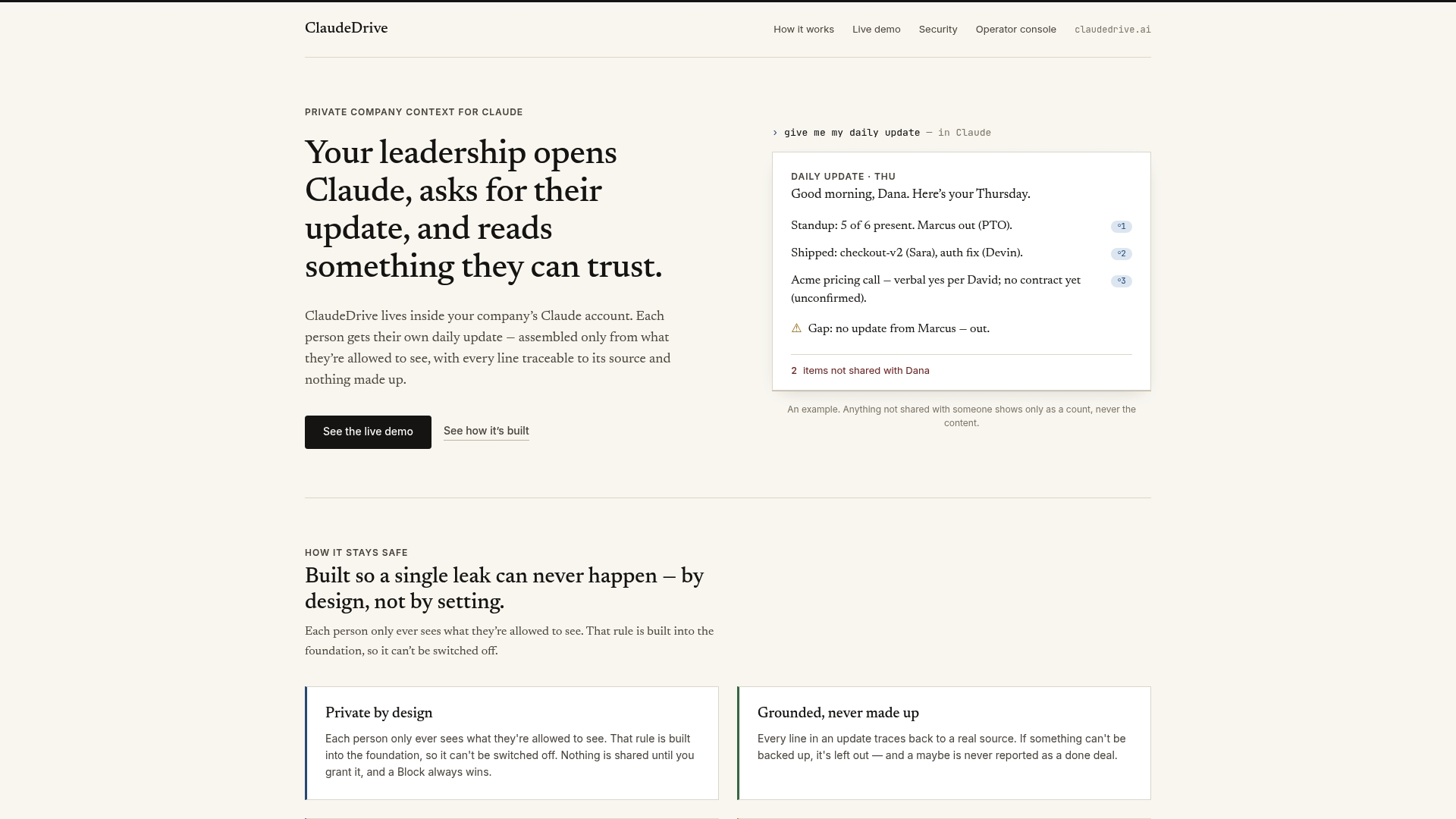
A permission-aware daily update system connects the tools your team already uses, meeting notes, GitHub, the calendar, and builds a daily update inside a Claude AI account leaders already open every day. No new dashboard to learn, no wiki to maintain. Every line in that update traces back to a real source, and access controls are enforced at the point of retrieval, so a person only ever sees what they’re allowed to see. Nothing leaks across the line between teams or ventures. Offboarding is instant, and every update carries a full audit trail back to its source, the same provenance discipline this article argues is non-negotiable for any system making factual claims.
If you’re evaluating how to bring trustworthy, source-linked updates to your leadership team, see the live demo or talk to us about a pilot.
Sources
- Detect hallucinations for RAG-based systems — AWS Blogs
- Freshness-aware retrieval with temporal priors — arXiv
- RAG-HAT: Hallucination-aware tuning pipeline — EMNLP Industry 2024