Notion Claude Integration for Leaders: Permissioned Daily Briefings
Discover how the Notion and Claude integration provides secure, personalized daily briefings, ensuring leaders access only relevant information.
ClaudeDrive
A Yungsten Tech product

Notion Claude Integration for Leaders: Permissioned Daily Briefings

A permission-aware Notion → Claude integration delivers per-user, source-traceable daily briefings inside your organization’s Claude account. Every line ties back to a real source document. Nothing surfaces that the reader isn’t cleared to see. That’s the short answer.
For it to hold, four things must be in place:
- Identity integration: users and groups synced from your IdP (Okta, Entra ID) via SCIM so Claude knows who is asking
- Connector permission mapping: each connected tool (Notion, GitHub, calendar) passes its own access rules into the retrieval layer
- Retrieval-stage enforcement: permissions are checked when content is pulled, before the model ever sees it, not after
- Provenance logging: every output line carries a record of the source document, author, timestamp, and model version
Miss any one of these and you don’t have a trusted briefing. You have a fast one.
Key Takeaways
A permission-aware Notion Claude integration delivers per-user, source-traceable daily briefings inside Claude when identity sync, connector permission mapping, retrieval-stage enforcement, and provenance logging are all in place.
| Point | Details |
|---|---|
| Audit impact is measurable | Lineage and traceability cut incident investigation time ~66% and audit-prep time ~62% in a controlled rollout. |
| Enforcement must happen at retrieval | Checking permissions before the model sees content prevents leakage that output filtering cannot catch. |
| Four-week pilot is sufficient | Week 0 planning through Week 4 validation gives enough signal to decide on full deployment. |
| Three vendor questions matter most | Ask about user-identity pass-through, exportable retrieval logs, and mixed-participant fallback behavior. |
| ClaudeDrive is the context layer | ClaudeDrive enforces retrieval-time permissions and per-line provenance inside Claude, with no new app to adopt. |
Table of Contents
- Why leaders adopt a permissioned Notion → Claude flow
- How permission enforcement and traceability must work
- What a Notion + ClaudeDrive integration delivers
- Your rollout checklist and pilot timeline
- Security guarantees to demand from vendors
- What a leader actually reads inside Claude
- Operational risks and concrete mitigations
- A vendor perspective on where this delivers most
- ClaudeDrive gives your leaders a briefing they can trust
- Sources
Why leaders adopt a permissioned Notion → Claude flow
The business case is measurable. A controlled enterprise rollout that added structured lineage and traceability to its AI platform reported incident investigation times down roughly 66%, audit-prep time down roughly 62%, and compliance findings down roughly 75% within 12 months. Those aren’t soft productivity gains. They’re the kind of numbers a COO can put in front of a board.
66% faster incident investigations. 62% faster audit prep. 75% fewer compliance findings. A single enterprise rollout adding lineage and traceability to its AI platform achieved all three within 12 months.
Beyond audit speed, the operational wins stack up quickly:
- Leaders stop manually cross-checking AI summaries against source documents
- Decisions carry a defensible evidence trail when legal or compliance asks
- Onboarding and offboarding are instant: remove a user from the IdP group and their access disappears from every connected source
The benefits of permission-aware AI updates compound over time because the briefing gets more useful as more sources are connected, not less trustworthy.
How permission enforcement and traceability must work
The core guarantee: the system must never surface data a user isn’t authorized to see, and that check happens at retrieval, before the model processes anything. Output filtering is not a substitute. Enforcement baked into retrieval eliminates entire classes of leakage that output-layer filtering cannot catch.
In plain terms, here’s what that requires:
- Identity and group sync: Okta or Entra ID pushes group membership to Claude via SCIM. Claude Enterprise supports custom roles, SCIM group sync, and connector permissions that administrators configure per role.
- Connector wiring that preserves source permissions: the Notion connector doesn’t flatten page-level access. It passes the requesting user’s identity to Notion at query time and returns only what that user can read. Connectors must inherit and respect source-system permissions, not override them.
- Participant-aware retrieval checks: deterministic participant-aware permission checks at retrieval time are necessary to prevent cross-user leakage in both retrieval-augmented and fine-tuned deployments. If two leaders share a briefing session, the system checks that every piece of content is accessible to all participants, not just the primary requester.
- Per-output provenance: each line in the briefing carries the source document ID, system of origin, author, retrieval timestamp, and model version used to generate it.
Pro Tip: Require your vendor to provide a written SLA on provenance completeness (percentage of output lines with full provenance records) and a defined log retention period before signing. Vendors who can’t answer this question haven’t built it.
What a Notion + ClaudeDrive integration delivers
ClaudeDrive connects Notion, meeting notes, GitHub, and calendar sources into a single permissioned context layer that feeds Claude. The features map directly to the problems leaders actually have.
| Feature | Leadership benefit | What to verify |
|---|---|---|
| Permissioned Notion retrieval | Each leader sees only their authorized pages | Connector passes user identity at query time |
| Source-traceable briefs | Every line links to the original document | Per-line citation includes doc ID and timestamp |
| Update cadence controls | Daily or weekly briefing cadence per user | Cadence is configurable per role, not only global |
| Instant offboarding | Remove from IdP group; access revoked immediately | Test with a deprovisioned account before launch |
| GitHub signal inclusion | Engineering leaders see PR and issue status | Repo and team-level visibility respected |
| Calendar context | Upcoming meetings and deadlines surfaced | Google Calendar supported |
Connecting meeting notes, GitHub, and calendar to a single permissioned layer is where most leaders find the most immediate time savings. Claude Enterprise’s role-based permission setup lets administrators assign connector access and model selection per role, so a chief of staff and a CTO can receive different briefing scopes from the same deployment.
Your rollout checklist and pilot timeline
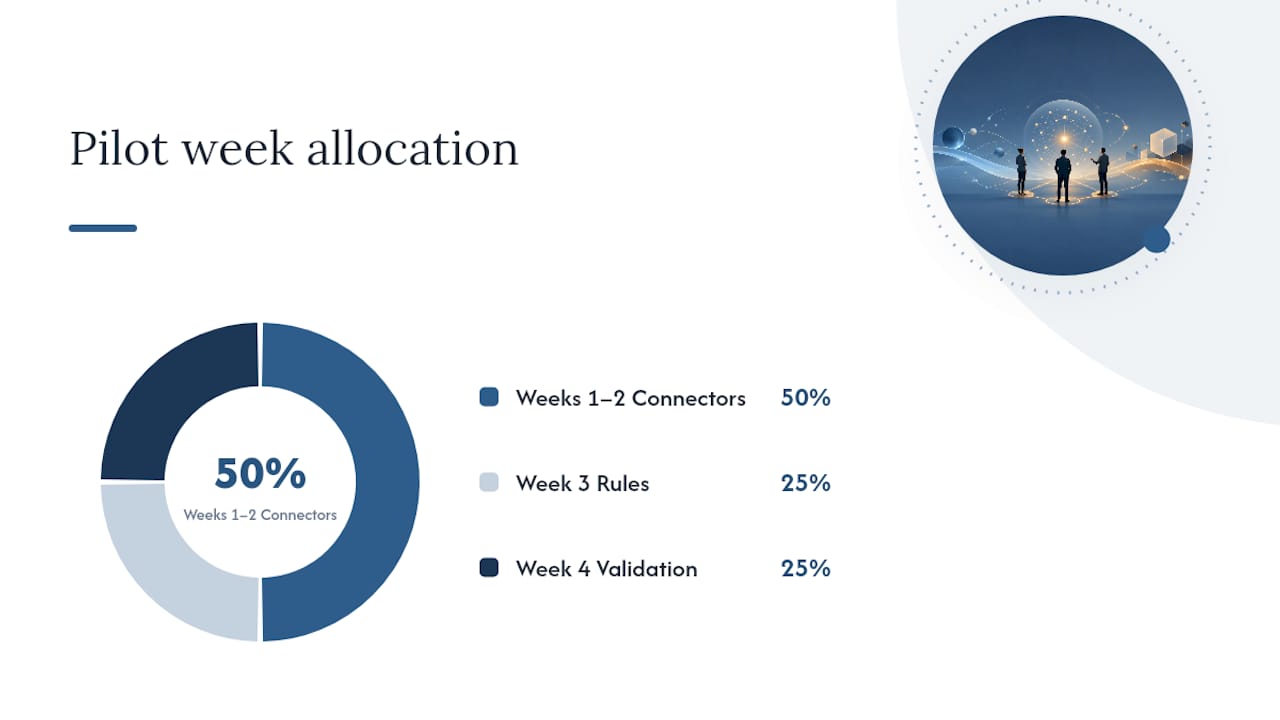
A four-week pilot is enough to validate trust before full deployment.
- Week 0 — Planning: identify 5–15 pilot users, list allowed sources, and confirm your IdP (Okta or Entra ID) supports SCIM provisioning to Claude Enterprise.
- Week 1–2 — Connectors and identity sync: wire Notion, GitHub, and calendar connectors; complete SCIM group mapping; verify connector admin credentials; set organization-wide tool policy in Claude.
- Week 3 — Rules and sample briefings: configure briefing templates, run sample queries for each pilot user, and confirm no cross-user content appears in outputs.
- Week 4 — Validation and launch: sample the audit log for provenance completeness, run a deliberate offboarding test, confirm retention policy is set, and open to the pilot group.
Go/no-go criteria before full rollout: provenance completeness on test queries, zero cross-venture leakage in adversarial test cases, retention policy confirmed, and offboarding verified.
Pro Tip: Run a parallel manual verification loop for the first two weeks. Have one person spot-check five briefing claims per week against the source documents. It tunes your source allowlist faster than any automated method.
Security guarantees to demand from vendors
The plain checklist of what any vendor must demonstrate:
- Retrieval-stage permission enforcement (not output filtering)
- Participant-aware checks when multiple users share a session
- Immutable provenance logs with document IDs, timestamps, and model version
- Versioned model metadata so you can reconstruct exactly what the model saw
These map directly to compliance needs. Provenance logs support eDiscovery. Immutable audit records satisfy governance reviews. The 66% reduction in incident investigation time and 62% reduction in audit-prep time cited earlier came specifically from adding lineage and traceability — not from the AI itself, but from the audit infrastructure around it.
RFP questions worth asking every vendor:
- Can you pass user identity to each connector at query time?
- Can you export raw retrieval logs with document IDs and timestamps?
- What encryption and retention controls exist on provenance data?
- How does your system handle a mixed participant set (internal + external users)?
Document-level permission preservation and keeping sensitive HR and investor information private are two areas where vendor answers reveal whether enforcement is real or aspirational. For broader agentic pipeline risk, AI data loss prevention guidance covers the connector-level controls worth requiring.
What a leader actually reads inside Claude
A typical daily briefing for a CTO running a 40-person team looks like this:
Top signals (as of this morning):
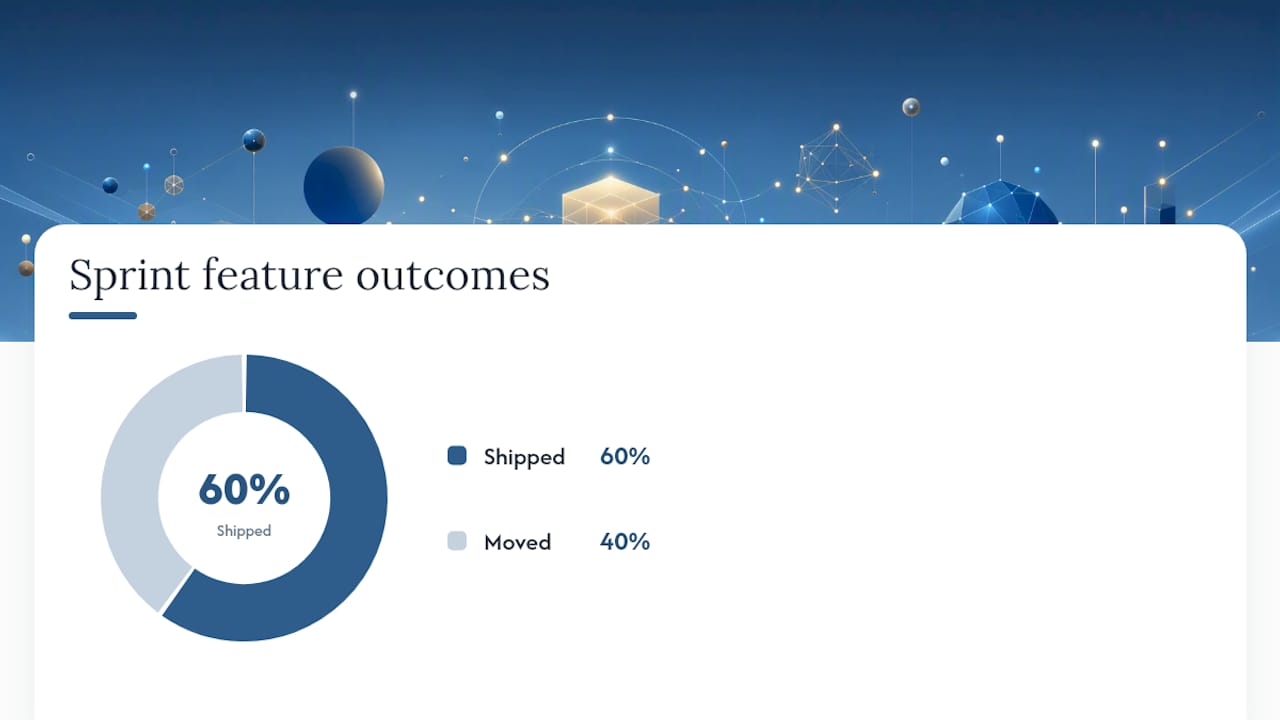
- Sprint 22 closed with 3 of 5 planned features shipped. Two items moved to Sprint 23. (GitHub · repo: product-core · updated 7:14 AM)
- Q3 board prep doc updated by CFO yesterday with revised ARR projections. (Notion · Board Prep 2026 · Sarah Chen · June 3)
- Engineering all-hands scheduled Thursday 2 PM. Agenda not yet attached. (Google Calendar · June 5)
Items requiring attention:
- PR #441 (auth refactor) has been open 9 days with no reviewer assigned. (GitHub · product-core)
Each line carries the source system, document title, author where available, and timestamp. A single click opens the original Notion page or GitHub item. If legal asks for the basis of a decision made on a Tuesday morning, the briefing log shows exactly what the CTO read and where it came from.
| Briefing section | Example line | Provenance fields |
|---|---|---|
| Top signals | Sprint 22 closed, 3/5 features shipped | GitHub repo, PR list, timestamp |
| Attention items | PR #441 open 9 days, no reviewer | GitHub issue ID, last-updated |
| Meeting context | Board prep doc updated by CFO | Notion doc title, author, date |
| Calendar | All-hands Thursday 2 PM | Calendar system, event ID |
Operational risks and concrete mitigations
The failure modes that turn a promising integration into an exposure:
- Identity drift: IdP groups fall out of sync with connector permissions. Mitigation: scheduled SCIM reconciliation (daily minimum) with alerting on sync failures.
- Connector over-privilege: a service account with admin-level Notion access returns more than the user should see. Mitigation: least-privilege service accounts scoped to the minimum required pages.
- Inference leakage in mixed sessions: when a session includes participants with different clearance levels, content accessible to only one participant can leak. PermLLM research confirms multi-domain coverage has practical limits and requires fallback strategies. Require the system to fall back to publicly accessible content only when participant sets are mixed.
- Stale allowlists: a Notion page moves or a GitHub repo goes private, but the allowlist isn’t updated. Mitigation: weekly allowlist reconciliation against live connector state.
- Log gaps: provenance records missing for a subset of outputs. Mitigation: provenance completeness checks on every briefing run, with alerts when coverage drops below threshold.
For multi-venture teams, context separation across ventures is a specific risk worth addressing in your vendor RFP. Board-level information staying out of engineering is a concrete example of where participant-aware enforcement matters most.
Pro Tip: Require a published runbook from your vendor covering offboarding and emergency access revocation. If they don’t have one written down, the process doesn’t exist in a form you can audit.
A vendor perspective on where this delivers most
ClaudeDrive delivers the most immediate value for leaders who need a daily briefing they can defend: board-ready summaries, audit trails for governance reviews, and a single place to read what happened without chasing five tools.
Early in adoption, clients typically spend the most time on source selection and claim-review cadence. The briefing is only as good as the sources connected to it. Common early requests include GitHub signal tuning (which repos, which signal types), meeting-note template alignment, and calendar context configuration. Multi-venture teams almost always need context separation configured before the first pilot briefing runs.
Briefing templates come in two forms: a standard daily executive template and custom templates built to match individual executive preferences. Most teams start with the standard template and customize after the first two weeks of pilot feedback.
ClaudeDrive gives your leaders a briefing they can trust
ClaudeDrive is the private company-context layer that feeds Claude. It enforces retrieval-time permissions, provides per-line provenance on every output, and requires no new app or dashboard for your leadership team to learn.
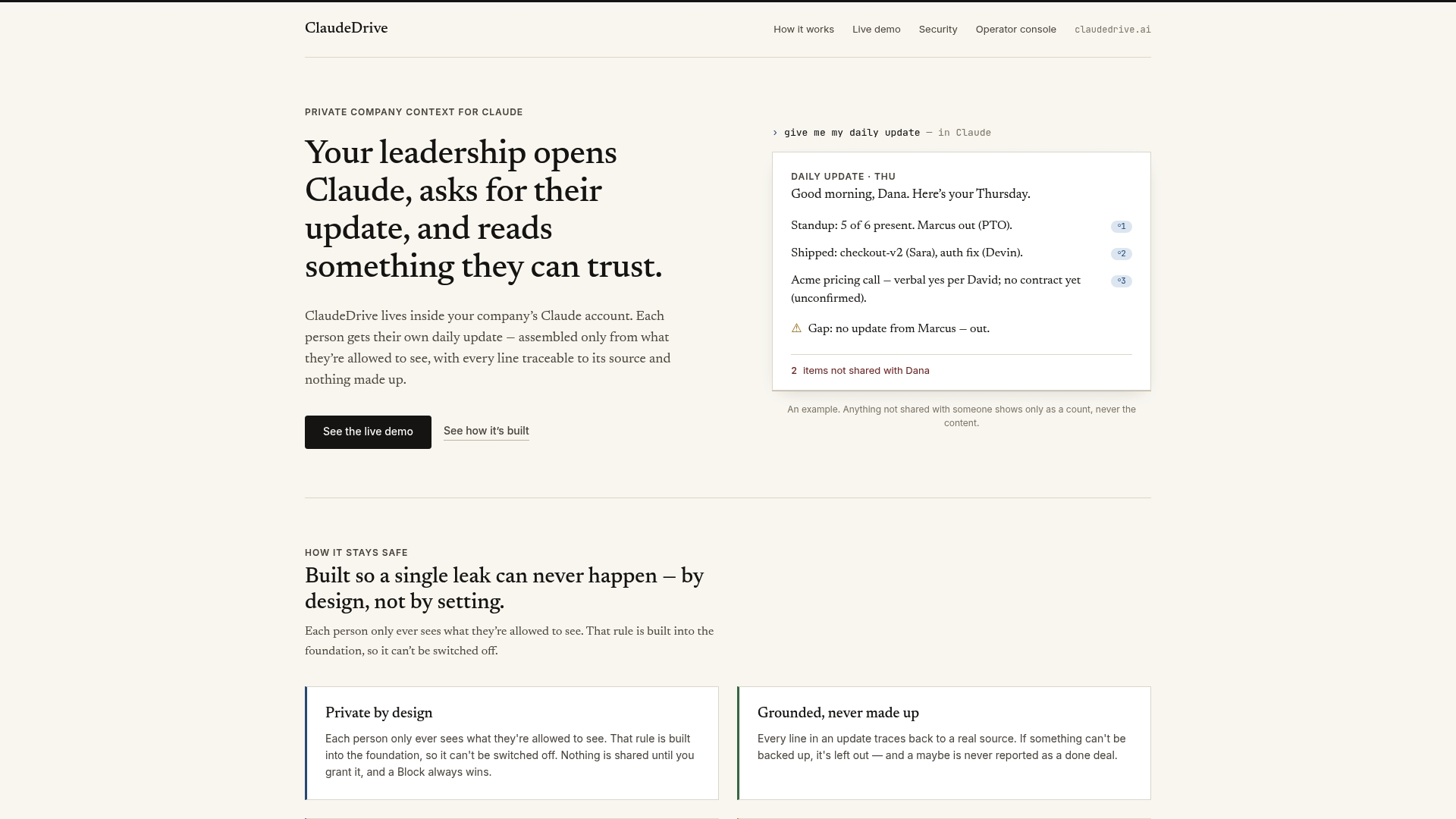
For a CTO or COO evaluating this decision, the next steps are straightforward: schedule a demo to see a live permissioned briefing, run the four-week pilot checklist above with 5–15 users, and request a sample provenance audit export to verify the log format before committing. Pricing follows a subscription SaaS model with team and organizational plans; the pilot is typically sponsored by the CTO, COO, or chief of staff. Individual users start free; team plans begin when organizational use scales.
See the live demo or talk to us about a pilot — and bring your source allowlist to the first conversation.
Sources
- Lineage, Traceability, and Reproducibility as Reliability Requirements in Enterprise AI Systems | International Journal of Intelligent Systems and Applications in Engineering
- Enterprise AI Must Enforce Participant-Aware Access Control
- Permissioned LLMs and access-control mechanisms (PermLLM)
- Enterprise AI access control: why permissions matter more than prompts